Business gifts tax rules in the UK are rarely as straightforward as they look on the surface. You might be a busy SME owner or startup founder. Perhaps you are a property landlord thanking loyal tenants. Buying a thank-you present should feel rewarding. Instead, a wave of accounting anxiety hits you immediately. Can you put that luxury hamper through the business account? Will a bottle of champagne reduce your Corporation Tax bill? Or will it just create a reporting headache at year-end? You want to be generous to the people helping your business thrive. Yet HMRC legislation often feels designed to penalise goodwill. You can protect your cash flow by understanding these rules. This knowledge lets you reward your team safely.

Why Business Gifts Tax Rules Confuse So Many Owners
When you run a company, rewarding staff and thanking clients feels like a natural cost of doing business. You spend money to build relationships, retain talent, and keep your brand top of mind. Logic suggests that if an expense helps your company grow, it should reduce your taxable profits.
The Reality of HMRC Tax Deductions
However, HMRC views corporate generosity through a very narrow lens. Tax legislation separates gifts into distinct buckets. It depends on the recipient, the item, and the total cost. You might give a £45 bottle of gin to an employee. HMRC treats this completely differently from the same gift given to a customer.
VAT recovery rules and National Insurance complicate things further. Digital record-keeping adds another layer of stress. It is easy to see why directors misclassify festive spending. Getting clarity on the fundamentals reduces your administrative burden. It also helps you budget accurately for the year ahead. Partnering with a professional for small business accounting services is often the smartest way to navigate these complexities.
The Core HMRC Rules for Business Gifts Tax
To stay compliant and make informed spending decisions, you must categorize your expenses. First, look at gifts for your team. This includes yourself as a director. Second, look at gifts for external contacts like clients.
Staff Gifts and HMRC Trivial Benefits
HMRC treats most employee gifts as a “benefit in kind”. Fortunately, you can avoid tax and National Insurance on small perks. They just need to qualify as HMRC trivial benefits.
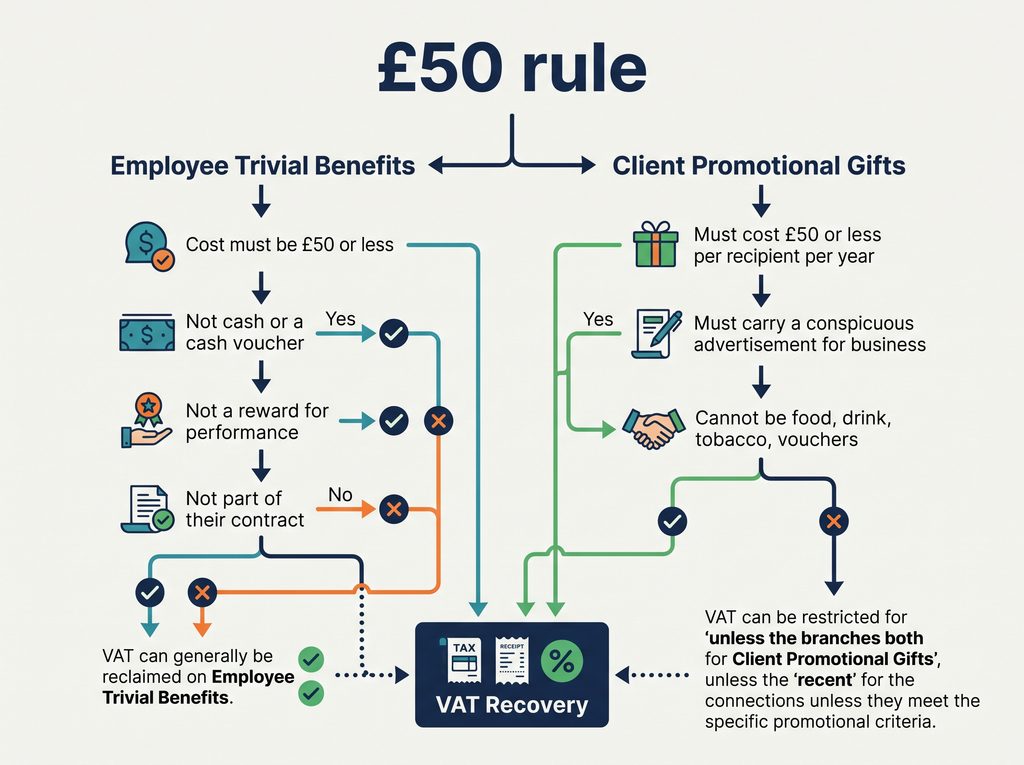
For a staff gift to remain tax-free, it must meet all four conditions:
- It costs £50 or less to provide per person (including VAT and delivery charges).
- It is not cash or a cash voucher (store gift cards without cash value are fine).
- It is not a reward for their work or performance.
- It is not in their employment contract or a salary sacrifice arrangement.
You can read the official statutory criteria directly on the GOV.UK trivial benefits guidance page.
The Close Company Director Cap
You might run a “close company”. This is a limited company controlled by five or fewer shareholders. Directors of these companies face an annual cap. Close company directors cannot receive trivial benefits worth more than £300 total across a tax year.
What happens if you buy an employee a birthday gift costing £55? The £50 limit is a strict cliff edge. If a gift costs £55, the entire £55 becomes taxable. You must then report it on a P11D form. The deadline is 6 July following the tax year end. You will also pay Class 1A National Insurance at 13.8%. Setting up proper tax compliance procedures helps you track these limits.
Tax-Deductible Client Gifts vs Business Entertainment Expenses
Rules tighten significantly when you buy presents for customers or suppliers. HMRC classifies most gifts to external contacts as business entertainment expenses.
Here is the core rule. Business entertainment never reduces your Corporation Tax or Income Tax. You can still pay for client gifts through your business bank account. This saves you from using personal dividend income. However, your accountant must “add back” the cost when calculating taxable profit.
The rules surrounding business entertainment expenses are highly nuanced. This is especially true for mixed-purpose promotional events. Specific exceptions and partial recovery rules exist. You should always seek tailored business advice before making large claims.
The Three Rules for Allowable Client Gifts
To claim tax-deductible client gifts against your profits, you must meet a strict exception. You must satisfy all three of these requirements:
- The total cost of gifts to that person stays under £50 per accounting period.
- The gift carries a conspicuous advertisement for your business. Your logo must be on the item itself, not just the wrapping.
- The item is not food, drink, tobacco, or an exchangeable voucher.
Imagine sending a client a £35 leather notebook. It features your company logo. This qualifies as an allowable deduction. Now imagine sending a £35 bottle of wine. You print your logo on the label. This remains disallowable because it is a drink. Proper corporate tax planning helps you make these distinctions correctly year-round.
Navigating VAT on Business Gifts
You might master the income tax side of business gifts tax. Then, you must look at Value Added Tax. The rules for VAT on business gifts operate under a separate legal framework. You can read the details in HMRC VAT Notice 700/7.
You can generally reclaim the input VAT paid on business gifts. This applies to staff and clients. The total gift cost per person simply must not exceed £50 (excluding VAT) over a 12-month period.
Notice the subtle trap here:
- For HMRC trivial benefits, the £50 threshold includes VAT. It applies per individual gift.
- For VAT on business gifts, the £50 threshold excludes VAT. You measure it cumulatively per recipient over 12 months.
Gifts to one person might cross that £50 ex-VAT mark. If you reclaimed the input VAT, a problem arises. You must account for output VAT on the total value. Many businesses choose not to reclaim input VAT on gifts over £50. This avoids the hassle of declaring output VAT later. Managing this requires a solid understanding of VAT rules.
Digital Record-Keeping, Deadlines, and Penalties
Tracking £50 limits per person over 12 months is difficult. Paper receipts stuffed in a shoebox make it impossible. Most VAT-registered businesses must maintain digital records under Making Tax Digital rules. You must use compatible software. Limited exemptions exist for digitally excluded taxpayers.
MTD for Income Tax is also expanding. This brings many sole traders and landlords into digital reporting. Qualifying income thresholds apply. Modern cloud accounting platforms like Xero or QuickBooks save time. You can attach digital receipt photos instantly. You can tag recipient names at checkout.
A professional bookkeeping service can set up dedicated nominal codes. This separates allowable promotional gifts from disallowable client entertainment.
Staying on top of your compliance calendar is equally important. You might miss a tax deadline for VAT or Corporation Tax. If so, HMRC applies a strict penalty regime. Late-payment interest begins accruing on day 1. First late-payment VAT penalties arise at day 15 on unpaid balances. These penalties increase further at day 30. Keeping clean books mitigates the risk of errors.
Common Errors and Record-Keeping Risks in Business Gifts Tax
Even conscientious directors fall into grey areas when recording gifts. Poor categorisation creates unnecessary compliance friction. Three frequent pitfalls often catch SMEs out during year-end reviews:
1. Confusing Performance Bonuses with Trivial Benefits
Founders often buy a £45 retail voucher to reward hard work. They log it as a tax-free trivial benefit. The statutory trivial benefit test fails here. Record-keeping risks like this cause problems. You must actually process this voucher through PAYE and payroll National Insurance. Keep trivial benefits strictly for non-work occasions like birthdays or Christmas.
2. Reimbursing Personal Cash or Splitting Invoices
Suppose you buy a £90 hamper for an employee. You ask the supplier for two £45 invoices. HMRC treats linked expenditure as one combined benefit. The entire £90 becomes taxable. Furthermore, an employee might buy a gift and claim a cash reimbursement. HMRC often views this cash as taxable earnings. Always purchase gifts directly using your company bank card.
3. Dumping All Gifts into “General Marketing”
Founders often code all restaurant bills and gifts under “Marketing”. This creates a tangled mess at year-end. Leaving disallowable client gifts in a deductible marketing bucket is risky. Your tax return will understate your taxable profit. Business travel and entertainment expenses have complex partial-recovery rules. However, lumping unbranded client gifts into advertising is dangerous. We untangle this common error frequently.

Your Step-by-Step Workflow for Managing Business Gifts Tax
You do not need a tax degree to keep your gifting organised. Follow a repeatable process every time you buy a gift. This saves hours of detective work later.
- Identify the Recipient First: Note whether the recipient is an employee, client, or contractor. This tells you which rules apply.
- Check the £50 Price Tag: Look at the total including VAT and delivery. Staying at £50.00 or below keeps staff gifts completely tax-free.
- Pay Directly: Use your company debit card or direct bank transfer. Avoid paying out of pocket.
- Snap the Receipt: Upload the VAT invoice to your accounting software immediately. Write the recipient and occasion in the description box.
- Use Dedicated Categories: Set up separate expense categories. Use Staff Welfare, Promotional Client Gifts, and Client Entertaining.
- Maintain a Director Tally: Close company directors should keep a simple spreadsheet. Track your personal trivial benefits carefully. This stops you from crossing the £300 tax-year limit.
Why Outsourcing Your Tax and Bookkeeping Makes Financial Sense
Running a business takes relentless focus. Spending Sunday evenings reading HMRC manuals drains your energy. Worrying about client hampers is a poor use of time.
Outsourcing your bookkeeping reduces your administrative burden. A qualified team gives you back valuable hours every month. Professional oversight improves accuracy across VAT returns and payroll. It also mitigates the risk of costly categorisation errors.
A dedicated accountant spots limits quickly. We separate allowable promotional costs from disallowable business entertainment expenses. We ensure you claim every legitimate tax relief. Discovering why cloud accounting is the future of finance with a trusted partner changes your business.
Partner with ASK Accountants UK Ltd in Wimbledon
Stop second-guessing your expense claims. You do not have to figure it out alone. At ASK Accountants UK Ltd, we have 15 years of experience. We help Wimbledon SMEs and landlords stay compliant.
We believe in plain-English advice and proactive communication. You might need help with Xero or P11D reporting. Perhaps you need a Corporation Tax strategy. Our friendly team is right around the corner.
Ready to take the stress out of your business accounts?
- Call us today: 020 8543 1991
- Visit our office: 178 Merton High St, Wimbledon, London, SW19 1AY
- Get in touch online: Reach out via our Contact Us page to book a confidential consultation.
Frequently Asked Questions About Business Gifts Tax
Does the £150 annual staff party allowance count towards business gifts tax?
No, the £150 per head annual staff function exemption is completely separate. Your company can host an annual tax-free event. This costs up to £150 per attendee. The event must be open to all staff. You can still give employees separate £50 trivial benefit gifts. Be aware that if the party costs £151 per head, the entire amount becomes taxable. You can verify the exact event conditions on GOV.UK’s annual functions page.
Can a property landlord claim gifts given to tenants against rental income?
Landlords face the same strict rules for tenant gifts. A welcome hamper with wine acts just like a client gift. Food and drink fail the conspicuous advertisement test. HMRC treats them as disallowable entertaining. However, you can provide a branded promotional item under £50. A branded key-ring or umbrella qualifies as a deductible expense. If you manage properties, looking into specialized property accounting can help clarify these exact deductions.
Are charitable donations treated the same way as business gifts?
No, charitable donations follow different tax rules entirely. A limited company might donate money or stock to a UK charity. This value usually reduces your Corporation Tax profits. It must be a qualifying donation without personal benefits attached. Sole traders handle charity donations differently. You claim these through Gift Aid on your Self Assessment return instead of standard business deductions. Always ask your accountant to record your donation structure properly.