There’s a version of business growth planning that looks great in a presentation slide and does absolutely nothing in the real world. You’ve seen it — the five-year plan with optimistic revenue curves and aspirational market share figures, printed nicely, filed somewhere, and never looked at again until someone finds it during an office clear-out three years later.
That’s not what this is about.
The businesses that actually grow — not just survive, not just tick along — tend to share something that has nothing to do with how polished their plan looks. It’s about whether the plan connects to the mechanics of the business. The cash. The people. The tax position. The processes that either hold you back or quietly multiply your capacity.
This guide is for business owners who are past the stage of hoping growth will just happen and want a structured, honest look at how to make it happen deliberately.
The Uncomfortable Truth About Where Growth Actually Starts
Before any strategy, any market expansion, any ambitious hiring plan — there’s a number. Usually several numbers. And most small business owners, if they’re being candid, don’t have an accurate picture of those numbers on any given Tuesday afternoon.
Business growth planning without financial clarity is essentially guessing dressed up in professional language. You can’t make sound decisions about scaling if you don’t know your real gross margin, your actual cash conversion cycle, or what your effective tax rate is doing to your net position.
This isn’t meant to be discouraging. It’s meant to be the first item on the real list — before anything else.
Building the Foundation: Financial Visibility You Can Actually Use
Cloud accounting has made this easier than it’s ever been. Platforms like Xero and QuickBooks, when set up properly (and that “when set up properly” is doing a lot of work in that sentence), give you a live picture of where you stand. Not a picture from six weeks ago. Not a summary your accountant sends in April. A real, current view.

Good business growth planning depends on three financial basics being genuinely under control:
- Bookkeeping that’s current — not three months behind. If your bookkeeping is perpetually in arrears, every decision you make is based on stale data.
- Management accounts, not just statutory accounts — your statutory accounts tell HMRC what happened. Management accounts help you understand what’s happening now and make forward-looking decisions.
- A cash flow forecast that’s actually maintained — even a simple 13-week rolling cash flow forecast changes how you think about hiring, investment, and timing decisions.
The team at Ask Accountant in Wimbledon work with a lot of SMEs across London who come in with solid ambitions but messy books — and the first job is almost always getting the financial foundation stable before the growth conversation can become meaningful. Their bookkeeping services and cloud accounting support are often the unglamorous but essential starting point.
What “Strategy” Actually Means for a Small Business
Strategy is one of those words that can mean everything or nothing depending on who’s using it. For a 10-person business, a growth strategy doesn’t need to be a 40-page document. What it does need to be is specific.
Here’s what specificity looks like in practice:
Rather than “expand into new markets,” a useful strategic goal looks like: “Win three new contracts in the healthcare sector in the next 18 months by targeting procurement managers at NHS trusts via direct outreach and case study content, aiming for £240,000 in incremental revenue.”
One of those statements can be acted on. The other is a vague aspiration.
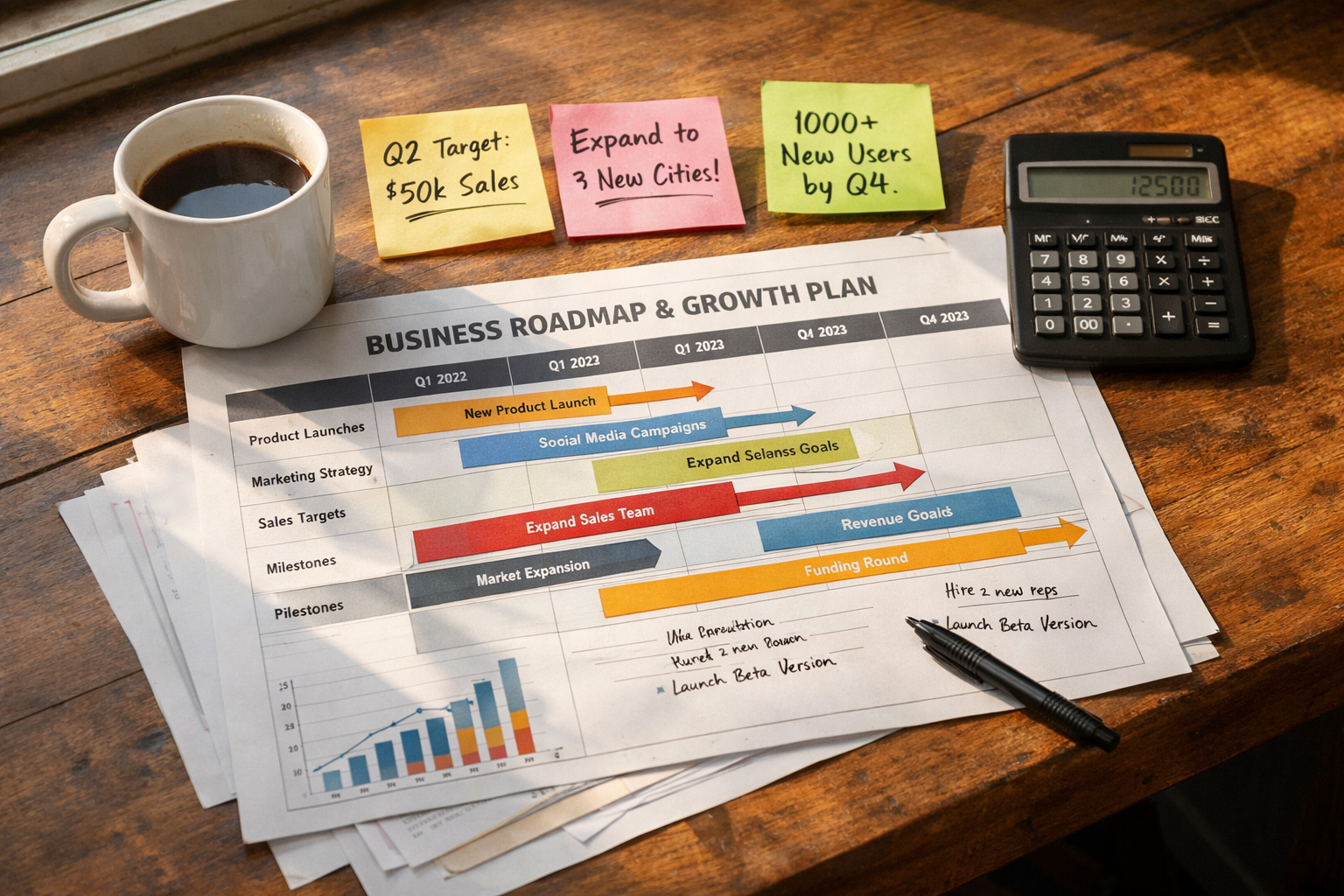
Business growth planning at the SME level works best when it lives in a one-to-two page document that everyone on the leadership team has genuinely read and can articulate — not a strategy deck that only the MD has seen.
A useful framework to structure this around:
- Where are we now? (Honest, numbers-backed assessment)
- Where do we want to be in 12/24/36 months? (Specific targets, not vibes)
- What has to be true for that to happen? (The assumptions you’re betting on)
- What do we do first? (Because sequencing matters enormously)
The Tax Dimension That Most Growth Plans Completely Ignore
Here’s something that would surprise a lot of business owners: the structure of your business — how it’s set up, how profits are extracted, how different income streams are accounted for — has a direct and sometimes dramatic effect on how much resource you have available to reinvest in growth.
A business paying more tax than it needs to isn’t just losing money to HMRC. It’s losing future capacity. Every £10,000 overpaid in Corporation Tax is £10,000 that didn’t go into a new hire, a piece of equipment, or a marketing campaign.
Proactive tax advisory — the kind that looks ahead rather than just reporting what happened — is genuinely part of business growth planning for any serious SME. This means things like:
- Reviewing your trading structure as revenues grow (sole trader vs. limited company vs. group structure)
- Understanding how R&D tax relief might apply if you’re doing anything remotely innovative
- Timing capital expenditure to maximise Annual Investment Allowance claims
- Getting ahead of VAT registration and flat rate scheme decisions
The corporate tax planning and tax advisory services at Ask Accountant are specifically oriented around this forward-looking approach — the kind that connects the tax position to the growth ambition, rather than treating them as separate conversations.
For construction businesses in particular, CIS (Construction Industry Scheme) refunds and claims can represent significant cash that’s sitting unclaimed — and that cash belongs in your business, not sitting with HMRC. Their CIS refund claim service exists precisely for this.
A Comparison: Reactive vs. Proactive Growth Planning
| Area | Reactive Approach | Proactive Growth Planning |
|---|---|---|
| Financial reporting | Annual accounts, submitted late | Monthly management accounts, live dashboards |
| Tax planning | File what’s due, pay the bill | Structure decisions around tax efficiency throughout the year |
| Cash flow | Monitor the bank balance and hope | Rolling 13-week forecast updated weekly |
| Hiring decisions | Hire when it feels necessary | Model the capacity and cost impact before committing |
| Business advice | Call the accountant when there’s a problem | Regular advisory sessions built into the calendar |
| Growth targets | Vague aspirations (“grow the business”) | Specific metrics with owners, timelines, and review dates |
The Scaling Trap — And How to Not Fall Into It
There’s a particular kind of failure that only happens to businesses that are growing. Everything is going well, revenues are climbing, you’re winning clients — and then something breaks. A cash flow crisis appears despite record sales. Quality drops. Key people leave. The very thing that made you good at £500k turnover turns out not to work at £1.5m.
This is sometimes called the scaling trap, and it’s remarkably common.
The reason it happens is that business growth planning usually focuses on revenue — how to get more customers, how to win more contracts — without equivalent attention to operational capacity. Can your systems handle twice the volume? Or can your team? Can your accountant, frankly?
A few questions worth building into your planning process:
- What breaks first if revenue doubles in six months?
- Which of your current processes are people-dependent in a way that creates single points of failure?
- Do you have the financial reporting infrastructure to make good decisions at the next size up?
The answers are usually uncomfortable. That’s fine. Better to confront them in a planning session than during a growth spurt when there’s no time to think.
Headcount, Payroll and the Employment Obligations Nobody Warned You About
Scaling a team is one of the clearest expressions of business growth planning in action. It’s also where a surprising amount of value gets accidentally destroyed.
Auto-enrolment obligations, for instance, catch a lot of growing businesses off guard. If you’re bringing on employees and haven’t properly set up a compliant workplace pension scheme, you’re exposed to HMRC penalties — and they’re not subtle about enforcement. Auto-enrolment services exist precisely because this is an area where getting it right requires knowing the specifics of staging dates, contribution rates, and which employees are eligible.

Payroll management as the team grows also becomes meaningfully more complex. What works for three employees rarely works without modification for fifteen. Having proper payroll management in place — ideally before you need it rather than after the first payroll crisis — is the kind of thing that sounds administrative and has real business consequences when it goes wrong.
Growth Enablers That Tend to Get Overlooked
Most conversations about business growth focus on sales and marketing, which makes sense. But there are a handful of operational enablers that have an outsized effect on growth capacity and tend to get much less attention:
Access to Finance — whether it’s an overdraft facility, asset finance, or invoice financing, having credit headroom available before you need it is dramatically easier than trying to arrange it in a hurry. Lenders want to see well-maintained accounts, a track record of profitability, and a coherent plan. All of which are easier to produce if your financial housekeeping has been solid.
Business Structure Review — as businesses grow, the structure that made sense at inception often stops being optimal. Group structures, holding companies, and trading entity design all affect everything from liability exposure to tax efficiency to your ability to bring in investment. This is worth a conversation with an experienced business adviser at intervals — not just at the start.
Inheritance and Succession Planning — for family businesses especially, ignoring what happens to the business in the longer term is a form of planning failure. Business Property Relief, gifting strategies, and the interaction between the business value and inheritance tax planning are areas where the decisions made (or not made) now have consequences that can either protect or significantly erode the value of everything you’ve built.
A Rough Benchmarking Guide: Where Should Your Numbers Be?
(Note: these are rough indicators for service/professional businesses. Sector-specific benchmarks will vary.)
| Metric | Healthy Range | Worth Investigating If… | Notes |
|---|---|---|---|
| Gross Margin | 40–65% | Below 35% | Varies enormously by sector |
| Net Profit Margin | 10–20% | Consistently below 8% | After owner salary drawn |
| Debtor Days | Under 30 days | Over 45 days | Cash flow indicator |
| Revenue per employee | £80k–£150k+ | Declining year-on-year | Tracks productivity |
| Current Ratio | 1.5–2.5x | Below 1.0x | Liquidity risk signal |
(The fourth column formatting here is intentionally a bit rougher — in practice, any real benchmarking table will have caveats that don’t fit neatly into a grid.)
Making Business Growth Planning a Habit, Not an Event
Annual planning retreats are fine. Quarterly reviews are better. But the businesses that sustain growth over multiple years tend to treat planning not as a periodic event but as an embedded operating rhythm.
What does that actually look like? Roughly:
- Weekly: Cash position check, key sales/pipeline metrics reviewed
- Monthly: Management accounts reviewed, variance to forecast discussed
- Quarterly: Full performance review against strategic targets, assumptions revisited
- Annually: Full strategic reset — where are we, what’s changed, what’s next?
The advisory conversation — with an accountant who understands the business, not just the compliance — fits into this rhythm. The business advisory services and business planning support at Ask Accountant are structured around exactly this kind of ongoing relationship rather than a once-a-year accounts submission.
💡 Worth knowing: If your current accountant only contacts you around year-end and Self Assessment deadlines, that’s not an advisory relationship — it’s compliance-only. For growing businesses, that’s often not enough.
The Digital Infrastructure Question
This is probably the section that would have seemed strange to include in a business growth article a decade ago. Now it’s table stakes.
Business growth planning in 2025 has to account for digital infrastructure — not in a vague “get on social media” way, but in terms of the operational backbone of how your business actually runs. Cloud-based accounting. Payroll software that integrates with your HR systems. CRM platforms that give you visibility on pipeline. These aren’t luxuries. For a growing business, they’re the difference between having information when you need it and flying blind.
The Making Tax Digital rollout from HMRC has also made some of this mandatory rather than optional — VAT-registered businesses are already within MTD, and the extension to Income Tax is coming. Getting the right digital accounting infrastructure in place now is planning ahead, not just compliance.
FAQ: Business Growth Planning
What is a business growth plan and why does it matter? A business growth plan is a document — ideally a concise, actionable one — that sets out where your business is now, where you want it to be, and what specific steps will get you there. It matters because decision-making without a defined direction tends to be reactive and short-term. With a plan, you’re making choices in the context of an intentional strategy.
How often should I revisit my business growth plan? At minimum, quarterly. More frequently during periods of rapid change — whether that’s fast growth, a difficult market environment, or significant operational changes. The plan should be a living document, not a filing cabinet resident.
Do I need an accountant to help with business growth planning? Not necessarily — but a good business accountant does more than the numbers. They can help you understand which growth decisions are financially sound, how different options affect your tax position, and whether your financial infrastructure can support the growth you’re planning. That kind of advisory input is genuinely valuable.
What’s the difference between a business plan and a growth plan? A business plan is typically written at inception or for external audiences (investors, lenders). A growth plan is an internal operational document focused on how an existing business moves from its current state to a defined future state. They share some structural similarities but serve different purposes.
How does tax planning connect to business growth? More directly than most people realise. Tax-efficient profit extraction, the right trading structure, properly timed capital expenditure, and proactive VAT planning all affect how much resource you have available to reinvest. Proactive tax advisory solutions treat tax not as an afterthought but as part of the financial strategy.
What are the most common reasons business growth plans fail? Lack of specificity (goals that can’t be measured), poor financial visibility (decisions made on stale or incomplete data), underestimating the operational changes required to support growth, and treating the plan as a document rather than a living process.
A Final Thought
The phrase “business growth planning” can sound like the kind of thing that happens in a boardroom with flip charts and consultants. For most small businesses, it’s considerably less theatrical than that — and considerably more useful.
It’s a clear-eyed look at where you are. A specific, honest articulation of where you want to go. And the discipline to track whether you’re actually getting there, and to adjust when you’re not.
If you’re at a point where you want to have that conversation with someone who understands both the strategic and financial dimensions, Ask Accountant are based at 178 Merton High St, London SW19 1AY, and can be reached on +44(0)20 8543 1991. They work with small and growing businesses across London on everything from accounting and bookkeeping to business advisory and proactive tax advisory solutions — the kind of practice that’s set up to talk about growth, not just compliance.