

Published by Ask Accountants UK Ltd | Inheritance Tax Guides
Death, as they say, is certain. So, unfortunately, is the paperwork that follows it. If you’re currently dealing with the estate of someone who has died, you’ve likely encountered a requirement that stops many executors cold: before you can pay inheritance tax, you need an HMRC inheritance tax reference number. Without it, HMRC cannot match your payment to the correct estate — and the whole probate process grinds to a halt. It sounds circular. It is, a little. But once you understand what this reference number is, why it exists, and how to get one, the process becomes considerably less stressful.
What Is an HMRC Inheritance Tax Reference Number?
The HMRC inheritance tax reference number (sometimes called an IHT reference number) is a unique identifier that HMRC assigns to a specific estate. Think of it as the account number for the deceased person’s inheritance tax liability. Without it, HMRC’s payment systems have no way of matching your payment to the right case.
It’s distinct from the deceased’s National Insurance number, their Unique Taxpayer Reference (UTR), or any other identifier they held during their lifetime. This is a new reference — generated specifically for the purposes of settling the estate’s IHT bill.
The reference typically looks something like this: IHT123456789 — a prefix followed by a string of digits.
You cannot simply make a payment to HMRC and hope it gets attributed to the right estate. That’s why this step exists.
Who Needs One — and When?
Not every estate requires an HMRC inheritance tax reference number. If the estate falls entirely below the inheritance tax threshold — broadly, £325,000 for most estates (the nil-rate band), or potentially up to £500,000 when the residence nil-rate band applies — and no IHT is actually due, you may not need one at all.
You will need an HMRC inheritance tax reference number if:
- The estate owes inheritance tax and you intend to pay HMRC directly
- You’re applying for a Direct Payment Scheme (paying IHT from the deceased’s bank account before probate)
- You’re making an instalment payment (IHT on certain assets like property can be paid in instalments over ten years)
The reference number is typically required at least three weeks before you intend to make payment. This is a non-negotiable waiting period — HMRC needs time to set up the account on their side. If you’re working to a probate deadline, that three-week window needs to be built into your timeline from the start.
⚠️ Timing Warning: HMRC strongly recommends applying for your inheritance tax reference number a minimum of three weeks before you plan to pay. Starting this process late is one of the most common causes of probate delays. Build this into your estate administration timeline early.
How to Apply for Your IHT Reference Number
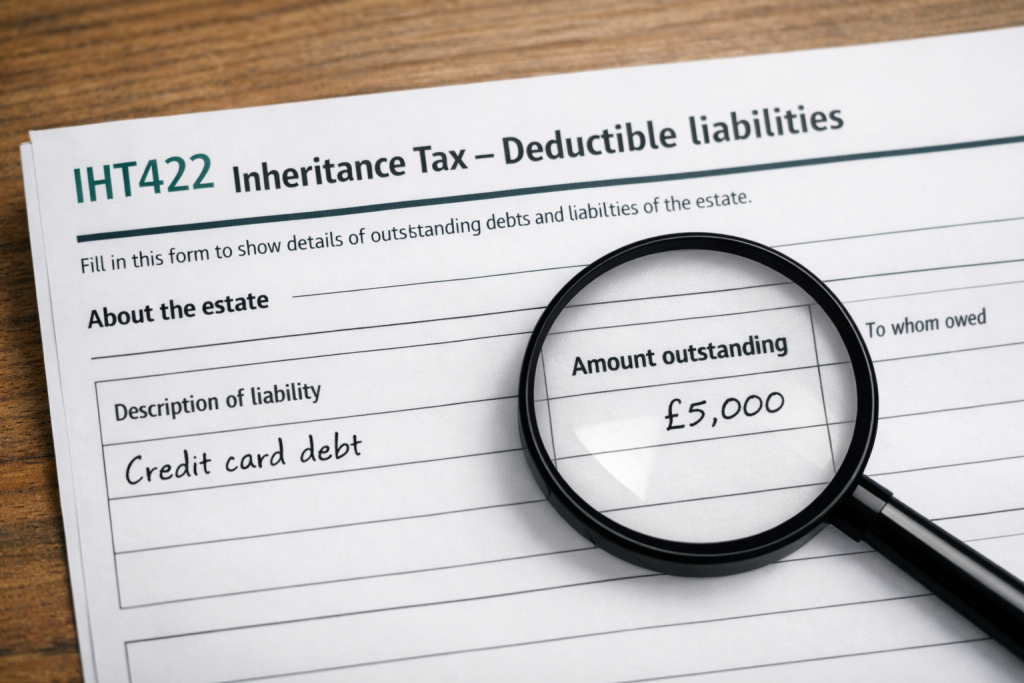
The application process itself is relatively painless. You can apply online via HMRC’s Government Gateway, or by post using form IHT422 — the “Application for an Inheritance Tax reference number” form.
Online application (recommended):
- Go to the GOV.UK Inheritance Tax reference page
- Sign in to (or create) a Government Gateway account
- Complete the online form with details about the deceased and the estate
- HMRC will issue the reference number — usually within a few days for online applications
By post using IHT422:
- Download the form from HMRC’s website
- Complete and return it to HMRC’s Inheritance Tax office in Nottingham
- Allow considerably longer — postal processing can take two to three weeks or more
For most executors and administrators, the online route is far preferable. The postal option exists largely for those without internet access or who face particular complications with their Government Gateway account.
If you need help with the IHT400 form itself (the main inheritance tax return), the reference number will be needed as part of that process too.
IHT422: Applying for Your Inheritance Tax Reference Number
Whether online or by post, the information required is broadly the same. Before you start the application, gather:
- Full name of the deceased
- Date of death
- Last known address of the deceased
- Your details as executor or administrator (name, address, contact information)
- Estimated value of the estate (a rough figure is acceptable at this stage)
- Whether you expect IHT to be payable
You don’t need to have finalised the estate valuation to apply. HMRC understands that executors are often applying during the early stages of estate administration, when precise figures aren’t yet available. A reasonable estimate is fine.
One thing that catches people out: if there are multiple executors, only one needs to apply for the reference number. You don’t need a separate application per executor.
Your HMRC Inheritance Tax Reference Number and Probate: The Right Order
Here’s where things get slightly complicated — and where a lot of families run into confusion.
In England and Wales, you generally need to pay (or at least account for) inheritance tax before the Probate Registry will grant probate. But to pay, you need the reference number. And to get the reference number, you need to apply in advance. So the sequence looks like this:
| Step | Action | Timing |
|---|---|---|
| 1 | Value the estate | As early as possible after death |
| 2 | Apply for HMRC inheritance tax reference number (IHT422) | At least 3 weeks before intended payment |
| 3 | Complete IHT400 (if applicable) and any supplementary schedules | Before or alongside payment |
| 4 | Pay IHT using the reference number | Within 6 months of death (to avoid interest) |
| 5 | Apply for probate, submitting IHT421 as evidence of payment | After IHT payment confirmed by HMRC |
The IHT421 is the form HMRC issues after you’ve submitted your IHT400 — it confirms the IHT position to the Probate Registry. This is a separate document to the reference number itself, but they’re all part of the same chain.
For Scotland and Northern Ireland, the process differs slightly (confirmation rather than probate in Scotland, for instance), but the need for an IHT reference number when tax is due remains consistent.
The Six-Month Deadline and Your IHT Reference Number
Inheritance tax is generally due within six months of the end of the month in which the person died. Miss this deadline and HMRC starts charging interest — currently at a rate that changes periodically, but it adds up.
Here’s the thing: six months sounds like plenty of time. In practice, between registering the death, obtaining death certificates, locating the will, instructing solicitors, and valuing the estate (which can involve professional valuers for property, shares, business interests, and other assets), that six-month window can feel rather tight.
When you factor in the three-week minimum lead time for the IHT reference number, plus processing time for payments to clear, experienced estate practitioners recommend beginning the IHT422 application process within the first couple of months after death — even if you’re still finalising figures.
You might find our guide on how long HMRC takes to process inheritance tax useful at this stage — processing times have been a point of frustration for many executors in recent years.
How to Pay Once You Have Your Inheritance Tax Reference Number
Once HMRC has issued your inheritance tax reference number, you can make payment by:
- CHAPS (same-day bank transfer — recommended for large sums close to deadlines)
- Online banking / Bacs (takes 3–5 working days to clear)
- Cheque (payable to “HM Revenue & Customs only”, with the reference written on the back)
The reference number must appear on every payment — whether you’re making a single lump sum or paying in instalments. If you’re using the Direct Payment Scheme to draw funds from the deceased’s bank account, the bank will require the reference number before processing anything.
A practical note: always keep a record of payments made, including the date, amount, and method. HMRC’s processing times mean there can be a gap between when you pay and when it’s reflected on their system — having your own paper trail matters.
What If the Estate Is More Complex?
Some estates are straightforward — a house, some savings, perhaps a pension. Others are considerably messier: business interests, agricultural land, overseas assets, trusts, gifts made in the seven years before death. For complex estates, you may be dealing with several supplementary IHT schedules alongside the main IHT400.
The HMRC inheritance tax reference number process remains the same regardless of complexity, but the surrounding paperwork multiplies quickly. Business Property Relief, for instance, requires IHT413 — and understanding whether assets genuinely qualify for relief is not always obvious.
This is where professional support becomes less of a luxury and more of a practical necessity. The team at Ask Accountants UK Ltd in Wimbledon works with executors and families on inheritance tax compliance, helping to navigate the reference number application, the IHT400, and the broader estate administration process — including situations where HMRC investigations arise from valuations or undisclosed assets.
A Quick Comparison: IHT Reference vs. Other IHT Numbers
One thing that confuses a surprising number of people is the distinction between the various reference numbers and identifiers that appear throughout the IHT process.
| Identifier | What It Is | When You Use It | Who Issues It |
|---|---|---|---|
| IHT Reference Number | Unique ID for paying IHT on a specific estate | When making IHT payments | HMRC (on request) |
| IHT421 | Probate summary confirming IHT position | Sent to Probate Registry | HMRC (after IHT400 submitted) |
| IHT400 Case Reference | HMRC’s internal reference for your submitted return | Correspondence with HMRC | HMRC (after IHT400 received) |
| Deceased’s NI Number | The person’s National Insurance identifier | Various identity checks during estate admin | Held by the deceased |
| Grant of Probate Reference | Probate Registry’s reference for the grant | Dealing with asset holders post-probate | His Majesty’s Courts & Tribunals Service |
(Note: The IHT400 case reference and the IHT payment reference number are related but not identical — make sure you’re using the right one when making payments vs. corresponding with HMRC about a return.)
The Instalment Option — When Paying in One Go Isn’t Feasible
For estates where the bulk of the value is tied up in property or business interests, paying the entire IHT bill in a single payment before probate can be genuinely impossible. The money simply isn’t liquid yet.
HMRC offers an instalment option for certain assets — primarily land and property, controlling shareholdings in unquoted companies, and some business assets. If you elect to pay by instalments, you’ll still need your HMRC inheritance tax reference number from the outset. The first instalment is generally due within six months of death, with the remaining nine payments spread annually.
One caveat: if the relevant asset is sold during the instalment period, the outstanding IHT becomes immediately due in full. Worth knowing before you make decisions about estate assets.
For more on IHT planning strategies, including how to structure assets to manage future IHT liabilities, our inheritance tax planning resources cover these options in detail.
What Happens If You Get It Wrong?
Late payment of IHT attracts interest from HMRC — charged from the date it was due, not from when they tell you about it. Currently this is set at HMRC’s late payment interest rate (linked to the Bank of England base rate plus a percentage), and it accumulates daily.
More serious errors — such as submitting an IHT400 with undervalued assets — can lead to HMRC investigations, penalties, and in rare cases where deliberate fraud is suspected, criminal proceedings. HMRC has sophisticated tools for cross-referencing estate valuations against market data, Land Registry records, and bank information.

Getting the HMRC inheritance tax reference number process right is just the beginning. Accurate valuations, proper completion of the IHT400 and its notes, and timely payment all matter enormously.
If you’re finding the process overwhelming — and frankly, many executors do, particularly when dealing with grief at the same time — speaking to a qualified tax professional is often the most efficient thing you can do. The team at Ask Accountants UK Ltd (based at 178 Merton High St, London SW19 1AY, reachable on 020 8543 1991) offers personal tax planning and full estate tax support, from initial reference number applications through to HMRC correspondence and beyond.
Frequently Asked Questions
How do I get an HMRC inheritance tax reference number? Apply online via the Government Gateway using HMRC’s online service, or complete form IHT422 and post it to HMRC’s Inheritance Tax office.
Do I need an IHT reference number if no tax is owed? Generally, no. The reference number is specifically for making IHT payments. If the estate is exempt or below the threshold and no tax is due, you may not need one. However, if you’re submitting an IHT400 for other reasons.
How long does it take to get the HMRC inheritance tax reference number? Online applications are typically processed within a few working days. Postal applications (IHT422) can take two to three weeks or longer.
Can I pay IHT without the reference number? No. HMRC requires the inheritance tax reference number to correctly allocate your payment to the right estate. Payments made without it risk being unallocated, which can cause significant delays and complications.
Is the IHT reference number the same as the IHT400 reference? Not exactly. The IHT reference number you receive after applying via IHT422 is used for making payments. The IHT400 return, once submitted, generates its own HMRC case reference for correspondence purposes. Both may be needed at different stages.
What if the estate is in Scotland? The IHT payment process is the same — you still need an HMRC inheritance tax reference number. The difference lies in the confirmation (rather than probate) process in Scotland, but IHT itself is a UK-wide tax.
Can the executor apply on behalf of the estate if there are multiple executors? Yes. One executor can apply for the reference number on behalf of all executors and the estate. There is no need for a separate application per executor.
What happens if I miss the six-month IHT deadline? HMRC will charge interest on the outstanding amount from the date payment was due. There are no fixed monetary penalties for late payment per se (unlike self-assessment), but the interest accrues continuously, and late or incorrect returns can attract penalties if HMRC determines there was carelessness or deliberate action.