

There’s a particular kind of stress that comes with being an executor. You’re grieving, you’re managing paperwork that could fill a filing cabinet, and somewhere in the middle of it all, HMRC is sitting on a form you posted weeks ago — and you have absolutely no idea what’s happening. If you’ve found yourself refreshing your emails hoping for news, or staring at a reference number wondering if anyone on the other end has actually looked at your file, you’re not alone.
So — how long does HMRC take to process inheritance tax? The short answer is: longer than you’d expect, and occasionally much longer than that. But the full picture is more nuanced, and understanding it can save you genuine anxiety (and potentially money in penalties if you’re not careful about deadlines).
Let’s get into it properly.
The Six-Month Rule — And Why It’s Already Working Against You
Before we even get to processing times, there’s something executors frequently misunderstand: the IHT payment deadline isn’t tied to when HMRC processes your forms. It’s tied to the date of death.
Inheritance tax must be paid within six months of the end of the month in which the person died. So if someone passed away in January, the tax is due by 31st July — regardless of whether you’ve received any acknowledgement from HMRC, regardless of whether probate has been granted, and regardless of whether the estate’s assets have been sold yet.
This creates an awkward situation that catches families off guard every single year. The estate’s money might be locked in a house that hasn’t sold, or in a bank account that won’t release funds without probate — but the tax is still due. HMRC does offer an instalment option for certain assets (property, for example), which spreads payments over ten years, but interest accrues on the outstanding balance.
⚠️ Quick reality check: Missing the six-month deadline doesn’t just mean a late payment — it means interest charges from the day the payment was due. In 2024, HMRC’s late payment interest rate sat at 7.5%. That adds up fast on a substantial estate.
What Actually Happens After You Submit the IHT400
You’ve filled in the IHT400 form, attached the relevant supplementary pages, written the cheque (or arranged a bank transfer), and sent the whole bundle off to HMRC’s Inheritance Tax department in Nottingham. Now what?
Here’s the rough sequence:
1. Acknowledgement of receipt — HMRC typically sends a reference number within 2–4 weeks. If you don’t receive this, it doesn’t necessarily mean your submission was lost, but it’s worth checking.
2. Caseworker assignment — Your file gets allocated to a caseworker. This is where timelines start to diverge dramatically based on workload and complexity.
3. Review of the return — HMRC checks the figures, verifies claimed reliefs (Business Property Relief, Agricultural Relief, transferable nil-rate band allowances, etc.), and may cross-reference with land registry data or other government systems.
4. IHT421 issued — This is the form HMRC sends to the Probate Registry (or directly to the applicant in some cases) confirming the tax has been calculated. You cannot get a Grant of Probate without this.
5. Closure or queries — If HMRC is satisfied, the case closes. If they have questions, you’ll receive a letter — and the clock resets somewhat while you respond.

So, How Long Does HMRC Take to Process Inheritance Tax? The Real Numbers
| Scenario | Typical HMRC Processing Time | Notes |
|---|---|---|
| Straightforward estate, no reliefs claimed | 8–12 weeks | Faster if no errors in submission |
| Estate with Business Property Relief (BPR) | 12–20 weeks | HMRC scrutinises BPR claims carefully |
| Transferable nil-rate band involved | 10–16 weeks | Needs evidence of deceased spouse’s unused allowance |
| Complex estate (multiple properties, foreign assets) | 6–12 months+ | Can extend significantly with queries |
| Errors or missing information in submission | Adds 4–8 weeks per query round | Each back-and-forth resets the queue position |
| Peak periods (Jan–March, post-Budget) | Add 2–6 weeks to any estimate | HMRC staffing and demand fluctuate seasonally |
These are realistic ranges based on commonly reported timelines — not HMRC’s own stated targets, which tend toward optimism.
The IHT421 Bottleneck: Why Probate Gets Stuck
Here’s something that trips people up: even after HMRC processes your inheritance tax return, there’s a separate wait for the probate process itself. The IHT421 — HMRC’s form confirming the tax position to the Probate Registry — has to be in place before a Grant of Probate is issued.
In recent years (particularly post-2020), probate waiting times have ballooned. HMRC and the Probate Registry are separate systems, and a delay in one feeds directly into a delay in the other. Executors have reported total waits of six months to over a year between death and receiving the Grant of Probate — which means frozen assets, frustrated beneficiaries, and a lot of awkward conversations.
If you want to understand the IHT400 and whether you need to complete it before applying for probate, that’s a question worth answering before you start the process rather than midway through.
What Can Slow HMRC Down (That You Can Actually Control)
Most delays fall into predictable categories. Knowing them in advance won’t make HMRC faster — but it will stop you from accidentally adding weeks to your own wait.
Valuation disputes. If HMRC disagrees with the value placed on property or business assets, they’ll instruct the Valuation Office Agency to conduct their own assessment. This alone can add months. Getting an independent professional valuation before submission — rather than using estimated figures — reduces the chance of challenge.
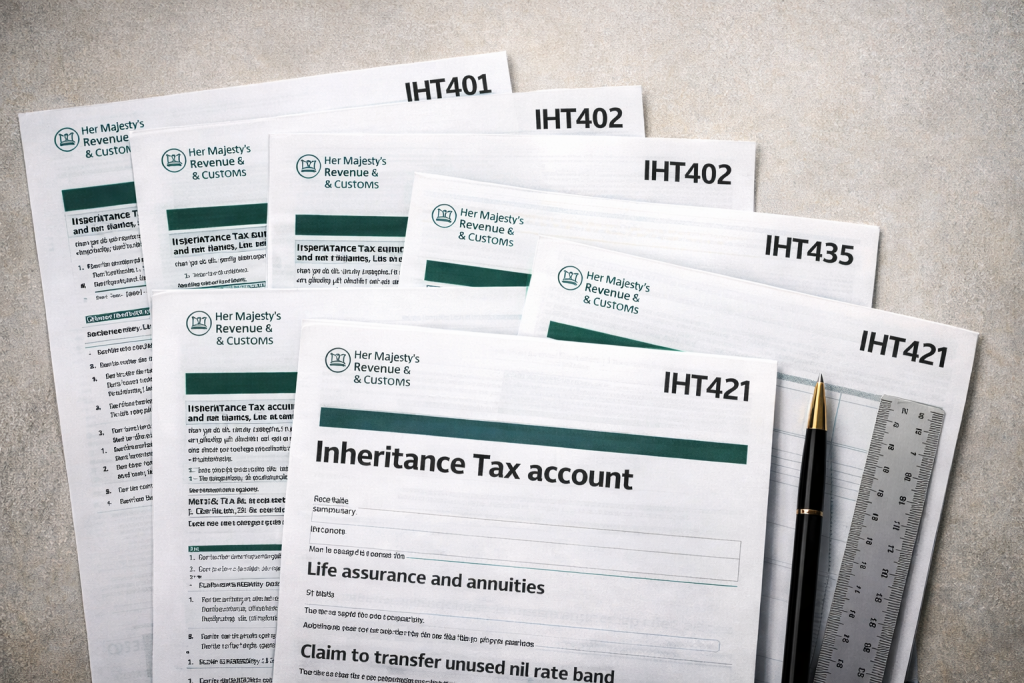
Missing supplementary forms. The IHT400 is rarely sufficient on its own. Depending on the estate, you’ll need additional schedules: IHT401 (domicile outside the UK), IHT402 (transferable nil-rate band), IHT403 (gifts), IHT404 (jointly owned assets), IHT405 (houses, land, and buildings), and several others. Submit one without the other and your case stalls.
Bank account details errors. Sounds minor. Isn’t. An incorrect sort code on a repayment claim can generate correspondence delays that last weeks.
Claimed reliefs without adequate evidence. Agricultural Property Relief and Business Property Relief are legitimate and valuable — but HMRC scrutinises them. If you claim BPR on shares in a trading company, be prepared to demonstrate that the business genuinely qualifies.
When HMRC Queries Your Return — And How to Respond Smartly
A query letter from HMRC isn’t necessarily bad news. Sometimes it’s purely procedural — they want a death certificate copy, or clarification on a pension value. Other times, it signals genuine scrutiny of a relief claimed or an asset valuation they consider low.
Respond promptly. Every week you take to reply adds to the timeline. If HMRC sends a query and you take four weeks to respond, you’ve added four weeks (minimum) to your case, because the file goes back into the queue rather than sitting on a caseworker’s desk.
If the query concerns something technical — valuation methodology, the qualifying conditions for a relief, or a trust arrangement — that’s when having professional support shifts from “nice to have” to “essential.” A tax specialist who deals regularly with HMRC inheritance tax queries will know what level of documentation satisfies their requirements. Guessing and submitting insufficient evidence just invites another round of correspondence.
The Interest Clock: A Very Expensive Reason to Pay First
This bears repeating, because the financial consequences are real.
How long does HMRC take to process inheritance tax is somewhat separate from when you need to pay it. Many executors make the mistake of waiting until HMRC has acknowledged their submission before paying — which is understandable, but costly.
The recommended approach:
- Calculate your best estimate of the tax due
- Pay that amount before the six-month deadline to stop interest accruing
- Submit the full IHT400 with the payment
- If the final figure differs (HMRC may accept a lower valuation, or you may have underpaid), the difference is settled afterward
Overpaying is better than underpaying. HMRC will refund an overpayment with repayment interest — currently lower than the late payment rate, but at least it flows in the right direction.
Nil-Rate Band, Residence Nil-Rate Band, and the Forms That Go With Them
If the estate benefits from a transferable nil-rate band (because a spouse or civil partner didn’t use their full allowance), claiming it correctly involves submitting IHT402 alongside the IHT400. Get the supporting documents right — the deceased spouse’s death certificate, details of their estate, any grants of probate from their estate — and this is relatively manageable. Miss something, and HMRC will ask for it.
The Residence Nil-Rate Band (RNRB), introduced in 2017 and currently sitting at £175,000 per person, adds another layer. If the property is being passed to direct descendants, this additional allowance can significantly reduce the bill — but it requires IHT435 (and IHT436 if transferring the deceased spouse’s unused RNRB). Understanding the inheritance tax threshold and how these allowances interact is genuinely complicated when property values are involved.
For a fuller picture of the inheritance tax limit and how allowances stack, it’s worth reading up before you begin rather than trying to learn on the fly.
Gifts, the Seven-Year Rule, and Whether HMRC Will Notice
Executors are legally required to disclose gifts made by the deceased in the seven years before death. This is uncomfortable territory — it means asking family members whether they received money, tracking down bank records, and potentially including gifts in the taxable estate that nobody expected to matter.
Inheritance tax gifts rules follow a taper relief system — gifts made between three and seven years before death are taxed at reducing rates, rather than the full 40%. But gifts made within three years of death are taxed in full (above the annual £3,000 exemption and other small allowances).
Failing to disclose gifts doesn’t make them disappear. HMRC has access to bank records, and they will sometimes cross-check. Undisclosed gifts discovered after probate is granted can trigger an HMRC investigation — a much more stressful process than simply declaring them upfront.
For a broader look at UK inheritance tax planning and how to legally reduce the bill, there are legitimate strategies that work well when implemented properly.
Processing Times Vs. Investigation Timelines: Very Different Things
A standard HMRC inheritance tax review and an HMRC investigation into an estate are not the same thing, and it’s worth being clear on the distinction.
Normal processing: HMRC reviews your submission, possibly asks a few questions, issues the IHT421, closes the case. This is the routine experience for most estates.
An investigation: HMRC has reason to believe figures are incorrect — intentionally or otherwise — and launches a formal review. This can involve requests for years of bank statements, professional valuations, business records, and formal correspondence that reads very differently from a routine query letter.
Investigations add months or years to the timeline. They’re stressful. They’re also largely avoidable through accurate, well-documented submissions. If an estate is complex enough that you’re uncertain about any aspect of the return, getting professional tax advisory support before submission is substantially cheaper than managing an investigation afterward.
Frequently Asked Questions
How long does HMRC take to process inheritance tax after submission? For a standard, error-free submission, expect 8–12 weeks for HMRC to process the IHT400 and issue the IHT421. Complex estates or those with claimed reliefs routinely take 3–6 months, sometimes longer.
Can you chase HMRC on an inheritance tax case? Yes. Once you have a reference number, you can contact HMRC’s Inheritance Tax helpline on 0300 123 1072. Be prepared to hold. Their helpline is notoriously busy, particularly in peak months.
What happens if HMRC takes longer than expected and you need probate urgently? In genuine hardship cases (for example, if the estate needs to sell a property to fund care costs for a surviving spouse), HMRC does have a fast-track process available. This requires a written request explaining the urgency. Results vary.
Does paying inheritance tax early affect how long HMRC takes to process? Not directly — payment and processing are handled through different channels. But paying early removes the interest risk while your case is in the queue.
Can you submit IHT400 online? Currently, the IHT400 is a paper form — though HMRC has been signalling moves toward digital submission. For more detail on whether IHT400 can be submitted online, check the current HMRC guidance, as this area is evolving.
What is the penalty for late inheritance tax? Interest accrues daily from the date payment was due. Additionally, HMRC can impose penalties for inaccurate returns — up to 100% of the unpaid tax in cases of deliberate understatement. Even careless errors carry penalties of up to 30%.
A Note on Getting Help Before You’re in Trouble
Inheritance tax is one of those areas where the cost of professional advice is genuinely small relative to the sums involved. An estate worth £800,000 with an IHT bill of £190,000 is not the moment to rely on a Google search and optimism.
Ask Accountant, based in South West London at 178 Merton High St, London SW19 1AY, works with executors, families, and individuals on everything from inheritance tax planning through to completing and submitting IHT returns, managing HMRC correspondence, and guiding clients through the full probate process. If you’re at the start of this journey — or stuck somewhere in the middle — a conversation costs nothing. You can reach the team on +44(0)20 8543 1991.
Because honestly? Knowing how long does HMRC take to process inheritance tax is useful. Knowing you’ve got someone competent reviewing the return before it goes in is better.
| Form | Purpose | When Required |
|---|---|---|
| IHT400 | Main inheritance tax return | When estate exceeds nil-rate band or IHT is payable |
| IHT401 | Domicile outside UK | Deceased had foreign domicile |
| IHT402 | Transferable nil-rate band | Surviving spouse/civil partner claiming unused allowance |
| IHT403 | Gifts and other transfers | Gifts made in 7 years before death |
| IHT405 | Houses, land, buildings | Any property in the estate |
| IHT421 | Probate summary (issued by HMRC) | Sent by HMRC to Probate Registry after processing |
| IHT435 | Residence Nil-Rate Band | Property left to direct descendants |