
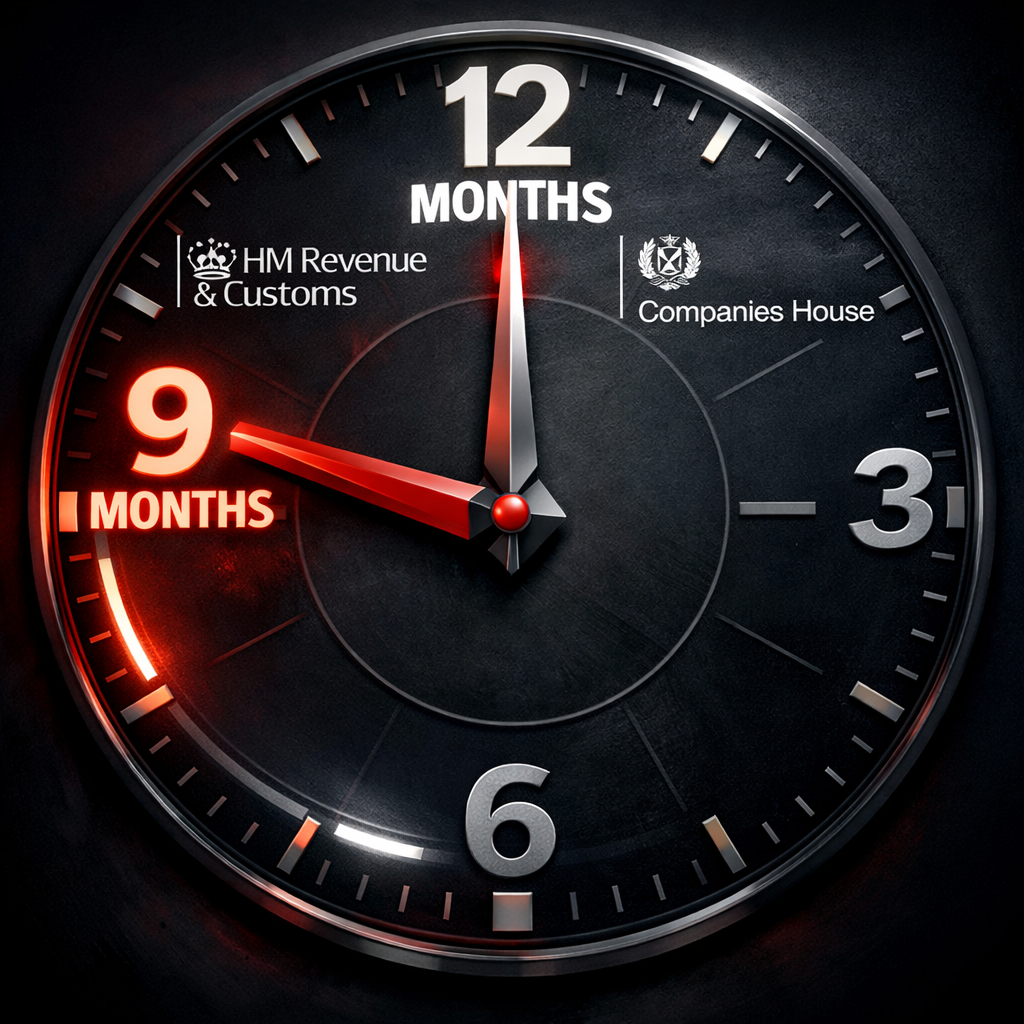
There’s a peculiar irony in running a business. You spend months building something brilliant—negotiating contracts, landing clients, perfecting your product—only to discover that missing a single date circled in red on some bureaucrat’s calendar can cost you more than your entire marketing budget.
I’m talking about corporate tax return deadlines, of course. And if you’re groaning already, I get it. But here’s the thing: understanding these deadlines isn’t just about avoiding penalties (though that’s obviously important). It’s about cash flow management, strategic planning, and—dare I say it—actually sleeping at night instead of wondering if HMRC is drafting a rather unpleasant letter with your company’s name on it.
Whether you’re running a one-person consultancy from your spare bedroom or managing a growing team in a proper office, the rules are the same. And they’re not negotiable. So let’s talk about what you actually need to know, when you need to know it, and why getting this right matters more than you might think.
When Your Clock Actually Starts Ticking
Most people assume the tax year is somehow universal. It isn’t. Your company’s accounting period—which determines everything about your corporate tax return deadlines—might have nothing whatsoever to do with the traditional 6 April to 5 April tax year that governs personal tax.
Your accounting period typically runs for 12 months and ends on whatever date you (or your accountant) decided when you set up the company. Many businesses align this with 31 March to keep things tidy with HMRC’s own financial year, but you’re not obligated to. Some companies end their accounting period on 31 December, others on 30 June. It’s flexible.
Here’s where it gets interesting: your first accounting period can actually run for up to 18 months if you incorporate mid-year and want to align with a specific date. But—and this is crucial—HMRC won’t let you file just one return for that extended period. You’ll need to split it into a 12-month period and a separate shorter period, filing two separate CT600 forms. Yes, it’s annoying.
The Two Dates That Define Your Compliance Status
Every UK limited company faces two critical deadlines, and confusing them is one of the most common mistakes I see business owners make.
Your CT600 filing deadline: 12 months after your accounting period ends. This is when you must submit your complete corporate tax return—the CT600 form, your statutory accounts, and tax computations showing how you calculated everything.
Your corporation tax payment deadline: 9 months and 1 day after your accounting period ends. Notice something? You need to pay before you file. This catches out countless businesses every year.
Let me spell that out with an example. Say your accounting period ends on 31 March 2025. You’ve got until 1 January 2026 to actually pay the tax you owe. But you don’t need to file the paperwork explaining that calculation until 31 March 2026. Bizarre? Perhaps. But those are the rules.
For businesses with profits exceeding £1.5 million, the payment schedule changes entirely. You’ll be making quarterly instalment payments starting 6 months and 13 days into your accounting period. If you’re in this category, you already know how much more complex (and cash-flow intensive) this becomes.
| Accounting Period Ends | Corporation Tax Payment Due | CT600 Filing Deadline |
|---|---|---|
| 31 March 2025 | 1 January 2026 | 31 March 2026 |
| 30 June 2025 | 1 April 2026 | 30 June 2026 |
| 30 September 2025 | 1 July 2026 | 30 September 2026 |
| 31 December 2025 | 1 October 2026 | 31 December 2026 |
Corporation Tax is usually due 9 months and 1 day after the end of the accounting period, while the CT600 must be filed within 12 months.
What Happens When You’re Late (Spoiler: Nothing Good)
Let’s be honest about something: HMRC doesn’t do warnings. They do penalties.
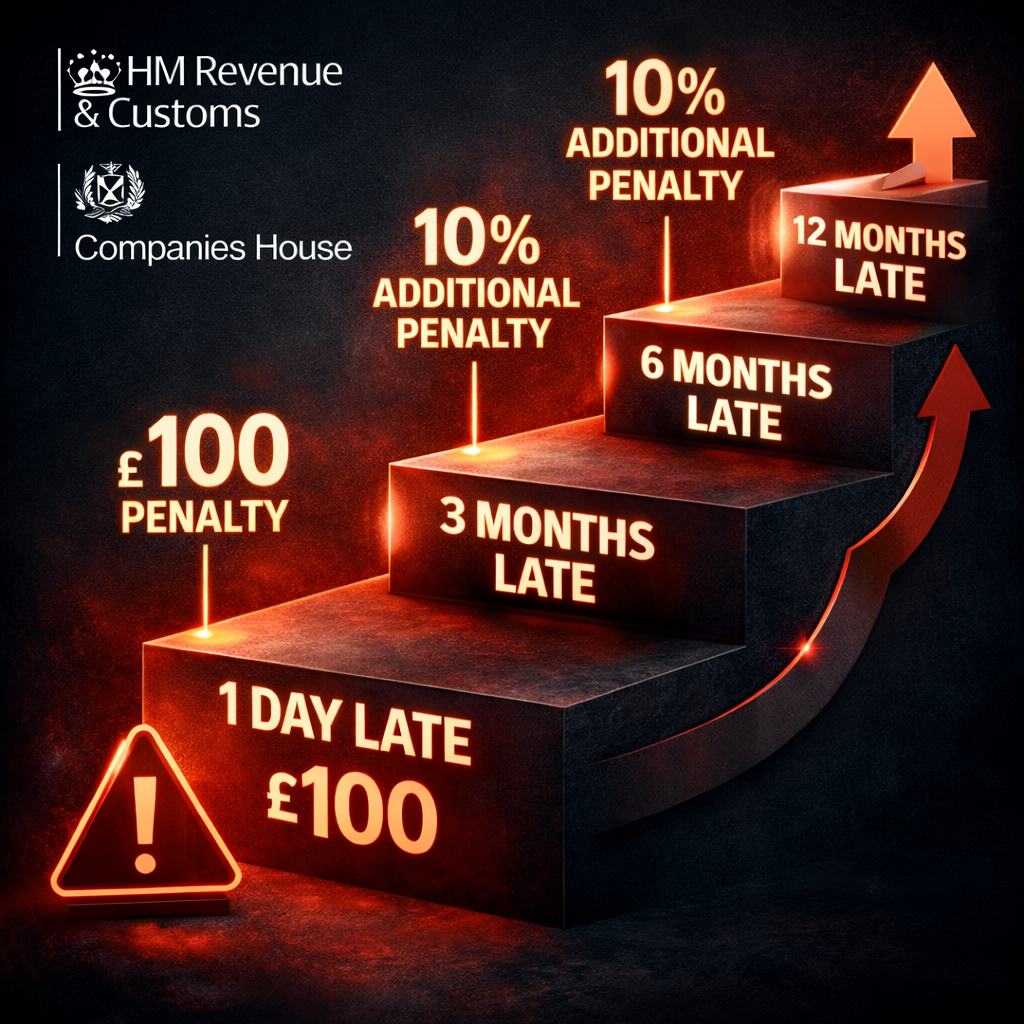
Miss your filing deadline by even a single day? That’s £100 gone, just like that. Three months late? Another £100. Six months? They’ll estimate what you owe, slap a 10% penalty on top of the unpaid tax, and still expect that original £200 in late filing fees. Twelve months? Another 10% penalty, plus interest accumulating at the Bank of England base rate plus 2.5%.
The penalties escalate fast, and they compound. A company that’s late three times in a row sees those initial £100 penalties jump to £500 each time. It’s HMRC’s way of saying, “We’re watching, and we’re not impressed.”
But here’s what really hurts: it’s not just about the money (though that stings). Late filings can trigger compliance reviews, affect your company’s credit rating, and create complications if you’re trying to secure funding or sell the business. Investors and lenders check these things. A pattern of late filing screams “disorganised management” to anyone who’s looking.
The thing that bothers me most? These penalties are entirely avoidable. Unlike some tax liabilities where there’s genuine complexity or room for interpretation, filing deadlines are just dates on a calendar. Missing them is almost always a failure of process, not understanding.
Understanding What Actually Goes Into Your Corporate Tax Return
The CT600 form itself is deceptively simple-looking. It’s essentially a summary sheet—your company details, your accounting period, your taxable profits, and the tax you owe. But behind that summary sits a mountain of supporting documentation.
You’ll need your full statutory accounts (profit and loss, balance sheet, the works), tax computations showing how you adjusted your accounting profits for tax purposes, and details of any capital allowances, R&D claims, or other reliefs you’re claiming. Each of these elements needs to align perfectly. HMRC’s systems will reject returns with validation errors, and fixing them under time pressure is nobody’s idea of fun.
Here’s something many business owners don’t realise: your accounting profit and your taxable profit are usually different numbers. Sometimes wildly different. That’s because accounting standards and tax law have different rules about what counts as an allowable expense. Client entertainment? Fine for your accounts, not allowable for tax. Depreciation? Great for accounts, but HMRC wants you to use capital allowances instead.
This reconciliation—figuring out exactly what you can and can’t claim—is where professional tax advisory solutions become genuinely valuable. Because getting it wrong doesn’t just mean paying more tax than necessary; it can trigger enquiries if your calculations look questionable.
The Corporation Tax Rates You’re Actually Paying in 2025
Since April 2023, the UK has operated a tiered corporation tax system. If your company’s taxable profits are £50,000 or less, you’re paying 19%—the “small profits rate.” Above £250,000? You’re at the main rate of 25%. Fall somewhere in between? Welcome to marginal relief territory, where your effective rate gradually increases.
The government’s 2024 Corporate Tax Roadmap committed to capping that main rate at 25% for this parliamentary term, which provides some planning certainty. But that’s cold comfort if you’re not claiming every allowance and relief you’re entitled to.
Capital allowances remain one of the most powerful tools for reducing your corporation tax bill. The Annual Investment Allowance lets you deduct up to £1 million on qualifying plant and machinery. Full expensing (also called “super-deduction” by some) allows 100% first-year relief on certain capital purchases. These aren’t minor adjustments—they can dramatically reduce your tax liability if you’re investing in equipment, IT infrastructure, or machinery.
| Taxable Profit | Corporation Tax Rate | Example Tax on £100,000 Profit |
|---|---|---|
| Up to £50,000 | 19% | £19,000 |
| £50,001 – £250,000 | 19% – 25% (marginal relief) | £21,375* |
| Over £250,000 | 25% | £25,000 |
*Based on marginal relief applying to profits between £50,000 and £250,000.
*Approximate after marginal relief calculation
First-Time Filers: What Nobody Tells You
If this is your company’s first year filing a corporate tax return, congratulations—you’ve picked a particularly fun time to learn about British bureaucracy.
Here’s the sequence: within three months of starting to trade (or receiving any income), you must register for corporation tax with HMRC. They’ll send you a Unique Taxpayer Reference (UTR) and information about your filing obligations. Don’t wait for them to chase you. If you miss this registration deadline, penalties start accumulating even before your first return is due.
Your first accounting period gets special treatment. You’ve got 21 months from your incorporation date to file your first statutory accounts with Companies House. But your corporation tax payment deadline? Still just 9 months and 1 day after your accounting period ends. And your CT600 filing deadline? Still 12 months after the period ends.
Many new business owners assume they’re in a grace period for that first year. They’re not. The rules apply from day one, and HMRC is remarkably unsympathetic to “but I didn’t know” arguments.
Strategic Timing: Why Your Year-End Date Matters More Than You Think
Choosing when your accounting period ends isn’t just administrative housekeeping. It affects when tax is due, when allowances refresh, and how you can plan major expenditures.
Companies that align with the 31 March year-end find it easier to plan around HMRC’s own financial year and the timing of Budget announcements. Those using calendar years (ending 31 December) find it easier to align with their own business cycles and reporting to stakeholders. Some industries have traditional year-ends that make sector comparisons simpler.
But here’s the kicker: you can change your accounting reference date. Companies House allows shortening at any time, and extensions are possible in limited circumstances. This can be strategically useful—pushing back a year-end to defer tax liability, or bringing it forward to accelerate claiming new allowances.
If you’re considering this, speak with someone who understands the implications. The team at Ask Accountant regularly helps businesses evaluate whether changing their year-end makes financial sense. It’s one of those decisions that seems minor until you realise how much it affects cash flow and compliance timelines.
Dormant Companies: The Deadline That Catches People Off Guard
“But my company didn’t do anything this year!” doesn’t exempt you from filing requirements. If Companies House considers your company active, you’re filing accounts. Full stop.
Dormant companies—those with no significant accounting transactions beyond fees paid to Companies House or to maintain bank accounts—still need to file dormant accounts and, in most cases, a dormant company tax return (CT600). The deadline structure is identical: 9 months for Companies House filings, 12 months for the CT600.
HMRC sometimes sends CT603 notices to dormant companies, demanding a return even when there’s no tax liability. Ignoring these notices leads to automatic penalties. You need to either file the return or formally notify HMRC that the company is dormant. This administrative requirement catches out loads of business owners who thought they’d parked their company indefinitely without ongoing obligations.
The Digital Transformation: How Online Filing Changed Everything
Paper returns for corporation tax are essentially extinct. HMRC requires online submission through your company’s Corporation Tax online account, linked to your Government Gateway credentials.
Making Tax Digital (MTD) has already rolled out for VAT and is spreading to Income Tax Self Assessment. Corporation tax was expected to follow, but in July 2025, HMRC announced they wouldn’t proceed with MTD for Corporation Tax. For now, at least, you’re not required to maintain digital records in specific software formats or submit quarterly updates.
That said, using cloud accounting solutions still makes enormous sense. Real-time data, automatic backups, integration with your bank feeds, and the ability to generate reports from anywhere with an internet connection—these aren’t just nice-to-haves anymore. They’re competitive advantages.
More practically, cloud software drastically reduces the year-end scramble. When your bookkeeping is current throughout the year, preparing your corporate tax return becomes straightforward rather than traumatic.
When Things Go Wrong: Appeals, Amendments, and Damage Control
Submitted your return and immediately spotted an error? You can amend a corporate tax return within 12 months of the filing deadline. After that window closes, you’re looking at an error or mistake relief claim, which has different rules and a four-year deadline.
Received a penalty that you think is unfair? You can appeal, but you need reasonable excuse. HMRC’s list of what constitutes “reasonable excuse” is surprisingly short: unexpected hospitalisation, death of a close family member, technical failures on HMRC’s own systems. “I was busy” doesn’t count. “My accountant forgot” doesn’t help you—the legal responsibility sits with the company directors.
If you’re facing an HMRC investigation or dispute, this is genuinely not the time to wing it. The tax authority has extensive powers to request information, impose penalties, and pursue debts. Getting proper representation isn’t optional at that point—it’s damage limitation. Services like HMRC investigations support exist precisely because these situations require specialist knowledge.
Beyond Compliance: Using Deadlines for Strategic Planning
The smartest business owners treat tax deadlines as planning triggers, not just obligations to be met.
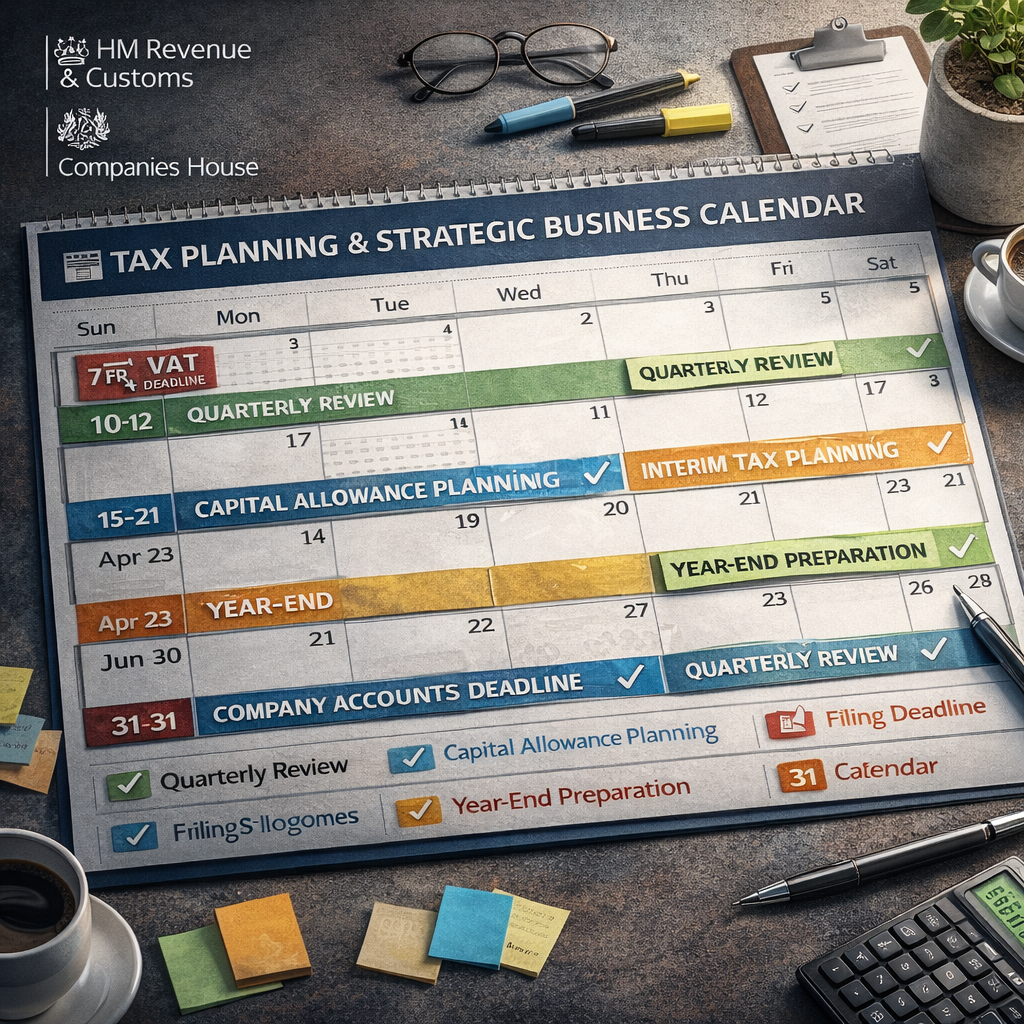
Knowing when your corporation tax is due helps you forecast cash flow accurately. You can time major purchases to fall within accounting periods where you’ve got higher profits (and thus more value from capital allowances). You can accelerate or defer income—within legal bounds, obviously—to manage when tax liabilities crystallise.
This is where the intersection of corporate tax planning and business advisory services becomes valuable. Because while filing on time keeps you compliant, strategic planning keeps more money in your business where it can actually work for you.
The Hidden Deadlines: Other Dates on Your Corporate Calendar
Corporate tax return deadlines don’t exist in isolation. If you’re running payroll, you’ve got PAYE and National Insurance obligations with monthly or quarterly deadlines. VAT-registered? That’s quarterly returns, usually. Companies House wants confirmation statements annually. Dividend distribution needs proper documentation and timing.
Each of these has its own penalty regime, and they don’t always align neatly. A business with a 31 December year-end might have corporation tax due in October, VAT returns in January, April, July, and October, PAYE submissions monthly, and their confirmation statement whenever their incorporation anniversary falls.
Managing this requires either exceptional personal organisation or—let’s be realistic—professional accounting and bookkeeping support that treats deadline management as part of the package rather than something you need to remember yourself.
Practical Systems That Actually Work
Here’s what successful business owners do differently when it comes to managing corporate tax return deadlines:
They automate reminders well in advance—not just the filing deadline, but milestones leading up to it. “Gather Q4 receipts” three months before year-end. “Review capital purchases” two months out. “Draft accounts ready for review” one month before.
They maintain monthly reconciliations instead of annual fire drills. When your bookkeeping is current every month, year-end becomes a review exercise rather than a reconstruction project.
They build cash reserves specifically for tax. Not hoping the money will be there when the payment is due—knowing it’s there because they’ve been setting aside a percentage of profit throughout the year.
They engage professional support before problems emerge, not after. The economics are straightforward: paying for proper business accounting services costs less than penalties, costs less than lost time, and typically saves more in legitimate tax planning than the fees cost anyway.
The Real Cost of Cutting Corners
I’ve seen businesses try to save money by handling their own corporate tax returns with minimal understanding of what they’re doing. Sometimes they get away with it. More often, they pay for it later—in penalties, in overpaid tax, in stress, or in opportunity cost.
There’s a perverse calculation some business owners make: “I can handle this myself and save £1,000 in accountant fees.” What they’re not factoring in is the time cost (what else could you be doing with those hours?), the error risk (how confident are you about capital allowances calculations?), and the opportunity cost (what tax planning strategies are you missing?).
False economies in tax compliance tend to compound. You miss a deadline, incur penalties, and now you’re behind for the next cycle too and miscalculate your tax liability, pay too little, and face interest charges plus potential investigation. You fail to claim available reliefs and pay more tax than legally required, year after year.
Looking Ahead: What’s Changing in the Tax Landscape
The 2024 Corporate Tax Roadmap provided some stability—no increases to the main 25% rate this parliamentary term, continued support for capital allowances and R&D reliefs. But the detail matters.
Capital allowances rates are shifting. From April 2026, the main rate writing-down allowance drops from 18% to 14%, partially offset by a new 40% first-year allowance on certain assets. The net effect is essentially a slight tax increase for most businesses, despite the government’s claims of maintaining support for investment.
National Insurance contributions for employers increased to 15% from April 2025, with the threshold dropping from £9,100 to £5,000. This doesn’t affect your corporate tax return directly, but it hits your employment cost calculations and payroll planning.
Dividend allowances remain frozen at £500, meaning directors taking income via dividends face higher personal tax bills on anything above that threshold. That affects how you structure your own remuneration, which feeds into corporate tax planning.
The Bottom Line: Treat Deadlines as Non-Negotiable
Look, I know this has been a lot of detail about dates and forms and penalties. But here’s the fundamental point: in the hierarchy of business priorities, tax compliance sits somewhere between “absolutely essential” and “utterly non-negotiable.”
You can be brilliant at what you do. Your product can be exceptional, your service outstanding, your team incredible. But if you miss a corporate tax return deadline, none of that matters to HMRC. They’re not interested in your excuses, your good intentions, or your complex personal circumstances.
The good news? Managing this properly isn’t actually that complicated. It requires systems, attention to detail, and either personal discipline or professional support. That’s it.

If you’re based in London and looking for accountants who treat deadline management as a core service rather than an afterthought, Ask Accountant at 178 Merton High St, London SW19 1AY (call +44(0)20 8543 1991) specialises in exactly this kind of practical, business-focused support. They handle everything from basic bookkeeping to complex proactive tax advisory solutions and business growth planning.
Corporate tax return deadlines matter. They matter financially, legally, and strategically. Get them right, and they fade into the background of business operations. Get them wrong, and they become expensive, stressful problems that distract from everything else you should be doing.
So mark your calendars. Set your reminders. Build your systems. And if any of this feels overwhelming or unnecessarily complex, remember that asking for help is always cheaper than paying penalties and always less stressful than lying awake at 3am wondering if you’ve missed something important.
Frequently Asked Questions
When is my corporation tax actually due? Your corporation tax payment is due 9 months and 1 day after your accounting period ends. So if your year-end is 31 March 2025, payment is due by 1 January 2026—well before your CT600 filing deadline.
Do I need to file a corporate tax return if my company made no profit? Yes. Even companies with losses or zero profit must file a CT600 return. HMRC needs to know about your financial position regardless of profitability, and losses can be valuable for future tax planning.
What happens if I file my CT600 late? Penalties start at £100 for being even one day late, rising to £200 at three months late. At six months late, HMRC adds a 10% penalty on top of unpaid tax, and another 10% at twelve months. Interest also accrues on late payments.
Can I file my own company tax return or do I need an accountant? Legally, you can file your own return. Practically, most businesses benefit from professional support due to the complexity of tax calculations, capital allowances, and available reliefs. The decision depends on your financial situation’s complexity and your own expertise.
How do I know when my first corporation tax return is due? Your first CT600 filing deadline is 12 months after your first accounting period ends, and payment is due 9 months and 1 day after that period ends. For new companies, this often catches people off guard—the first-year deadlines are the same as every subsequent year.
What’s the difference between Companies House accounts and the CT600? Your statutory accounts filed with Companies House show your company’s financial position. Your CT600 is your corporation tax return filed with HMRC, showing your taxable profits and tax calculation. Both are required, have different deadlines, and serve different purposes.
Can I change my accounting period to get more time? You can change your accounting reference date, which affects future periods. However, you can’t change it retrospectively to extend a deadline you’re already approaching. Changes need to be planned well in advance and filed with Companies House.
What if HMRC rejects my CT600 submission? HMRC’s systems validate returns for technical errors, missing information, or inconsistencies. If rejected, you’ll receive an error message. Fix the issues and resubmit immediately—the deadline doesn’t extend because of technical problems.
Do dormant companies still need to file corporation tax returns? Usually yes. Even dormant companies typically need to file a dormant company CT600. HMRC often sends CT603 notices to dormant companies requiring returns. Ignoring these notices results in automatic penalties.
How far back can I go to claim relief if I discover I overpaid? You can amend a return within 12 months of the filing deadline. After that, you have four years from the end of the accounting period to make an error or mistake relief claim. Time limits are strict—once they pass, overpayments typically can’t be recovered.