
Last updated: January 2026 | Reading time: 12 minutes
Look, I’ll be blunt: the inheritance tax system is designed to catch the unprepared. Frozen thresholds since 2009. Property prices that’ve gone bonkers. A 40% tax rate that bites harder than a Rottweiler with a grudge.
And yet… most families stumble into HMRC’s trap because they didn’t know there were escape routes.
Here’s what gets me: people spend decades building wealth, protecting their families, squirreling away savings—and then hand over nearly half of it to the taxman because they didn’t take action. The real kicker? Most of it could’ve been avoided with proper planning and a basic understanding of how inheritance tax actually works.
So let’s fix that, shall we?
The £325,000 Threshold That Hasn’t Budged in 17 Years
First things first. Every individual gets a nil-rate band of £325,000. That’s the amount you can pass on tax-free, no questions asked. Been stuck at that level since April 2009, mind you (cheers, successive Chancellors). Anything above that? HMRC takes 40% of it.
But—and this is where it gets interesting—there’s also something called the residence nil-rate band. An extra £175,000 per person, available when you leave your home to direct descendants. Kids, grandkids, step-children… you get the idea.
Run the numbers for a married couple: £325,000 + £325,000 (two nil-rate bands) + £175,000 + £175,000 (two residence nil-rate bands) = £1 million that can pass tax-free between spouses and down to children.
That’s the theory, anyway. Reality tends to be messier.
Quick Win: If your estate is hovering around the £500,000 mark and includes your home, you’re potentially looking at zero inheritance tax—if you structure things correctly and your property goes to your children or grandchildren.
The Seven-Year Clock (And Why It Matters More Than Ever)
Here’s where inheritance tax planning gets properly tactical.
Give away money now, survive seven years, and HMRC can’t touch it. Die within those seven years? The gift gets dragged back into your estate for tax calculations. It’s called a Potentially Exempt Transfer (PET), which is accountant-speak for “this gift might be tax-free, depending on whether you’re still breathing in 2032.”
Morbid? A bit. Effective? Absolutely.
The seven-year rule has been around since 1969 (older than most Beatles albums), and it’s one of the most powerful tools for reducing inheritance tax on family property. But there’s a catch—actually, several catches.
How the Taper Relief Works
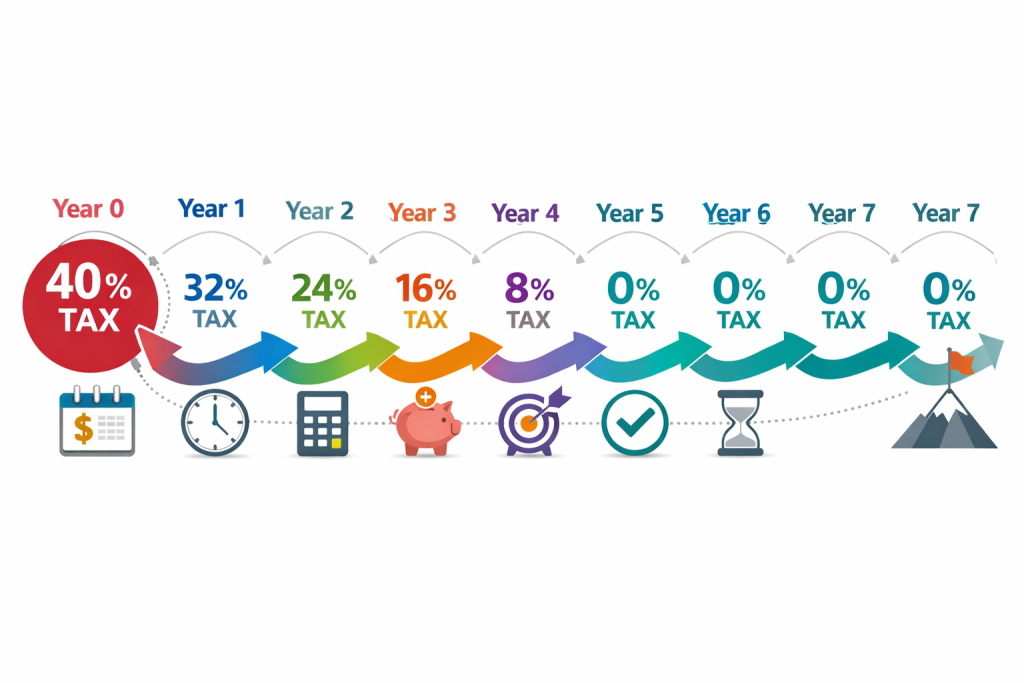
If you don’t quite make it to the seven-year finish line, there’s still hope. Taper relief kicks in after three years, reducing the tax on gifts according to this sliding scale:
| Years Between Gift and Death | Tax Rate on Gift |
|---|---|
| Less than 3 years | 40% |
| 3 to 4 years | 32% |
| 4 to 5 years | 24% |
| 5 to 6 years | 16% |
| 6 to 7 years | 8% |
| 7+ years | 0% (tax-free!) |
Translation: the longer you survive after making a gift, the less your family pays. Simple maths, high stakes.
Heads Up: Rumours are swirling that Rachel Reeves might extend this to a ten-year rule or scrap it entirely. Nothing’s confirmed yet, but if you’ve been sitting on gifting plans, you might want to stop sitting.
Exemptions That Actually Work (Not the Rubbish Ones)
Right, let’s talk about the exemptions that don’t require you to live another seven years or consult three tax advisers first.
The Annual £3,000 Exemption – You can give away £3,000 each tax year, completely tax-free. Didn’t use it last year? Brilliant—you can carry forward one year’s unused allowance, giving you £6,000 to play with. Not exactly life-changing money, but it adds up over time (especially if both spouses use theirs).
Wedding Gifts – Parents can gift £5,000 to each child getting married. Grandparents? £2,500. Anyone else gets £1,000. Civil partnerships count too. Just don’t try claiming this exemption for someone’s third wedding—HMRC’s seen that one before.
Small Gifts of £250 – You can give as many people as you like up to £250 each year, as long as you haven’t used another exemption on them. Great for Christmas or birthdays… less great if you’re trying to shift serious wealth.
Regular Gifts from Income (This One’s Sneaky Good) – If you make regular payments out of your income (not savings), and they don’t affect your standard of living, they’re completely exempt. No seven-year rule. No limits. Pensioners paying into grandchildren’s ISAs or Junior SIPPs? This is your golden ticket. Just keep records proving the gifts were regular and didn’t leave you eating beans on toast.
What About the Family Home?
Property’s where most people trip up with inheritance tax, mainly because UK house prices have done their level best to bankrupt common sense over the past two decades.
Your family home qualifies for that extra £175,000 residence nil-rate band I mentioned earlier—but only if you leave it to direct descendants. Leave it to your niece? Sorry, no extra allowance. Leave it to your civil partner? They’re exempt anyway (transfers between spouses don’t attract inheritance tax at all).
There’s also a nasty taper for estates worth over £2 million. For every £2 your estate exceeds that threshold, you lose £1 of the residence nil-rate band. Hit £2.4 million? You’ve lost the entire £175,000 allowance. Lovely.

Can You Gift Your Property and Still Live in It?
Short answer: Not really.
Longer answer: HMRC has a specific rule for this called “gifts with reservation of benefit.” Give away your house but keep living in it rent-free? HMRC treats it as if you still own it. The gift fails. Your inheritance tax bill stays exactly where it was.
Want to make it work? You need to either:
- Move out completely and survive seven years, or
- Pay your children (or whoever you gifted it to) full market rent plus your share of household bills, and then survive seven years
Neither option is particularly appealing if you’re 72 and rather fond of your kitchen.
When Trusts Stop Being Boring and Start Saving You Money
I know. The word “trust” makes most people’s eyes glaze over faster than a double lecture on VAT regulations.
But here’s the thing about trusts: they can ring-fence assets outside your estate while giving you control over how and when beneficiaries receive them. Useful if you’ve got family property you want protected, minor children who aren’t ready for a windfall, or… complicated family dynamics (we’ve all got them).
Common types include:
- Bare Trusts – Simple. Assets held for a named beneficiary who gets them at 18. No inheritance tax on creation, but assets still count as part of your estate if you die within seven years of setting it up.
- Discretionary Trusts – More flexible, but there’s an immediate 20% tax charge if you put in more than £325,000. Also subject to 10-yearly inheritance tax charges of up to 6%. (Told you trusts had a dark side.)
- Interest in Possession Trusts – Someone gets the income (say, from rental property), but the capital goes to someone else later. Tax treatment varies.
Before you rush off to set one up: get professional advice. A badly structured trust can cost your family more than doing nothing at all. Ask Accountant specialises in estate planning and can walk you through whether a trust actually makes sense for your situation—or whether simpler strategies would do the job just as well.
Business and Agricultural Relief (While They Last)
Own a trading business? Working farmland? Until April 2026, you can pass these on with 100% inheritance tax relief—no limits on value.
That’s… changing.
From 6 April 2026, only the first £1 million of qualifying business or agricultural property gets full relief. Anything above that? 50% relief, which means an effective inheritance tax rate of 20% on the excess.
If you’ve got a £3 million farm or a £5 million family business, you need to be planning now. Options include:
- Restructuring ownership (potentially bringing in family members earlier)
- Life insurance to cover the tax bill (not ideal, but sometimes necessary)
- Phased gifting strategies combined with the seven-year rule
- Incorporation (for some businesses—definitely not for all)
This is technical stuff. The kind of planning that benefits from sitting down with someone who does inheritance tax for a living, not Googling it at 2am.
| Relief Type | Current Rules (Until April 2026) | New Rules (From April 2026) |
|---|---|---|
| Business Property Relief | 100% on unlimited value | 100% on first £1m, then 50% |
| Agricultural Property Relief | 100% on unlimited value | 100% on first £1m, then 50% |
| Combined Limit | N/A (no limit) | £1m shared between both reliefs |
Pensions: The Loophole That’s Closing
For years, pensions have been the secret weapon of inheritance tax planning. Money in a defined contribution pension? Sits outside your estate. Can be passed to beneficiaries tax-free (if you die before 75) or at their marginal rate (if you die after 75). No inheritance tax. Ever.
Until April 2027, that is.
From then on, unused pension funds will count towards your estate for inheritance tax purposes. That’s potentially a massive change for anyone who’s been using pensions as an inheritance tax shelter.
What should you do? Honestly, it depends on your age, health, income needs, and about seventeen other factors. But generally speaking:
- If you’re already retired and drawing down, you might want to accelerate withdrawals and gift the money (utilising the seven-year rule)
- If you’re younger, maxing out pension contributions is still smart—just factor in the 2027 change
- If you’re sitting on a £500k+ pension pot and don’t need the income, talk to a tax adviser about rebalancing your estate
Life Insurance: The Boring Solution That Actually Works
Nobody wants to talk about life insurance. But here’s the reality: if your estate’s going to face a £200,000 inheritance tax bill, and your main asset is an illiquid property, your executors are going to have problems.
A whole-of-life policy written in trust can:
- Pay out exactly when needed (on death)
- Sit outside your estate (if it’s in trust)
- Give executors immediate cash to pay HMRC (avoiding forced property sales)
There’s also something called “gift inter vivos” insurance—specialist cover that pays out the taper-relief-adjusted tax if you die within seven years of making a gift. The premium decreases as you get closer to that seven-year mark. Clever stuff, if you can afford it.
Charity Gifts and the 36% Rate
Leave 10% or more of your net estate to charity? The inheritance tax rate on the rest drops from 40% to 36%.
Now, I can already hear you thinking: “Hang on, I’m giving away 10% to save 4%? That’s backwards maths.”
And you’d be right—sort of. The actual savings depend on your estate size and what you were planning to leave to charity anyway. If you were already leaving 5% to a cause you care about, bumping it to 10% might make sense. If you weren’t planning on leaving anything? Probably doesn’t.
Run the numbers. Ask Accountant can model different scenarios for you so you’re not just guessing.
Record-Keeping (Or: How to Not Screw This Up)
Here’s an unglamorous truth: brilliant planning falls apart without documentation.
Your executors will need to prove to HMRC that:
- Gifts were made when you said they were (for the seven-year rule)
- Regular payments came from income, not capital (for the income exemption)
- Wedding gifts were actually for weddings (not “weddings”)
- Small gifts stayed under £250 per person
Keep:
- Bank statements showing transfers
- Letters or emails confirming gifts
- Records of income vs expenditure (especially for pensioners making regular gifts)
- Trust deeds, if you’ve set up trusts
- Life insurance policy documents

Stick them all in one place. Label them. Tell your executors where they are. For the love of all that’s holy, don’t leave them in a box in the loft with no instructions.
Pro Tip: Use a “lifetime gifts register”—a simple spreadsheet tracking every significant gift, the date, the recipient, and which exemption you’re claiming. Your executors will thank you. So will your beneficiaries.
What’s Coming Next? (The 2027 Pension Changes and Beyond)
We’ve covered the April 2026 changes to agricultural and business relief. We’ve mentioned the 2027 pension inclusion. But there’s more speculation floating around:
- Extending the seven-year rule to ten years (or scrapping it entirely)
- Introducing a lifetime gifting cap (like the US system)
- Further restrictions on trusts
- Changes to the residence nil-rate band taper
None of this is confirmed. But the direction of travel is pretty clear: inheritance tax is a revenue raiser that successive governments like, and they’re tightening the net.
What should you do?
Don’t wait for the “perfect” plan. Tax laws change. Thresholds shift. What works brilliantly in 2026 might be useless in 2028. But doing something sensible now—using current exemptions, starting the seven-year clock on meaningful gifts, reviewing your will—beats doing nothing and hoping for the best.
Common Mistakes That Cost Families Thousands
Mistake #1: Assuming Inheritance Tax Is “Only for the Rich”
Not anymore. A three-bedroom house in London? You’re over the basic threshold before you’ve counted savings, pensions, or that classic car in the garage.
Mistake #2: Leaving It All to the Surviving Spouse
Transfers between spouses are tax-free, yes—but if the surviving spouse then has a £900,000 estate and dies six months later, you’ve wasted planning opportunities. Sometimes it makes sense to leave assets directly to children (within allowances) rather than funnelling everything through one spouse.
Mistake #3: Gifting the House But Staying Put
We covered this earlier. Bears repeating because so many people think they’ve been clever, only to discover HMRC treats it as a failed gift.
Mistake #4: Not Updating Your Will
Got divorced ten years ago? Remarried? Had more kids? Your 1997 will might not reflect current reality. Review it. Especially if there’ve been changes to inheritance tax law since you last looked at it.
Mistake #5: DIY Complex Planning
Look, I’m all for self-sufficiency. But if your estate includes business property, multiple properties, overseas assets, or complex family arrangements? This isn’t the place to wing it. Get proper tax advisory from people who do this professionally.
Why Early Planning Beats Last-Minute Scrambling
Here’s the frustrating bit about inheritance tax: the earlier you start, the more options you have.
Start at 50? You can make substantial gifts and likely outlive the seven-year rule. Additionally, you can restructure business ownership gradually. You can use multiple years of income-exemption gifting.
Start at 78? Your options narrow considerably. Big gifts become riskier (health permitting). The seven-year clock feels less certain.
And if you wait until someone’s seriously ill? You’re often too late for anything except damage limitation.
The families who pay the least inheritance tax aren’t necessarily the wealthiest—they’re the ones who planned earliest.
How Ask Accountant Can Help
Look, inheritance tax planning isn’t something you sort out over a Sunday roast and a bottle of wine. It requires proper analysis of your estate, understanding of current rules, projections for future changes, and—crucially—advice that’s tailored to your family situation.
At Ask Accountant, we’ve spent years helping London families reduce inheritance tax on family property through practical, legally sound strategies. Not offshore schemes. Not dodgy workarounds. Just smart use of reliefs, exemptions, and planning techniques that actually work.
We’ll review your estate, identify inheritance tax liabilities, explain your options in plain English (none of this “hereinafter referred to as the settlor” nonsense), and build a plan that fits your goals. Whether that’s simple gifting strategies, trust structures, business relief planning, or a combination of approaches.
You can reach us at +44(0)20 8543 1991 or visit our office at 178 Merton High St, London SW19 1AY. We also handle business accounting services, bookkeeping, tax advisory solutions, and pretty much everything else that keeps HMRC happy—but inheritance tax planning is one of the areas where we see families make the biggest difference to what they leave behind.
Frequently Asked Questions
Q: Do I need to pay inheritance tax if I inherit my parents’ house?
A: You personally don’t pay it—the estate does, before assets are distributed. But if the estate can’t cover the tax bill, beneficiaries sometimes have to sell assets (like the house) to pay HMRC. This is exactly why planning matters.
Q: Can I give my house to my children and still live in it?
A: Only if you pay them full market rent plus your share of bills—and then survive seven years. Otherwise it’s a “gift with reservation” and still counts as part of your estate. Not ideal, honestly.
Q: What happens if I die within seven years of making a gift?
A: The gift gets added back into your estate for inheritance tax calculations. If the total (estate + gifts) exceeds £325,000, tax is due. Taper relief applies after three years, reducing the rate.
Q: Is inheritance tax charged on everything I own?
A: Not quite. Spouse/civil partner transfers are exempt. So are charity gifts. And there are various reliefs for business property, agricultural land, and (until 2027) pensions.
Q: How much can I gift each year without worrying about inheritance tax?
A: £3,000 annual exemption, plus unlimited small gifts of £250 per person, wedding gifts (amounts vary), and regular gifts from income that don’t affect your living standards. Beyond that, you’re into potentially exempt transfers territory.
Q: Should I take out life insurance to cover inheritance tax?
A: Depends on your estate composition and liquidity. If your main asset is property and there’s not enough cash to pay the tax, life insurance written in trust can solve that problem. Worth discussing with an adviser.
Q: What’s the residence nil-rate band, and do I qualify?
A: An extra £175,000 allowance when you leave your home to direct descendants (children, grandchildren, etc.). But it tapers away for estates over £2 million, and there are other conditions.
Q: Can inheritance tax planning protect my business?
A: Often, yes—through Business Property Relief. But the rules are changing in April 2026 (only first £1m gets full relief). If you’ve got a valuable trading business, get advice now, not later.
The Bottom Line
Inheritance tax doesn’t have to devastate your family’s wealth. With proper planning, most families can significantly reduce—or even eliminate—their inheritance tax liability.
The strategies are there: exemptions, reliefs, the seven-year rule, trust structures, business planning. What’s often missing is simply the knowledge that these options exist, and the willingness to act on them.
Don’t leave it to chance. Don’t assume “it’ll be fine.” And definitely don’t wait until it’s too late to do anything except watch HMRC take a chunk that could’ve stayed with your family.
Start the conversation now. Review your estate. Make a plan. Your family will thank you for it.
About Ask Accountant: We’re a London-based accountancy firm specialising in inheritance tax planning, business advice, tax advisory solutions, and accounting services for families and businesses across South West London. From our office on Merton High Street, we help clients navigate complex tax issues with clarity and confidence.
Related Services: Personal Tax Planning | Business Advice | Inheritance Tax Services | UK Inheritance Tax Planning Guide