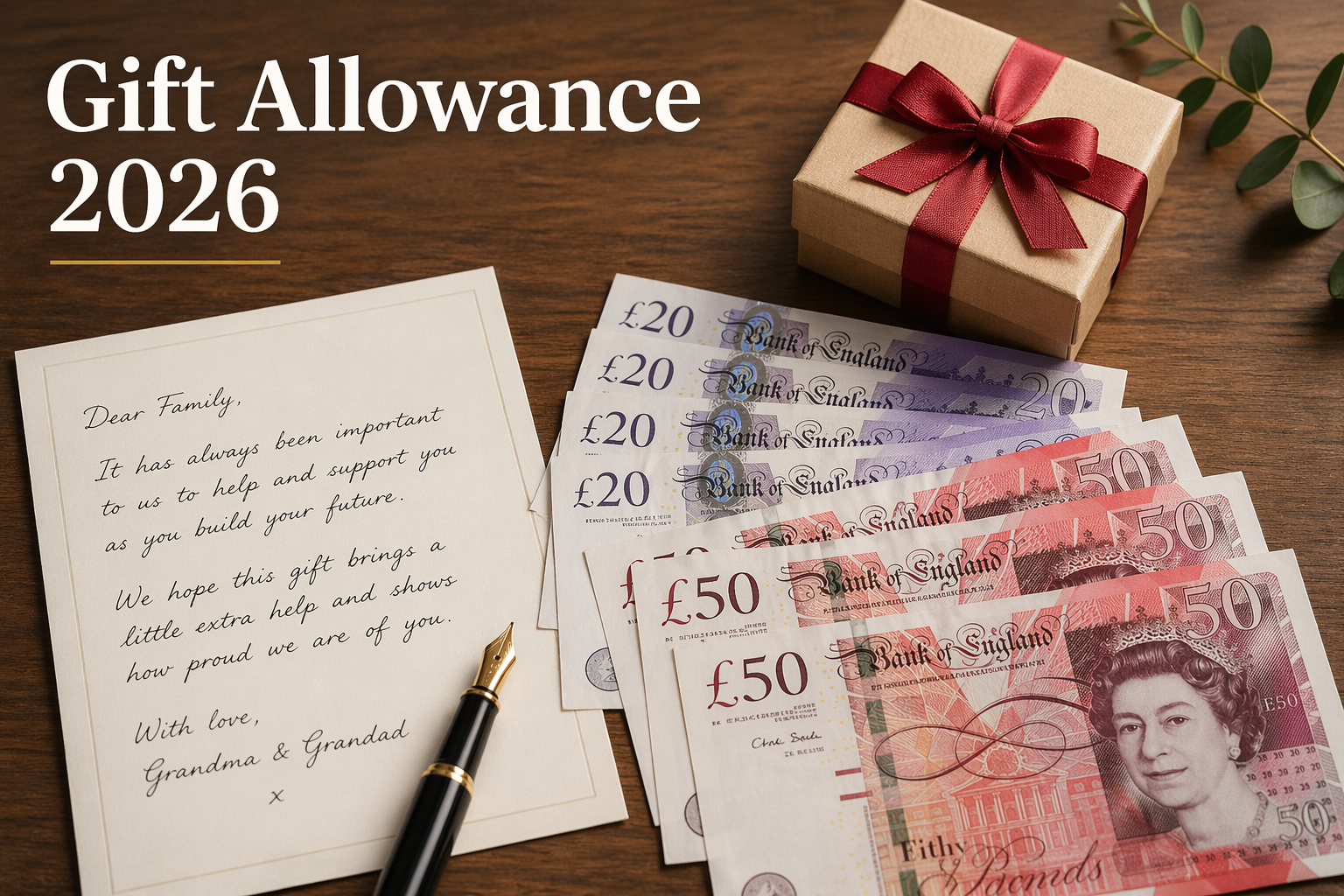
Nobody sits down over breakfast and thinks, “Right, I’d better check my gift allowance 2026 rules before I hand my daughter that birthday cheque.” And yet, every year, thousands of families in the UK unknowingly create inheritance tax headaches for their loved ones — simply by being generous without understanding how much they can give tax-free.
It’s not exactly a thrilling dinner party topic. But if you’re passing money to children, grandchildren, or anyone else you actually like, knowing where the tax-free lines sit could save your estate tens of thousands of pounds. Or, more accurately, it could save them that money — because you’ll be long gone when HMRC comes knocking.
Let’s go through all of it. Properly. No jargon avalanche, no glossing over the bits that matter.
What Is the Annual Gift Allowance — and Why Hasn’t It Changed Since 1981?
The annual exemption for gifts in the UK sits at £3,000 per tax year. One person. One year. Three thousand pounds. You can give this away completely free of inheritance tax (IHT), no questions asked. If you didn’t use last year’s allowance, you can carry it forward by one year — giving you a potential £6,000 to work with in 2026/27, provided you used none of your 2024/25 allowance.
Here’s the thing that genuinely annoys tax professionals: that £3,000 figure has not moved since 1981. In today’s money, adjusting for inflation, it would be closer to £12,000. The government has chosen, persistently and across multiple administrations, to leave it exactly where it is. So while house prices and school fees have climbed ferociously, the gift allowance has sat frozen like a disappointed relative at Christmas.
For 2026, the gift allowance 2026 rules remain unchanged from prior years — but with inheritance tax reform on the horizon (pension assets pulling into IHT from April 2027, and agricultural/business property relief changes already underway), understanding your gifting position right now is arguably more pressing than it has been in years. The team at Ask Accountants UK Ltd has seen a notable uptick in clients wanting to structure their giving before these changes bite — and frankly, that’s wise.
The Full Gift Allowance Picture in 2026 — Beyond the £3,000
Most people know about the annual £3,000. Far fewer know about everything sitting alongside it. The UK gift allowance system is actually a patchwork of overlapping exemptions, each with its own quirks.
Small Gifts — The Overlooked Relief
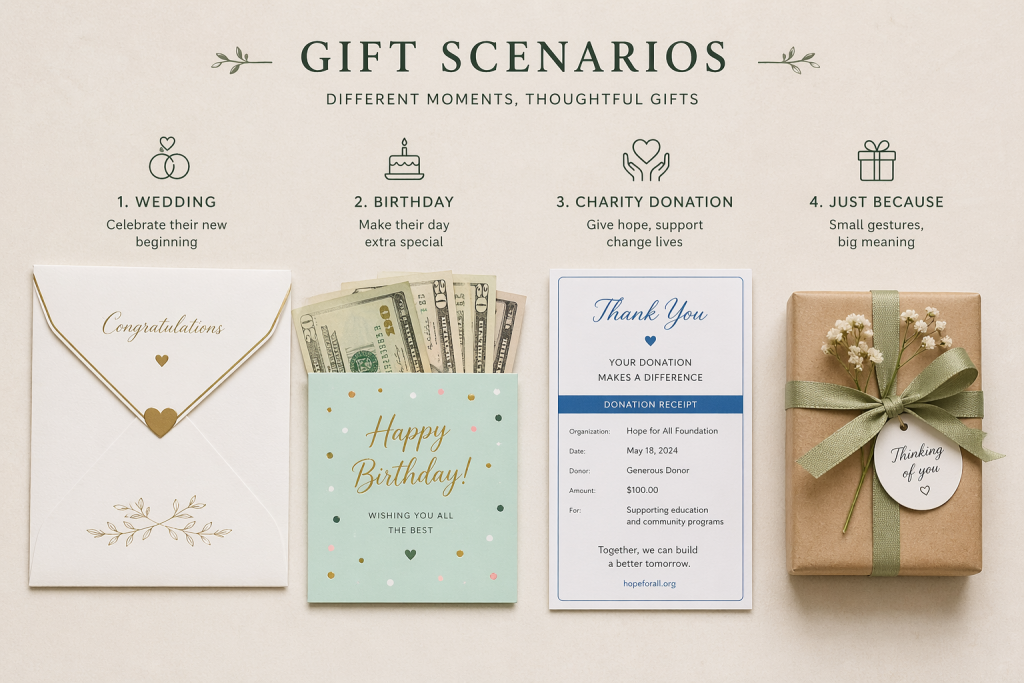
You can give up to £250 per person to as many people as you like each tax year, and none of it counts toward IHT. The catch: you can’t combine this with any other exemption for the same person. So if you’ve already used your £3,000 annual allowance to gift your son £3,000, you can’t then hand him a “small gift” on top.
Wedding and Civil Partnership Gifts
This one has genuine generosity baked in. If someone you know is getting married or entering a civil partnership, you can give:
- £5,000 — if you’re a parent of the person getting married
- £2,500 — if you’re a grandparent or great-grandparent
- £1,000 — for anyone else
The gift must be made before the ceremony, and the marriage must actually happen. (Yes, a cancelled wedding doesn’t trigger the exemption. Life is cruel.)
Gifts from Normal Expenditure Out of Income
This is the exemption that the genuinely wealthy use most aggressively — and that most ordinary people have never heard of. If you can demonstrate that a regular gift:
- is made from your income (not capital)
- forms part of your normal expenditure
- doesn’t reduce your own standard of living
…then there’s no upper limit on how much you can give tax-free under this route. A retired professional paying their grandchild’s school fees every term, consistently, year after year, from their pension income? That could pass entirely outside the IHT net. Documentation matters enormously here — HMRC will want evidence of the pattern when assessing your estate. This is exactly the kind of gift allowance 2026 scenario where a conversation with a personal tax planning specialist pays for itself quickly.
Maintenance Payments
Payments for the maintenance of an ex-spouse, dependent children, or a dependent relative — for example, a parent over 70 who can no longer support themselves financially — fall outside IHT entirely. There’s no specific monetary cap, but the payment must genuinely cover maintenance costs rather than serve as a disguised gift.
Gifts to Charities, Political Parties, and Housing Associations
Gifts to UK-registered charities are exempt from IHT entirely — both during your lifetime and on death. Gifts to qualifying political parties and housing associations also benefit from exemption, though with some conditions.
UK Gift Allowances at a Glance (2026/27)
| Type of Gift | Annual Limit | Key Conditions |
|---|---|---|
| Annual exemption | £3,000 | Can carry forward 1 year if unused |
| Small gift exemption | £250 per person | Unlimited recipients; can’t combine with annual exemption for same person |
| Wedding gift — parent | £5,000 | Must be before ceremony; marriage must proceed |
| Wedding gift — grandparent | £2,500 | Same conditions as above |
| Wedding gift — anyone else | £1,000 | Same conditions as above |
| Gifts from surplus income | No limit | Must be regular, from income, not affect living standards — keep records |
| Charity gifts | Unlimited | UK-registered charity; fully IHT-exempt |
| Gifts to spouse / civil partner | Unlimited | Both must be UK-domiciled (conditions apply otherwise) |
The Seven-Year Rule — Where Most People Get Unstuck
Any gift that doesn’t fall within the exemptions above becomes what HMRC calls a Potentially Exempt Transfer, or PET. The crucial thing about a PET: survive seven years after making the gift, and it falls completely outside your estate for IHT purposes. Die within seven years, and HMRC pulls some or all of it back in.
This is where taper relief enters — a sliding scale that reduces the IHT owed on PETs depending on how long you survived after the gift. People frequently misunderstand taper relief as reducing the gift’s value. It doesn’t. Taper relief only reduces the tax on the portion exceeding your nil-rate band. Keep that distinction clear when modelling the impact of gift allowance 2026 planning on your estate.
Taper Relief on Potentially Exempt Transfers
| Years Between Gift and Death | Tax Rate Applied | Effective Reduction vs. Full 40% |
|---|---|---|
| Less than 3 years | 40% | None — full rate applies |
| 3–4 years | 32% | 20% reduction |
| 4–5 years | 24% | 40% reduction |
| 5–6 years | 16% | 60% reduction |
| 6–7 years | 8% | 80% reduction |
| 7+ years | 0% | Fully exempt — outside estate |
The lesson here is simple and slightly uncomfortable: start gifting early. The seven-year clock only starts when money actually changes hands. Thinking about it for three years and then gifting it means those three years are wasted. Every year of delay is a year of taper relief you’re not accruing.
For a thorough walk through of how this interacts with your broader estate, the inheritance tax gifts rules guide on the Ask Accountants UK website is worth reading before you do anything else.
⚠ The “Gifts with Reservation” Trap
If you give away an asset but continue to benefit from it — for example, you gift your house to your children but keep living in it rent-free — HMRC treats it as if you never gave it away. The property stays in your estate for IHT purposes. This rule catches more people than you’d expect, particularly with property.
Does Your Gift Trigger Income Tax or Capital Gains Tax?
IHT is the obvious concern when people research gift allowance 2026 — but it’s not the only tax worth tracking.

Capital Gains Tax (CGT) can apply when you gift an asset that has risen in value — shares, a second property, a business interest. HMRC treats you as if you sold the asset at market value on the date of the gift, even though you received nothing. The current CGT rates (following the October 2024 Budget changes) run at 18% for basic-rate taxpayers and 24% for higher/additional-rate taxpayers on most assets. That’s a real cost, and it can bite unexpectedly. GOV.UK explains how CGT applies to gifts in more detail if you want the raw rules.
Cash gifts, on the other hand, don’t trigger CGT — which is one reason why straightforward cash transfers within the annual gift allowance are so administratively clean.
Income tax generally doesn’t apply to gifts received. The recipient pays no tax on money someone gives them. But if that money then generates income (say, you give your adult child £50,000 and they put it in a savings account), the interest sits in their hands and they pay tax on it normally.
One nuance worth flagging: if you give money to a minor child and it generates more than £100 per year in income, HMRC attributes that income back to you, the parent, for tax purposes. This sometimes gets called the “parental settlement” rule, and it exists specifically to prevent parents from sheltering income in their children’s lower tax bands.
Couples: Doubling Up on Gift Allowance
Married couples and civil partners each hold their own annual gift allowance — independently. That means a couple can give away £6,000 per year under the annual exemption alone, or £12,000 if both partners carry forward one year of unused allowances each.
Stack that against wedding gift exemptions — both partners can give £5,000 each to a marrying child, for a combined £10,000 — and the sums start to add up meaningfully, entirely outside the IHT net. Planning your gift allowance 2026 contributions as a couple rather than individually can make a substantial difference over time.
Many couples miss this doubling effect simply because they treat their finances as a single pot. For gifting purposes, thinking separately is worth the mental effort — and worth documenting clearly.
💡 Keep a Gifts Register
There’s no legal requirement to notify HMRC of gifts in real time — but when someone dies, their executors must account for gifts made in the previous seven years on the IHT400 form. Having a simple spreadsheet showing dates, recipients, amounts, and which exemption applies makes this vastly easier. Start one today. Future executors (and your family) will be grateful.
The Nil-Rate Band — How Gifts Interact with Your Estate’s Main IHT Threshold
Every individual holds a nil-rate band of £325,000 — the amount that can pass on death entirely free of IHT. HMRC’s inheritance tax overview confirms this threshold has stayed frozen since 2009, and the government has locked it at this level until at least 2030. That frozen ceiling, combined with rising asset values, has dragged a far greater number of estates into IHT territory than ever before.
There’s also the residence nil-rate band (RNRB) of up to £175,000, available where a main residence passes to direct descendants. So a single person could potentially pass £500,000 tax-free on death — and a couple up to £1 million, assuming they meet the qualifying conditions.
Here’s where the gift allowance 2026 picture becomes important in the context of your wider estate: PETs that fail (i.e., you die within seven years of making them) come back into your estate and consume your nil-rate band first. Only the excess above that band faces the 40% charge. So if you made a £200,000 PET five years before death and your estate sits at £600,000, the calculation grows complicated — fast.
For a full breakdown of how the nil-rate band, RNRB, and gifting strategies layer together, the inheritance tax limit explained guide is genuinely useful reading. Want to estimate your own estate’s position? There’s an inheritance tax calculator available too.
Giving to Children vs. Grandchildren — Is There a Difference?
For the annual gift allowance and small gifts exemption? No. The gift allowance 2026 annual exemption lets you give £3,000 (or £250 per person) to anyone — a child, grandchild, neighbour, or your accountant’s cat. The relationship makes no difference for these exemptions. HMRC’s gifting guidance confirms this clearly.
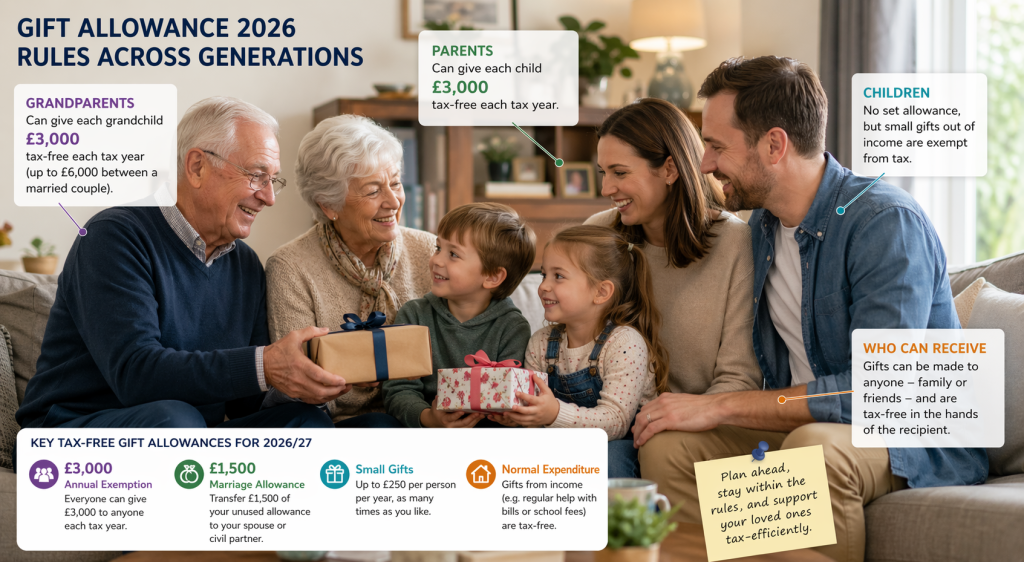
The relationship becomes relevant for wedding gifts (different limits for parents vs. grandparents vs. others, as covered above) and for the residence nil-rate band on death (it only applies where a residence passes to “direct descendants,” which includes children, grandchildren, and step-children, but has specific definitions).
For junior ISAs, it’s worth noting separately: you can contribute up to £9,000 per tax year into a junior ISA for a child under 18. This comes from your own money after tax and counts toward the child’s ISA allowance rather than being a “gift allowance” in the IHT sense — but it’s a clean, HMRC-approved way to build wealth for the next generation without triggering gift complexities.
Business Owners — An Additional Layer
If you own a business or shares in an unlisted company, Business Property Relief (BPR) may let you pass those assets on with up to 100% IHT relief — during your lifetime or on death. From April 2026, however, BPR is being restricted: only the first £1 million of qualifying business assets will attract 100% relief, with the remainder taxed at an effective 20% rate.
This is a significant change. Business owners who previously assumed their company shares would pass entirely tax-free need to revisit that assumption. IHT planning strategies that incorporate gifting during lifetime — rather than relying solely on BPR — are increasingly important.
The team at Ask Accountants UK Ltd offers personal tax planning alongside business advice specifically for situations like this — where personal wealth and business ownership are tangled together and need untangling before the rules change further.
Frequently Asked Questions on Gift Allowance 2026
How much can I give tax-free in the UK in 2026?
Under the annual exemption alone, you can give away £3,000 per tax year free of inheritance tax. Add in the small gifts exemption (£250 per person to unlimited individuals), wedding gift exemptions, and gifts from surplus income, and the total amount a couple can give tax-efficiently in a single year can be substantially higher. The annual gift allowance of £3,000 remains unchanged for 2026/27.
Can I give my child £10,000 tax-free?
Not directly from a single exemption — but it’s achievable through combining them. For example: £3,000 annual exemption + £3,000 carried forward from the previous year + £5,000 wedding gift (if they’re getting married) = £11,000 entirely exempt. Outside of these exemptions, a cash gift of £10,000 becomes a PET — tax-free if you survive seven years.
Do I need to tell HMRC about gifts?
Not in real time, no. There’s no requirement to notify HMRC when you make a gift. However, your executors will need to account for gifts made in the seven years before your death on the IHT400 form. Keeping records yourself makes this much simpler for the people left to deal with your estate.
Can my spouse and I both use our gift allowances?
Yes — each person has their own annual gift allowance. Married couples and civil partners each have an independent £3,000 annual exemption, so between you, you can give £6,000 per year tax-free (or up to £12,000 if you’ve both been carrying forward the previous year’s unused allowance).
What happens to a gift if I die within seven years?
HMRC classes it as a “failed PET” and pulls it back into your estate for IHT purposes. Taper relief may reduce the tax charge if you survived more than three years after making the gift, but the gift doesn’t disappear from the calculation. The seven-year rule makes starting early — rather than planning to gift shortly before death — the only strategy that genuinely works.
Are gifts to grandchildren treated differently?
For the annual exemption and small gifts exemption, no — the relationship between giver and recipient doesn’t matter. Wedding gift limits differ by relationship (grandparents can give up to £2,500 vs. £5,000 for parents). Otherwise, the rules are the same regardless of family relationship.
What is the gift tax rate in the UK?
The UK doesn’t have a formal “gift tax” as such. Gifts are primarily addressed through inheritance tax (IHT) at 40% on the taxable portion of the estate (and failed PETs), though taper relief applies if you survive 3–7 years after giving. Capital Gains Tax may also apply where you gift an asset that has increased in value. Cash gifts within the exemptions attract no tax whatsoever.
When to Get Professional Advice — and When You Can Manage Alone
Honestly? If you’re giving the occasional £3,000 to your children each Christmas and not much else, you probably don’t need an accountant for that specific decision. Use the allowance. Keep a note. Done.
The complexity escalates — sharply — when you’re dealing with:
- Gifts of property or shares rather than cash
- Large lump sums that become PETs
- Business assets and the changing BPR landscape
- Trusts as a gifting vehicle
- Coordinating gift strategies across a couple or a wider family
- Estates already above or near the nil-rate band threshold
For any of those, the cost of professional advice is almost certainly dwarfed by the potential IHT saving. Ask Accountants UK Ltd, based in Merton High Street in London, handles personal tax planning, IHT strategy, self assessment, and tax compliance for individuals and families across London and beyond. You can reach the team on 020 8543 1991 if you’d like to work through your own gifting position before the next tax year begins.
The rules around gift allowance 2026 are not inherently complicated — but they interact with each other, with your estate, with CGT, and with whatever the government decides to change next in ways that catch people off guard. A single conversation at the right moment can make a significant difference to what your family actually receives.
This article is for general information purposes only and does not constitute individual tax advice. Tax rules may change and their application depends on personal circumstances. Always consult a qualified professional before making decisions about gifts and inheritance tax planning.