Summarize this blog post with: ChatGPT | Perplexity | Claude | Grok
You already know you have an HMRC tax bill to pay, but paying the full amount by the deadline may simply not be realistic. What many taxpayers do not realise is that there may be options for spreading an eligible tax debt into manageable payments. In this guide, we’ll explain how an HMRC payment plan works, who may qualify, how to set one up, and what to do if you cannot afford your tax bill.
Key Takeaways
- HMRC payment plans can allow eligible taxpayers to spread an outstanding tax liability into manageable instalments instead of paying the full amount at once.
- Time to Pay arrangements depend on the tax owed, your circumstances, affordability, payment history, and ability to maintain the agreed repayments.
- Self Assessment taxpayers who cannot pay their bill in full should review available payment options and act as early as possible.
- Interest and charges may still apply to unpaid tax even when an HMRC payment arrangement has been agreed.
- Affordable repayment planning requires an honest review of income, essential expenses, existing debts, and realistic monthly cash flow.
- Missed payments should be addressed quickly because ignoring a broken payment arrangement can lead to further HMRC collection action.
What Is an HMRC Payment Plan and How Does It Work?
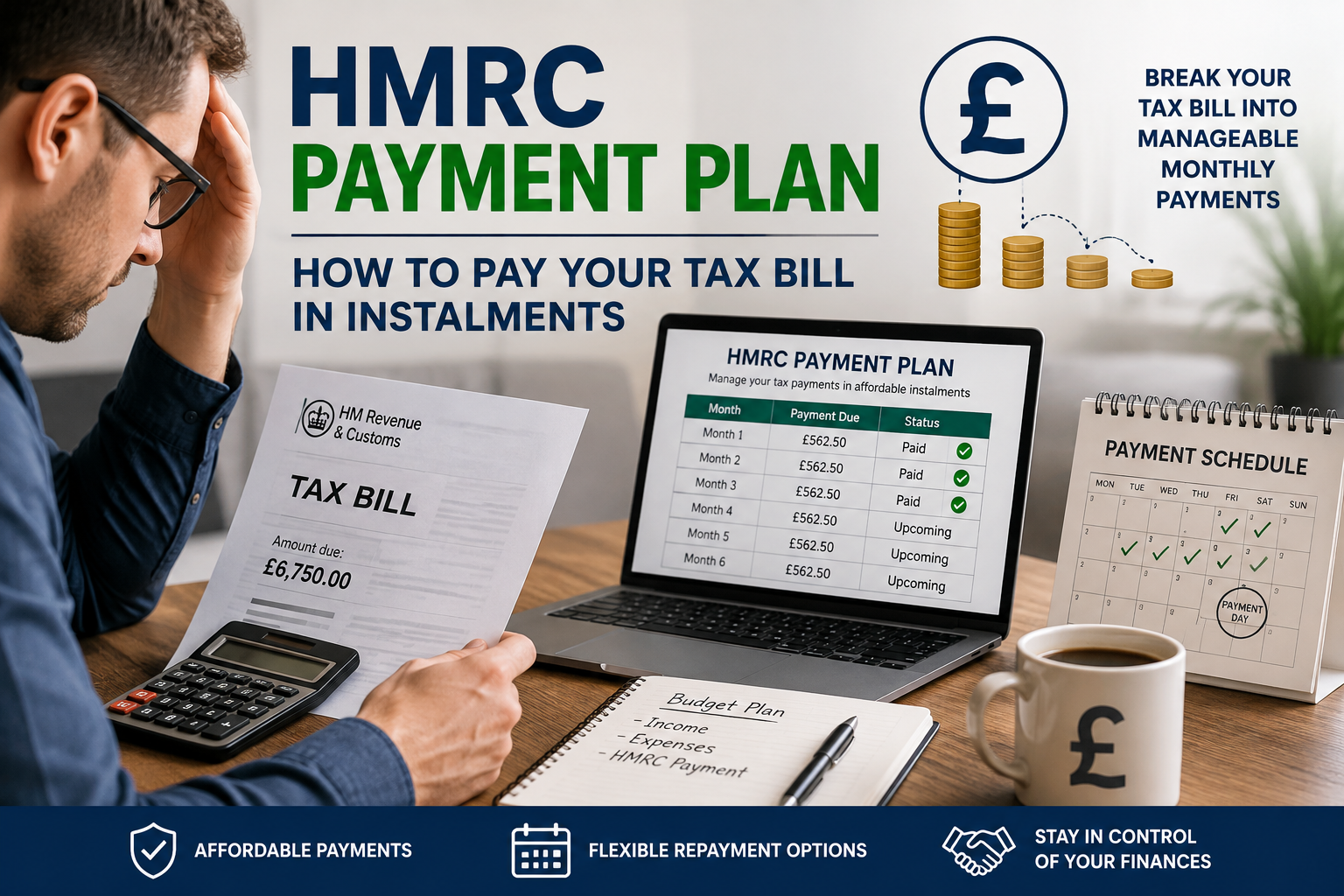
An HMRC payment plan is an arrangement that allows an eligible taxpayer to repay an outstanding tax liability over time instead of paying the full amount in one payment. Rather than ignoring a tax bill you cannot afford, you may be able to agree a schedule that breaks the debt into instalments.
First, an HMRC payment plan is often discussed alongside a Time to Pay arrangement. An HMRC Time to Pay arrangement involves agreeing a repayment schedule based on the taxpayer’s circumstances and ability to make and maintain the required payments. For example, if you owe £6,000 but can realistically afford £500 per month, HMRC may consider a repayment arrangement based on your individual circumstances.
Second, not every taxpayer or tax debt will be treated in exactly the same way. HMRC may consider factors such as the type of tax owed, the amount outstanding, your previous payment history, and whether your proposed repayments are affordable.
Moreover, arranging a payment plan does not mean the underlying tax bill disappears. A payment plan changes how the debt is paid, not the amount of tax originally due. For example, you may still need to pay interest on tax that remains outstanding.
For taxpayers dealing with a Self Assessment bill, understanding the normal Self Assessment tax return deadlines can help you act before a payment problem becomes more difficult to manage.
Why Does an HMRC Payment Plan Matter?
An HMRC payment plan matters because taking early action can help you manage an unaffordable tax bill and reduce the risk of the debt escalating through further collection action. A tax bill can quickly become stressful when it competes with rent, payroll, suppliers, household costs, or other essential commitments.
First, a structured repayment arrangement can improve cash-flow management. For example, a freelancer who owes £4,800 after a profitable year may have less cash available by the payment deadline because clients have paid invoices late.
Second, contacting HMRC is generally more constructive than simply leaving the bill unpaid. A taxpayer who cannot pay an HMRC bill in full should review their payment options and take action as early as possible rather than ignoring the debt.
At the same time, you should confirm that the bill is accurate before agreeing to repay it. For example, checking allowable expenses, income figures, and previous payments may reveal an error or overpayment. You can direct readers to how to check your HMRC tax bill and tax overpayment and HMRC refunds before a repayment arrangement is finalised.
Plus, the scale of Self Assessment makes payment planning relevant to millions of taxpayers. HMRC reported that 11.5 million Self Assessment tax returns were due for the 2023/24 tax year — Source: HM Revenue & Customs, 2025. A significant number of taxpayers therefore face annual tax calculations that may differ substantially from their monthly cash flow.
Can You Pay an HMRC Tax Bill in Instalments?
You may be able to pay an HMRC tax bill in instalments if HMRC accepts that a payment arrangement is appropriate for your circumstances. Eligibility and available options depend on the type of liability and your individual financial position.
Who Is Eligible for an HMRC Time to Pay Arrangement?
Eligibility for an HMRC Time to Pay arrangement depends on whether the taxpayer can demonstrate a realistic ability to repay the tax debt over an agreed period. HMRC may consider the amount owed, the type of tax, your payment history, your financial circumstances, and whether you can maintain the proposed instalments.
For example, two taxpayers may both owe £10,000 but have very different repayment capacity. One may have stable monthly income and affordable expenses, while the other may have irregular income and substantial existing commitments.
Moreover, HMRC can refuse a payment plan if the proposed arrangement is not considered suitable or if the taxpayer cannot meet the required conditions. Offering an unrealistically low monthly payment simply to delay the debt may not solve the problem.
What Information Will HMRC Consider?
HMRC will generally need enough information to understand the debt and assess whether the proposed repayments are realistic. You should therefore prepare a clear picture of your finances before requesting an arrangement.
For example, useful information may include:
- The total amount of tax owed
- Your income and expected future income
- Essential business or household expenses
- Existing debts and regular commitments
- The amount you can realistically pay each month
- Details of previous payments already made
That being said, affordability should be realistic rather than optimistic. An affordable payment plan is more valuable than an ambitious arrangement you are likely to miss after the first few months.
How Do You Set Up an HMRC Payment Plan?
You can set up an HMRC payment plan through the relevant online service when you meet the applicable conditions, or by contacting HMRC directly when your circumstances require a tailored arrangement. The exact process can vary depending on the tax you owe.
Step 1: Confirm Exactly How Much You Owe
The first step in arranging an HMRC payment plan is confirming the exact amount of tax that remains outstanding. You should check your tax account, tax calculation, payments already made, and any interest or charges that may have been added.
For example, a sole trader might initially believe they owe £8,000 but discover that a payment on account has already been credited. Before negotiating repayments, make sure the balance is correct.
Moreover, you should review whether your return includes all legitimate deductions and allowable expenses. For further guidance, use how to reduce your Self Assessment tax bill legally.
Step 2: Calculate What You Can Actually Afford
The second step is calculating a monthly repayment amount that fits your genuine cash flow. This means reviewing income, essential costs, debt commitments, and likely changes in your financial position.
For example, if your monthly income averages £3,500 and essential commitments total £2,800, proposing a £1,000 monthly tax payment would probably be unrealistic.
A simple affordability calculation could look like this:
| Monthly item | Example amount |
|---|---|
| Average monthly income | £4,000 |
| Essential household and business costs | £2,700 |
| Existing debt commitments | £400 |
| Available before HMRC payment | £900 |
| Proposed HMRC instalment | £700 |
| Remaining financial buffer | £200 |
As such, a financial buffer can help protect the arrangement when your income fluctuates or an unexpected expense occurs.
Step 3: Use the Appropriate HMRC Service or Contact HMRC
The third step is using the relevant HMRC online service where available or contacting HMRC to discuss a Time to Pay arrangement. You should have your tax reference, outstanding balance, and affordability information ready before starting.
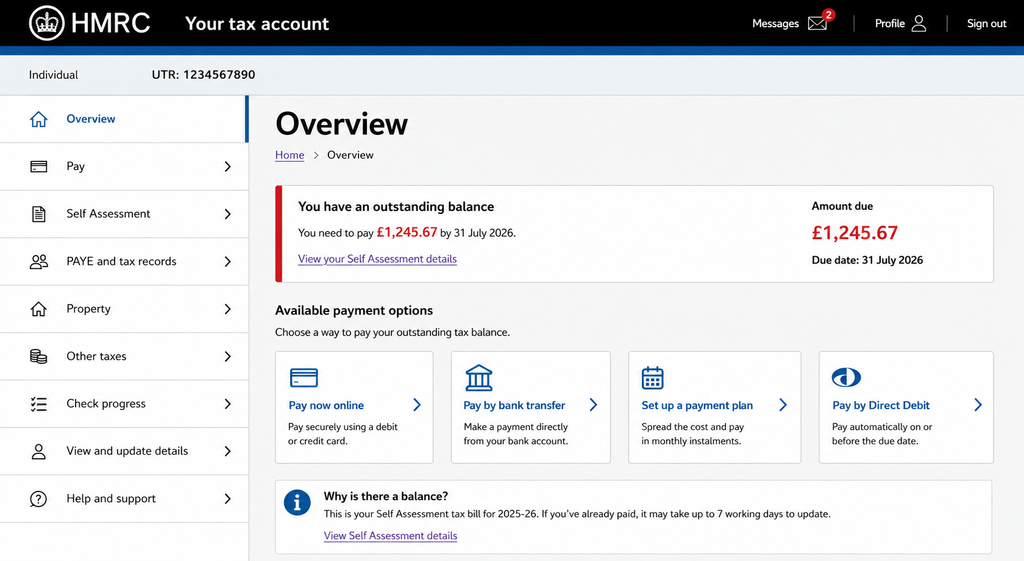
For example, some Self Assessment taxpayers may be able to arrange instalments online if they meet the applicable criteria, while more complex debts may require direct discussion with HMRC.
Step 4: Keep a Record of the Agreement
The final step is keeping clear records of your HMRC payment arrangement and every payment you make. This helps you monitor the balance and identify problems before you miss an instalment.
For example, save confirmation messages, note payment dates, and set reminders several days before each instalment is due. A repayment schedule works best when payments are treated as a fixed financial commitment rather than an optional expense.
What Happens If You Cannot Pay Your Self Assessment Tax Bill?
If you cannot pay your Self Assessment tax bill in full, you should assess your payment options and contact HMRC or use the relevant online service as early as possible. Ignoring the bill can make the situation more expensive and difficult to resolve.
First, check when the tax became due by reviewing the relevant Self Assessment tax return deadlines. A payment problem is easier to manage when you act before additional charges or collection action develop.
Second, explore whether you can make a partial payment immediately while arranging the remaining balance. Paying what you can afford may reduce the amount that remains outstanding, although your specific position will depend on the tax and charges involved.
Moreover, understand the difference between filing and paying. You may still need to submit your return even if you cannot afford the full bill. For more detail, include Self Assessment tax return guide.
HMRC received more than 11 million Self Assessment returns for the 2023/24 tax year, demonstrating the scale of the annual filing system — Source: HM Revenue & Customs, 2025. The important point is simple: an inability to pay does not make the filing obligation disappear.
How Long Can an HMRC Payment Plan Last and How Much Will You Pay?
The length and monthly cost of an HMRC payment plan depend on your individual circumstances, the amount owed, and the repayment arrangement HMRC is prepared to accept. There is no single repayment period that automatically applies to every taxpayer.
For example, the same £6,000 tax debt could produce very different monthly payments:
| Outstanding tax debt | Repayment period | Illustrative monthly payment* |
|---|---|---|
| £6,000 | 6 months | £1,000 |
| £6,000 | 12 months | £500 |
| £6,000 | 18 months | £333.33 |
| £6,000 | 24 months | £250 |
*Illustrative figures only. Interest or other charges may affect the total amount payable.
First, longer repayment periods reduce the immediate monthly burden. For example, spreading £12,000 over 24 months produces a lower monthly instalment than repaying it over 12 months.
However, a longer repayment period can mean more interest accrues on unpaid amounts where interest applies. The cheapest arrangement is not always the easiest to maintain, so affordability and total cost should both be considered.
What Happens If You Miss a Payment on an HMRC Time to Pay Arrangement?
Missing an agreed HMRC payment can put your repayment arrangement at risk, so taxpayers should contact HMRC promptly if their financial circumstances change. A missed instalment should not be ignored.
First, act as soon as you know you may be unable to make the payment. For example, a contractor whose major client delays payment should not wait until several instalments have been missed before seeking help.
Second, explain what has changed and assess whether you can continue making payments at a different level. A change in circumstances may require the repayment arrangement to be reviewed rather than simply abandoned.
That being said, repeatedly missing payments can damage the arrangement. HMRC may take further action to collect an outstanding debt if an agreed plan is not maintained.
Does HMRC Charge Interest on a Payment Plan?
HMRC may charge interest on tax that remains unpaid even when a payment arrangement has been agreed, depending on the type of tax liability and the circumstances. A payment plan should therefore not automatically be viewed as a way to freeze the cost of the debt.
First, an HMRC payment arrangement does not necessarily stop interest or other charges from applying to unpaid tax, depending on the type of liability and the circumstances. For example, spreading a tax debt over time may make the monthly payments manageable while interest continues to accrue on the outstanding balance.
Moreover, late-payment penalties and late-payment interest are not the same thing. Interest is generally linked to the period for which tax remains unpaid, while penalties can arise under separate rules when statutory payment deadlines are missed.
For a detailed explanation of possible charges, link to HMRC late payment penalties explained and what happens when you miss a Self Assessment deadline.
HMRC’s official late-payment interest rate is linked to the Bank of England base rate and can change over time, so taxpayers should always check the current applicable rate — Source: HM Revenue & Customs, 2026.
What Tools Can Help You Manage an HMRC Payment Plan?
HMRC payment plan tools can help you confirm your tax balance, assess affordability, calculate instalments, and keep track of repayment dates. The best approach is to combine official HMRC services with a simple personal cash-flow calculation.
Use Your HMRC Online Account
An HMRC online account can provide access to relevant tax information and, where available, payment options for eligible taxpayers. Before arranging instalments, review the outstanding balance and confirm which tax liability you are dealing with.
Build a Simple Affordability Calculator
An affordability calculator is a simple tool for estimating how much you can consistently pay towards your tax debt each month. You can create one using a spreadsheet, a budgeting app, or even a basic monthly income-and-expense list.
For example, subtract essential costs and existing commitments from your reliable monthly income. The remaining amount provides a starting point for considering a realistic HMRC monthly payment.
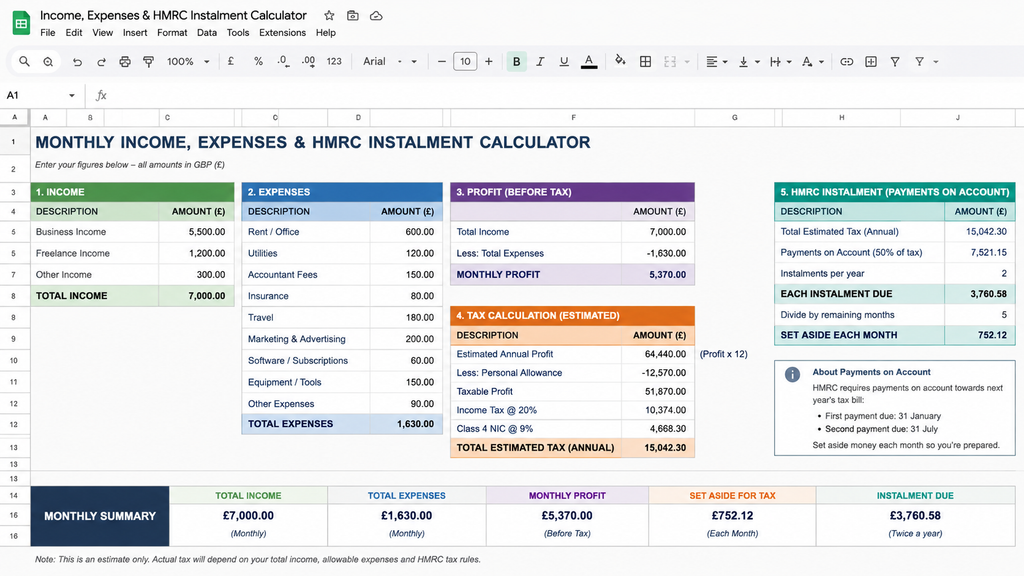
Plus, you can use free tools such as Google Sheets or a basic budgeting template alongside professional accounting software. The tool itself matters less than producing an honest and sustainable cash-flow figure.
Use This Practical HMRC Payment Plan Checklist
A practical checklist helps you prepare the information needed to discuss a realistic repayment arrangement with HMRC. Complete these steps before applying or making contact:
- Confirm the exact tax liability.
- Check that your tax return and calculations are accurate.
- Review income and expected future income.
- List essential household and business expenses.
- Identify existing debt commitments.
- Calculate a realistic monthly repayment amount.
- Gather your tax references and account information.
- Keep written records of any agreement.
An HMRC payment plan should be based on sustainable cash flow, not on a monthly payment figure chosen simply to make the debt disappear faster.
What Should You Do If You Cannot Afford Your HMRC Tax Bill?
If you cannot afford your HMRC tax bill, you should confirm the debt, calculate what you can realistically pay, review the available payment options, and take action as early as possible. The longer you leave an unaffordable tax bill without addressing it, the harder it may become to manage.
First, verify that the amount is correct. For example, check payments already made, allowable expenses, and whether you have an overpayment that affects the balance.
Second, prepare a realistic affordability assessment. By reviewing your actual income and essential expenditure, you can propose or discuss repayments that are more likely to be sustainable.
Third, use the relevant HMRC online service where available or contact HMRC to discuss your circumstances. If your finances are complex, the debt is substantial, or you cannot afford the payments proposed, consider professional help with HMRC tax problems
Finally, do not let the tax debt distract you from future tax obligations. A repayment plan for an existing bill does not automatically solve future tax liabilities. Continue budgeting for upcoming tax payments so that one debt does not become several overlapping debts.
Conclusion
An HMRC payment plan can provide eligible taxpayers with a structured way to repay tax debt when paying the full amount immediately is not realistic. A Time to Pay arrangement may help you spread the cost, but it should be based on an honest assessment of what you can afford and maintain.
Ultimately, the most important step is taking action early rather than ignoring the problem. Confirm what you owe, check your affordability, explore the available payment options, and contact HMRC or seek professional support when your circumstances are more complicated.
By dealing with the problem before it grows, you can create a clearer path towards becoming up to date with your tax obligations. If you need support with a complex tax debt or repayment situation, consider HMRC payment and tax planning services.
Written by ASK Accountants UK Ltd — Tax and accounting specialists providing practical guidance on Self Assessment, tax obligations, HMRC compliance, and financial planning.
Reviewed by ASK Accountants UK Ltd — Qualified tax and accounting professionals with expertise in UK taxation, HMRC processes, and taxpayer compliance.
Disclaimer: This article was initially drafted using AI assistance. However, the content has undergone thorough revisions, editing, and fact-checking by human editors and subject matter experts to ensure accuracy.