Summarize this blog post with: ChatGPT | Perplexity | Claude | Grok
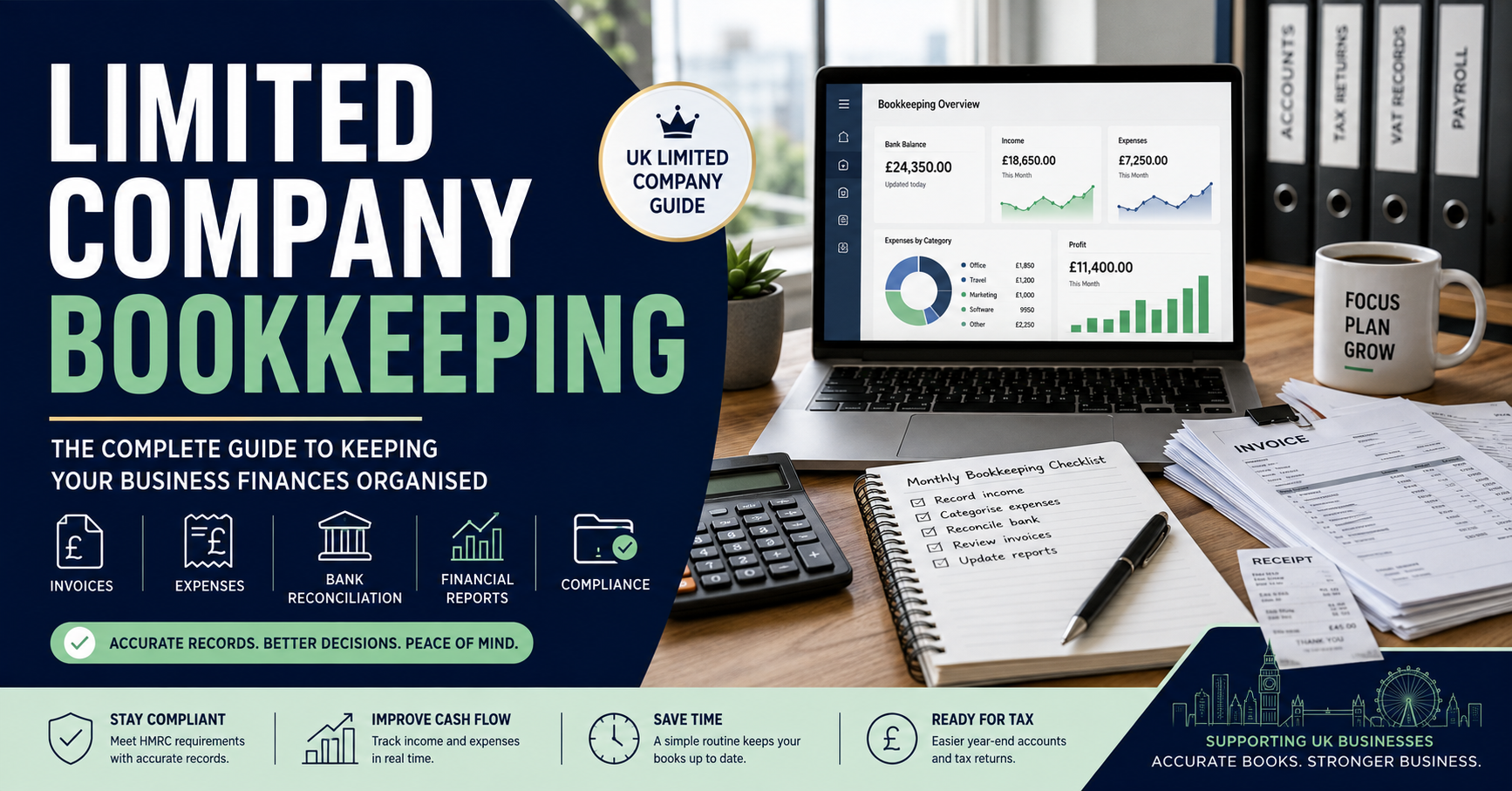
You already know that running a limited company means keeping track of the money coming in and going out. But simply saving a few invoices and checking your bank balance is not the same as maintaining proper company records. In this guide, we’ll explain exactly what limited company bookkeeping involves, what records to keep, how to create a simple routine, and how to avoid mistakes that can cause problems later.
Key Takeaways
- Limited company bookkeeping is the process of recording, organising, and maintaining accurate financial records for a company’s business transactions.
- Accurate records support company accounts, tax reporting, cash flow management, and informed business decisions.
- Company bookkeeping records should include income, expenses, invoices, receipts, bank transactions, and relevant payroll or VAT information.
- Bank reconciliation helps ensure that transactions recorded in your bookkeeping system match actual activity in your business bank account.
- A monthly bookkeeping routine can prevent missing records and reduce the workload required at year-end.
- Accounting software can automate transaction tracking, invoicing, bank reconciliation, and financial reporting.
- Professional support can become valuable when transactions grow more complex or you no longer have time to maintain accurate records.
What Is Limited Company Bookkeeping?
Limited company bookkeeping is the process of recording, organising, and maintaining financial records for all business transactions carried out by a limited company. It covers the everyday financial activity that creates the foundation for your accounts, tax calculations, and business decisions.
First, bookkeeping involves recording what your company earns and spends. For example, if you issue a client with a £2,000 invoice, pay £500 for software and receive a £300 supplier refund, each transaction should be recorded correctly.
Second, bookkeeping is not the same as accounting. Bookkeeping focuses on maintaining accurate transaction records, while accounting uses those records to prepare reports, calculate tax liabilities, and assess your company’s financial position.
For example, a bookkeeper may categorise a £120 software subscription as a business expense, while an accountant may later use the complete records to prepare annual accounts and calculate Corporation Tax.
Moreover, effective limited company bookkeeping involves recording income and expenses, retaining supporting documents, reconciling bank transactions, and reviewing financial records regularly. These tasks create a reliable financial record that you and your accountant can work from.
For UK limited company directors and small business owners, understanding these responsibilities is particularly important. The target audience for this guide includes contractors, consultants, freelancers, agency owners, e-commerce sellers, and growing businesses that need a practical approach to managing company finances.
Why Is Accurate Bookkeeping Important for a Limited Company?
Accurate bookkeeping is important because it gives a limited company reliable financial records for compliance, tax reporting, cash flow management, and decision-making. Without accurate records, even a profitable business can struggle to understand its true financial position.
First, good bookkeeping makes year-end reporting easier. For example, when every sale, expense, receipt, and bank transaction has already been recorded, preparing annual accounts becomes far less stressful. limited company accounting responsibilities.
Second, regular bookkeeping supports accurate tax calculations. Your bookkeeping records help identify business income and relevant costs, making it easier to prepare for Corporation Tax for limited companies.
In addition, good records can improve cash flow management. For example, a monthly review may reveal that £8,000 of customer invoices are overdue while several supplier payments are approaching.
Regular bookkeeping helps a limited company maintain accurate financial records throughout the year instead of reconstructing transactions when accounts or tax returns are due. This approach can reduce errors and make deadlines easier to manage.
The UK government’s guidance also requires companies to keep adequate accounting records that show and explain their transactions and disclose their financial position with reasonable accuracy — Source: GOV.UK, 2026.
What Records Does a Limited Company Need to Keep?
A limited company needs to keep records that show its income, expenses, assets, liabilities, and supporting evidence for its financial transactions. The exact records will depend on how the business operates and whether it is registered for VAT or runs payroll.
Income and sales records
First, income records show how much money your company has earned and where that income came from.
For example, a consulting company may keep:
- Sales invoices
- Customer payments
- Credit notes
- Online payment records
- Sales reports
Each transaction should be linked to clear supporting information. This makes it easier to identify unpaid invoices and confirm that recorded income matches money received.
Expense and purchase records
Second, expense records show what the company has spent money on for business purposes. For example, you might record software subscriptions, office costs, professional fees, marketing, travel, or equipment.
However, recording an expense is not simply a matter of copying everything from your bank statement. You should also categorise the transaction and retain appropriate supporting documents.
Bank, payroll and VAT records
Moreover, companies should retain relevant bank statements and transaction records. If your company has employees or pays directors through payroll, payroll records may also be required.
Similarly, VAT-registered businesses need appropriate VAT records.VAT registration for limited companies and VAT accounting and record keeping can help you understand the additional responsibilities.
| Record type | What it shows | Example |
|---|---|---|
| Sales invoices | Money charged to customers | £1,500 consulting invoice |
| Purchase invoices | Business purchases | Software supplier invoice |
| Receipts | Evidence supporting expenditure | Train ticket or equipment receipt |
| Bank statements | Actual money movements | Monthly business bank activity |
| Payroll records | Employee and director payments | Monthly PAYE payroll |
| VAT records | VAT transactions and calculations | VAT on sales and purchases |
How Do You Do Bookkeeping for a Limited Company Step by Step?
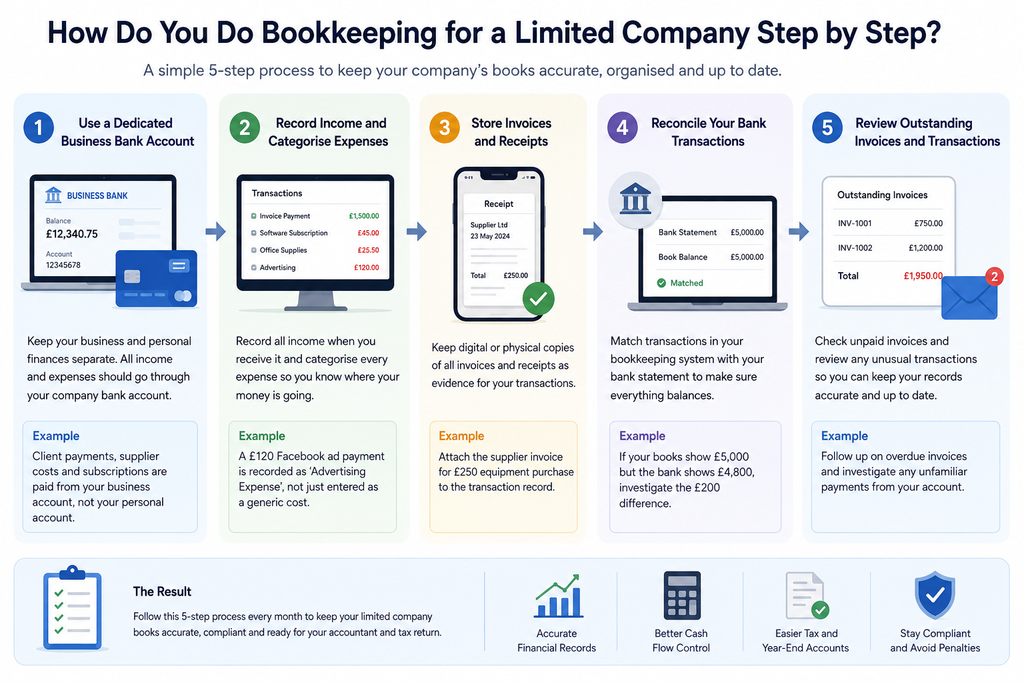
Bookkeeping for a limited company involves creating a consistent process for recording transactions, storing evidence, categorising expenses, and reconciling your records. The most effective approach is usually to create a simple workflow and repeat it throughout the year.
1. Use a dedicated business bank account
First, a dedicated business bank account separates company transactions from personal spending. For example, client payments, supplier costs, and business subscriptions should normally flow through the company’s financial records rather than being mixed with everyday personal spending.
By separating transactions, you can make reconciliation easier and reduce confusion over what belongs to the company.
2. Record income and categorise expenses
Second, record money coming into the business and categorise money going out. For example, a £200 advertising payment and a £200 software subscription may both be expenses, but recording them under appropriate categories gives you a clearer picture of where the company spends money.
Expense categorisation turns a list of transactions into useful financial information.
3. Store invoices and receipts
Next, retain supporting documents for transactions. For example, if your company purchases a laptop, the bank transaction alone may not explain what was purchased or why.
Digital storage can make this process easier. Many accounting platforms allow you to attach a receipt or invoice directly to the related transaction.
4. Reconcile your bank transactions
Then, bank reconciliation is the process of matching transactions in your bookkeeping records with transactions shown on your company’s bank statement.
For example, if your bookkeeping system shows £5,000 received from customers but the bank statement only confirms £4,500, the difference should be investigated.
This process can identify:
- Missing transactions
- Duplicate entries
- Incorrect amounts
- Bank charges
- Transactions recorded in the wrong period
5. Review outstanding invoices and unusual transactions
Finally, review unpaid customer invoices and transactions that require clarification. For example, an unfamiliar payment from the company account may need to be identified before your books are finalised.
If directors take money from or pay money into the company outside normal salary or dividend arrangements, those transactions should also be recorded appropriately.
How Often Should a Limited Company Update Its Bookkeeping?
A limited company should update its bookkeeping regularly enough to keep financial records accurate, with a monthly routine being realistic for many small businesses. The ideal frequency depends on the number and complexity of transactions.
First, businesses with high transaction volumes may benefit from daily or weekly updates. For example, an e-commerce company processing dozens of sales each day may need more frequent reviews.
Second, a consultant issuing only a few invoices each month may find that a monthly routine is sufficient. The key is consistency rather than choosing an unnecessarily complicated schedule.
| Frequency | Best suited to | Main benefit |
|---|---|---|
| Daily | High-volume businesses | Up-to-date transaction records |
| Weekly | Growing companies | Faster error detection |
| Monthly | Many small limited companies | Manageable and consistent |
| Quarterly | Very low transaction volumes | Lower admin, but higher catch-up risk |
A monthly bookkeeping routine can help limited company directors identify missing transactions, monitor cash flow, and keep financial records ready for accounting and tax purposes.
What Are the Most Common Limited Company Bookkeeping Mistakes?
The most common limited company bookkeeping mistakes involve missing records, incorrect categorisation, unreconciled transactions, and leaving financial administration until year-end. These mistakes can make accounts preparation slower and increase the risk of errors.
Mixing personal and business finances
First, mixing personal and company spending can make it difficult to identify genuine business transactions. For example, paying for groceries and business software from the same account creates unnecessary reconciliation work.
Losing receipts and invoices
Second, missing documents can create gaps in your records. For example, a £600 equipment purchase may appear on your bank statement, but the original invoice provides important supporting information.
Misclassifying transactions
Moreover, incorrect categorisation can produce misleading reports. For example, recording a personal transaction as a business expense may distort your profit figures.
Ignoring reconciliation and deadlines
Finally, failing to reconcile accounts regularly can allow errors to remain unnoticed for months. common bookkeeping mistakes small businesses make can provide further examples.
Consistent bookkeeping prevents small errors from becoming large year-end problems.
Can I Do My Own Bookkeeping for a Limited Company?
You can do your own limited company bookkeeping if you understand the basic requirements, have enough time to maintain accurate records, and use a reliable process. Many small company directors manage routine bookkeeping themselves while using an accountant for year-end accounts and tax work.
First, DIY bookkeeping can work well for a simple business with a manageable number of transactions. For example, a freelance consultant with 10 customer invoices and 20 expenses per month may be able to maintain records efficiently.
However, complexity can change the equation. VAT, payroll, multiple employees, inventory, overseas transactions, or significant director transactions may require more expertise and more time.
Professional bookkeeping support becomes valuable when the cost of errors or lost time exceeds the cost of getting help.
You can also combine both approaches by handling day-to-day records yourself and using professional accounting services for limited companies for reviews, compliance, and year-end work.
What Bookkeeping Software Is Best for a Small Limited Company?
The best bookkeeping software for a small limited company is software that matches the company’s transaction volume, reporting needs, VAT requirements, and ability to maintain records consistently. A good platform should reduce manual work rather than create another administrative burden.
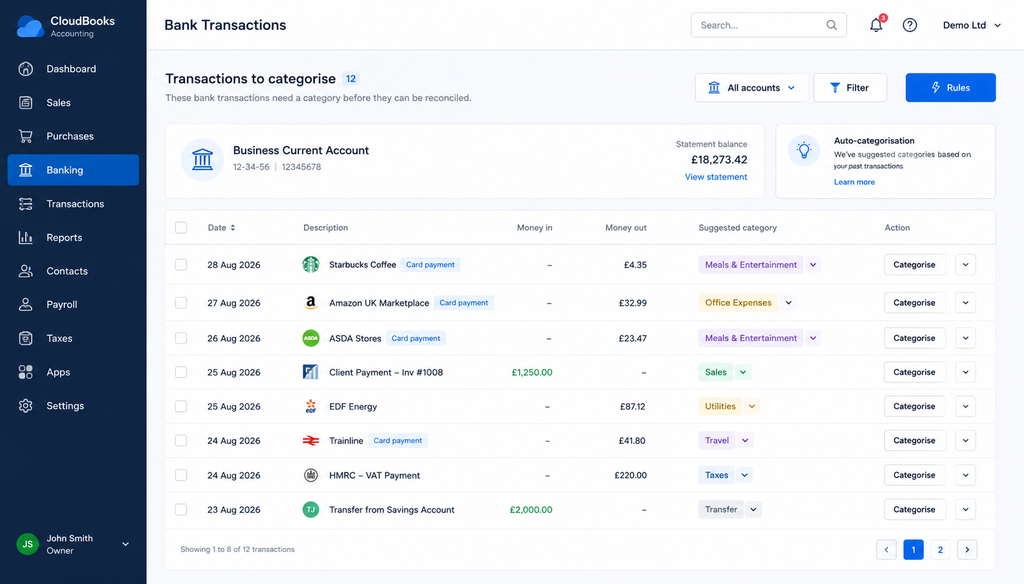
First, cloud accounting software can help automate bank feeds, invoice creation, expense categorisation, receipt storage, and reconciliation. For example, when a business bank transaction appears automatically in the system, you can review and categorise it instead of manually entering every item.
Popular options include Xero, QuickBooks, and FreeAgent, while spreadsheets may still be suitable for some very simple businesses.
That being said, software does not replace bookkeeping knowledge. Automation can speed up data entry, but you still need to check that transactions are recorded correctly.
A simple monthly bookkeeping workflow
First, collect all invoices and receipts.
Second, review income and business expenses.
Third, reconcile bank transactions.
Fourth, check outstanding customer invoices.
Finally, review your profit, expenses, and available cash before moving into the next month.
What Should You Do Next to Create a Limited Company Bookkeeping Routine?
Creating a limited company bookkeeping routine starts with establishing a simple process that you can repeat consistently throughout the year. You do not need a complicated finance department to maintain organised records.
Start with this checklist:
Immediately
- Open or confirm a dedicated business bank account.
- Choose a bookkeeping method or accounting software.
- Create a secure system for storing invoices and receipts.
- Understand your limited company accounting responsibilities.
Every week
- Save new receipts and supplier invoices.
- Record or review new income.
- Check overdue customer invoices.
Every month
- Reconcile bank transactions.
- Categorise expenses.
- Review director transactions.
- Check cash flow and outstanding payments.
- Investigate missing or unusual transactions.
Before year-end
- Review your financial records for completeness.
- Ensure supporting documents are available.
- Check relevant deadlines, including Corporation Tax return deadlines.
- Prepare your records for your accountant if you use one.
A simple routine followed every month is usually more effective than a perfect system used only once a year.
Conclusion
Limited company bookkeeping is easiest to manage when you record transactions consistently instead of trying to reconstruct an entire year’s finances at the last minute. By keeping invoices, receipts, expenses, bank records, and other financial information organised, you can make tax reporting and year-end accounts significantly easier.
Ultimately, you do not need to become a professional accountant to maintain good company records. By creating a manageable monthly routine, using appropriate software, and seeking professional help when needed, you can keep your limited company financial records under control and spend more time running your business.
Written by ASK Accountants UK editorial team — providing practical guidance on UK bookkeeping, tax, and accounting matters for limited companies and small businesses.
Reviewed by ASK Accountants UK accounting team — experienced in UK accounting, bookkeeping, company accounts, and tax compliance.
Disclaimer: This article was initially drafted using AI assistance. However, the content has undergone thorough revisions, editing, and fact-checking by human editors and subject matter experts to ensure accuracy.