
Summarize this blog post with: ChatGPT | Perplexity | Claude | Grok
If you have been watching your business turnover approach the VAT threshold, you have probably already wondered whether you need to register and how to complete the process. What is less obvious is which sales count towards the threshold, when your registration must start and what changes after you register. In this guide, we explain how to complete VAT registration online, what information HMRC requires and how to manage your VAT responsibilities afterwards.
Key Takeaways
- VAT registration allows a business to register with HMRC and take on VAT charging, record-keeping, reporting and payment responsibilities.
- The UK VAT registration threshold is £90,000 of VAT taxable turnover. A business normally must register when its VAT taxable turnover goes over £90,000 in the previous 12 months, or when it expects VAT taxable turnover in the next 30 days alone to go over £90,000.
- Online VAT registration is the standard route for most UK businesses, although certain businesses must use alternative procedures.
- Voluntary VAT registration is available to eligible businesses below the mandatory threshold.
- VAT registration dates matter because late registration can mean VAT is due from an earlier date.
- VAT-registered businesses must keep appropriate records and submit VAT Returns using Making Tax Digital-compatible software, unless an exemption applies.
- Regular turnover monitoring helps businesses identify when registration is required and avoid preventable compliance problems.
What Is VAT Registration Online?
VAT registration online is the process of registering a business with HMRC so it can charge VAT where applicable and meet its VAT reporting and payment obligations.
First, VAT registration is not simply an application for a VAT number. It creates ongoing responsibilities for your business, including charging the correct VAT, keeping records, submitting VAT Returns and paying VAT due to HMRC. Most businesses complete the process online through GOV.UK.
For example, a small consultancy with taxable turnover above £90,000 generally needs to register, while a business below the threshold may be able to register voluntarily.
Mandatory VAT registration
Mandatory VAT registration applies when your business meets a VAT registration requirement. The most common trigger is VAT taxable turnover going over the £90,000 registration threshold.
Moreover, the threshold is based on taxable turnover rather than profit. For example, a business making £95,000 of relevant taxable sales but only £20,000 profit may still need to register.
Voluntary VAT registration
Voluntary VAT registration allows an eligible business below the mandatory threshold to register for VAT. This can be useful where reclaiming VAT on business purchases or presenting a VAT-registered business profile commercially outweighs the additional administration.
Why Does VAT Registration Matter?
VAT registration matters because registering at the correct time helps a business charge, report and pay VAT correctly while avoiding problems caused by late registration.
First, the registration date determines when your VAT obligations begin. If you cross the threshold based on the rolling turnover test, HMRC sets an effective date using specific rules rather than simply allowing you to choose a convenient date.
For example, if your taxable turnover first exceeds £90,000 on 15 July, HMRC states that you normally need to register by 30 August and your effective registration date is 1 September.
Why monitoring turnover is essential
Your business should review VAT taxable turnover at the end of every month rather than checking sales only at year-end. The test looks back over the previous 12 months, so a business can become liable to register during the year even when its annual accounts are not yet prepared.
For example, if your VAT taxable turnover for the 12 months ending 31 August is £91,000, you normally need to apply for registration by 30 September. Your effective date of registration is normally 1 October.
What are the consequences of registering late?
Late VAT registration can create additional VAT liabilities because HMRC may determine that VAT should have been accounted for from an earlier effective date. Depending on the circumstances, penalties and interest may also apply.
The safest approach is to identify your potential registration date before submitting the application, particularly where turnover has recently crossed the threshold.
When Does a Business Need to Register for VAT in the UK?
A UK business generally must register for VAT when its VAT taxable turnover goes over £90,000 in the previous 12 months, when it expects VAT taxable turnover in the next 30 days alone to go over £90,000, or when another mandatory VAT registration rule applies.
What is the VAT registration threshold?
The UK VAT registration threshold is £90,000 of VAT taxable turnover. Businesses should check the current threshold on GOV.UK before relying on it, as VAT thresholds can change.
VAT taxable turnover is the total value of supplies your business makes that are not VAT exempt or outside the scope of UK VAT. It includes standard-rated, reduced-rated and zero-rated supplies, but it is not the same as business profit.
For example:
| Business figure | Amount | Relevant to VAT threshold? |
|---|---|---|
| Taxable sales | £82,000 | Yes |
| VAT-exempt income | £10,000 | Generally no |
| Business expenses | £30,000 | No |
| Business profit | £52,000 | No |
The important figure is therefore the relevant taxable turnover, not what remains after expenses.
What is the 30-day VAT registration test?
The 30-day forward-looking test applies when, at any time, you expect the value of your VAT taxable supplies in the next 30 days alone to go over £90,000. You must notify HMRC within 30 days of that date, and your effective date of registration is normally the date you first realised this would happen.
For example, if on 1 May you sign a contract that means your VAT taxable supplies in the following 30 days alone will be more than £90,000, you normally need to notify HMRC within 30 days. Your effective date of registration is normally 1 May, the date you realised the threshold would be exceeded.
Are there other mandatory registration situations?
Some businesses can have VAT registration obligations that do not depend on the standard £90,000 threshold. For example, a business that is not established in the UK may need to register for VAT if it makes, or expects to make, taxable supplies in the UK, regardless of the value of those supplies. This area can be complex, particularly where goods, services, online marketplaces or cross-border transactions are involved, so specialist advice may be appropriate.
How Do You Register for VAT Online With HMRC?
You can register for VAT online by checking your obligation, preparing your business information, completing HMRC’s VAT application and retaining the confirmation.
Step 1: Check whether you need to register
First, at the end of each month, calculate your VAT taxable turnover for the previous 12 months. You must also consider whether you expect your VAT taxable turnover in the next 30 days alone to go over £90,000.
HMRC also provides an online tool to help businesses understand what VAT registration may mean for them.
Step 2: Gather your business information
Next, prepare the information HMRC is likely to require. Having this ready can make the application much easier.
You may need details including:
- Your business name and trading details
- Business address and contact information
- Your business activity
- Taxable turnover information
- Company information, where applicable
- National Insurance details where relevant
- Unique Taxpayer Reference or other tax details
- Bank information
- Information about associated businesses where applicable
- Expected VAT registration circumstances
[Internal link: **”business accounting services” → Business Accounting Services page]
Step 3: Access HMRC’s online VAT registration service
Most businesses can register through HMRC’s online VAT service. HMRC states that most businesses should register online, including partnerships and groups of companies in many circumstances.
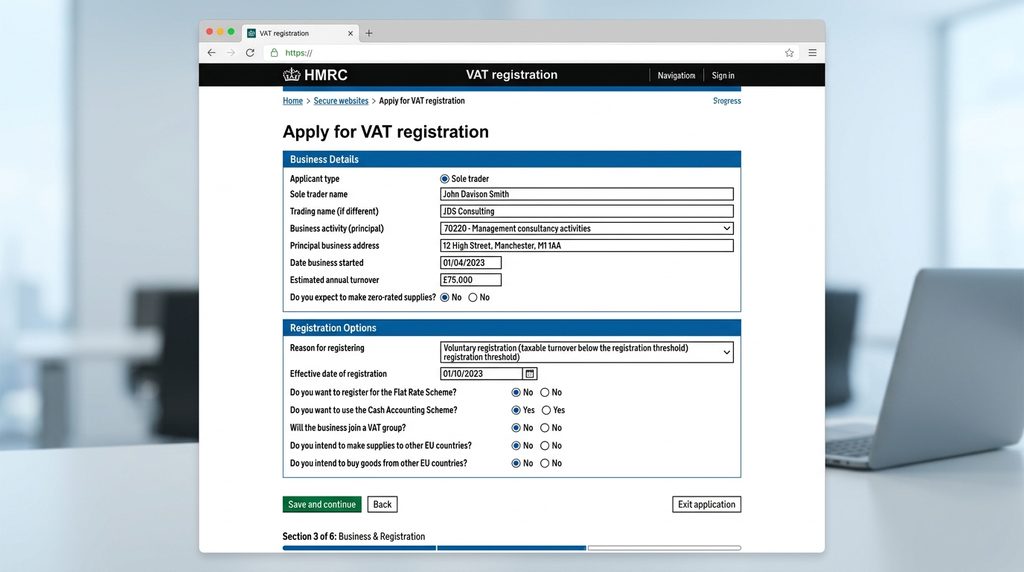
Step 4: Complete the VAT registration application
Enter your information carefully and make sure the effective registration date is correct. Pay particular attention to taxable turnover, business activities and the reason you are registering.
For example, a limited company that crossed the threshold in August should not simply enter the application date if HMRC’s rules require an earlier effective date.
Step 5: Submit and retain your confirmation
Finally, submit the application and retain evidence of what you submitted. Keep supporting calculations showing how you determined your turnover and registration date.
Your VAT registration application should be supported by clear records, especially if your turnover is close to the threshold.
What Information Do You Need to Register for VAT Online?
You need business, identification, turnover and accounting information to complete an online VAT registration application accurately.
First, the exact information can vary depending on your business structure and circumstances. Sole traders, partnerships and limited companies may have different details to provide.
A practical VAT registration checklist includes:
| Information | Why it matters |
|---|---|
| Business details | Identifies the business applying |
| Business activity | Helps establish the nature of taxable supplies |
| Taxable turnover | Determines whether registration is required |
| Registration reason | Establishes why you are registering |
| Owner/director information | Helps identify responsible persons |
| Company details | Relevant to limited companies |
| Bank details | May be needed for VAT administration |
| Tax references | Helps HMRC identify your tax records |
| Associated business details | Relevant in certain circumstances |
Moreover, accurate turnover calculations are particularly important because the VAT registration requirement can depend on the amount and nature of your taxable supplies.
How Long Does Online VAT Registration Take?
HMRC says it aims to send a VAT registration certificate showing your full registration details within 30 days. Actual processing times can vary, particularly where HMRC needs additional information or checks the application.
First, do not assume that submitting the application immediately gives you the VAT number. HMRC must process the registration and confirm the business’s VAT position.
For example, you may submit an application today but still need to use your determined effective registration date when working out your VAT obligations.
Do not delay compliance simply because you are waiting for the VAT registration number. Keep appropriate records from the relevant effective date and follow HMRC’s instructions.
Can You Register for VAT Voluntarily?
Voluntary VAT registration allows an eligible business with taxable turnover below £90,000 to register for VAT.
First, voluntary registration can make commercial sense where a business regularly incurs VAT on its costs and can benefit from reclaiming eligible input VAT. It may also be appropriate where customers expect suppliers to be VAT registered.
For example, a growing consultancy below the threshold that purchases significant equipment and services may consider whether voluntary registration is financially worthwhile.
At the same time, voluntary registration creates ongoing VAT administration. You must apply the correct VAT treatment to your supplies, charge VAT on taxable supplies at the appropriate rate, maintain VAT records, submit VAT Returns and account to HMRC for VAT due.
What Happens After You Register for VAT?
After VAT registration, your business must apply the correct VAT treatment to its supplies, charge VAT where required, issue valid VAT invoices where appropriate, keep VAT records, submit VAT Returns and pay VAT due to HMRC or claim eligible repayments.
What is a VAT registration number?
A VAT registration number, or VRN, is the identification number HMRC gives a VAT-registered business. HMRC states that the number is 9 digits and must be included on invoices where required.
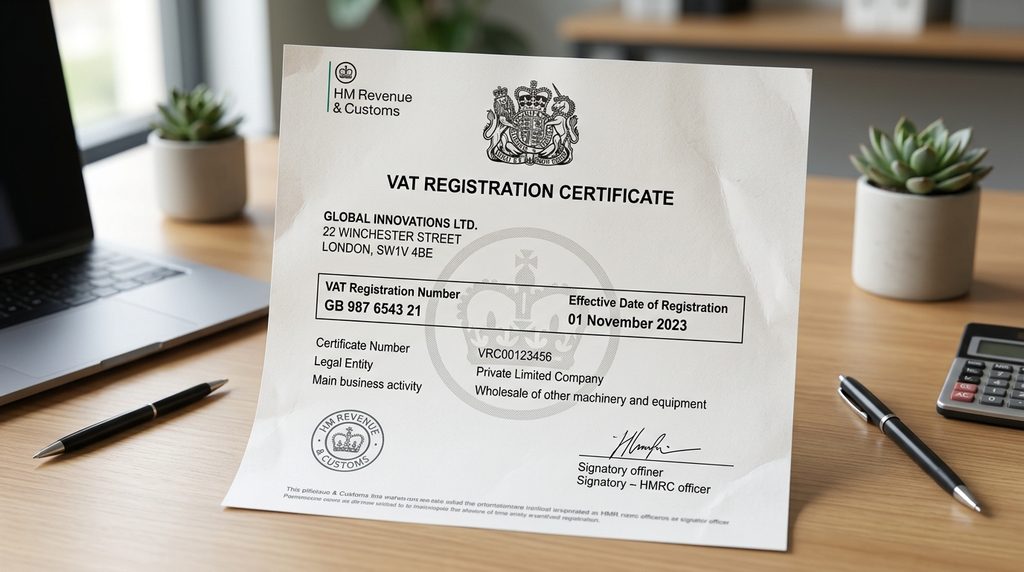
When does VAT registration start?
Your VAT registration starts from the effective date of registration, which depends on why you are registering and the relevant VAT rules.
For businesses that exceed the rolling threshold, the effective date is generally determined according to when the threshold was exceeded. For businesses expecting to exceed the threshold within 30 days, the effective date can be the date the business realised this would happen.
What VAT rate should you charge?
The standard VAT rate is currently 20%, although certain goods and services can qualify for reduced or zero rates.
For example, a £1,000 standard-rated service would normally have £200 VAT added, producing a £1,200 VAT-inclusive invoice.
What are VAT Returns?
VAT Returns report the VAT your business has charged to customers and the VAT it may be able to reclaim on eligible business purchases. Most VAT-registered businesses submit returns using accounting software compatible with Making Tax Digital.
What VAT records must a registered business keep?
VAT records should include sales and purchase information, VAT invoices, VAT charged, VAT incurred and any relevant adjustments. HMRC generally requires VAT business records to be kept for at least 6 years, although records needed for other tax purposes may need to be retained for longer.
What is Making Tax Digital for VAT?
Making Tax Digital for VAT requires VAT-registered businesses to keep certain VAT records digitally and submit VAT Returns using compatible software, unless an exemption applies.
What Are the Common VAT Registration Mistakes?
Common VAT registration mistakes include miscalculating taxable turnover, choosing the wrong registration date and delaying registration after becoming liable.
First, confusing turnover with profit is one of the most important errors to avoid. For example, £95,000 of taxable sales and £40,000 of expenses does not mean your relevant turnover is £55,000.
Other common mistakes include:
- Counting exempt income incorrectly
- Ignoring the rolling 12-month calculation
- Missing the 30-day forward-looking test
- Using the application date instead of the correct effective date
- Failing to retain turnover calculations
- Assuming voluntary registration has no ongoing obligations
- Issuing invoices incorrectly after registration
- Failing to prepare digital VAT records
Moreover, businesses should check unusual circumstances before relying solely on the standard £90,000 test.
How Do You Calculate Taxable Turnover for VAT Registration?
VAT taxable turnover is the total value of supplies that count towards the VAT registration threshold. It generally includes standard-rated, reduced-rated and zero-rated supplies, but excludes VAT-exempt and outside-the-scope income.
First, HMRC defines taxable turnover by reference to supplies that are not exempt from VAT.
For example, if a business has £78,000 of VAT taxable sales and £14,000 of VAT-exempt income, its VAT taxable turnover is normally £78,000, not £92,000. However, the VAT treatment of each income stream should be checked carefully because some supplies are zero-rated rather than exempt, and zero-rated sales still count towards the registration threshold.
The VAT threshold calculation is based on taxable supplies, not simply every amount appearing in your bank account.
A useful monthly review can include:
- Total sales for the latest month.
- Taxable sales included in that period.
- Exempt supplies.
- The rolling 12-month taxable total.
- Expected taxable sales over the next 30 days.
What Tools Can Help With VAT Registration and Compliance?
Accounting software can help businesses monitor taxable turnover, maintain digital VAT records and prepare information for VAT Returns.
First, software should support your bookkeeping process rather than replace your understanding of the VAT rules. For example, a cloud accounting system can help categorise sales and purchases while giving you a clearer view of turnover.
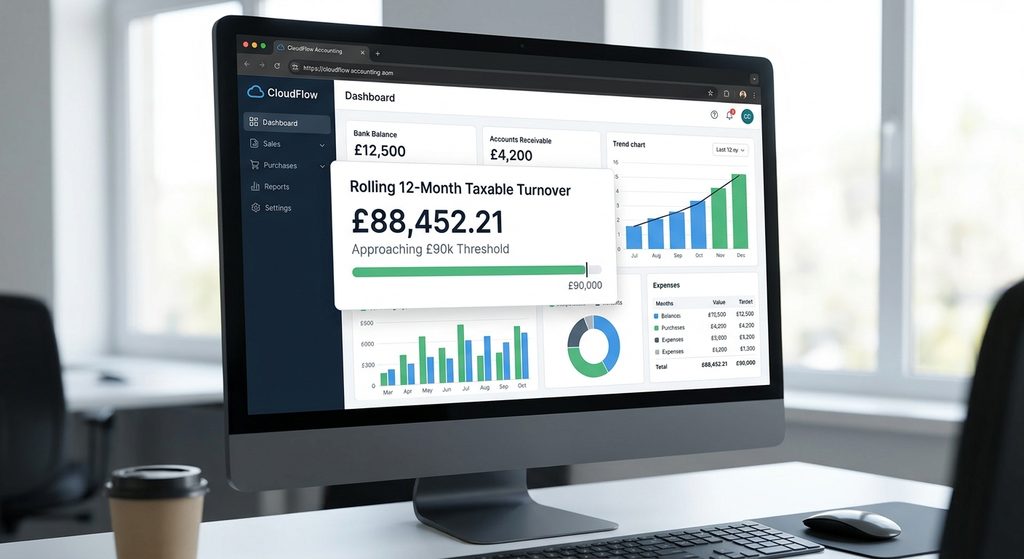
You can also use HMRC’s online VAT resources to check registration requirements and estimate the potential impact of registering. HMRC provides a tool specifically designed to help businesses assess what VAT registration could mean for them.
For businesses already registered, compatible accounting software is central to Making Tax Digital for VAT because VAT Returns must generally be submitted through compatible software.
What Should You Do Next After VAT Registration?
The next step after VAT registration is to update your invoicing, accounting, bookkeeping and VAT reporting processes so they reflect your effective registration date.
First, use this practical checklist:
- Save your VAT certificate and confirm your effective registration date.
- Record your VAT registration number and use it correctly on relevant invoices.
- Update your prices and invoices to account for VAT where applicable.
- Set up VAT-compatible accounting software.
- Create and retain digital VAT records.
- Review input VAT to identify eligible amounts you can reclaim.
- Monitor VAT deadlines for returns and payments.
- Reconcile your VAT records before submitting each return.
- Keep supporting documents for your VAT calculations.
- Review your VAT position regularly as your business grows.
Moreover, professional support can be particularly valuable when your business has complex supplies, overseas transactions, property income, associated businesses or a disputed registration date.
Conclusion
VAT registration online is the standard way for most UK businesses to register for VAT with HMRC, but the application itself is only one part of the process.
First, check your taxable turnover against the £90,000 threshold and consider the 30-day forward-looking test. Next, prepare accurate business information, complete the HMRC application and confirm your effective registration date.
After registration, your responsibilities continue through VAT invoicing, digital record keeping, VAT Returns and payments or repayments. Making these processes part of your normal bookkeeping routine can make VAT compliance much easier.
If you are unsure whether your business needs to register, when your registration should start or how VAT will affect your pricing and cash flow, professional advice can help you make the right decision before submitting your application.
Written by ASK Accountants UK Ltd, Chartered Certified Accountants, Wimbledon, London, with expertise in UK accounting, VAT, taxation and small business compliance.
Reviewed by ASK Accountants UK Ltd, Chartered Certified Accountants and UK tax advisers, specialising in VAT, business accounting and tax compliance.