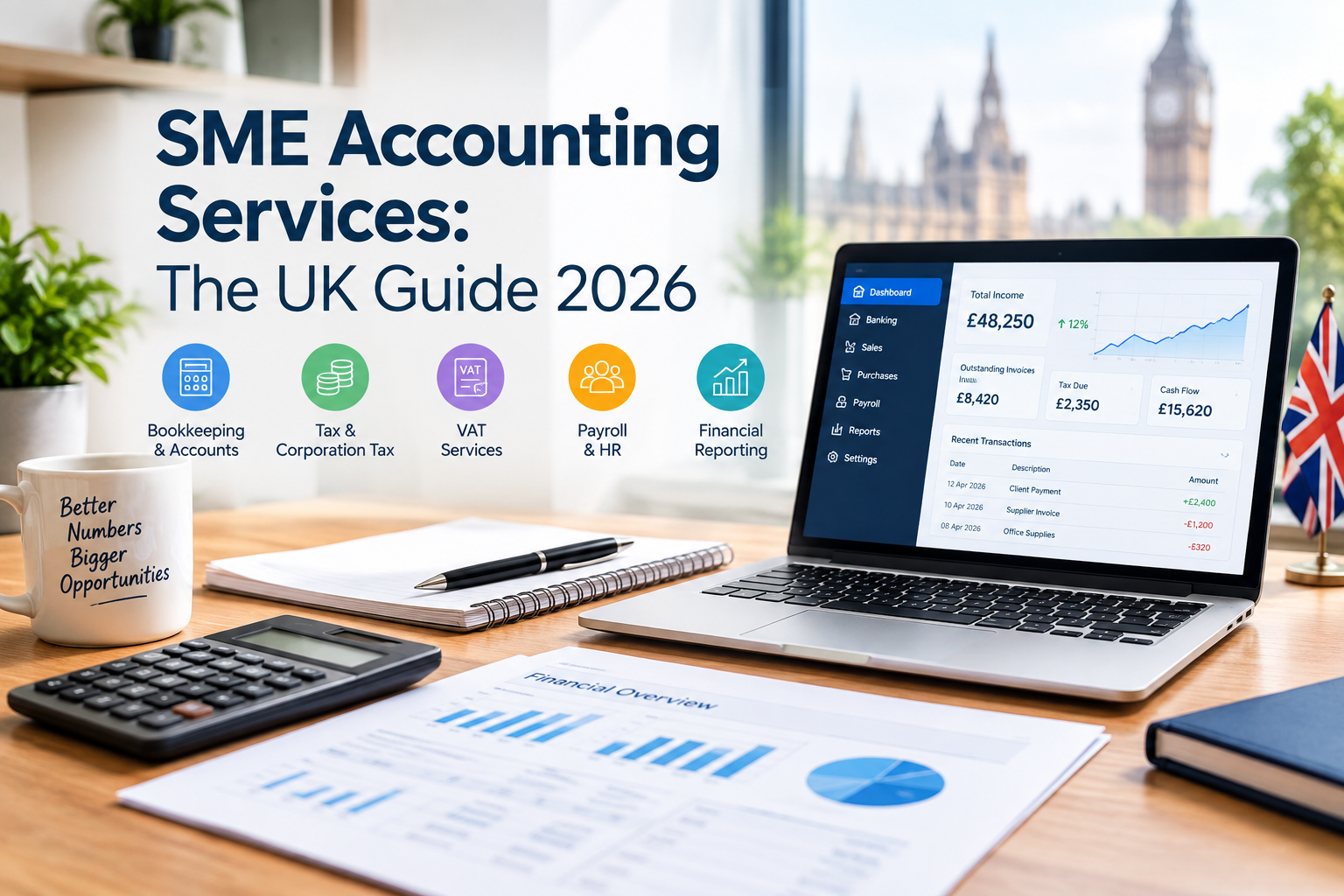
Most SME owners already know they need to keep their books, manage invoices, track expenses, and stay on top of tax deadlines. However, knowing which accounting tasks need professional support and how accounting can contribute beyond compliance is often less clear. In this guide, we’ll explain what SME accounting services include, how they work, what affects their cost, and how to choose accounting support that fits your business.
Key Takeaways
- SME accounting services help small and medium-sized businesses manage bookkeeping, accounts, tax, VAT, payroll, compliance, and financial reporting.
- Professional accounting support can reduce administrative work while helping businesses maintain accurate financial records and meet important filing obligations.
- SME accounting services can range from basic bookkeeping and annual accounts to management reporting, cash-flow forecasting, tax planning, and wider financial advice.
- Outsourced accounting can provide professional financial expertise without requiring a full-time internal accounting team.
- Accounting software allows SMEs and accountants to share financial information efficiently through bookkeeping, banking, payroll, reporting, and document management.
- Accounting costs vary according to business structure, transaction volume, payroll, VAT requirements, software, reporting needs, and advisory support.
- Choosing an SME accountant involves comparing experience, services, communication, software capability, pricing transparency, compliance support, and scalability.
What Are SME Accounting Services?
SME accounting services are professional financial services that help small and medium-sized businesses manage bookkeeping, accounts, tax, payroll, VAT, compliance, and financial reporting. For example, a UK limited company may use an accountant to maintain records, prepare annual accounts, calculate Corporation Tax, process payroll, and submit required information to HMRC and Companies House.
Moreover, accounting services for small businesses can cover much more than recording transactions. Depending on the provider, services may include budgeting, cash-flow forecasting, management accounts, tax planning, financial analysis, and business advice.
The UK has approximately 5.7 million private-sector businesses, and SMEs account for 99.85% of the business population. — Source: Department for Business and Trade, 2025
For growing businesses, professional accounting can therefore become an important operational resource rather than simply a year-end requirement.
Read more: accounting services for small businesses
What Does an SME Accountant Do?
An SME accountant helps a business maintain financial records, meet tax and reporting obligations, and understand its financial position. For example, an accountant may review monthly figures and identify that rising sales are being offset by increasing supplier costs.
In addition, an accountant may coordinate several areas of financial administration, including:
- Bookkeeping and bank reconciliation
- Annual accounts preparation
- Corporation Tax returns
- VAT returns
- Payroll and PAYE
- Management accounts
- Cash-flow forecasting
- Tax planning
- Companies House compliance
- Financial reporting
The exact service depends on the business and its agreement with the accounting firm.
What Is the Difference Between an SME Accountant and a Bookkeeper?
A bookkeeper primarily records and organises financial transactions, while an accountant generally interprets financial information and handles wider reporting, tax, compliance, and advisory responsibilities. For example, a bookkeeper may reconcile your bank account while an accountant uses those records to prepare annual accounts and Corporation Tax calculations.
At the same time, the distinction is not always absolute because some firms provide combined bookkeeping and accounting services. Your business may therefore work with one provider for both functions. Read more: bookkeeping services for small businesses
Why Are Accounting Services Important for SMEs?
Accounting services are important for SMEs because accurate financial information supports compliance, cash-flow management, profitability analysis, and informed business decisions. For example, reliable monthly records can show whether your business is generating genuine profit or simply experiencing temporary increases in cash.
First, professional accounting support can reduce the risk of missed deadlines and incomplete records. Private limited companies normally have nine months after their financial year-end to file annual accounts with Companies House, while Corporation Tax is generally due nine months and one day after the end of the accounting period.
Second, accurate accounting gives owners clearer visibility over income, expenses, outstanding invoices, liabilities, and available cash. For example, a business might appear profitable on paper but still struggle to pay suppliers because customers are taking too long to settle invoices.
Finally, accounting information can support better business decisions. Management accounts can help you decide whether to hire an employee, increase prices, reduce costs, invest in equipment, or delay expenditure.
What Do SME Accounting Services Include?
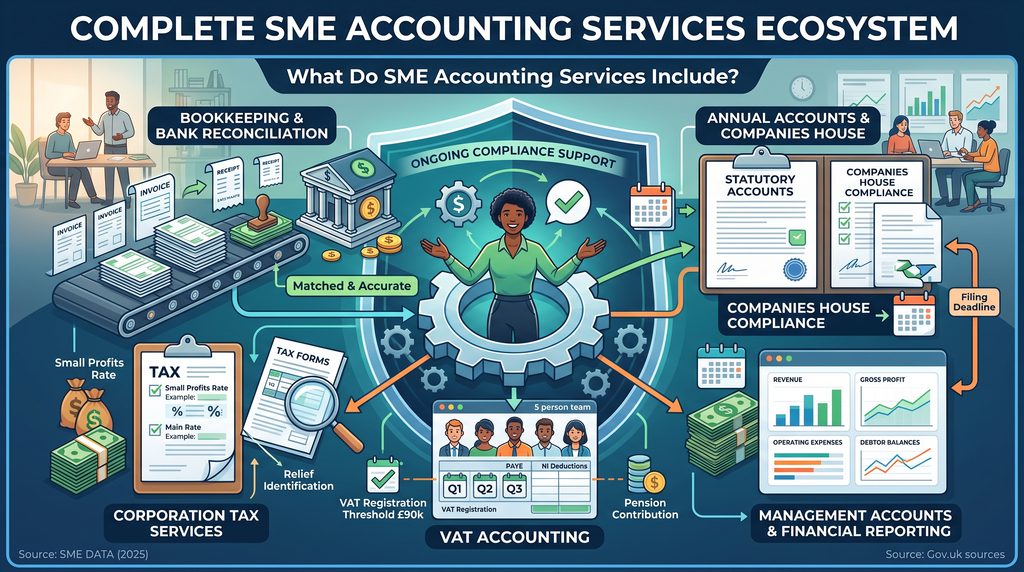
SME accounting services typically include bookkeeping, annual accounts, Corporation Tax, VAT, payroll, financial reporting, cash-flow support, and compliance services. For example, a growing limited company may combine monthly bookkeeping with quarterly management reports and annual tax filings.
SME Bookkeeping Services
SME bookkeeping services involve recording, categorising, and reconciling business transactions. For example, your accountant may match bank transactions against invoices, supplier bills, expense receipts, and other accounting records.
Moreover, accurate bookkeeping creates the foundation for VAT returns, management reports, annual accounts, and tax calculations. Businesses can also benefit from understanding business expenses you can claim so that legitimate costs are recorded correctly.
Annual Accounts and Companies House Compliance
Annual accounts summarise a company’s financial activity and are used for statutory reporting and tax purposes. For example, a private limited company generally needs to prepare annual accounts and submit them to Companies House within the applicable deadline.
Furthermore, the accounts can provide information used when calculating Corporation Tax. Companies House and HMRC have separate filing and payment requirements, so businesses need to manage both obligations carefully.
Read more:
Corporation Tax Services
Corporation Tax services help companies calculate taxable profits, identify relevant reliefs, and meet HMRC filing and payment obligations. For example, for financial year 2026, the small profits rate is 19% for companies with profits below £50,000, while the main rate is 25% for profits above £250,000, subject to the applicable rules and thresholds.
In addition, companies with profits between £50,000 and £250,000 may be eligible for Marginal Relief, with thresholds potentially affected by factors such as associated companies.
VAT Accounting Services
VAT accounting services help businesses monitor taxable turnover, prepare VAT records, and submit VAT returns where required. For example, a business approaching the VAT threshold needs to monitor its taxable turnover rather than waiting until the end of its financial year.
The UK VAT registration threshold is £90,000 of taxable turnover, and businesses can also register voluntarily below that threshold.
Read more: VAT registration threshold
Payroll and PAYE Services
Payroll services for SMEs help employers calculate employee pay, deductions, and relevant PAYE reporting. For example, an employer with five employees may outsource monthly payroll so salaries, tax deductions, National Insurance calculations, and reporting are handled consistently.
In addition, outsourcing payroll can reduce the administrative burden created by employee starters, leavers, salary changes, workplace benefits, and pension administration.
Read more: PAYE payroll for employers
Management Accounts and Financial Reporting
Management accounts provide regular financial information that helps business owners monitor performance between annual reporting periods. For example, monthly reports might show revenue, gross profit, operating expenses, debtor balances, and cash position.
Consequently, management accounts can turn bookkeeping data into information that supports day-to-day decisions.
How Do SME Accounting Services Work?
SME accounting services typically work through a recurring process that combines financial record-keeping, compliance, reporting, review, and communication. For example, an outsourced accountant may collect documents monthly, reconcile transactions, prepare VAT or payroll submissions, and produce management reports.
- Step 1: Assess Your Accounting Needs First, the accountant assesses your business structure, transaction volume, employees, VAT position, accounting software, reporting requirements, and existing records. This assessment determines which services your business actually needs.
- Step 2: Set Up Accounting Software Next, the accountant establishes or reviews your accounting system and connects relevant banking, invoicing, payroll, and document-management functions. Cloud accounting can allow business owners and accountants to access the same financial information without repeatedly exchanging spreadsheets.
- Step 3: Record and Reconcile Transactions Then, transactions are recorded and reconciled against supporting information. Regular reconciliation helps identify missing transactions, duplicated entries, incorrect classifications, or unexplained differences.
- Step 4: Complete Recurring Compliance Work After that, the accountant handles agreed recurring obligations such as VAT returns, payroll, and other reporting requirements. The exact frequency depends on the business’s obligations.
- Step 5: Prepare Year-End Accounts and Tax Returns Finally, year-end information is reviewed and used to prepare statutory accounts and relevant tax submissions. The accountant can also discuss financial results and identify areas requiring further attention.
When Should a Small Business Hire an Accountant?
A small business should consider hiring an accountant when financial administration becomes complex, time-consuming, or difficult to manage accurately. For example, rapid growth, VAT registration, employing staff, or forming a limited company can create accounting responsibilities that exceed an owner’s available time.
Common indicators include:
- You are spending significant owner time on bookkeeping.
- Your transaction volume is increasing.
- You have started employing staff.
- Your business has registered or needs to consider registering for VAT.
- You operate through a limited company.
- You are approaching important tax or filing deadlines.
- You need regular management reports.
- You want support with tax planning or business growth.
For startups, professional support can also help establish sound financial processes early. Read more: accounting for startups
Should an SME Outsource Its Accounting?
Outsourcing accounting allows an SME to access professional financial expertise without maintaining a full-time internal accounting team. For example, a ten-person company may outsource bookkeeping, payroll, VAT, annual accounts, and tax rather than employ several specialist finance staff.
Moreover, outsourcing can provide flexibility because the level of support can change as the business grows.
Read more: outsourced bookkeeping services
How Much Do SME Accounting Services Cost in the UK?
SME accounting service costs depend on the business structure, transaction volume, employees, VAT obligations, software, reporting requirements, and level of advisory support required. For example, a small company with straightforward bookkeeping needs will generally have different requirements from a growing employer with VAT, payroll, management accounts, and multiple revenue streams.
| Cost factor | Why it affects fees |
| Business structure | Sole traders, partnerships, and limited companies have different compliance requirements |
| Transaction volume | More transactions can require more bookkeeping and reconciliation work |
| Employees | Payroll creates additional processing and reporting requirements |
| VAT | VAT registration adds record-keeping and return responsibilities |
| Software | Setup, integration, and ongoing software support may affect fees |
| Management reporting | Monthly or quarterly reports require additional preparation and analysis |
| Tax advisory | Strategic tax planning generally requires additional professional input |
Therefore, businesses should avoid choosing an accountant based solely on the lowest advertised fee. Instead, compare what is included, what is excluded, and what additional work costs.

What Accounting Software Do SMEs Use?
SMEs commonly use cloud accounting software, bookkeeping systems, payroll platforms, receipt-capture tools, banking integrations, and reporting systems. For example, a cloud accounting platform can allow an accountant to review transactions while the business owner uploads invoices and receipts from the same system.
Furthermore, accounting software can reduce manual data entry and improve collaboration. However, software does not replace professional judgement because transactions still need to be classified correctly and financial information needs appropriate review.
Free or lower-cost options may also be available for specific bookkeeping and spreadsheet tasks, but businesses should assess security, functionality, integrations, reporting, and compliance requirements before choosing a system.
Can an Accountant Handle VAT and Payroll for an SME?
An accountant can handle VAT and payroll for an SME when these services are included in the engagement and the business provides the necessary information. For example, an accounting firm may process monthly payroll, maintain payroll records, prepare VAT returns, and communicate with HMRC on agreed matters.
Moreover, professional support can help coordinate VAT and payroll with the wider accounting records. This reduces the risk of different systems containing conflicting information. Read more: Self Assessment deadlines
How Can SME Accounting Services Improve Cash Flow Management?
SME accounting services can improve cash-flow management by giving business owners clearer information about income, expenses, receivables, liabilities, and expected cash requirements. For example, a monthly cash-flow forecast can highlight a potential funding gap before several large supplier payments become due.
In addition, accountants can help identify overdue customer invoices, recurring expenses, seasonal patterns, and upcoming tax liabilities. These insights can help an owner plan payments rather than react to unexpected cash shortages. Read more: HMRC payment plan
How Do I Choose the Right SME Accounting Service?
The right SME accounting service should match your current compliance requirements while providing the software, reporting, communication, and financial support needed as your business grows. For example, a startup may initially need bookkeeping and annual accounts, while a growing employer may later require payroll, VAT, management accounts, and forecasting.
Before choosing a provider, check:
- SME experience — Does the firm regularly work with businesses similar to yours?
- Service coverage — Are bookkeeping, tax, VAT, payroll, and accounts included where required?
- Software expertise — Can the accountant work with your preferred accounting system?
- Communication — How quickly can you expect responses?
- Pricing transparency — Are monthly fees and additional charges clearly explained?
- Compliance support — Will the firm help with HMRC and Companies House requirements?
- Scalability — Can the service expand as your business grows?
- Security — How does the provider protect financial and business information?
What Should I Ask an Accountant Before Hiring Them?
Before hiring an accountant, ask exactly what services are included, how fees are calculated, which software they support, who will manage your account, and what happens when additional work is required. For example, ask whether payroll, VAT registrations, tax enquiries, year-end adjustments, and business advice are included or charged separately.
You should also ask about deadlines, communication arrangements, document sharing, and the process for approving submissions.
Can SME Accountants Help With Tax Planning and Business Growth?
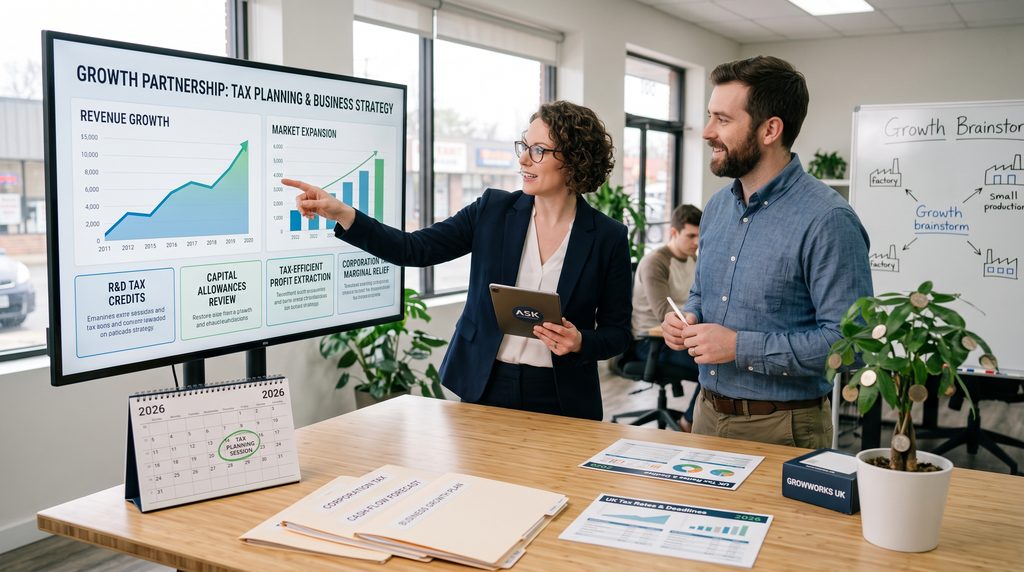
SME accountants can support tax planning and business growth by analysing financial information and identifying relevant planning opportunities within applicable UK rules. For example, an accountant may review expenditure, capital purchases, company profits, or the timing of transactions when discussing potential tax implications.
However, tax planning should be based on the business’s actual circumstances rather than generic strategies. A qualified adviser can consider the relevant rules, available reliefs, company structure, and commercial objectives.
Moreover, financial reporting can help owners understand whether growth is improving profitability. Accounting data becomes more valuable when it helps you make decisions before problems occur.
What’s Next? Choosing the Right Accounting Support for Your SME
The next step is to assess your current accounting workload, identify compliance gaps, and decide which responsibilities you want to manage internally versus outsource. For example, you may discover that you only need bookkeeping and annual accounts today but expect to add payroll and management reporting within the next year.
Use this checklist before speaking to an accounting provider:
- [ ] List your current accounting tasks.
- [ ] Identify upcoming HMRC and Companies House deadlines.
- [ ] Check whether VAT registration applies.
- [ ] Review your payroll requirements.
- [ ] Identify your preferred accounting software.
- [ ] Decide whether you need monthly management reporting.
- [ ] Ask providers for transparent fee structures.
- [ ] Confirm which services are included.
- [ ] Establish who is responsible for providing documents and approvals.
- [ ] Ask how the service can scale with your business.
Finally, compare providers based on fit and scope rather than price alone. The cheapest service may not cover the responsibilities your business actually needs.
Conclusion
SME accounting services help businesses manage bookkeeping, tax, VAT, payroll, statutory accounts, reporting, and wider financial responsibilities. Professional accounting support can reduce administrative pressure while giving business owners better information for managing cash flow, profitability, compliance, and growth.
Ultimately, the right accounting service should reflect the complexity of your business today while being capable of supporting tomorrow’s requirements. By assessing your needs, comparing transparent service packages, checking software compatibility, and establishing clear responsibilities, you can turn accounting from a routine compliance task into a useful business resource.
Written by ASK Accountants UK Ltd Editorial Team
Reviewed by UK Accounting and Tax Subject Matter Reviewer