
Last updated: September 2026
Most company directors know that their limited company needs to file annual accounts with Companies House, but knowing that you need to file is very different from knowing exactly what to prepare, which accounts apply to your business and when everything is due. In this guide, we’ll explain filing company accounts step by step, including deadlines, documents, account types, filing methods, common mistakes and the latest Companies House requirements.
Key Takeaways
- Company accounts are statutory financial statements prepared for a company’s financial year and filed with Companies House when required.
- Private limited companies generally have 9 months after their financial year ends to file annual accounts with Companies House.
- Micro-entities, small companies and eligible dormant companies may be able to file simpler accounts when they meet the relevant conditions.
- Companies House accounts and a Company Tax Return are separate filings with different filing deadlines and different authorities.
- Accurate bookkeeping records provide the foundation for preparing company accounts and meeting related tax obligations.
- Directors remain responsible for filing accounts on time, even when an accountant or filing agent prepares and submits them.
- Companies House accounts-filing requirements are changing from April 2028, including mandatory commercial software filing for annual accounts.
What Are Company Accounts and Why Do You Need to File Them?
Filing company accounts is the process of submitting a company’s annual statutory financial statements to Companies House in accordance with UK company law. Company accounts are prepared from the company’s accounting records and provide financial information about the business for its accounting period.
First, statutory accounts can include a balance sheet, profit and loss account, notes to the accounts and, where applicable, a directors’ report and auditor’s report. For example, a small eligible company may have simpler reporting requirements than a larger company.
Moreover, preparing accounts and filing accounts are not exactly the same task. Company accounts preparation involves turning bookkeeping records into the required statutory financial statements, while filing means delivering the appropriate accounts to Companies House.
In addition, Companies House filing should not be confused with submitting a Corporation Tax return. Companies House receives annual accounts, while HMRC receives the Company Tax Return and deals with Corporation Tax.
For more help with the accounting side, see our guide to accounting for limited companies.
Why Is Filing Company Accounts Important?
Filing company accounts is important because it is a recurring legal responsibility that keeps a company’s financial information on the public register. Companies must generally send accounts and reports to Companies House every year, including companies that are small, large, trading or non-trading.
First, timely filing helps keep the company’s Companies House record up to date. For example, a company that misses its deadline can receive an automatic late-filing penalty rather than simply receiving an informal reminder.
Second, good accounting records make the filing process easier. Limited company bookkeeping helps ensure that income, expenses, assets, liabilities, payroll and other transactions are properly recorded before statutory accounts are prepared.
Moreover, persistent failure to file can have more serious consequences. Companies House states that a company can be fined and struck off the register if it does not send its accounts or confirmation statement.
As such, filing accounts should be treated as part of your company’s normal annual compliance routine rather than a task to leave until the final few days.
Who Needs to File Annual Accounts With Companies House?
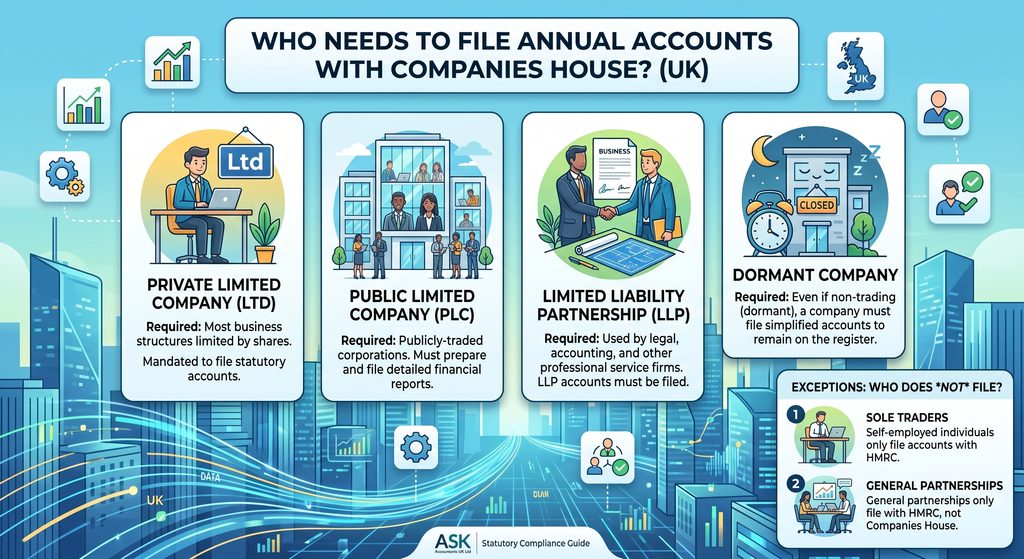
Most UK registered companies must file annual accounts with Companies House every year, although the form and amount of information required can vary. The filing requirements depend on factors such as company size, status and whether the company qualifies for particular exemptions.
First, private limited companies generally have annual accounts obligations regardless of whether they made a profit. A company that traded for only part of the year may still have accounts to prepare and file.
Second, dormant companies are not automatically exempt. A dormant company can have simplified filing requirements, but it generally still needs to submit the appropriate dormant accounts to Companies House.
For more information, see our guide to dormant company accounts.
What Types of Company Accounts Can You File?
The main company accounts categories include micro-entity, small-company, dormant and full accounts, with eligibility depending on the company’s circumstances and applicable accounting-period rules. Different categories can have different disclosure and filing requirements.
For accounting periods beginning on or after 6 April 2025, Companies House guidance sets the following size thresholds:
| Company category | At least 2 of these conditions must generally apply |
|---|---|
| Micro-entity | Turnover ≤ £1 million; balance sheet total ≤ £500,000; average employees ≤ 10 |
| Small company | Turnover ≤ £15 million; balance sheet total ≤ £7.5 million; average employees ≤ 50 |
| Medium/large | Above the relevant small-company thresholds or otherwise outside the small-company regime |
What Are Micro-Entity Accounts?
Micro-entity accounts are simplified statutory accounts available to companies that meet the relevant micro-entity conditions. Currently, qualifying micro-entities can benefit from reduced information requirements and may qualify for audit exemption.
For example, a company with turnover of £600,000, a balance sheet total of £300,000 and an average of eight employees may meet the numerical micro-entity thresholds, subject to the full eligibility rules.
See our guide on micro-entity accounts for more detail.
What Are Small Company Accounts?
Small company accounts allow eligible companies to use the small companies regime and disclose less information than medium or large companies. For accounting periods beginning on or after 6 April 2025, a company generally needs to meet at least two of the £15 million turnover, £7.5 million balance sheet and 50-employee conditions.
For example, a business with £5 million turnover, £3 million balance sheet total and 30 employees may meet the numerical thresholds, although other eligibility rules still need to be considered.
More information is available in our guide to small company accounts.
Do Dormant Companies Have to File Accounts?
Dormant companies generally still have to file accounts with Companies House, although eligible dormant companies can use simplified requirements. Dormant status therefore does not mean that all annual filing obligations disappear.
For example, a company that has stopped trading but remains registered may still need to prepare and deliver dormant company accounts.
What Documents Are Needed to File Company Accounts?
The documents needed for filing company accounts depend on the company’s size, accounting regime, audit status and circumstances. Statutory accounts can include a balance sheet, profit and loss account, notes and, where applicable, reports from directors and auditors.
First, gather your underlying financial information before preparing the accounts. Your checklist should normally include:
- Bank statements
- Sales invoices and income records
- Purchase invoices and receipts
- Payroll information
- Fixed asset information
- Loans and liabilities
- Director’s loan account information
- VAT records, where applicable
- Corporation Tax information
- Prior-year accounts
- Accounting and bookkeeping records
Moreover, accurate records can help identify errors before filing. For example, reconciling a business bank account can reveal a missing transaction that would otherwise affect the reported figures.
You can also review business expenses you can claim to ensure relevant business expenditure has been recorded correctly.
How Do You File Company Accounts With Companies House?
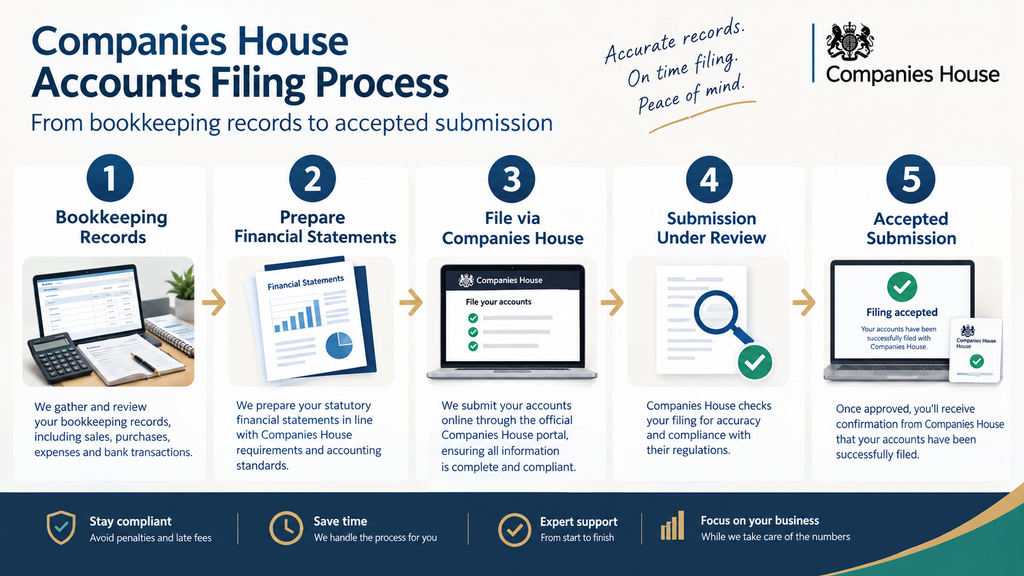
Before filing company accounts, directors should ensure that the financial records are complete, the correct accounts type has been prepared, the accounts have been approved and the filing is submitted through an appropriate Companies House filing method.
Follow these steps:
- Check your accounting reference date. This determines your accounting year and helps establish the filing deadline.
- Establish the accounts period. Confirm exactly which financial period the accounts cover.
- Update your bookkeeping. Reconcile bank accounts and check income, expenses, assets and liabilities.
- Prepare the statutory accounts. Use the correct regime for your company.
- Check audit requirements. Establish whether your company qualifies for audit exemption.
- Obtain director approval. Accounts must be approved before filing.
- Choose a filing method. Available methods depend on the accounts type.
- Submit the accounts. Check all required information carefully before submission.
- Check acceptance. Keep confirmation that Companies House has accepted the filing.
- Retain supporting records. Keep the accounting information used to prepare the accounts.
When Are Company Accounts Due at Companies House?
A private limited company generally has 9 months after the end of its financial year to file its annual accounts with Companies House. The first accounts normally have a different deadline of 21 months after incorporation for a private company.
For example, if a private company’s financial year ends on 31 December 2026, its annual accounts would generally need to reach Companies House by 30 September 2027.
The first-year rule is different. If a private company is filing its first accounts and those accounts cover more than 12 months, the deadline is generally 21 months from incorporation.
Importantly, the Companies House deadline is different from the HMRC deadlines. Corporation Tax is generally due 9 months and 1 day after the end of the Corporation Tax accounting period, while the Company Tax Return is generally due 12 months after that period ends.
| Obligation | Typical private-company deadline |
|---|---|
| Companies House annual accounts | 9 months after financial year end |
| Corporation Tax payment | 9 months and 1 day after Corporation Tax accounting period |
| Company Tax Return | 12 months after Corporation Tax accounting period |
See our guide to Corporation Tax deadlines for the tax timetable.
What Is the Difference Between Companies House Accounts and a Corporation Tax Return?
Companies House accounts and a Company Tax Return are separate filings: the accounts are filed with Companies House, while the Company Tax Return is submitted to HMRC.
First, company accounts show the company’s financial position and performance using the applicable accounting framework. The Company Tax Return provides HMRC with information needed to calculate and report the company’s Corporation Tax position.
Second, the deadlines are different. For a typical private company, accounts are generally due nine months after the financial year end, while the Company Tax Return is due 12 months after the Corporation Tax accounting period ends.
This distinction matters because filing your Companies House accounts does not automatically mean your Corporation Tax obligations are complete.
For a broader explanation, see Corporation Tax return.
Can You File Company Accounts Online?
Yes, eligible company accounts can be filed electronically using Companies House filing services or compatible commercial software, depending on the accounts type. Companies House provides software guidance and a tool for finding suitable filing software.
However, the filing system is changing. From 1 April 2028, all companies will be required to file annual accounts using commercial software in iXBRL format, and the web and paper-based accounts filing services will close.
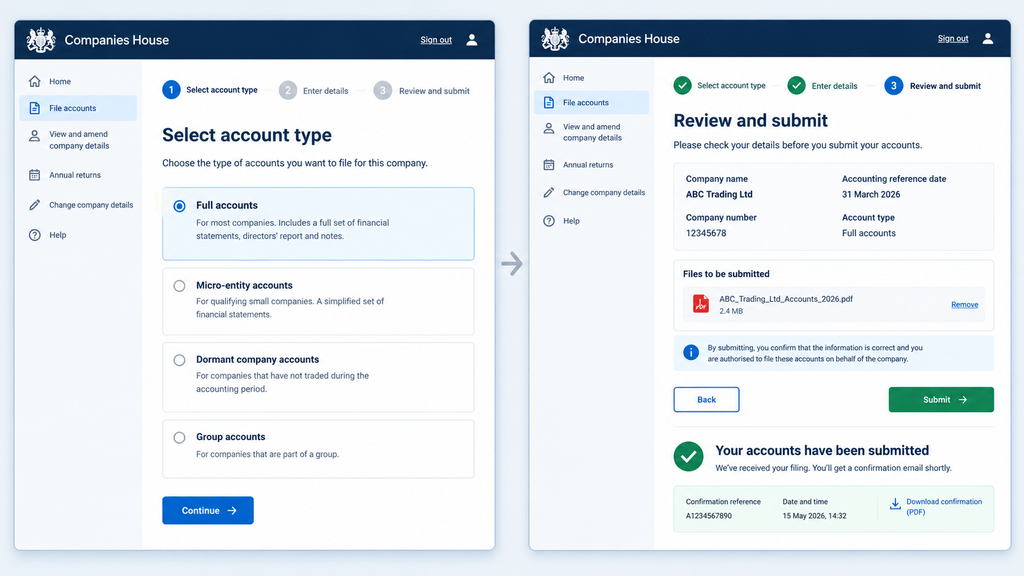
Companies House says the online service to file accounts and a Company Tax Return together closed on 31 March 2026, so companies should use the current filing routes appropriate to their accounts.
What Happens If You File Company Accounts Late?
Late filing of company accounts can result in an automatic penalty, and continued non-compliance can lead to enforcement action including potential company strike-off.
For private companies, the current late-filing penalties are:
| How late are the accounts? | Private company penalty |
|---|---|
| Up to 1 month | £150 |
| More than 1 but not more than 3 months | £375 |
| More than 3 but not more than 6 months | £750 |
| More than 6 months | £1,500 |
The penalty is doubled if accounts are late two years in a row.
If you have already missed your deadline, submit the accounts as soon as possible rather than waiting. If you receive a penalty and have grounds to appeal, Companies House provides an appeal process requiring a specific reason and relevant supporting details.
What Tools and Professional Support Can Help With Filing Company Accounts?
Accounting software, bookkeeping systems and professional accountancy support can make company accounts preparation and filing more organised and reduce the risk of compliance errors. The right approach depends on your company’s complexity, accounting knowledge and filing requirements.
First, accounting software for small businesses can help maintain financial records throughout the year and may support accounts filing. Some commercial products can also support submissions to HMRC.
Second, an accountant can prepare and file accounts on your behalf. Companies House confirms that using a professional does not remove the company’s legal responsibility for its accounts, records or performance.
For growing businesses, outsourced bookkeeping services can help keep records organised throughout the year instead of reconstructing transactions immediately before the accounts deadline.
Free and official resources are also available. Companies House provides guidance and a software-finder tool, while HMRC provides information about Corporation Tax and company tax returns.
What’s Next After Filing Your Company Accounts?
After filing company accounts, you should confirm acceptance, save the submitted documents and review your company’s next Companies House and HMRC deadlines.
First, check that Companies House has accepted the submission rather than assuming that uploading the accounts means the process is complete.
Second, save a copy of the filed accounts and supporting records. Maintaining an organised digital file can make future accounts preparation easier.
Third, add the next filing deadline to your compliance calendar. For example, a company with a 31 March year end can plan bookkeeping reviews several months before its following Companies House deadline.
Finally, prepare for the upcoming Companies House reforms. From April 2028, all companies will need to file annual accounts through commercial software, while small companies and micro-entities will face changes concerning profit and loss information and publication.
Conclusion
Filing company accounts is a recurring legal responsibility that becomes much easier when bookkeeping, account preparation and deadline planning are handled throughout the year. Private limited companies generally have nine months after their financial year end to file annual accounts, while first accounts usually have a longer initial deadline.
Moreover, the correct accounts type depends on your company’s circumstances, so directors should check whether micro-entity, small-company, dormant or another reporting regime applies.
Most importantly, remember that Companies House accounts and the Corporation Tax Return are separate compliance requirements with different deadlines. By keeping accurate records, checking your accounts category and submitting the correct information on time, you can make annual filing a routine part of running your company.
If you need help keeping your records organised or preparing for your annual filing obligations, consider professional accounting for limited companies before the deadline approaches.
Written by ASK Accountants UK Ltd Editorial Team
Reviewed by ASK Accountants UK Ltd — Professional Accounting & Tax Review