
Are you spending hours staring at spreadsheets every month just to get your team paid? Running a business is hard enough without the late-night anxiety of tax calculations. You want to focus on growing your company, serving your clients, or managing your properties. But instead, you are stuck deciphering tax codes and pension rules. This is exactly why payroll outsourcing has become a vital tool for UK business owners.
As a stressed SME owner, startup founder, or busy landlord, your time is your most valuable asset. Managing wages internally often drains that time. The rules change constantly, and the pressure to get it right is immense. If you are tired of the monthly administrative headache, this guide is for you. We will walk through the core rules, common pitfalls, and practical steps you can take to manage your obligations with confidence.

The Core HMRC Rules You Need to Know
Understanding the fundamentals of small business payroll is the first step toward better management. The landscape of UK employment taxes is complex. It involves multiple moving parts that require strict attention to detail.
Most employers must operate PAYE (Pay As You Earn) as part of their business operations. PAYE is the system HMRC uses to collect Income Tax and National Insurance contributions (NICs) directly from employee wages. However, it is important to acknowledge that there are limited exemptions. For example, if none of your employees are paid more than the Lower Earnings Limit, you might not need to register for a PAYE scheme. You can review the official GOV.UK PAYE guidance for specific thresholds. But even in these exempt cases, you must still keep meticulous payroll records.
Real Time Information (RTI) Reporting
Gone are the days of simple annual returns. HMRC now requires Real Time Information (RTI) reporting. This means you must report your employees’ pay, tax, and deductions to HMRC on or before each payday. This digital requirement demands reliable software and a structured monthly routine to ensure you submit accurate data on time.
Navigating Auto-enrolment Pensions
Alongside PAYE management, you must also navigate workplace pensions. By law, most employers must provide a workplace pension scheme. You must automatically enrol eligible staff and make contributions to their pension pots. Managing these auto-enrolment pensions adds another layer of monthly calculation and reporting to your workload. You must assess your staff every pay period, handle opt-outs, and submit declarations of compliance to The Pensions Regulator.
Common Errors and Record-Keeping Risks
Managing wages internally often leads to well-intentioned mistakes. These mistakes can cause frustration for your team and create unwanted administrative burdens. It is crucial to be aware of common errors and record-keeping risks so you can take steps to prevent them.
1. Mismanaging Tax Codes and Statutory Pay
Employees frequently change tax codes. If HMRC issues a new tax code for a staff member and you fail to update it in your system, you will deduct the wrong amount of tax. This leads to unhappy employees and complicated corrections later.
Furthermore, calculating statutory pay is notoriously tricky. Statutory Sick Pay (SSP), Statutory Maternity Pay (SMP), and Statutory Paternity Pay (SPP) all have specific qualifying criteria and calculation methods. Misunderstanding these rules can result in underpaying staff or failing to recover eligible amounts from HMRC.
2. Missing Deadlines and Penalty Risks
Timing is everything when it comes to HMRC compliance. Missing your RTI submission deadlines or paying your PAYE bill late can have financial consequences.
It is important to be precise with HMRC penalties so you know exactly what is at stake. Late-payment interest begins on day 1. The first penalties arise at day 15 and increase at day 30. Managing your cash flow and calendar effectively is essential to mitigate the risk of errors and avoid these unnecessary costs.
3. Misclassifying Expenses and Benefits
Providing perks to your team is a great way to boost morale. However, processing expenses and benefits through your payroll system requires careful handling.
Many business owners get confused by rules surrounding business entertainment or company vehicles. The rules in these areas are highly nuanced. There are exceptions and partial recovery rules depending on how the vehicle is used or who is being entertained. Because these regulations are so complex, you should always seek specific advice tailored to your unique situation before processing these benefits.
A Step-by-Step Workflow for PAYE Management
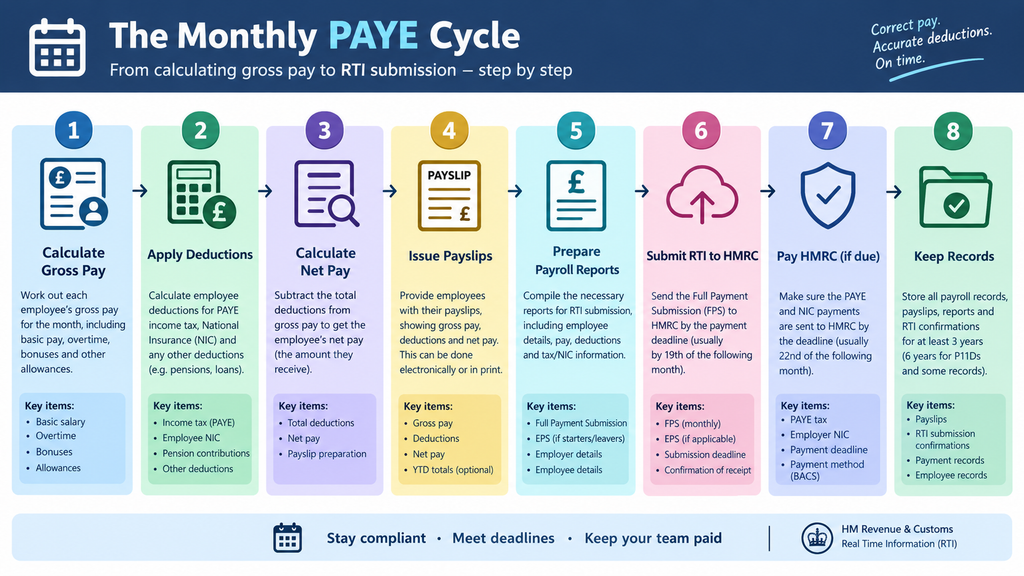
If you are currently handling things in-house, having a structured workflow can reduce your administrative burden. Following a consistent checklist each month helps improve accuracy and ensures nothing falls through the cracks.
Here is a practical workflow you can implement:
- Gather Payroll Data: Collect all timesheets, overtime records, and details of any bonuses or commissions well before payday.
- Update Employee Records: Enter any new tax codes from HMRC. Update personal details like changes of address. Process any new starters or leavers.
- Calculate Gross Pay: Tally up the total earnings for each employee before any deductions are made.
- Process Deductions: Calculate Income Tax, National Insurance, and any student loan repayments using your chosen software (many of our clients prefer to switch to QuickBooks).
- Assess for Pensions: Check if any staff have crossed the age or earnings threshold for pension auto-enrolment this period. Deduct the correct pension contributions.
- Generate Payslips: Create detailed, legally compliant payslips for every team member. These must show gross pay, all deductions, and net pay.
- Submit RTI to HMRC: Send your Full Payment Submission (FPS) to HMRC on or before the day you pay your staff.
- Pay Your Team: Transfer the net wages into your employees’ bank accounts.
- Pay HMRC: Ensure your PAYE and National Insurance bill is paid to HMRC by the 22nd of the following month (if paying electronically).
This checklist is comprehensive, but it also highlights exactly why so many founders eventually look for external support.

Why Payroll Outsourcing Makes Strategic Sense
You have big goals for your business. Spending a full day every month running calculations does not help you achieve them. This is where professional payroll outsourcing comes into play.
Handing this function over to experts is not just about saving time. It is a strategic decision that offers several tangible benefits to your growing business.
It Helps Improve Accuracy
Tax legislation is constantly evolving. Rates change, thresholds shift, and new statutory rules are introduced regularly. Staying on top of every minor update is a full-time job. Professional payroll outsourcing helps improve accuracy because you have dedicated experts monitoring these changes for you. They use specialized software and robust review processes to ensure every calculation is correct the first time.
It Mitigates the Risk of Errors
Mistakes in calculating wages have a direct impact on employee morale. If your team is paid incorrectly, trust is broken immediately. Furthermore, calculation errors lead to compliance issues. Outsourcing this task mitigates the risk of errors and ensures your staff are paid the right amount on the right day. This creates a happier, more stable work environment.
It Reduces Administrative Burden
Think about the hours you spend gathering timesheets, running software updates, and submitting reports. Now imagine getting all those hours back. Payroll outsourcing can reduce your administrative burden significantly. You simply provide the raw data (like hours worked), and the experts handle the entire complicated lifecycle. You receive ready-to-distribute payslips and clear instructions on how much to pay HMRC.
Better Data Security
Employee financial details are highly sensitive. Keeping this data secure is a major GDPR responsibility. Professional accountants use secure portals and encrypted software to manage your team’s information. This offers a much higher level of data protection than storing spreadsheets on a local hard drive or sending personal details via unencrypted emails.
Choose ASK Accountants for Payroll Outsourcing
At ASK Accountants UK Ltd, we understand the pressure you are under. We know that as an SME owner or landlord, you need partners who genuinely care about your success.
With 15 years of experience helping businesses, we provide a human touch to financial management. We do not just run the numbers. We take the time to understand your business structure, your team, and your long-term goals.
Our comprehensive London payroll services are designed to integrate seamlessly with your operations. Whether you have one employee or fifty, our team will manage your RTI submissions, process statutory pay, and handle your auto-enrolment obligations.
By trusting us with your PAYE management, you can finally reclaim your evenings and focus on what you do best. We can also integrate these services with our broader financial solutions. If you need help keeping your daily records straight, you can learn more about our bookkeeping service options.
Are you ready to remove the stress of payday? We are here to help you build a more efficient business.
Contact us today to discuss your specific needs. Call our friendly team on 020 8543 1991 or visit us in person at 178 Merton High St, London. You can also reach out through our Contact Page to schedule a consultation.
Frequently Asked Questions About Payroll Outsourcing
To help you make an informed decision, we have compiled a few common questions business owners ask when considering external support.
How much does payroll outsourcing typically cost?
The cost varies depending on the number of employees you have and the frequency of your pay periods (weekly or monthly). Most professional firms charge a flat base fee plus a small amount per employee. Because it saves you hours of valuable time and helps prevent costly mistakes, it is generally considered a highly cost-effective investment for SMEs.
Does an outsourced service handle pension auto-enrolment?
Yes, a comprehensive service will manage your auto-enrolment duties. This includes assessing your workforce each pay period, calculating the correct employer and employee contributions, and assisting with your regulatory declarations. If you need more general information on pension duties, you can read the official guidance directly from The Pensions Regulator.
Do I still need to communicate directly with HMRC?
When you use a professional service, your accountant acts as your authorized agent. This means they can communicate with HMRC on your behalf regarding routine PAYE matters. They will submit your digital reports and handle standard queries. However, you remain ultimately responsible for paying your tax bills on time. Our service provides you with the exact figures and payment references you need to make those payments easily.