

Let us be completely honest about running a business right now. You are already juggling cash flow, team management, and daily operations. The last thing you need is a massive headache from HMRC regarding your vehicles. If you provide a vehicle to yourself or your team, calculating the tax on company cars can feel like an endless maze of compliance and paperwork.
You want to reward your hard-working staff or perhaps drive a decent vehicle for your client meetings. However, you absolutely do not want to stumble into unexpected tax liabilities. Many business owners assume providing a vehicle is a simple business expense. The reality is far more complicated. HMRC views private vehicle use strictly, and failing to understand these regulations can lead to heavy administrative burdens.
This guide will break down exactly how these rules work in plain English. We will explore how to manage your obligations, streamline your reporting, and keep your business moving forward smoothly.

How HMRC Calculates Tax on Company Cars
When your limited company provides a vehicle to an employee or director that is available for private use, HMRC steps in. They classify this perk as a Benefit in Kind company car. Because it is a benefit, it carries a taxable value.
HMRC calculates the tax on company cars using a very specific formula. They look at two main factors: the P11D value of the vehicle and its official CO2 emissions.
The P11D value is not just the sticker price you saw at the dealership. It includes the list price of the car, the cost of delivery, VAT, and any optional extras you added before the car was delivered. Even if you negotiated a massive discount with the dealer, HMRC still uses the official list price to calculate the tax burden.
Once you have the P11D value, you multiply it by a percentage determined by the vehicle’s CO2 emissions. A high-emission diesel SUV will sit in the highest bracket (up to 37%), while a zero-emission vehicle sits at the very bottom. This resulting figure is the Benefit in Kind (BiK) value. The employee then pays income tax on this BiK value, and the employer pays Class 1A National Insurance Contributions on it.
The Massive Shift to Electric Vehicles
If you are looking at the current tax landscape, you cannot ignore the electric company car tax benefits. HMRC actively encourages businesses to go green.
For the 2024/25 tax year, a fully electric vehicle attracts a BiK rate of just 2%. Let us compare that to a petrol car. If you buy a £40,000 petrol vehicle with high emissions, the BiK rate could be 37%. That creates a taxable benefit of £14,800. A higher-rate taxpayer would pay £5,920 in tax just to drive it.
If you buy a £40,000 electric vehicle, the 2% rate means the taxable benefit is only £800. That same higher-rate taxpayer would pay just £320 for the year. This stark contrast is exactly why so many company fleets in London and across the UK are transitioning rapidly to electric power.
Employer Obligations and P11D Reporting
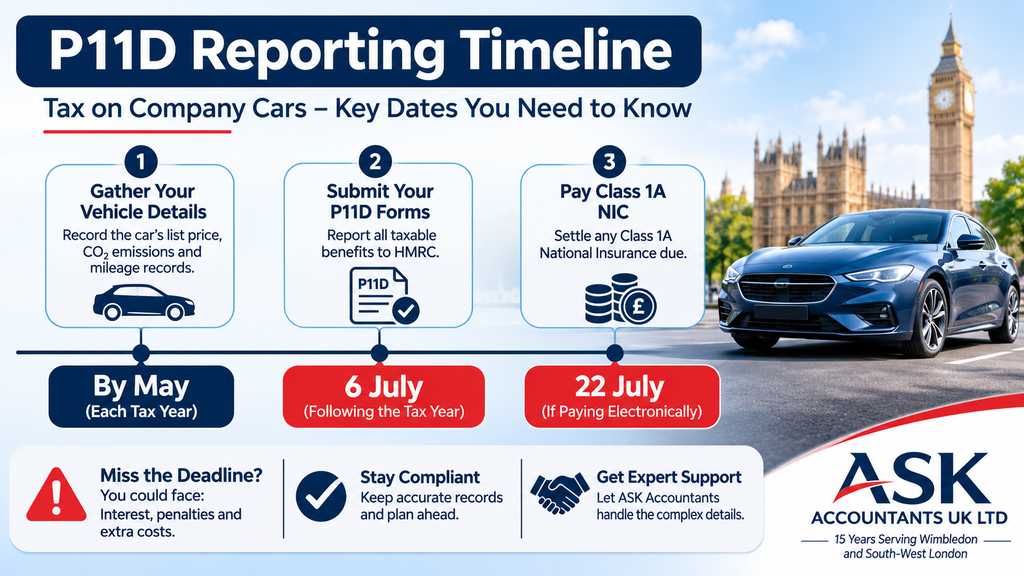
As the employer, your job does not stop at handing over the keys. You are responsible for accurate P11D reporting at the end of the tax year.
Also, you must submit a P11D form to HMRC for every employee who receives a taxable benefit. You must also submit a P11D(b) form, which summarises all the Class 1A National Insurance you owe as an employer. If you are a director of a one-person limited company, you still have to report this for yourself. Getting this paperwork right can reduce administrative burden later on.
HMRC Deadlines and the Cost of Missing Them
Compliance relies heavily on strict timelines. You must submit your P11D forms to HMRC by the 6th of July following the end of the tax year. You must then pay any Class 1A National Insurance owed by the 22nd of July (if paying electronically).
If you miss these deadlines, the financial consequences are precise and immediate. Late-payment interest begins on day 1; first penalties arise at day 15 and increase at day 30.
These costs accumulate quickly and unnecessarily. Most VAT-registered businesses must also account for the input tax on leased vehicles, which adds another layer of deadline management to your plate. Staying organised is the only way to mitigate the risk of errors and avoid these escalating charges.
Common Errors and Record-Keeping Risks with Tax on Company Cars
Business owners often fall into the same traps when managing vehicle compliance. Rather than viewing these as mere administrative hiccups, you must treat them as common errors and record-keeping risks.
Here are three major pitfalls to watch out for:
- Misunderstanding Private Use: Many founders believe that if they only drive the company car to and from the office, it counts strictly as business use. HMRC disagrees. Ordinary commuting between your home and a permanent workplace is classified as private use. If the car is available for private use, the tax applies.
- The Pool Car Trap: Some businesses try to classify vehicles as “pool cars” to avoid the BiK charge entirely. HMRC rules on this are incredibly strict. A pool car must be available to multiple employees, it must be kept at the business premises overnight, and any private use must be purely incidental. If a director takes the pool car home for the weekend, it immediately loses its pool car status.
- Providing Private Fuel: If your company pays for the fuel an employee uses for private journeys, this creates a completely separate tax charge called the Fuel Benefit Charge. HMRC uses a set multiplier (£27,800 for 2024/25) multiplied by the car’s CO2 percentage. This charge is often so high that it outweighs the cost of the fuel itself.
Important Note: The rules surrounding business entertainment or company vehicles are highly nuanced. There are exceptions and partial recovery rules depending on the structure of your business and how vehicles are deployed. You should always seek specific professional advice before making definitive fleet decisions.

A Practical Workflow for Managing Tax on Company Cars
You do not need to let vehicle compliance overwhelm your week. By setting up a reliable internal system, you can handle this efficiently. Use the following step-by-step workflow to keep your records straight.
Step 1: Document Vehicle Details Immediately
The moment your business acquires a new vehicle, create a dedicated digital file. Record the exact list price, the cost of any optional extras, the date of first registration, and the official CO2 emissions figure. Do not wait until July to hunt for this paperwork.
Step 2: Implement Strict Mileage Tracking
You must be able to prove business versus private mileage. Relying on paper logbooks often leads to missing entries and errors. Use digital tools or apps that track trips via GPS. Cloud software makes this incredibly simple. By integrating these tools with platforms like Xero or QuickBooks, you create an airtight audit trail. Check out our guide on how cloud accounting works to see how this integrates with your broader finances.
Step 3: Review the Fuel Strategy
Decide clearly whether the company will provide fuel for private use. If you require employees to reimburse the company for their private fuel to avoid the fuel benefit charge, they must pay back every single penny before the 6th of July deadline. Ensure this policy is written in their employment contracts.
Step 4: Schedule P11D Preparations in May
Do not leave your reporting until July. Set an internal deadline for late May to gather all mileage logs, confirm the vehicles used by each employee, and begin drafting the P11D forms. This gives you time to address any missing data without rushing.
Step 5: Consult Your Accountant Annually
Vehicle tax bands and BiK rates change frequently. Make vehicle strategy a standard agenda item during your annual financial review with your accountant.
Why Outsourcing Your Vehicle Tax Strategy Makes Sense
Trying to manage complex HMRC vehicle rules internally often leads to frustration and wasted hours. When you are focused on scaling your operations, dedicating a whole day to calculating CO2 percentages and Class 1A contributions is not the best use of your time.
Outsourcing this specific task to a professional outsourced finance department is a smart investment. A dedicated accountant helps improve accuracy across all your reporting. We handle the P11D submissions, calculate the exact Benefit in Kind values, and ensure your National Insurance payments are mapped out perfectly.
This approach can reduce administrative burden for your management team. You gain peace of mind knowing that experienced professionals are tracking your deadlines, leaving you free to focus on bringing in revenue and managing your clients.
How ASK Accountants UK Ltd Can Help You
At ASK Accountants UK Ltd, we understand the specific pressures placed on small and medium-sized enterprises. We have spent 15 years helping SMEs across South-West London navigate the complexities of HMRC compliance and we do not just process numbers. We provide proactive business advice that helps you make smart strategic choices regarding your business assets.
If you are struggling with the tax on company cars, or if you just want to ensure your current vehicle setup is as tax-efficient as possible, we are ready to assist.
Take control of your compliance today. Call our team directly on 020 8543 1991 to discuss your situation, or visit our offices at 178 Merton High St, London. You can also explore our full range of tax compliance services online or contact us via our website.
Frequently Asked Questions About Tax on Company Cars
How can I find out the exact Benefit in Kind rate for my vehicle? The Benefit in Kind rate is determined primarily by the vehicle’s official CO2 emissions and the type of fuel it uses. You can check the specific rate for your vehicle by using the official company car tax calculator provided by GOV.UK. You will need to know the vehicle’s P11D value and exact emissions data to get an accurate figure.
Does a commercial van attract the same tax as a company car? No, commercial vans are treated differently under HMRC rules. If a van is used primarily for business and only has “insignificant” private use (like grabbing a coffee on the way to a job), it does not usually attract a BiK charge. If it is used regularly for private journeys, there is a fixed flat-rate benefit charge, which is generally much lower than the tax on company cars.
What happens if an employee contributes toward the cost of the car? If an employee makes a capital contribution toward the cost of the vehicle (up to a maximum of £5,000), this amount is deducted from the P11D value before the Benefit in Kind is calculated. This is a legitimate way to reduce the tax on company cars for the individual, provided the payment is documented correctly in the company accounts and tax records.