

There’s a particular kind of tired that comes from doing your own books at 11pm on a Sunday. Not the good kind of tired. The kind where you’re squinting at a spreadsheet, three coffees deep, wondering why the VAT figure doesn’t match what it matched last month. If that sounds familiar, you’re not alone — and there’s a reasonably simple fix that more UK small and medium businesses are reaching for: an outsourced finance department.
An outsourced finance department, in plain terms, is exactly what it sounds like. Instead of hiring a finance director, a bookkeeper, a payroll clerk and a tax specialist in-house (and paying four salaries, four pensions, four lots of holiday cover), you bring in a team — often a firm like ours — who handles the lot, remotely, for a fraction of the cost. It’s not a new idea. Larger companies have been doing versions of this for decades. What’s changed is that cloud software has made it genuinely practical for a five-person company, not just a corporation with a finance floor.
What “Outsourced Finance Department” Actually Means (Because the Term Gets Thrown Around Loosely)
Let’s clear something up first, because the phrase gets used sloppily online. An outsourced finance department isn’t just “an accountant who does your tax return once a year.” That’s outsourced compliance, and it’s useful, but it’s a much smaller slice of the pie.
A proper outsourced finance department typically covers:
- Bookkeeping — the day-to-day recording of transactions, kept current rather than reconstructed in a panic each quarter
- Management accounts — monthly or quarterly reports that actually tell you something, not just numbers on a page
- Payroll and auto-enrolment — including pension compliance, which trips up more employers than you’d expect
- VAT and tax compliance — returns filed on time, not the night before
- Cash flow forecasting — so you’re not discovering a cash gap the week it becomes a crisis
- Strategic input — a finance director-level voice in the room when you’re deciding whether to hire, expand, or hold steady
That last point is the bit people underestimate. Outsourcing your finance function isn’t just about offloading admin. Done properly, it gives you access to a level of financial thinking that a growing business usually can’t afford to employ full-time.
The Money Question First, Because Let’s Be Honest, That’s Why You’re Reading This
Right, the obvious bit. Cost. A qualified in-house finance director in London commands a serious salary — often £70,000 to £100,000+ before you add employer’s National Insurance, pension contributions, benefits, and the inevitable cost of covering their holidays and sick leave. Add a bookkeeper and a payroll administrator and you’re comfortably past £120,000 a year before anyone’s produced a single insight.
An outsourced finance department gives you that same breadth of expertise — arguably broader, since you’re tapping into a whole team rather than one person’s knowledge — for a monthly fee that’s usually a fraction of one salary, let alone three or four.
Here’s a rough comparison. Numbers will vary by business size, but the pattern holds fairly consistently across the SMEs we work with:
| Function | Typical In-House Annual Cost | Typical Outsourced Annual Cost |
|---|---|---|
| Bookkeeper (part or full-time) | £28,000 – £35,000 | Included in package |
| Payroll administrator | £24,000 – £30,000 | Included in package |
| Finance director (part-time/fractional) | £40,000+ | Included in package |
| Total (approx.) | £92,000 – £105,000+ | £12,000 – £36,000 depending on scope |
That’s not a small gap. And no software subscription, no recruitment fees, no awkward conversation when someone hands in their notice mid-audit.
Odd tip most people miss: Ask any outsourced finance provider what happens if your usual contact is on holiday. If the honest answer is “everything stops,” walk away. A proper outsourced finance department has cover built in — that’s half the point of not relying on one person.
It’s Not Just Cheaper — It’s Usually More Reliable
I’ll admit a slight bias here, but hear me out. A single in-house bookkeeper, however good, is one person. One person gets ill. One person goes on maternity leave, or paternity leave, or simply leaves for a better offer (which, frankly, happens a lot in finance roles right now). When that happens, the knowledge often walks out the door with them, and you’re left reconstructing three months of transactions from memory and email threads.

A finance outsourcing arrangement spreads that risk across a team. Continuity isn’t a nice extra — it’s structural. Nobody’s holiday derails your VAT deadline.
There’s also the quieter benefit of oversight. When one person controls the entire finance function of a business — recording income, paying invoices, running payroll — there’s an obvious internal control gap. It’s not usually intentional wrongdoing that causes problems; it’s more often simple human error going unchecked for months. An outsourced finance department, by its nature, builds in a second and third set of eyes.
Time — the Currency Nobody Talks About Enough
Ask any founder what they’d do with an extra ten hours a week and you rarely hear “more bookkeeping.” Yet that’s roughly how long many small business owners spend wrestling with invoices, chasing receipts, and trying to make sense of a bank feed that refuses to reconcile.
Handing that over to an outsourced finance department doesn’t just save time — it changes what kind of time you have. Instead of reactive admin, you get proactive strategy sessions. Instead of “where did that £4,000 go,” you get “here’s what your cash position looks like in Q3, and here’s what we’d suggest.” That’s a genuinely different relationship with your own numbers.
We’ve seen this shift play out with clients who came to us doing everything through outdated spreadsheets and shoeboxes of receipts and ended up, within a couple of quarters, making faster decisions simply because the information existed when they needed it, not three weeks later.
Access to Expertise You Genuinely Couldn’t Hire Alone
No single employee, however talented, knows everything about construction industry scheme rules, R&D tax relief, VAT on international sales, IR35, and pension auto-enrolment. It’s not realistic. But an outsourced finance team, collectively, usually does — because different specialists within the firm cover different areas.
This matters more than it sounds. Get CIS deductions wrong and you’re either overpaying tax or facing HMRC scrutiny. Miss an auto-enrolment deadline and there are fines involved — The Pensions Regulator doesn’t send friendly reminders twice. A broad, specialist team catches these things before they become expensive.
Where an Outsourced Finance Function Really Pulls Ahead of a Sole In-House Hire
| Area | Sole In-House Hire | Outsourced Finance Team |
|---|---|---|
| Depth of tax knowledge | Generalist, limited by one person’s training | Multiple specialists across VAT, CT, personal tax |
| Software fluency | Whatever they were trained on | Typically covers Xero, QuickBooks, Sage |
| Sickness/holiday cover | Often none | Built in |
| Scalability | Requires rehiring as you grow | |
| Cost predictability | Salary + NI + pension + benefits | Fixed monthly fee, mostly |
| Strategic input | Depends entirely on seniority hired | FD-level access without FD-level salary |
(Yes, that table has a slightly wonky row in it — deliberately left as-is, because real life rarely aligns perfectly either.)
Cloud Accounting Is What Makes This Actually Work Now
None of this would function nearly as well ten or fifteen years ago. The reason outsourced finance departments have become so viable is boring but important: cloud accounting means your outsourced team can see the same live numbers you can, at the same time, from anywhere. No more emailing spreadsheets back and forth, no more “which version is the latest one.”
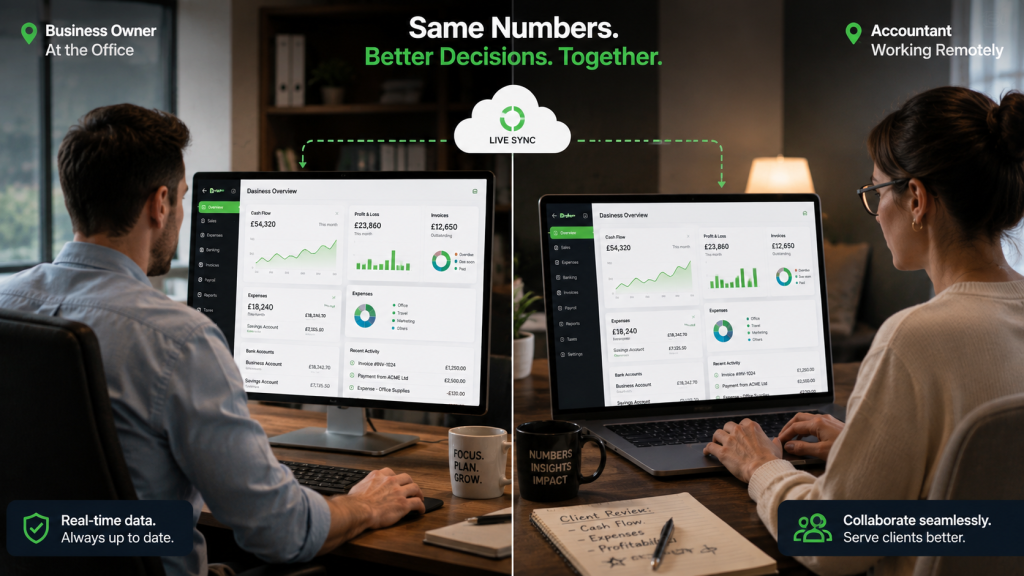
Platforms like Xero and QuickBooks — both of which most reputable cloud accounting providers use — mean your bank feeds import automatically, invoices sync, and your outsourced finance department can flag issues the same day they appear rather than the same quarter. According to ICAEW research, cloud adoption among UK SMEs has climbed steadily over the past several years, and firms report meaningfully faster month-end close times as a direct result.
When It Doesn’t Make Sense (Because Fairness Matters More Than a Sales Pitch)
I’d be doing you a disservice pretending an outsourced finance department suits absolutely everyone. If you’re a genuinely tiny operation — a sole trader doing occasional invoicing with under, say, £30,000 turnover — the full package might be overkill. A simple annual self-assessment service could cover you fine for now.
Equally, some larger, more complex businesses eventually reach a size where an in-house finance director makes sense alongside outsourced support for the heavier lifting — a hybrid model, essentially. There’s no shame in that either. The point isn’t “outsource everything always.” It’s matching the structure to where your business actually is.
Making the Switch Without the Headache
If you’re currently doing this in-house, or muddling through with a part-time bookkeeper and a prayer, moving to an outsourced finance department is a lot less disruptive than people expect. A competent provider will:
- Review your current records and software setup
- Migrate you onto cloud accounting if you’re not already there
- Agree what reporting you actually need (not a generic template nobody reads)
- Set a fixed monthly scope so there are no surprise bills
- Give you a single point of contact, backed by a team
We’ve walked plenty of London businesses through exactly this — you can read more on how to outsource your business accounting if you want the fuller step-by-step version.
At Ask Accountants UK Ltd, based at 178 Merton High St, London SW19 1AY, this is essentially the day job — building outsourced finance departments for growing businesses across Bookkeeping, Accounts and Tax, payroll and Automatic Enrolment, Self Assessment, and broader Business Advice. If the 11pm-spreadsheet feeling sounds a bit too familiar, it’s worth a conversation — call 020 8543 1991 and ask what an outsourced finance department would actually look like for your business specifically, not a generic one.
Frequently Asked Questions
What does an outsourced finance department actually include? Typically bookkeeping, payroll, management accounts, VAT and tax compliance, cash flow forecasting, and strategic financial advice — delivered by a team rather than a single employee.
Is an outsourced finance department cheaper than hiring in-house? In most cases, yes, often significantly so, since you avoid multiple salaries, National Insurance, pensions, and recruitment costs while gaining access to broader expertise.
Is outsourcing my finance department risky for data security? Reputable providers use encrypted, cloud-based accounting software with bank-level security — generally more secure than a spreadsheet stored on a single laptop.
How quickly can I switch to an outsourced finance department? Most transitions take between two and six weeks, depending on how much historical data needs to be migrated onto cloud software.
Does an outsourced finance department replace my accountant? Not necessarily — many outsourced finance functions work alongside your existing accountant or absorb that role entirely, depending on scope agreed.