
Running a business in the United Kingdom comes with an overwhelming amount of daily pressure. You are constantly trying to balance client demands, manage your staff, and keep a very close eye on your cash flow. Whether you are a stressed SME owner trying to scale operations, a startup founder navigating your first year of trading, or a busy landlord managing multiple commercial properties, your time is incredibly valuable. The last thing you need on your plate is a massive headache caused by confusing tax paperwork. Unfortunately, getting your documentation wrong can lead to severe financial bottlenecks. This is exactly why understanding the specific VAT Invoice Requirements is so crucial from the very beginning.
When you supply goods or services, getting the paperwork absolutely right is vital. The exact VAT Invoice Requirements govern how you prove your financial transactions to the government. If you make a mistake, it can cause immediate payment delays from your commercial clients. It also creates a tangled financial trail that takes hours of precious time to fix. We understand completely how overwhelming this feels. This comprehensive guide strips away the confusing jargon. It gives you the clear, actionable knowledge you need to maintain perfect compliance without losing sleep.

Why Understanding VAT Invoice Requirements Matters So Much
Every transaction you execute leaves a permanent financial footprint. Once your business is registered for Value Added Tax, that footprint becomes a matter of strict legal scrutiny. A valid tax document is the ultimate proof of a transaction between you and your customer. It is the core piece of evidence that allows you to calculate the right amount of tax owed to the government at the end of your financial quarter.
Furthermore, it allows your business-to-business customers to reclaim the tax they have paid on your services. If you fail to provide the correct documentation, your commercial customers might rightfully refuse to pay your invoice. They desperately need that specific piece of paper for their own financial survival. Therefore, your internal documentation processes directly impact your cash flow and your professional reputation in the marketplace.
Working with a professional to handle these processes can reduce administrative burden significantly. Proper oversight helps improve accuracy across your entire accounting system and mitigates the risk of errors before they become costly problems. If you want peace of mind, you need to understand the fundamental rules.
The Core HMRC VAT Invoice Rules You Need to Know
Understanding the basic framework laid out by the government is your first crucial step to financial clarity. Most VAT-registered businesses must issue a formal document when they supply standard-rated or reduced-rated goods and services to another VAT-registered entity. You cannot simply write a total amount on a scrap of paper or send a casual text message requesting payment. The HMRC VAT invoice rules are highly specific about what must be displayed.
To stay compliant, you should create a valid VAT invoice template within your chosen software. This template must clearly display several mandatory pieces of information. First, you need a unique, sequential invoice number. You cannot have arbitrary gaps in your numbering system because this makes financial auditing incredibly difficult.
Next, you must include your official business name, your registered business address, and your unique nine-digit registration number. You must also include the date the document is officially issued and the time of supply. The document needs your customer’s full trading name and address. Finally, you must provide a clear description of the goods or services, the unit price excluding tax, the specific rate of tax applied, and the total amount of tax charged shown clearly in sterling. Missing even one of these elements can render the entire document legally invalid.
Standard Invoices vs Modified Invoices
Not every single business transaction requires the same massive amount of administrative heavy lifting. If you operate a bustling retail shop or a busy cafe, you might be eligible for an easier administrative route. For retail supplies totaling under £250 including tax, you are permitted to issue a simplified document.
This streamlined version requires significantly less detail. You only need to include your business name, address, official registration number, the time of supply, a brief description of the items, and the tax-inclusive total. You must also clearly state the specific tax rate applicable to the sale. Understanding these variations in the VAT Invoice Requirements can save high-volume retailers countless hours of unnecessary data entry.
Tax Points and Time of Supply
The concept of a “tax point” is frequently misunderstood by even the most experienced entrepreneurs. However, it is an essential part of the HMRC VAT invoice rules. The tax point dictates exactly which financial quarter a specific transaction belongs to.
The basic tax point is simply the date you supply the goods or complete the service. However, an “actual” tax point is created if you issue a document or receive payment before the basic tax point occurs. For example, if you take an upfront deposit in January for a service you will not complete until March, the tax point is created in January. Getting this timing wrong means you might report the transaction in the wrong financial period. This throws off your entire quarterly return and creates unnecessary complications. Expanding your knowledge of tax points helps improve accuracy in your reporting.
Embracing Making Tax Digital for VAT
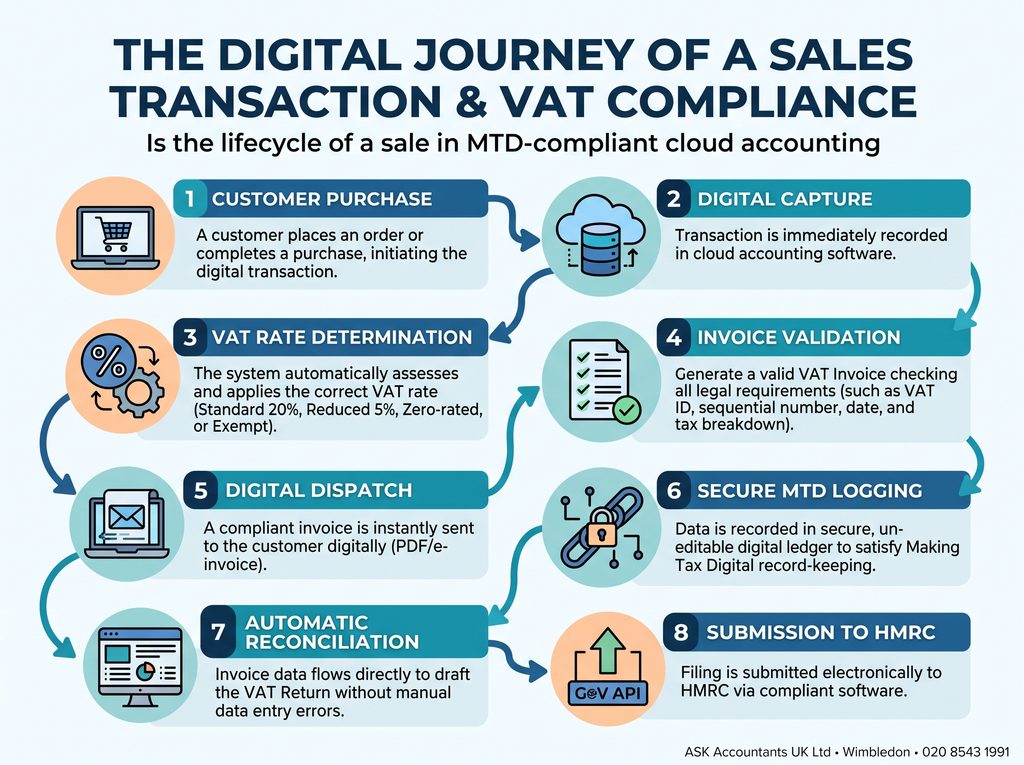
The days of keeping physical receipts in a shoebox under your desk are completely gone. The government has aggressively modernized the UK tax system, and you must adapt your internal workflows accordingly. Most VAT-registered businesses must now keep their records digitally. This massive government initiative is widely known as Making Tax Digital for VAT.
Under these modern rules, you are required to submit your quarterly returns using compatible, approved software. Your outgoing and incoming transactions must be recorded in a purely digital format. This brings us to a critical concept known as digital links. You must maintain seamless digital connections between your different pieces of software.
For example, if you use a bespoke billing platform and a separate main accounting system, the financial data must transfer digitally. You cannot manually type the figures from one system to another. You cannot rely on copying and pasting data in spreadsheets. Using modern, robust tools like cloud accounting software makes this entire process straightforward and highly secure. Excellent software ensures your VAT record keeping is pristine and fully compliant with the latest digital mandates. You can find more official guidance on compliant software directly on GOV.UK.
Common Errors and Record-Keeping Risks
Even the most careful and diligent business founders make mistakes from time to time. However, consistent errors in your financial records can lead to serious consequences and unwanted government scrutiny. Here are three common errors and record-keeping risks you must actively avoid to protect your enterprise.
1. Mismanaging the Tax Point
As mentioned earlier, confusing the date you type up the bill with the actual legal tax point is incredibly common. If your accounting software defaults to today’s date rather than the date the service was actually rendered or the deposit was paid, your VAT record keeping will be fundamentally flawed. You must train your staff to double-check these dates constantly.
2. Mishandling Bad Debt Relief
It is a sad reality of business that sometimes clients simply refuse to pay their bills. If you have already issued a valid document and paid the required tax to the government, you are left severely out of pocket. You can claim this money back through bad debt relief. However, the debt must be older than six months, and you must have previously accounted for the tax on a past return. Many businesses try to claim this relief too early or fail to keep the strict documentation required to prove the debt is genuinely bad.
3. Claiming Complex Business Expenses
It is incredibly tempting to try and reclaim tax on every single business expense you incur throughout the year. However, when dealing with expenses like business entertainment or company vehicles, the rules are highly nuanced, there are exceptions/partial recovery rules, and readers should seek specific advice. Trying to guess these complex calculations yourself is a major compliance risk. Seeking expert advice from our VAT Accounting team mitigates the risk of errors dramatically.
The Strict Reality of HMRC Penalties
The government has a highly structured and rigorous framework for late payments and administrative errors. It is vital to understand the exact timeline of financial consequences. Late-payment interest begins on day 1; first penalties arise at day 15 and increase at day 30.
We do not state this to cause panic. However, it is critically important to realize that these financial charges can add up extremely quickly if you ignore your obligations or let your administration pile up. Adhering strictly to the VAT Invoice Requirements is your best defense against these unnecessary financial drains. Utilizing proper professional bookkeeping helps improve accuracy and ensures you never miss a crucial deadline.
Step-by-Step Workflow for Perfect VAT Record Keeping
Mastering your daily documentation does not have to be a painful, time-consuming ordeal. You can easily build a streamlined, highly effective process that protects your business and gives you immense peace of mind. Follow this practical checklist to maintain total control over your business finances.
- Step 1: Invest in Quality Cloud Software. Choose a reliable, government-approved platform like Xero that integrates seamlessly with your business bank accounts.
- Step 2: Automate Your Billing Templates. Set up a valid VAT invoice template inside your software. Ensure it automatically pulls in your registration number, business address, and sequential numbering.
- Step 3: Train Your Internal Team. Make sure anyone who issues bills or handles expenses understands the crucial difference between the document creation date and the legal tax point.
- Step 4: Verify Supplier Details Thoroughly. Before paying a large supplier bill, always check that they have provided a fully compliant document with absolutely no missing information.
- Step 5: Reconcile Your Accounts Frequently. Do not wait until the absolute end of the quarter to do your bookkeeping. Match your bank feeds to your software every single week to catch anomalies early.
Implementing this workflow diligently can reduce administrative burden and drastically improve the financial health of your company.
The Solution: Why Outsourcing Reduces Administrative Burden
You did not launch a bold new startup or acquire a portfolio of commercial properties just to spend your late evenings reading dry government tax legislation. Your time is far too valuable to be spent buried in complex spreadsheets and tax calculations. Outsourcing your financial administration to a dedicated professional is a highly strategic decision for any growing enterprise in the UK.

Delegating this complex, high-stakes work can reduce administrative burden across your whole team. It allows you to step back from the daily grind and focus purely on scaling your operations, managing your staff, and delivering total excellence to your customers. A professional accountant ensures your documentation meets every single legal standard perfectly. Proper external support helps improve accuracy on every return and significantly mitigates the risk of errors, providing you with invaluable peace of mind.
Partner with ASK Accountants UK Ltd
At ASK Accountants UK Ltd, we take the heavy stress out of financial management so you can breathe easier and focus on growth. We have spent 15 robust years helping ambitious SMEs, innovative startups, and successful property landlords in Wimbledon and across South-West London navigate their complex finances. Our team knows the local business landscape intimately. That means we understand exactly the kind of pressure you are under every single day.
Let our highly experienced team handle your documentation, your quarterly tax returns, and your long-term strategic financial planning. We provide absolute clarity, unwavering professional support, and total peace of mind for you and your family.
Are you completely ready to streamline your financial processes and protect your hard-earned cash flow? Visit us in person at 178 Merton High St, Wimbledon. You can also visit our contact us today page or simply call our friendly team directly on 020 8543 1991 to discuss your specific business needs.
Frequently Asked Questions (FAQs)
Q1: How long must I keep my financial records and tax documents?
You must generally keep all of your business records for a minimum of 6 full years. This strict timeline includes all issued and received bills. Keeping these records securely stored digitally in the cloud is highly recommended. Digital storage completely prevents physical damage, fading, or loss over time.
Q2: Can I issue electronic documents instead of traditional paper ones?
Yes, electronic documents are completely acceptable and are actually strongly encouraged under current Making Tax Digital for VAT initiatives. However, your electronic documents must still absolutely meet all the standard legal VAT Invoice Requirements we discussed above. For more detailed rules on electronic invoicing, you can consult GOV.UK guidelines.
Q3: What exactly should I do if I lose a crucial document from a supplier?
If you lose a critical document, you cannot simply write out a makeshift replacement yourself. You must contact the original supplier directly and ask them to issue a formal replacement. This specific replacement document must be clearly marked with the word ‘duplicate’ to remain legally compliant for your VAT record keeping.