

Running a small business in the UK requires wearing many hats. You are the sales director, the HR manager, and the financial controller all at once. When the business grows, you might want to reward your hard-working team. Providing a vehicle is a fantastic incentive. Alternatively, you might want to purchase a vehicle for your own travel. This is where the complexities of Company Car Tax come into play.
Many SME owners and startup founders find this topic incredibly stressful. The rules change frequently based on environmental policies and government budgets. Calculating the exact costs can consume hours of your valuable time. This Company Car Tax guide is designed to remove the confusion. We will explain the fundamental rules in simple language. By the end of this post, you will understand how to structure your vehicle purchases efficiently. You will also learn how to avoid costly mistakes that keep many business owners awake at night.

The Fundamentals of Benefit in Kind
To understand how vehicle taxation works, you must first understand the concept of a Benefit in Kind. A Benefit in Kind is any non-cash perk provided to an employee or director. Because this perk saves the individual from buying a car out of their own pocket, HMRC views it as a form of income. The government insists that tax is paid on this hidden income.
When you provide a car that is available for private use, it triggers this Company Car Tax charge. It is vital to note that commuting between a home and a permanent workplace is legally classified as private use. Even if an employee only takes the car home at the weekend, the vehicle is considered available for private use.
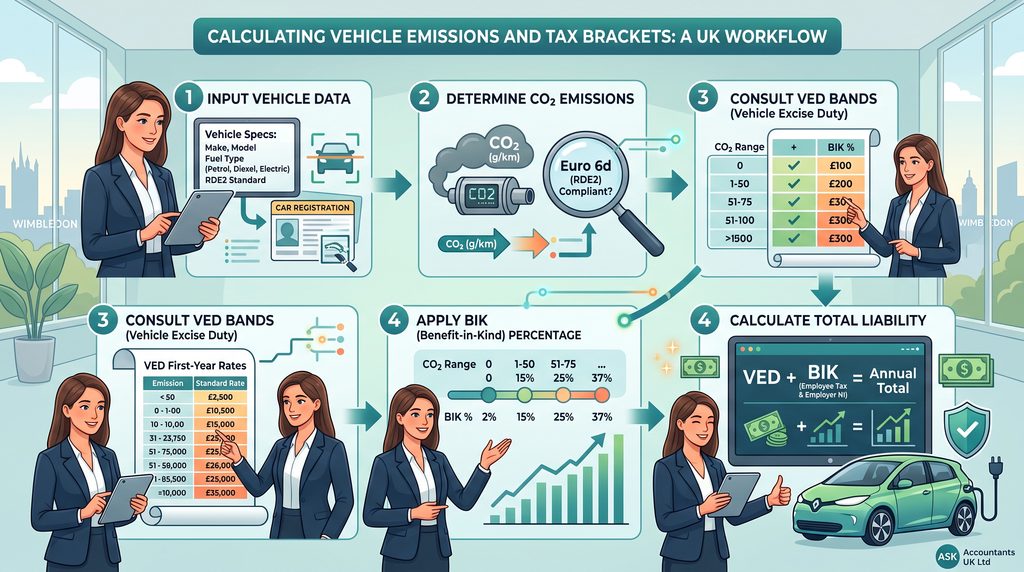
The value of this benefit is not based on what the vehicle is currently worth. Instead, it is calculated using a specific formula. The formula takes the original list price of the car and multiplies it by a percentage determined by the vehicle’s carbon dioxide emissions. The resulting figure is added to the employee’s taxable income for the year. The employee pays Income Tax on this amount, and the employer pays Class 1A National Insurance contributions.
Navigating HMRC Company Car Rules and Deadlines
The HMRC company car rules dictate how these benefits must be reported. Employers are responsible for submitting P11D forms for every employee who receives a taxable benefit. The reporting period follows the standard tax year, running from the 6th of April to the 5th of April.
You must submit these P11D forms to HMRC by the 6th of July following the end of the tax year. In addition to the forms, you must calculate and pay the employer’s Class 1A National Insurance by the 22nd of July (or the 19th of July if you still pay by post). Missing these deadlines is a very common issue for busy startups and landlords managing property companies.
Record-keeping is another critical area. Most VAT-registered businesses must comply with Making Tax Digital (MTD) rules, though there are limited exemptions for specific types of businesses. While MTD currently focuses on VAT and Income Tax, maintaining pristine digital records of all vehicle expenses is essential. If you make a mistake or pay late, the financial consequences are strict. Late-payment interest begins on day 1. First penalties arise at day 15 and increase at day 30. Therefore, staying organized and using cloud accounting software like QuickBooks or Xero is your best defense against unexpected costs.
How Electric Company Car Tax Changes the Game
In recent years, the government has used the tax system to push businesses toward greener transport. The result is that electric company car tax is currently the most attractive tax incentive available to UK SMEs. If you purchase or lease a fully electric vehicle, the tax savings can be transformational for your cash flow.
The Benefit in Kind rate for vehicles with zero emissions is fixed at a remarkably low 2% until April 2025. Following that, it will increase by a mere 1% each year until it reaches 5% in 2028. This long-term visibility allows you to plan your business growth and your fleet with confidence.
Let us look at a practical example. Imagine you choose a brand new electric vehicle with a list price of fifty thousand pounds. At a 2% rate, the taxable benefit value is just one thousand pounds for the year. A higher-rate taxpayer (paying 40% income tax) would only pay four hundred pounds over the entire year to drive a premium vehicle.
Now, compare this to a petrol or diesel car with the exact same list price. A high-emission vehicle could fall into the maximum 37% tax bracket. The taxable benefit would be eighteen thousand, five hundred pounds. The same higher-rate taxpayer would owe over seven thousand pounds in Company Car Tax for that year. The difference is staggering.
Beyond the Benefit in Kind savings, companies can often claim 100% First Year Allowances on new electric cars. This means you can deduct the entire cost of the car from your pre-tax profits in the year of purchase. This dramatically reduces your Corporation Tax legally. When you factor in the lower running costs and government grants for charging points, going electric is highly recommended.
Salary Sacrifice Schemes: A Win-Win Strategy
Many forward-thinking businesses in the UK are adopting salary sacrifice schemes for their vehicles. This is an arrangement where an employee agrees to reduce their gross salary in exchange for a fully expensed company car. Under normal circumstances, HMRC rules prevent you from gaining a tax advantage by swapping salary for a benefit.
However, there is a special exemption for ultra-low emission vehicles emitting 75 grams of CO2 per kilometre or less. Fully electric cars fit perfectly into this category.
Through an electric vehicle salary sacrifice scheme, the employee saves Income Tax and National Insurance on the portion of their salary they gave up. They do have to pay the standard Company Car Tax based on the low 2% rate, but the net saving is still highly attractive. Meanwhile, the employer saves on Employer National Insurance contributions because the overall gross payroll is lower. This strategy helps small businesses attract and retain top talent without offering massive cash bonuses.
Common Errors and Record-Keeping Risks
Even with the best intentions, it is easy to make mistakes when managing vehicle benefits. The rules are dense, and an unexpected HMRC tax investigation is something every business owner wants to avoid. Here are three common errors and record-keeping risks that you need to actively manage.
1. Incorrectly Calculating the P11D Value
The list price used for tax purposes is rarely the price you actually paid. The P11D value must be the manufacturer’s official list price on the day the car was registered. It must include the cost of delivery, standard number plates, and VAT. It must also include any optional extras fitted to the car, such as upgraded wheels or a premium sound system. Business owners often use the discounted price they negotiated with the dealer. This results in under-reported values and incorrect tax codes for employees.
2. Mishandling Pool Cars
A pool car is a vehicle kept at the business premises, shared by multiple employees, and strictly never used for private journeys. Because there is no private use, a pool car does not trigger a Company Car Tax liability. However, you must maintain exhaustive digital logs proving the vehicle remains at the office overnight. If an employee takes the car home because they have an early meeting the next day, HMRC may challenge the pool car status. Without bulletproof mileage logs, you risk creating a heavy tax burden retroactively.
3. Misunderstanding Fuel Benefits
If you provide a vehicle and also pay for the fuel the employee uses for private travel, you trigger a separate fuel benefit charge. This is a very expensive addition to the employee’s tax bill. The calculation uses a flat multiplier set by the government, meaning the employee could pay more in tax than the fuel is worth. The rules around claiming VAT on fuel, business entertainment travel, and mixed-use journeys are highly nuanced. There are exceptions and partial recovery rules that apply depending on the specific journey. You should always seek specific business advisory advice before deciding to cover private fuel costs.

Your Step-by-Step Company Car Tax Workflow
Managing your fleet smoothly requires a proactive approach. Do not leave these tasks until the end of the tax year. Follow this structured checklist to mitigate the risk of errors and ensure your business remains compliant.
- Step 1: Pre-Purchase Research. Before signing any lease or purchase agreement, verify the exact CO2 emissions and the official list price. Use this data to project the tax costs for both the business and the driver.
- Step 2: Employee Agreements. Ensure you have clear, written agreements with your staff regarding private use. If they are paying a contribution toward the private use of the car, ensure this is documented (as it can lower the taxable benefit value).
- Step 3: Implement Digital Tracking. Do not rely on paper logbooks. Provide your team with a smartphone app to log business miles. This ensures you have clear evidence of all journeys.
- Step 4: Review Tax Codes. When a new vehicle is provided, advise the employee to update the estimated benefits in their personal tax account. This helps HMRC adjust their tax code immediately, preventing a large shock bill at the end of the year.
- Step 5: Year-End Preparation. Schedule a review of all fleet data in early June. Cross-check your mileage logs with fuel receipts.
- Step 6: Submit P11D Forms. Ensure all declarations are filed securely through your accounting software well before the July 6th deadline.
Integrating these steps into your routine bookkeeping services will save you immense stress down the line.
Why Outsourcing Tax Management is a Smart Investment
Handling complex tax legislation is not why you started your business. As an SME owner, your focus should be on winning new clients, improving your services, and growing your revenue. Trying to decode the latest government updates on vehicle emissions takes you away from these core activities.
Working with a certified professional can reduce administrative burden significantly. A dedicated accountant helps improve accuracy across your entire financial operation. We manage the P11D submissions, calculate the precise National Insurance liabilities, and integrate everything into your payroll management smoothly. We also review your future vehicle plans to ensure you are maximizing available reliefs and avoiding unnecessary expenses. Letting an expert manage your compliance ensures you have peace of mind and accurate financial forecasts.
About ASK Accountants UK Ltd
At ASK Accountants UK Ltd, we believe that high-quality financial advice should be accessible, clear, and actionable. We have 15 years of experience supporting SME owners, startup founders, and landlords across Wimbledon and South-West London. We understand the daily pressures you face, and we are committed to helping you build a profitable, sustainable business.
Whether you need help transitioning your fleet to electric vehicles, managing complex payroll benefits, or optimizing your Corporate Tax planning, our team is ready to assist. We pride ourselves on offering personalized service without the confusing jargon.
Do not let the complexities of Company Car Tax hold your business back. Call us today on 020 8543 1991 to speak with one of our experts. You can also visit our office at 178 Merton High St for a face-to-face consultation. If you prefer to reach out online, please visit our Contact Us page to book an appointment.
Frequently Asked Questions About Company Car Tax
How do HMRC rules apply to hybrid vehicles?
The rules for hybrid vehicles depend entirely on their electric range and CO2 emissions. For a plug-in hybrid with very low emissions, the tax bracket is determined by how many miles the car can travel on battery power alone. A hybrid that can travel over 130 miles electrically will have a much lower tax rate than one that only manages 30 miles. You must check the exact manufacturer specifications.
Can a sole trader or partnership have a company car?
The Benefit in Kind rules are specifically designed for directors and employees of limited companies. If you operate as a sole trader or a standard partnership, you are taxed differently. You will calculate the percentage of your vehicle expenses that relate strictly to business use, and you will deduct that portion from your trading profits. For precise definitions and claiming guidelines, always consult the official guidance on GOV.UK.
What happens if I stop using the vehicle halfway through the year?
If a vehicle is returned or becomes unavailable to the employee for a continuous period of 30 days or more, the Company Car Tax charge is apportioned. You will only pay tax for the exact number of days the vehicle was officially available for private use. You must update your payroll software to reflect this change in availability so the employee’s tax code can be corrected.