
If you are losing sleep over voluntary VAT registration UK rules before your turnover hits £90,000, you are certainly not alone. Many SME owners, startup founders, and landlords across South-West London ask us this exact question every week. Registering early can unlock valuable tax refunds on your startup costs. At the same time, it introduces quarterly filing deadlines and digital record-keeping duties. Making the wrong call can squeeze your profit margins or add unnecessary admin to a busy week. In this guide, we break down the rules, weigh the real pros and cons, and help you decide if registering early makes sense for you.

What Are the Core Rules for Voluntary VAT Registration UK?
Under current GOV.UK VAT registration rules, you must register for VAT if your taxable turnover exceeds £90,000 in any rolling 12-month period. You must also register if you expect it to go over £90,000 in the next 30 days. Below that £90,000 mark, you can opt into voluntary VAT registration UK at any time, provided you make (or intend to make) taxable supplies.
Once registered, you must charge VAT (usually 20% at the standard rate) on your taxable sales. You will also submit regular VAT Returns to HMRC. Most VAT-registered businesses must follow Making Tax Digital (MTD) for VAT rules. This means keeping digital records and filing returns through HMRC-compatible software like Xero or QuickBooks. Note that HMRC grants limited exemptions from MTD. You may qualify if digital record-keeping is impractical due to age, disability, location, or religious beliefs, or if your business is in insolvency. Check the official criteria in the GOV.UK MTD exemption guidance.
It is also vital to understand how HMRC handles late payments. Under HMRC’s penalty regime, late-payment interest begins on day 1 after your due date. If your VAT remains unpaid, first penalties arise at day 15 (charged at 3% of the VAT owed). Those penalties increase at day 30, alongside daily interest charges. You can check the exact timeline in the GOV.UK late payment penalties guide. Staying organised from day one helps you avoid these extra costs.
Should I Register for VAT Voluntarily? Key Factors to Consider
Asking yourself “should I register for VAT voluntarily” comes down to two things. First, who are your customers? Second, how much VAT do you pay on your own costs? Before you apply using our online VAT registration guide, look closely at your customer base.
- You sell mainly to VAT-registered businesses (B2B): Your corporate clients can usually reclaim the VAT you charge them. Adding 20% VAT to your invoices does not make you more expensive to them. Meanwhile, you get to reclaim VAT on your own business purchases.
- You sell mainly to the general public (B2C): Individual consumers and non-registered businesses cannot reclaim VAT. If you register early, you face a tough choice. You must either raise your prices by 20% or absorb the VAT out of your profit margin.
- You sell zero-rated goods or services: Some items carry 0% VAT, such as most food, children’s clothing, and books. If your suppliers charge you 20% VAT, registering early often puts you in a regular VAT repayment position with HMRC.
- Your startup costs are high: New businesses often spend heavily on equipment, stock, or fit-outs. Registering early lets you reclaim the input VAT you have paid out.
Advantages and Disadvantages of VAT Registration Before £90,000
Weighing the advantages and disadvantages of VAT registration helps you look past the headline numbers. A quick tax refund looks great on paper. However, it can create pricing headaches if your market is price-sensitive.
Advantages of Registering Early
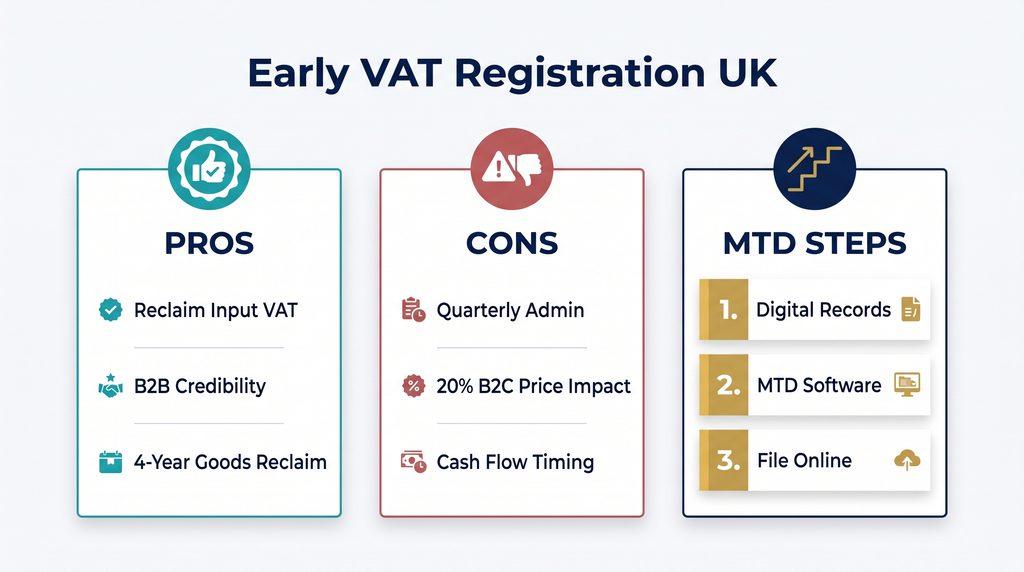
- Reclaiming input VAT on expenses: You can recover VAT paid on qualifying tools, software, stock, and professional fees. This directly improves your cash flow.
- Professional credibility: Showing a VAT number on your invoices can signal to larger clients that your business is well established, even if your turnover sits below the VAT registration threshold.
- Pre-registration VAT recovery: You can potentially recover VAT paid on certain startup purchases made before your registration date.
Disadvantages of Registering Early
- Higher administrative burden: You must issue compliant VAT invoices and keep digital records under MTD. You also have to file quarterly returns (or monthly returns if you choose).
- Reduced price competitiveness for B2C: Many competitors below £90,000 are not VAT-registered. Charging an extra 20% to retail customers can make your quotes look expensive.
- Cash flow timing: Under standard VAT accounting, you pay VAT to HMRC based on your invoice date. That applies even if your customer pays late, unless you use the Cash Accounting Scheme.
Reclaiming VAT Before Registration: How Far Back Can You Go?
One of the biggest draws of registering early is reclaiming VAT before registration. Many founders spend thousands on laptops, machinery, legal fees, and stock before they ever send an invoice. HMRC lets you claim back some of this pre-registration VAT on your first VAT Return. You just need to meet the conditions in the GOV.UK expense reclaim rules.
Here are the standard time limits:
- Goods (up to 4 years): You can reclaim VAT on goods bought up to 4 years before your registration date. You must still own them and use them in your business (or have used them to make other goods you still hold).
- Services (up to 6 months): You can reclaim VAT on services bought up to 6 months before your registration date. Those services must relate to your ongoing VAT-taxable business activities.
To make a valid claim, you must hold proper VAT invoices. Your records must also show the purchases were for business use. For a deeper breakdown of eligible claims, read our guide to reclaiming VAT for business savings.
Common Errors and Record-Keeping Risks with Voluntary VAT Registration UK
Even careful business owners can trip over technical VAT rules once they register. Rather than viewing these as guaranteed audit triggers, think of them as common errors and record-keeping risks. Avoiding them prevents unexpected tax bills and stressful HMRC enquiries.
1. Misunderstanding Business Entertainment and Vehicle Rules
Many directors assume they can reclaim VAT on every business receipt. In reality, VAT recovery on business entertainment (like client lunches or hospitality) is generally blocked. Limited exceptions do exist for staff entertaining. Company vehicles are equally tricky. Input VAT on buying a car is usually blocked unless the car is used exclusively for business. Commercial vehicles, lease agreements, and fuel scale charges follow separate partial recovery rules. Because these rules are highly nuanced with strict exceptions and partial recovery calculations, you should always seek specific advice before claiming VAT on vehicles or entertainment.
2. Reclaiming VAT Without Valid Evidence
A credit card slip or a bank statement entry is rarely enough for HMRC. To reclaim input VAT, you generally need a valid VAT invoice. It must show the supplier’s VAT number, the date, and the VAT rate charged. Relying on incomplete receipts creates real risk during a compliance check.
3. Ignoring the Flat Rate Scheme or Cash Accounting Options
New registrants sometimes stick with standard VAT accounting without checking simpler options. Businesses with low costs may benefit from checking whether the VAT Flat Rate Scheme suits their margins. Meanwhile, service businesses with slow-paying clients often prefer Cash Accounting. That way, you only pay HMRC once your customer pays you.

Step-by-Step Workflow to Manage Voluntary VAT Registration UK
If the numbers stack up in your favour, follow this practical workflow to manage voluntary VAT registration UK smoothly:
- Run a margin and cash flow check: Model your B2B versus B2C sales split. Estimate how much input VAT you will recover over the next 12 months.
- Gather your pre-registration invoices: Pull together valid VAT receipts for goods bought in the last 4 years (still on hand) and services bought in the last 6 months.
- Choose the right VAT scheme: Pick between Standard VAT, Cash Accounting, or the Flat Rate Scheme based on your cash flow and supplier costs.
- Apply online with HMRC: Register through your Government Gateway account. Pick an effective registration date that protects your pre-registration reclaim window.
- Connect MTD-compatible software: Set up cloud accounting software like Xero or QuickBooks. Enter your 9-digit VAT number and link your bank feeds.
- Update your invoice templates: Make sure every sales invoice shows your VAT number, net amount, VAT rate, and gross total from your registration date.
- Set calendar reminders: Mark your quarterly filing and payment deadlines. They usually fall one calendar month and seven days after each VAT quarter ends. Staying ahead helps you avoid day 1 interest and day 15 penalties.
Why Outsourcing Your VAT Returns Is a Smart Investment
Managing voluntary VAT registration UK alongside running a growing company or property portfolio takes serious time. You have to check supplier invoices, apply partial recovery rules, and keep Making Tax Digital for VAT records current. It is very easy for busy founders to fall behind.
Outsourcing your VAT compliance to a qualified accountant can reduce your administrative burden. It frees up hours every month so you can focus on winning clients. A dedicated bookkeeping service paired with specialist VAT services helps improve accuracy across your digital ledgers. It also mitigates the risk of costly calculation errors or missed deadlines. For landlords and property investors juggling commercial versus residential VAT exemptions, tailored property accounting support is especially valuable.
Get Expert Help in Wimbledon and South-West London
If you are still unsure about voluntary VAT registration UK, let our team at ASK Accountants UK Ltd take the guesswork out of it. We are Chartered Certified Accountants with 15 years of experience helping SMEs, startup founders, and landlords in Wimbledon and across South-West London navigate HMRC rules with confidence.
We can run the numbers on your pre-registration VAT reclaims, set up Xero or QuickBooks, or handle your quarterly VAT returns for you. Call us today on 020 8543 1991, visit our office at 178 Merton High St, Wimbledon, London SW19 1AY, or reach out via our contact page to book a consultation.
Frequently Asked Questions (FAQs)
1. Can I deregister if voluntary VAT registration UK does not work out?
Yes. You can ask HMRC to cancel your VAT registration if your taxable turnover stays below the deregistration threshold (currently £88,000, as outlined on GOV.UK). Keep one rule in mind before you cancel. You may need to account for VAT on stock or assets you still own at deregistration if the VAT on them exceeds £1,000.
2. How long does it take to get a VAT number after applying?
HMRC typically processes online VAT applications within a few weeks. Checks can take longer if they ask for extra business details. While waiting for your VAT number, you cannot show VAT as a separate charge on your invoices. Instead, adjust your pricing temporarily or tell customers a VAT-only invoice will follow once your number arrives.
3. Does voluntary VAT registration apply to landlords with rental properties?
Most residential rental income is exempt from VAT. That means residential landlords generally cannot register for VAT or reclaim VAT on property repairs. Commercial property is different. Landlords can sometimes choose to “opt to tax” a commercial building to charge VAT on rent and reclaim VAT on refurbishment costs. Because property VAT rules are complex, always speak with an accountant before registering.