
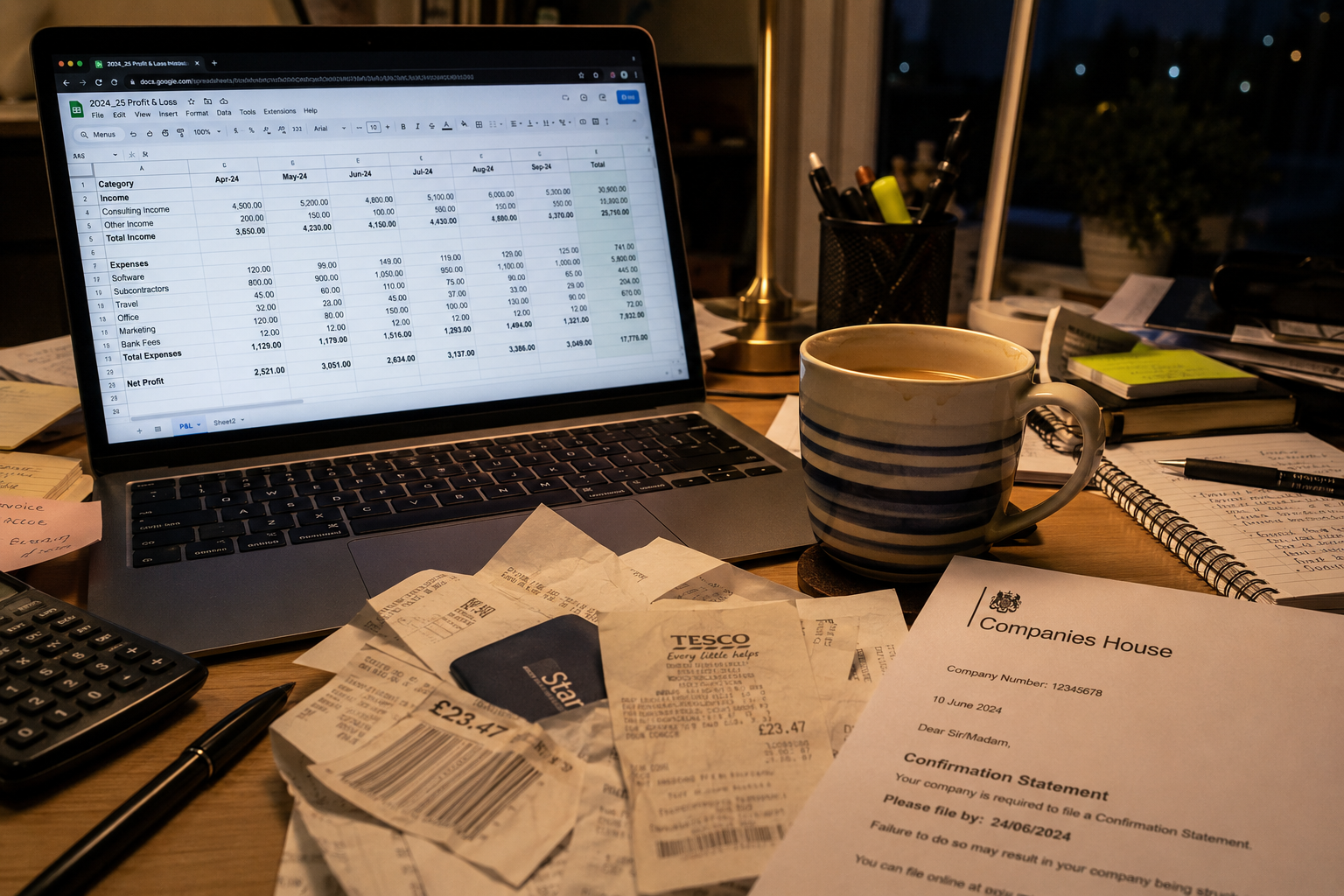
Ask any new company director what keeps them awake at three in the morning and you’ll get a fairly predictable shortlist. Cashflow. That weird email from HMRC. And — sooner or later — the slightly panicked question of what expenses can a limited company claim before this year’s corporation tax bill lands like a brick through the letterbox.
I’ve sat with dozens of directors over the years (sometimes at our office on Merton High Street, sometimes over a too-strong flat white) and the conversation almost always begins the same way: “I think I’ve been missing things.” Usually, they have. Sometimes by quite a lot.
So let’s actually do this properly. Not a checklist scraped off the back of an HMRC pamphlet. A real walk through what your company can legitimately deduct, the traps that catch even careful directors, and the bits the internet keeps getting wrong.
The Two Words HMRC Will Quietly Judge You On
Before anything else: wholly and exclusively. Memorise the phrase. Tattoo it somewhere sensible. Every single expense your limited company puts through has to clear that bar — meaning the cost was incurred entirely for the purposes of trade, not a hybrid of work and “ooh, while I’m at it, I’ll grab milk.”
The principle is laid out on HMRC’s own guidance, and although the page is written with sole traders in mind, the test applies just as ruthlessly to limited companies under Corporation Tax rules.
Dual-purpose costs get disallowed. That’s the rule that catches people. A laptop bought to “use for the business and the kids’ homework”? HMRC’s view is binary — either it’s clearly business with an evidenced split, or it’s nothing.
Right. With that out of the way, here’s what you can actually claim.
Salaries, Pensions and the Small Army You Might Not Realise You Have
Staff costs are the heaviest line on most P&Ls, and when you’re working out what expenses can a limited company claim, this is where the biggest deductions tend to live — wages, employer’s National Insurance, pension contributions, the lot. Even if your “staff” consists of you and the company dog.
This is also the area where most directors leave money on the table. Workplace pensions in particular. Through a limited company, you can make employer pension contributions and they’re an allowable business expense (within the annual £60,000 cap for the 2025/26 tax year). Done properly, this is one of the most tax-efficient moves a director can make — corporation tax saved on the way in, and the funds growing outside your estate.
We help a lot of directors structure this through our personal tax planning and auto enrolment services, and the difference between getting it right and “I’ll sort it next year” can run into thousands.
Training that’s relevant to the existing trade is also claimable. CPD courses, professional development, that AWS certification you’ve been putting off. Not — and people will try — a course in oil painting because you “find it relaxing for client work.” There’s a fuzzy line between updating existing skills (allowable) and acquiring brand-new ones (often disallowed as capital in nature), so when in doubt, ask.
A Roof, a Desk, and What Expenses a Limited Company Can Claim on Office Costs
Rent on commercial premises is straightforward — fully deductible. Same with business rates, electricity, water, cleaning, the lot.
But here’s where it gets interesting for the bulk of small UK limited companies that operate at least partly from a spare room.
Home office: the £6 a week shortcut
HMRC lets you claim a flat £6 per week (£312 a year) for working from home without keeping a single receipt. No proof, no fuss, no late-night spreadsheet sessions. It’s the path of least resistance — and the path most directors take, because honestly, who has time?
If your actual home running costs are higher and you can apportion them properly (by room and by hours used), you can claim a larger sum. A director I work with in Wandsworth runs about £2,800 a year through this calculation, all defensible. The key word being defensible.
Equipment, kit, and the AIA
Laptops, monitors, that ergonomic chair you finally caved and bought — capital expenditure, claimed under the Annual Investment Allowance. The AIA currently sits at £1 million per year, so unless you’re buying a private jet for the business (please don’t), you’ll get 100% tax relief in the year of purchase.
| Item | How it’s claimed | Rate (2025/26) |
|---|---|---|
| Laptops, computers, monitors | Annual Investment Allowance | 100% in year 1 |
| Office furniture & fittings | Annual Investment Allowance | 100% in year 1 |
| Vans (new or used) | AIA / capital allowances | 100% in year 1 |
| Cars — fully electric / zero emission | First Year Allowance | 100% in year 1 |
| Cars — higher CO₂ | Writing Down Allowance | 6% per year |
On the Road: Mileage, Travel and the Commute Trap
This is where directors get themselves into trouble most often when asking what expenses can a limited company claim around travel. The single biggest myth in this whole conversation is that you can claim your daily drive into the office. You cannot. Ordinary commuting from home to your normal place of work is never claimable — limited company or otherwise.

What you can claim is travel to temporary workplaces, client visits, off-site meetings, and anything else that’s clearly a business journey.
If you use your own car, HMRC’s approved mileage rates (AMAP) for 2025/26 are:
- 45p per mile for the first 10,000 business miles
- 25p per mile thereafter
- 24p per mile for motorcycles
- 20p per mile for bicycles (yes, really)
Keep a mileage log. Dates, destinations, purpose. HMRC adores asking for these during enquiries, and “trust me” is not a defence. Train fares, taxis, hotel rooms, airport parking, even subsistence on overnight trips — all in the pot, provided the trip was genuinely for business.
Phones, Broadband, and the Contract Trick Most Directors Miss
Want to claim your mobile phone bill in full? Put the contract in the company’s name. Done. The whole bill becomes an allowable business expense and there’s no benefit-in-kind charge — provided it’s the company’s contract, not yours.
If the contract is in your personal name, you can only claim itemised business calls. Which, given that most modern phone tariffs lump everything into a single monthly fee, often works out as approximately zero.
Same logic applies to broadband, though it’s rarer to have a household line solely in the company’s name.
Professional Services (the Bit Where We Have to Mention Ourselves)
Accountancy fees, legal advice, business consultancy, company secretarial costs — all allowable, provided they relate to the business rather than your personal affairs. If your accountant prepares your personal self-assessment alongside the company accounts, that portion is technically a benefit in kind and needs splitting out.
This is one of the more common areas where directors ask us what expenses can a limited company claim and then look mildly horrified at the answer. The cost of accounts and tax preparation reduces your corporation tax bill, yes. Same goes for bookkeeping fees. Even corporate tax planning work counts as a deductible cost — there’s a faintly amusing recursion to the fact that paying us to reduce your tax bill is itself a way of reducing your tax bill.
If you’re curious about typical fees, we wrote a separate piece on the cost of an accountant for a limited company which might save you a few awkward conversations.
⚠️ The trap most online articles miss: Fines and penalties are never allowable. That speeding ticket on the way to a client meeting? Doesn’t count. The late filing penalty from Companies House? Also not. HMRC takes a dim view of letting taxpayers deduct the cost of breaking rules. There’s a whole guide we keep updating on HMRC corporate tax return penalties if you’ve already had one of those love letters.
Marketing, Sponsorship, the Website Nobody Clicks On
Marketing expenses are broadly allowable — Google Ads, social campaigns, the redesigned website, business cards (do those still exist?), trade show fees. As long as it’s promoting the business and not, say, your personal Instagram, it goes through.
Sponsorship is a slightly trickier beast. HMRC will look at whether there’s a genuine commercial benefit. Sponsoring your local Sunday league team where you also happen to play? Expect questions. Sponsoring a community event with branded signage that drives visible enquiries? Generally fine.
Pensions, Insurance, and the Bits People Forget
Once you’ve got the basics nailed, the answer to what expenses can a limited company claim starts widening into territory most directors haven’t explored. Beyond pensions (covered above), the company can pay for:
- Business insurance — public liability, professional indemnity, employer’s liability, contents
- Cyber insurance — increasingly common, fully allowable
- Key person insurance — allowable, but the tax treatment of any payout gets complicated; worth a chat before setting up
- Private medical insurance — allowable as a company cost but triggers a benefit in kind, with employer NIC at 15% for 2025/26
- Eye tests and glasses — if required for screen work, claimable without BIK
- Annual director health check — one per year, broadly OK
The £150 Staff Do (and the £50 Trivial Benefit Nobody Talks About)
Two of the most underused reliefs in the entire UK tax code, and both are accessible to even single-director companies.
Annual staff event allowance: Up to £150 per head, per year, for an annual function open to all staff. Christmas party. Summer barbecue. Whatever. If the cost per attendee stays under £150 (including VAT and any partners brought along), it’s tax-free for everyone and a deductible expense for the company.
Go a penny over £150, though, and the whole amount becomes a benefit in kind. Not just the excess. The whole thing. So watch the maths.
Trivial benefits: Gifts to employees of £50 or less (per gift, including VAT) that aren’t cash, aren’t a reward for performance, and aren’t in any contract. Birthday flowers. A bottle of wine. A John Lewis voucher. Directors are capped at six trivial benefits per year (£300 total), but for an average two-director company that’s a tidy £600 of tax-free benefit annually.
What You Absolutely Cannot Claim as a Limited Company Expense (and Yet People Try)
Let me save you some HMRC heartburn. The following are not allowable, no matter how creatively you frame them:
- Client entertainment — meals, drinks, hospitality boxes. Recorded in the books, but added back when calculating corporation tax. Doesn’t reduce the tax bill.
- Your daily commute.
- Everyday clothing — suits, even “for client meetings.” Branded uniform or genuine protective gear is fine; the rest is not.
- Speeding fines, parking fines, late filing penalties.
- Personal expenses dressed up — gym memberships, family holidays “for inspiration.”
- Drawings — these aren’t expenses, they’re dividends or salary.
- Double-counting capital expenditure — depreciation versus capital allowances; you pick one.
Now, knowing what expenses can a limited company claim is only half the battle. The other half is having the paperwork to prove it when somebody asks. Here’s a quick reference table — and yes, the formatting’s slightly rough around the edges. That’s how real reference sheets look when you’ve actually used them.
| Expense Type | Allowable? | Things to Watch |
|---|---|---|
| Staff salaries & employer NIC | Yes | Must be genuine work; market-rate for family members |
| Workplace pension contributions | Yes | £60,000 annual allowance applies |
| Mileage (own car) | Yes | 45p / 25p split; mileage log required |
| Home office flat rate | Yes | £6 per week, no receipts |
| Mobile phone | Yes (if contract in company name) | Personal contracts get messy |
| Client entertainment | Recorded but disallowed for CT | VAT also not reclaimable |
| Annual staff party | Yes, up to £150/head | Cliff-edge — £150.01 = whole lot taxable |
| Trivial benefits | Yes | £50 cap per benefit; £300/year director cap |
| Training relevant to trade | Yes | New skills vs existing — debatable line |
| Speeding/parking fines | No | Never. Don’t even ask. |
| Eye tests for screen work | Yes | Glasses only if exclusively for VDU use |
Pre-Trading Expenses: The Bit Nobody Told You About
Here’s a free one. Anything you spent in the seven years before incorporation that would have been an allowable expense had the company existed at the time? You can claim it. Domain registration, that consultancy you paid for to validate your idea, even the laptop you bought “before deciding to go limited.”
The treatment is that these costs are deemed to be incurred on the first day of trading. A tidy bit of relief most new directors miss entirely.
Records, Records, Records
I’ll keep this short because nobody enjoys reading about record-keeping.
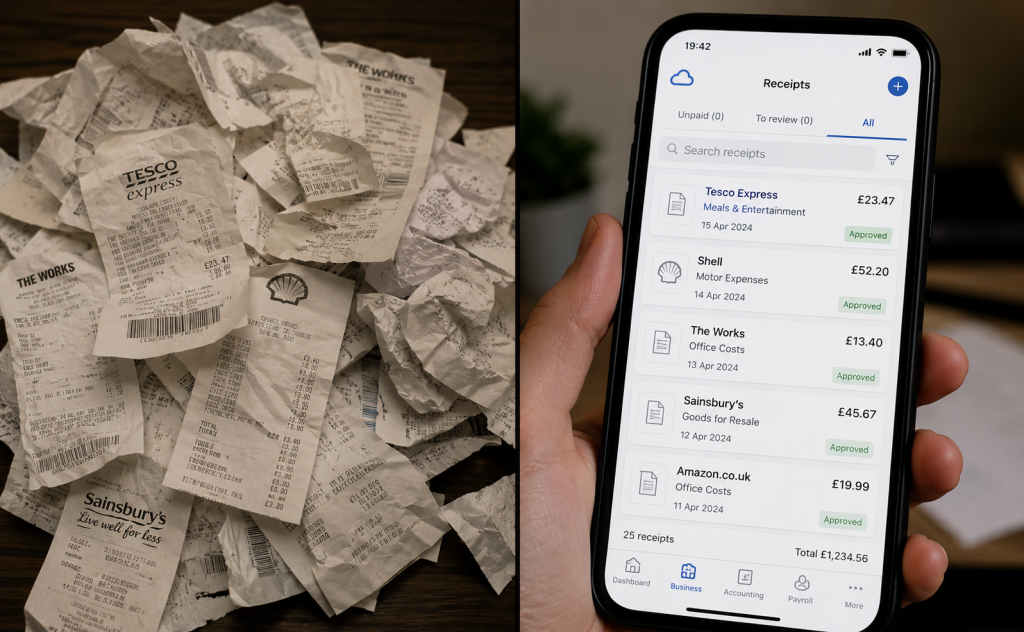
Whatever you’ve claimed, you’ll need to prove it. The honest truth about what expenses can a limited company claim is that the rules are only half the story — proof is the other half. Limited companies must keep their books for six years from the end of the financial year. HMRC can open an enquiry within that window, and “I can’t find the receipt” is the fastest route to a disallowed claim and an additional tax bill.
Digital is fine. Photographs of receipts are fine. Just keep them somewhere that isn’t a damp shoebox. Honestly, this is half the reason we push directors toward cloud accounting — every receipt scanned, every claim categorised, every audit trail intact.
If HMRC do come knocking, our HMRC investigations team has seen most of what they ask for. The directors who sleep through these enquiries are the ones who got their record-keeping right years before the letter arrived.
VAT, by the Way
Quick note for the VAT-registered: most of the allowable expenses above also let you reclaim input VAT, provided you’ve got a valid VAT invoice. The notable exceptions — and these catch people out — are client entertainment (no VAT recovery) and most cars (no VAT recovery on purchase, partial on leasing). Our VAT team handles the awkward edges where the rules genuinely don’t make sense at first reading.
An Honest Word Before You Go
If you’ve made it this far, you’ll have noticed that what expenses can a limited company claim isn’t really one question — it’s about thirty, layered, with rules that shift slightly each tax year. The £150 staff allowance, the 45p mileage rate, the £60,000 pension cap, the six-year retention rule, the wholly-and-exclusively test — none of these are intuitive on first read.
So if you’d like a second pair of eyes on your expense policy, or you suspect you’ve been understating claims for a year or two (it happens — a lot), Ask Accountants UK Ltd is at 178 Merton High St, London SW19 1AY, and the kettle is usually on. 020 8543 1991, or pop in via our contact page and we’ll set up a chat. No invoice for the conversation.
We also help with business advice, tax compliance, self-assessment, company secretarial work, and the day-to-day bookkeeping most directors would rather not think about.
Frequently Asked Questions
Can a limited company claim food and drink as an expense?
Only when it’s part of business travel — i.e. you’re away from your normal workplace overnight or for a clearly business trip. Lunch at your desk doesn’t qualify. Coffee with a client falls into entertainment territory (recorded but added back for CT).
Can I claim clothing as a limited company expense?
Only if it’s genuine protective equipment, uniform, or branded workwear that wouldn’t be worn outside work. A suit, however smart, doesn’t count — even if you only wear it to client meetings.
What expenses can a limited company claim before it starts trading?
Pre-trading expenses incurred up to seven years before the trade began can be claimed on the first day of trading, provided they would have been allowable had the company already existed.
Are dividends an allowable limited company expense?
No — dividends are a distribution of post-tax profit, not a business expense. They don’t reduce corporation tax in any way.
Can I claim my home mortgage as a limited company expense?
The capital repayment, no. A proportion of mortgage interest may be allowable if you can evidence a genuine business-use split, but most directors find the £6/week flat rate simpler and HMRC-safe.
How long should I keep records of what expenses a limited company can claim?
Six years from the end of the financial year for limited companies. Digital copies are accepted by HMRC, so a phone snap of every receipt is enough provided it’s stored somewhere durable.
Is VAT on business expenses reclaimable?
If your company is VAT-registered, yes — for most legitimate business expenses, with notable exceptions including client entertainment and cars in most cases.
Can I claim a company Christmas party as an expense?
Up to £150 per head per year, including VAT and the cost of any plus-ones. Go over by even a penny and the entire amount becomes a taxable benefit.
What about gifts to clients?
Allowable only if the gift carries a clear advert for your business, costs under £50 per client per year, and isn’t food, drink, tobacco or a voucher.