
If you’ve been treating your tax return like a once-a-year dental appointment — something you dread, postpone, then panic about in January — I have some news that will either ruin your weekend or, if you read on, possibly save your skin. The Making Tax Digital deadline 2026 is no longer a vague threat looming on a government press release. It’s here. 6 April 2026 is the day the rules change for hundreds of thousands of sole traders and landlords across the UK, and HMRC has stopped postponing it.
I’ve spent a long time in client meetings watching faces go from polite curiosity to mild alarm when this topic comes up, and the alarm is, frankly, warranted. The shift from one annual Self Assessment return to four quarterly updates plus an end-of-year declaration is not a tweak. It’s a new rhythm. A new mindset. And for plenty of small businesses we’ve worked with at Ask Accountants UK Ltd, it’s the first time digital recordkeeping has stopped being optional and started being the law.
Let’s untangle what’s actually happening, who’s caught in the net, and what you can do this week (yes, this week) to avoid the kind of mess that ends in penalty points and unflattering letters from Whitehall.
So What Is This Whole Making Tax Digital Thing, Really?
Making Tax Digital — MTD if you’re tired of typing it — is HMRC’s long-running project to drag UK tax reporting into something resembling the 21st century. VAT got it first, back in 2019. Income tax is next. And the Making Tax Digital deadline 2026 specifically refers to MTD for Income Tax Self Assessment, or MTD ITSA if you enjoy acronyms.
Here’s the short version: instead of one annual tax return summarising the year, you’ll keep your records digitally — in software HMRC has tested and recognised — and send four quarterly updates plus a Final Declaration. The annual Self Assessment as you’ve known it is being quietly dismantled for those affected.
Why? HMRC argues it cuts errors and gives taxpayers a clearer view of what they owe throughout the year. Critics argue it’s a fair bit of admin disguised as simplification. Both can be true.
Who Actually Has to Worry About 6 April 2026?
This is the question I get more than any other, and the answer is more specific than people assume. From April 2026, MTD ITSA applies to:
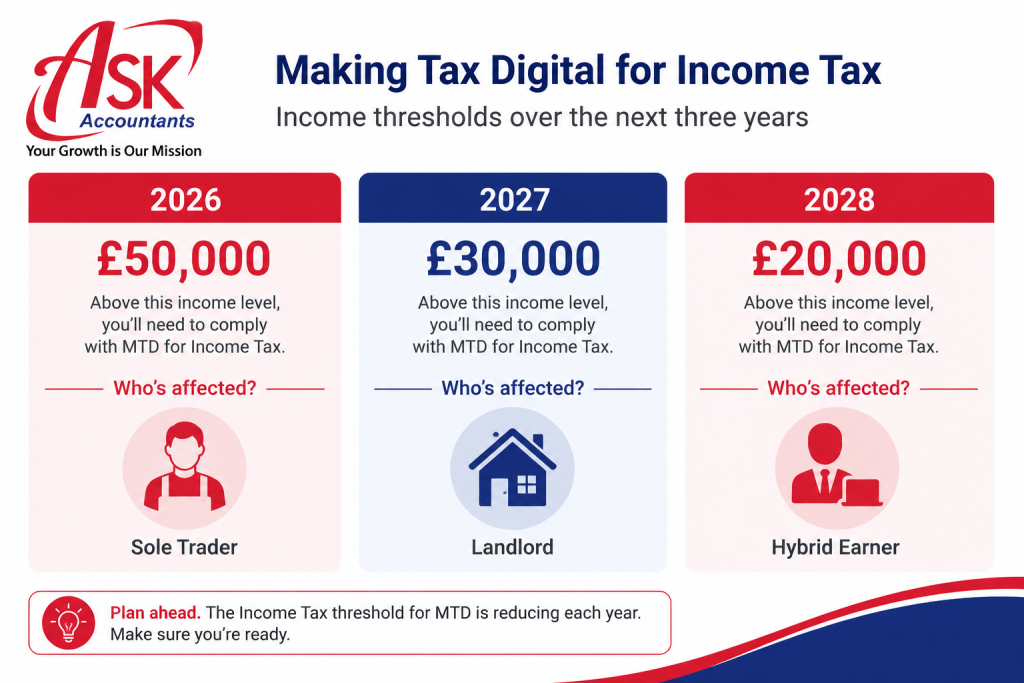
- Sole traders and landlords with qualifying income above £50,000 in the 2024/25 tax year
- Combined gross income from self-employment and/or UK property — added together, not separately
- “Gross” means total turnover before expenses, not your profit
If you ran a side-hustle that turned over £28,000 and rented out a flat bringing in £23,000, your qualifying income is £51,000 — and yes, you’re in scope. HMRC bases this assessment on the figures shown on the Self Assessment return due 31 January 2026 (covering the 2024/25 tax year). If you crossed the threshold there, expect a letter. Many were sent in late 2025 and early 2026.
The threshold is also being lowered in stages, so even if you’ve dodged it this round, the calendar is closing in:
| Start Date | Qualifying Income Threshold | Who’s In Scope |
|---|---|---|
| 6 April 2026 | Above £50,000 | Sole traders & landlords (Phase 1) |
| 6 April 2027 | Above £30,000 | Phase 2 — medium earners |
| 6 April 2028 | Above £20,000 | Phase 3 — most self-employed and landlords |
What doesn’t count toward that threshold? PAYE wages from your day job. Pensions. Dividends. Bank interest. Investment income. The test is only trading income and property income — combined.
Quick reality check: If you’re a director taking dividends and a small salary, with no other trading or rental income, you’re probably outside MTD ITSA entirely. The traditional Self Assessment route still applies to you. Don’t panic-buy software you don’t need.
The Bit That Trips People Up: What “Digital Records” Actually Means
This is where good intentions tend to fall apart. “Digital records” doesn’t mean a tidy Excel spreadsheet on your laptop (sorry, I know). It means records kept in software that HMRC officially recognises as MTD-compatible.
The software needs to do three things:
- Store your income and expense data in a digital format
- Connect to HMRC via something called an Application Programming Interface (API)
- Submit your quarterly updates and Final Declaration on your behalf
There’s also a rule about “digital links” — your data has to move between systems electronically, without you copying and pasting it across. If your bookkeeper hand-types your figures into another piece of software at quarter-end, technically that breaks the chain.
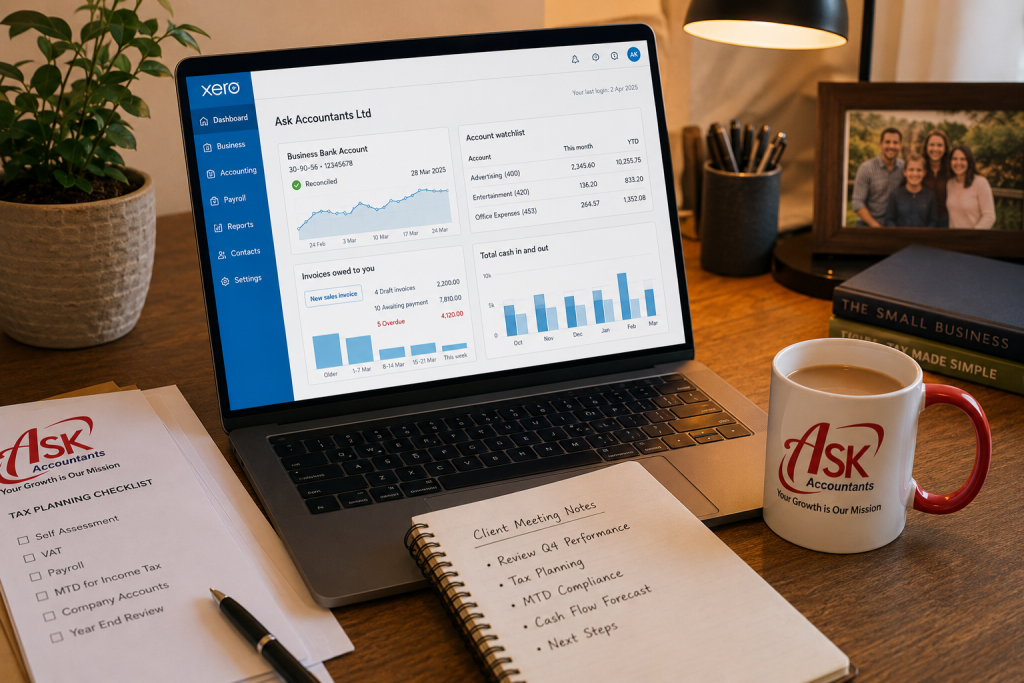
HMRC keeps a current list of recognised products on the GOV.UK compatible software page. Big names you’ll see: Xero, QuickBooks, FreeAgent, Sage, plus a wave of cheaper or free tools like QuickFile and bridging utilities for spreadsheet diehards.
I won’t tell you which to pick — that depends on whether you’ve got bank feeds, multiple income streams, or a soft spot for cloud accounting (which we have written about here if you’re curious). What I will say: don’t sign a 12-month contract on something pretty without testing it against your actual records first.
When You Submit, and What It Looks Like
Quarterly updates run on the tax year, not your accounting year. That trips people up, particularly landlords who’ve been used to thinking in calendar months.
The standard tax-year quarters and deadlines are:
| Quarter Covers | Submission Deadline |
|---|---|
| 6 Apr – 5 Jul | 7 August |
| 6 Jul – 5 Oct | 7 November |
| 6 Oct – 5 Jan | 7 February |
| 6 Jan – 5 Apr | 7 May |
So your first quarterly update under the Making Tax Digital deadline 2026 rollout is due 7 August 2026, covering 6 April to 5 July 2026. That’s not loads of time after the financial year kicks off — which is why the prep work matters now.
You can elect to use calendar quarters instead (1 Jan to 31 Mar, etc.) if your business runs cleaner on month-end dates. That election is per business, and most software lets you toggle it. Personally, I find calendar quarters easier to align with bank statements, but it’s horses for courses.
Then there’s the Final Declaration — the digital replacement for the annual Self Assessment summary. It pulls in everything: your quarterly figures, plus other income (savings, dividends, employment), allowances, claims, the lot. Due by 31 January after the tax year ends. Same deadline as the old Self Assessment, then. The familiarity is small comfort, but it’s something.
The Penalty System Has Changed Too (and Not Gently)
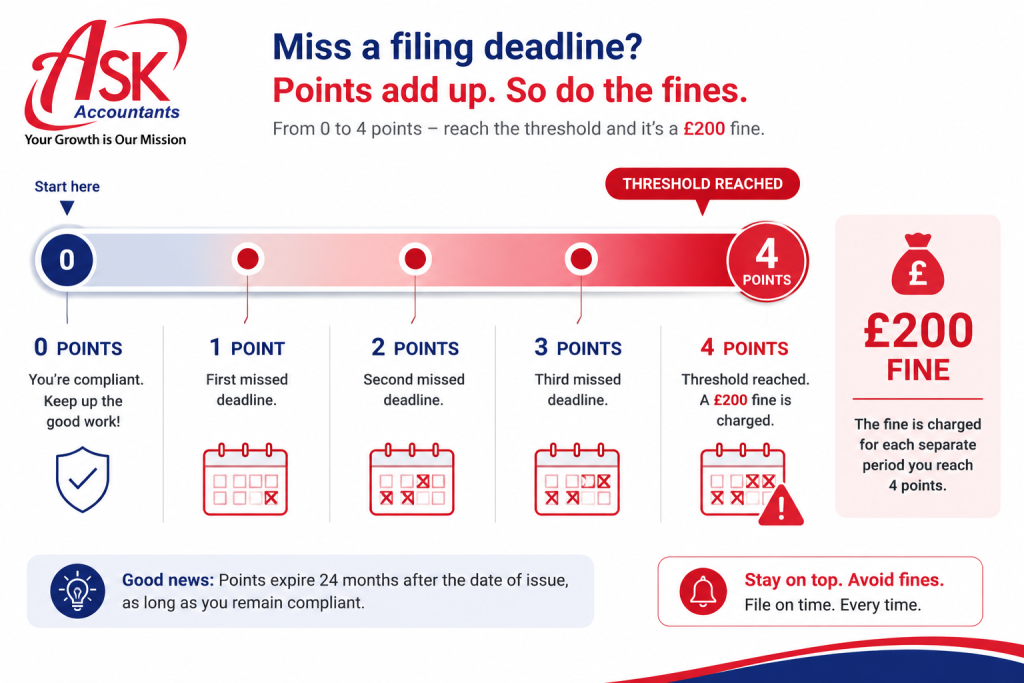
The old £100-after-one-day late fee is gone for those in MTD ITSA. In its place: a points system. Charming, isn’t it?
Every missed deadline — quarterly update or Final Declaration — earns one point. Hit four points and you get a £200 penalty. Each additional missed submission after that? Another £200. The points stay on your record until you complete a “compliance period” — for ITSA, that’s 24 months of on-time filing to wipe the slate clean.
There’s a “soft landing” period for the 2026/27 tax year where HMRC has indicated some flexibility on quarterly update penalties, but don’t bank on it being generous. Late payment penalties operate on a separate, harsher track: 3% of unpaid tax at day 15, another 3% at day 30, plus 10% annualised interest accruing daily after that (rates correct under the 2025/26 regime).
The Practical Stuff: What to Actually Do Before April
Here’s the bit you can take to the bank — the actual sequence we walk clients through at our office on Merton High Street. It’s not glamorous. It works.
1. Check whether you’re caught. Look at your 2024/25 Self Assessment figures. Add up your gross self-employment and gross rental income. Over £50,000? You’re in for 2026. Borderline? Get a second pair of eyes on it.
2. Sign up with HMRC. You can sign up voluntarily now — and frankly, a dry run before April is the most useful thing you can do. There’s no hard registration deadline yet, but your first quarterly update is due 7 August 2026 regardless. Better to discover your software doesn’t talk to HMRC in June than in late July.
3. Pick your software. Run a free trial. Connect a bank feed. Categorise a month of transactions. If it’s painful in May, it’ll be agony in August.
4. Sort out your bookkeeping process. This is where many sole traders genuinely struggle — the shoebox-of-receipts approach doesn’t survive quarterly reporting. Our bookkeeping service exists for exactly this reason, but whether you do it yourself or hand it off, you need a system that captures transactions weekly, not annually.
5. Diarise the deadlines. Set calendar alerts a fortnight before each quarterly due date. Treat them like VAT returns — non-negotiable.
6. Talk to an accountant if any of this is uncomfortable. Genuinely. The cost of a half-hour conversation now is dramatically less than the cost of getting it wrong twice.
A Word on VAT and the Wider Picture
If you’re already running a VAT-registered business, Making Tax Digital isn’t entirely new. You’ve been on MTD for VAT since 2019 or 2022 depending on turnover, and that regime continues unchanged. The 2026 deadline is the income tax expansion. We covered the VAT side in some detail in our MTD for VAT guide — worth a re-read if you’ve forgotten the basics.
For limited companies, MTD for Corporation Tax has been delayed and is now not expected before April 2026 at the earliest, with most reliable forecasts pointing toward 2030 or later. So if you trade through a Ltd, the Making Tax Digital deadline 2026 doesn’t apply to your company’s corporation tax — only to your personal income if you also have qualifying self-employment or rental income.
Where Ask Accountants UK Ltd Fits In
We’re based at 178 Merton High Street in Wimbledon — small enough to know our clients’ names and remember which ones loathe spreadsheets, large enough to handle the more complex stuff. The work we do on MTD readiness ranges from “help me pick software and run my first quarter” to full-service Tax Compliance, Self Assessment, Cloud Accounting setup, and ongoing Bookkeeping that puts you ahead of every HMRC deadline rather than scrambling toward it.
We also help with HMRC Investigations (which become marginally more likely when you start submitting four times a year instead of once), Business Advice, CIS Claims, Personal Tax Planning, and the Company Secretarial work that keeps everything else above water.
If you’re staring at the Making Tax Digital deadline 2026 with that familiar sinking feeling, a conversation costs nothing. Call us on 020 8543 1991, or pop in. We’ll tell you straight whether you need to act, what you need to do, and roughly what it’ll cost — without selling you software you don’t need or scaring you about penalties that don’t apply.
Frequently Asked Questions
Will I still file a normal Self Assessment in January 2027? No — not the traditional one. The Final Declaration via your MTD-compatible software replaces it under the Making Tax Digital deadline 2026 rules. The deadline date (31 January) stays the same.
What if my income drops below £50,000 after I’m signed up? You can apply to leave MTD ITSA if your qualifying income falls below the threshold for three consecutive tax years. Until then, you stay in.
Can I still use a spreadsheet? Not on its own. You’d need bridging software to connect Excel to HMRC’s API and maintain digital links. Doable, but more fiddly than just using a proper cloud tool — though many landlords still prefer it.
Is there an exemption for digitally excluded people? Yes. HMRC allows exemptions on grounds of age, disability, remote location with poor broadband, or religious reasons. You apply directly to HMRC — it’s case-by-case and not granted lightly.
Will HMRC really fine me £200 for one missed quarterly update? Not for one. You need four points. But if you miss two quarterly updates plus the Final Declaration in your first year, you’re at the threshold and one more slip triggers the fine. The penalty system has changed — points accumulate before fines kick in.
What happens if I have employment income alongside self-employment? Your PAYE wages don’t count toward the qualifying income threshold. But once you’re in MTD ITSA, your Final Declaration includes employment income, dividends, investments — the full picture.
Do I have to use an accountant for MTD? Legally? No. Practically? It depends on your tolerance for software, deadlines, and HMRC error codes at 11pm on a Sunday. Many sole traders manage fine alone with good software. Others find that handing it to an accountant near them is the difference between dreading tax and barely thinking about it.