
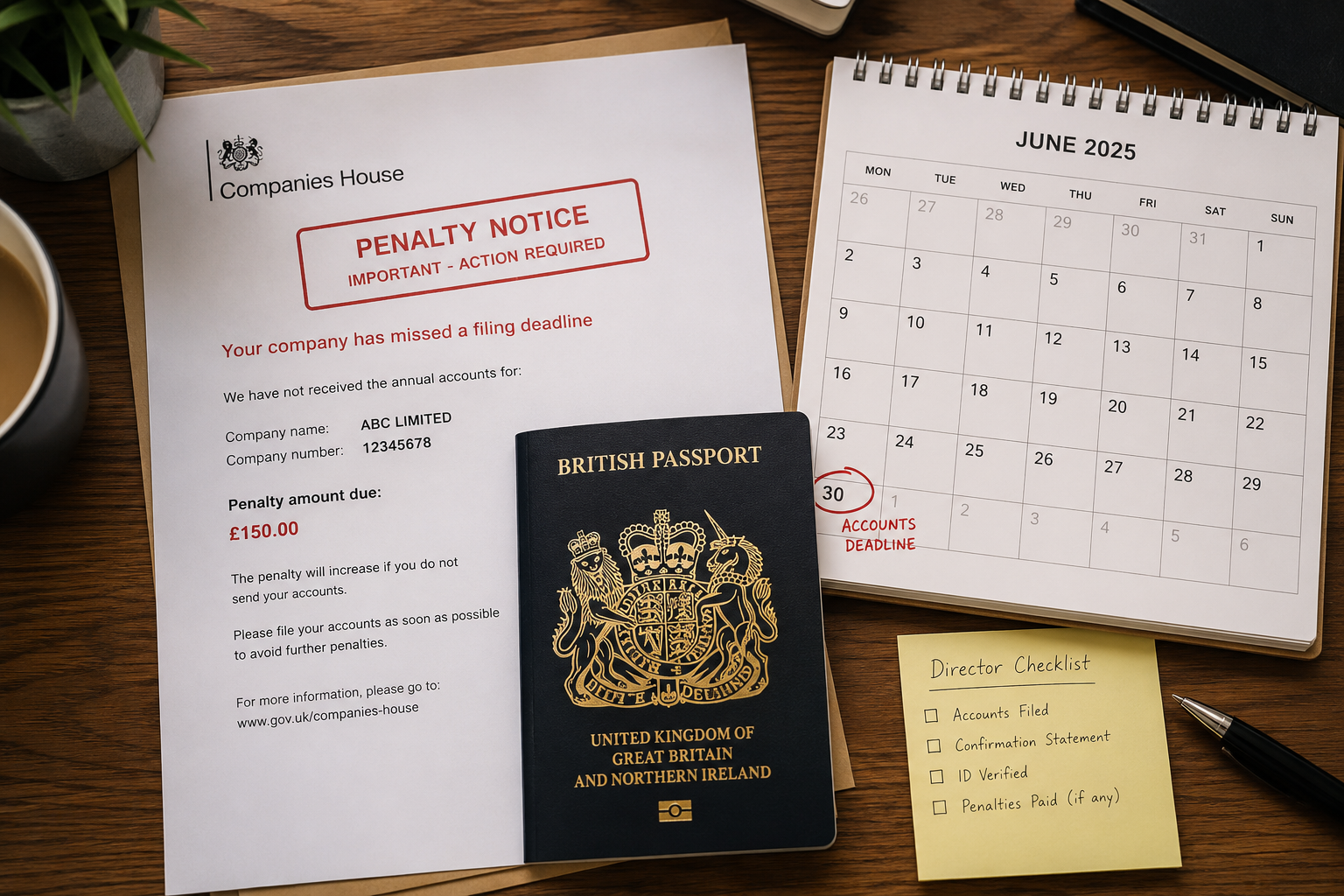
There’s a particular flavour of dread that hits when a brown envelope from Companies House lands on the doormat. You know the one. Half junk mail energy, half “oh no, what have I forgotten.” If you run a UK limited company, that envelope usually means one thing: a Companies House filing deadline has crept up on you again, quietly, the way deadlines do.
Here’s the thing nobody tells you when you first register a company. Companies House filing deadlines aren’t one big date circled in red pen. They’re a scattered constellation of dates — annual accounts, confirmation statements, corporation tax, identity verification — each with its own clock, its own penalty structure, and its own capacity to ruin an otherwise fine Tuesday. Get comfortable, because we’re going to map the whole thing out, warts and all.
The Two Dates Every Director Actually Needs to Remember
Strip away the jargon and every private limited company faces two recurring Companies House filing deadlines. First, your annual accounts. Second, your confirmation statement. They sound similar. They are not the same thing, and mixing them up is one of the most common (and costly) mistakes directors make.
Annual accounts tell Companies House — and the world, since the register is public — how your company performed financially. The confirmation statement, by contrast, is a snapshot check: are your directors, shareholders, registered office and SIC codes still accurate? No numbers involved, just a “yes, still correct” (or an update if things have changed).
Both are legal obligations under the Companies Act 2006. Both apply whether your company is trading, dormant, or quietly doing nothing at all. And missing either one sets off a chain of consequences that starts with a fine and can, in the worst cases, end with your company being struck off the register entirely.
Annual Accounts: Nine Months Sounds Generous Until It Isn’t
Private companies get 9 months after their accounting reference date (ARD) to file annual accounts. That’s your company’s financial year-end, essentially — and it’s usually the last day of the month in which you incorporated, unless you’ve changed it.
First-year accounts work differently, though, and this is where a lot of new directors trip up. Your very first set of accounts is due 21 months after the date of incorporation, not 9 months after year-end. Miss that distinction and you could be filing weeks early or, worse, weeks late without realising.
A quick worked example, because abstract deadlines are meaningless until you see them in motion: incorporate on 10 March 2026, and your ARD defaults to 31 March. Your first accounts are due by 10 December 2027 (21 months from incorporation) — but every year after that, the deadline reverts to 9 months after 31 March, landing on 31 December. Two different rhythms, same company.
Quick gut-check: if you genuinely can’t remember your company’s ARD, log into the Companies House WebFiling service right now and check. It takes ninety seconds and saves a genuinely miserable afternoon later.
Directors juggling both HMRC and Companies House deadlines often find the two blur together — worth reading our breakdown of corporation tax return deadlines alongside this one, since the two regulators no longer share a single filing route (more on that shortly).
The Confirmation Statement: Small Job, Big Consequences
If annual accounts are the marathon, the confirmation statement is the fifteen-minute admin sprint that somehow still catches people out. You have 14 days after the end of your 12-month review period to file it — form CS01, done online in most cases.
The fee changed recently, and it’s worth flagging because a surprising number of directors are still quoting the old figure. Filing online now costs £50 (up from £34, effective 1 February 2026). Paper filing costs a rather punishing £110. If your review period ends close to that fee change, filing a few days earlier can genuinely save you money — not a reason to rush, but a nice bit of housekeeping.
Here’s the twist that catches people out: there’s no escalating financial penalty for a late confirmation statement, unlike accounts. Sounds like a relief, right? It isn’t. Instead, Companies House can move straight to strike-off proceedings, and failing to file at all is a criminal offence that can see directors personally prosecuted. No fine ladder to climb — just a much blunter consequence waiting at the end of the runway.
What Happens When You Miss a Companies House Filing Deadline
Let’s talk numbers, because vague warnings never scared anyone into action quite like an actual invoice does.
| How late the accounts are | Private company penalty | Public company penalty |
|---|---|---|
| Not more than 1 month | £150 | £750 |
| 1 to 3 months | £375 | £1,500 |
| 3 to 6 months | £750 | £3,000 |
| More than 6 months | £1,500 | £7,500 |
Those figures double automatically if you file late two years running — the system has no patience for repeat offenders. And penalties are charged to the company, not the director personally, though the legal responsibility for making sure filings happen still sits squarely on directors’ shoulders. Convenient for the accounts, less convenient for the conscience.
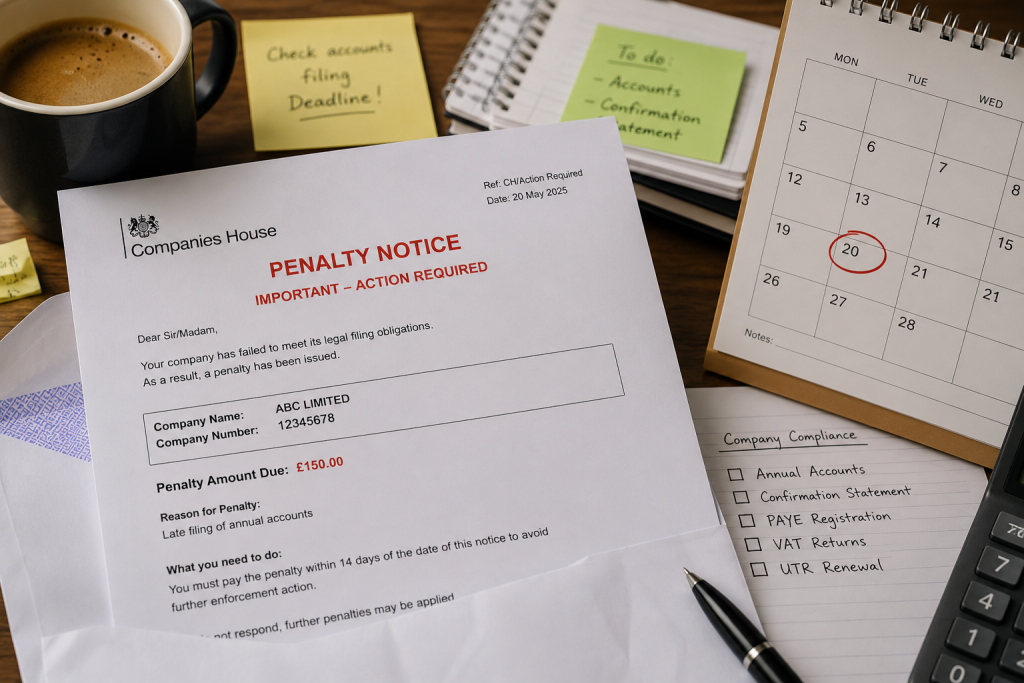
One thing worth remembering: Companies House will not accept “I forgot” or “my accountant was ill” as grounds for appeal. Genuinely exceptional circumstances only — fire, flood, bereavement, that sort of territory. You can read the official penalty guidance directly from Companies House if you want the unfiltered version.
For businesses that have already fallen behind, our guide on HMRC corporate tax return penalties covers the parallel — and separate — penalty regime that runs alongside Companies House deadlines.
Corporation Tax Runs on Its Own Clock (Annoyingly)
This trips up more directors than almost anything else: Companies House and HMRC are two entirely different organisations, with two entirely different deadlines, tracking the same underlying accounting period. It feels like it should be one job. It isn’t.
- Corporation Tax payment: due 9 months and 1 day after your accounting period ends
- Company tax return (CT600): due 12 months after your accounting period ends
Notice the payment deadline comes before the return deadline. Slightly backwards-feeling, but that’s how it’s always worked — HMRC wants the cash roughly in line with your Companies House accounts filing, even though the paperwork itself has longer to land.
And here’s a genuinely important 2026 update that a lot of directors haven’t clocked yet: the joint HMRC/Companies House filing service (known as CATO) closed permanently on 31 March 2026. From 1 April 2026 onwards, company tax returns and annual accounts must be filed separately, each through commercial software. If your accountant — or your previous DIY setup — was relying on that combined service, it’s gone, and you’ll need a proper software solution for both submissions now. This is exactly the sort of change where outsourcing to a firm that already runs cloud accounting software pays for itself in avoided stress alone.
Sole traders and landlords have their own overlapping obligations too, worth a glance if that applies to you: our guide to Self Assessment key dates sits alongside this one nicely.
2026’s Curveball: Identity Verification
Here’s the bit that genuinely is new, and genuinely does affect every director reading this. Under the Economic Crime and Corporate Transparency Act 2023, Companies House introduced mandatory identity verification for directors and People with Significant Control (PSCs).
The mechanics: existing directors and PSCs have until 18 November 2026 to complete verification — either through GOV.UK One Login directly, or via an Authorised Corporate Service Provider (an accountant, solicitor, or formation agent registered with Companies House for this purpose). Anyone appointed as a new director or PSC after 18 November 2025 has to verify before the appointment is even recorded. No verification, no valid appointment.

Skip it, and you’re not just facing an admin headache. Continuing to act as a director without verifying is an offence, and — this is the part that should get your attention — Companies House can now reject or block a confirmation statement filing over a single unverified director. One overlooked name, and your entire filing stalls, deadline be damned.
I’ll be honest: this is the change I get asked about most right now, more than accounts or the confirmation statement combined. It’s new, it’s confusing, and the process itself (via the GOV.UK ID Check app) has had its share of teething problems reported by directors trying to use it. If you’d rather have someone else navigate it, that’s precisely the kind of company secretarial work an accountant registered as an ACSP can take off your plate entirely.
A Consolidated View (Admittedly a Bit Rough Around the Edges)
Directors juggling multiple companies — or just multiple deadlines within one — tend to want everything on a single page. Here’s an attempt at that, pulled together from the sections above:
| Filing | Deadline | Cost | Notes |
|---|---|---|---|
| Confirmation statement | 14 days after review period ends | £50 online | |
| Annual accounts (ongoing years) | 9 months after ARD | Free to file | Penalties from £150 |
| First accounts | 21 months from incorporation | Free | |
| Corporation tax payment | 9 months + 1 day after period end | — | Paid to HMRC, not Companies House |
| CT600 return | 12 months after period end | Free | Separate submission since CATO closed |
| Director/PSC ID verification | By 18 Nov 2026 (existing); before appointment (new) | Free via GOV.UK One Login |
(You’ll notice that table isn’t quite as tidy as it should be — some rows have a cost column, some don’t quite line up. A bit like the deadlines themselves, if we’re honest.)
Building a Filing Calendar That Actually Works
Knowing the Companies House filing deadlines is one thing. Actually hitting them, year after year, while running a business, is another matter entirely. A few things genuinely help:
- Sign up for Companies House email reminders. Free, and you can add up to four recipients — so your accountant gets nagged too, not just you.
- Work backwards from your ARD, not forwards from “whenever I get round to it.” Put the accounts deadline in your calendar the day your company is incorporated, not eight months later.
- Separate the confirmation statement from your accounts mentally. They feel similar. They’re not. Treat them as two entirely different tasks with two entirely different owners of blame if missed.
- Get identity verification done early, especially if you’ve got multiple directors or PSCs scattered across different time zones — the process takes longer than you’d expect for anyone without a straightforward UK passport.
If any of this sounds like more admin than you signed up for when you started the business — fair enough, most directors feel that way by year two — a proper business advice relationship with an accountant tends to take the whole calendar off your hands. Ask Accountants UK Ltd, based on Merton High Street in Wimbledon, handles exactly this kind of ongoing compliance work for London SMEs — accounts, bookkeeping, company secretarial filings, and the identity verification paperwork that’s currently causing so much confusion.
Frequently Asked Questions
What’s the very next Companies House filing deadline I should check? Almost certainly your confirmation statement — it comes round every 12 months regardless of anything else, and it’s the one people forget precisely because there’s no financial penalty attached (until the strike-off letters start arriving).
Do dormant companies still have Companies House filing deadlines? Yes. Dormant companies still file both a confirmation statement and a (simplified) set of accounts every year. “Not trading” is not the same as “exempt.”
Can I ask for an extension on a Companies House filing deadline? Sometimes, and only if you apply before the deadline passes with a genuine reason — a natural disaster, IT failure at Companies House itself, that kind of thing. Extensions are not granted after the fact.
What if I’ve already missed a deadline? File as soon as physically possible. The penalty clock stops the day accounts land, and delaying further only pushes you into a higher penalty band. If HMRC penalties are stacking up alongside it, our guide on tax investigation risks is worth a read too, since repeated late filing can sometimes flag a company for closer scrutiny.
Is the confirmation statement the same as an annual return? Not any more — the confirmation statement replaced the old annual return back in 2016. Different form, similar spirit: keeping the public register accurate.
Getting In Front of It
None of this is designed to frighten anyone off running a limited company — Companies House filing deadlines are entirely manageable once you know where they sit on the calendar. The trouble is almost never the deadlines themselves. It’s the assumption that you’ll “remember” when three other things are competing for your attention that week.
If you’d rather hand the whole tangle over — accounts, confirmation statements, identity verification, the lot — Ask Accountants UK Ltd offers accounts and tax, bookkeeping, and company secretarial services from their Wimbledon office, alongside broader support like tax compliance and HMRC investigation representation. A quick call to 020 8543 1991 is usually enough to get every deadline mapped out and off your desk for good.