
Let us be completely honest about running a business. The end of the quarter, when your VAT return is due, is often stressful for any small business owner. You may spend your weekends buried in receipts, dreading the complex HMRC portal. You may also worry about making a mistake that could trigger a lengthy HMRC tax investigation. Professional support can make the process much simpler. It can also reduce errors and give you greater peace of mind when dealing with complicated tax requirements.
You started your business to follow your passion, build a legacy, and serve your customers. You did not start it to become a part-time tax expert. However, dealing with HM Revenue and Customs is an unavoidable part of the journey. The rules are becoming stricter, the digital requirements are expanding, and the penalties for getting it wrong are more severe than ever.
In this comprehensive guide, we are going to break down everything you need to know about your quarterly reporting. We will cover the absolute basics, dive into the mandatory Making Tax Digital rules, outline the new penalty systems, and show you exactly how to take the stress out of your tax compliance.

What Exactly is a VAT Return?
Before we get into the complex rules and software requirements, let us clarify the basics. If your business has a taxable turnover above the current VAT registration threshold (or if you registered voluntarily), you are acting as an unpaid tax collector for the government.
Every time you make a sale, you charge your customers Value Added Tax. This is known as your Output Tax. Conversely, when you buy supplies, stock, or services for your business, you pay tax to your suppliers. This is known as your Input Tax.
Your quarterly VAT return is simply a mathematical calculation submitted to HMRC that shows the difference between the two.
If you charged more tax to your customers than you paid on your purchases, you owe HMRC the difference. If you paid more tax on your business expenses than you charged your customers, HMRC owes you a refund.
Let us look at a very simple example. Imagine you run a marketing agency. In one quarter, you invoice your clients for £20,000 plus 20% tax. Your Output Tax is £4,000. During that same quarter, you buy new laptops and pay for software subscriptions totaling £5,000 plus 20% tax. Your Input Tax is £1,000. When you file your report, you will deduct your £1,000 Input Tax from your £4,000 Output Tax. You will then pay the remaining £3,000 directly to HMRC.
While the math sounds simple in theory, the reality of tracking, categorizing, and proving every single transaction is where small business owners quickly get overwhelmed.
The New Rules: Making Tax Digital (MTD) VAT Return Explained
HMRC has completely revolutionized how businesses must report their finances. The old system of keeping a shoebox full of paper receipts and typing numbers into a basic online portal is officially dead.
Under the Making Tax Digital VAT return rules, all registered UK businesses are now legally required to keep their financial records digitally. You must also use compatible software to submit your data directly to HMRC through a secure API connection. You can read the official GOV.UK guidance on Making Tax Digital for a full breakdown of the government mandate.
Why did HMRC do this? The government estimates that billions of pounds are lost every year due to avoidable administrative errors. By forcing businesses to use digital links, they want to eliminate manual typing errors and ensure greater accuracy in tax reporting across the country.
The days of mailing in physical paperwork or manually typing nine boxes of data into the HMRC website are long gone. If you try to submit a manual paper document today, HMRC is entirely unforgiving. They can hit you with immediate penalties of up to £400 simply for failing to file digitally, even if your actual calculation is perfectly accurate. You must ensure your software is compliant.
Understanding Your VAT Return Deadline
Getting your numbers right is only half the battle. You also have to submit your digital data and pay any money owed on time.
For the vast majority of businesses on a standard quarterly cycle, the VAT return deadline is exactly one calendar month and seven days after your accounting period ends. This specific deadline applies to both the submission of the digital form and the physical clearing of funds into the HMRC bank account.
Let us look at a few common quarterly examples to make this crystal clear:
- If your quarter ends on March 31st, your deadline to file and pay is May 7th.
- If your quarter ends on June 30th, your deadline is August 7th.
- If your quarter ends on September 30th, your deadline is November 7th.
- If your quarter ends on December 31st, your deadline is February 7th.
We highly recommend setting up a direct debit mandate with HMRC through your online account. If you use a direct debit, the payment is usually taken from your bank account three working days after the 7th of the month. This gives you a tiny bit of extra breathing room for your business cash flow, while ensuring you never accidentally miss a manual payment transfer.
The Strict HMRC Penalties System
In recent years, HMRC rolled out a completely new, incredibly strict system for penalizing businesses that miss their deadlines. They transitioned to a points-based penalty system. This was designed to be much tougher on repeat offenders and those who chronically ignore their filing obligations.
Here is exactly how the new HMRC penalties system works today:
- The Points Accumulation: You receive 1 penalty point for every late submission.
- Nil Returns Count: This penalty point is applied even if you owe zero money for the quarter. You are penalized for the failure to report your data, not just the failure to pay the bill.
- The Financial Hit: If you file quarterly and accumulate 4 points, you will automatically receive a £200 financial penalty.
- Ongoing Fines: Once you hit that 4-point threshold, you will face an additional £200 fine for every single subsequent late submission until your points officially expire.
Expiring your penalty points requires a long period of perfect compliance. If you are on quarterly reporting, you must submit everything exactly on time for an entire 12-month period to wipe the slate clean. For a busy startup founder trying to juggle client work, marketing, and team management, a single forgotten deadline can quickly spiral into a costly compliance nightmare.
Common VAT Return Mistakes That Trigger HMRC Audits
Even when business owners try their absolute best to remain compliant, innocent mistakes happen. Unfortunately, HMRC does not always view these mistakes as innocent. A sudden spike in reclaimed money or inconsistent figures can easily trigger an automated compliance check.
Here are the most common errors we see small businesses make when they try to handle their own VAT return without professional guidance:
1. Claiming Business Entertainment
You absolutely cannot claim money back on entertaining clients. Whether it is a fancy dinner at a restaurant in Central London, taking a prospective client to a Wimbledon tennis match, or hosting a corporate golf day, HMRC strictly prohibits reclaiming the tax on these expenses. Many business owners assume that because it is a legitimate business expense for corporation tax purposes, the extra tax can also be claimed. This is a massive red flag for inspectors. If you claim this and get audited, the penalties can be severe.
2. Losing Valid Tax Invoices
To legally claim input tax on a business purchase, you must hold a valid, detailed invoice from your supplier. A simple credit card receipt, a pro-forma invoice, or a bank statement line is not enough proof for HMRC. The invoice must show the supplier’s registration number, the date, a description of the goods, and the exact amount charged. If HMRC audits you and you cannot produce the formal invoices for your claims, they will demand the money back, plus heavy interest charges.
3. Misunderstanding the Flat Rate Scheme
The VAT Flat Rate Scheme is designed to simplify administration for very small businesses, but the rules surrounding it are complex. Many businesses fail to apply the correct percentage for their specific industry sector. Others forget that they still need to monitor their turnover to ensure they remain eligible to use the scheme. Furthermore, if you are deemed a “limited cost business”, you must apply a much higher flat rate of 16.5%, which catches many independent contractors by surprise.
4. Claiming Tax on Cars and Fuel
Buying a company car is a common business milestone, but the rules are incredibly restrictive. You generally cannot reclaim the extra tax on the purchase of a new car unless it is used 100% for business purposes (like a taxi or a driving school car) and is unavailable for private use. If you claim the cost on fuel, you must either only claim for specific business mileage or apply the fuel scale charge if there is any private use. Getting this wrong is a very common trigger for an audit.
A Step-by-Step Workflow for Preparation
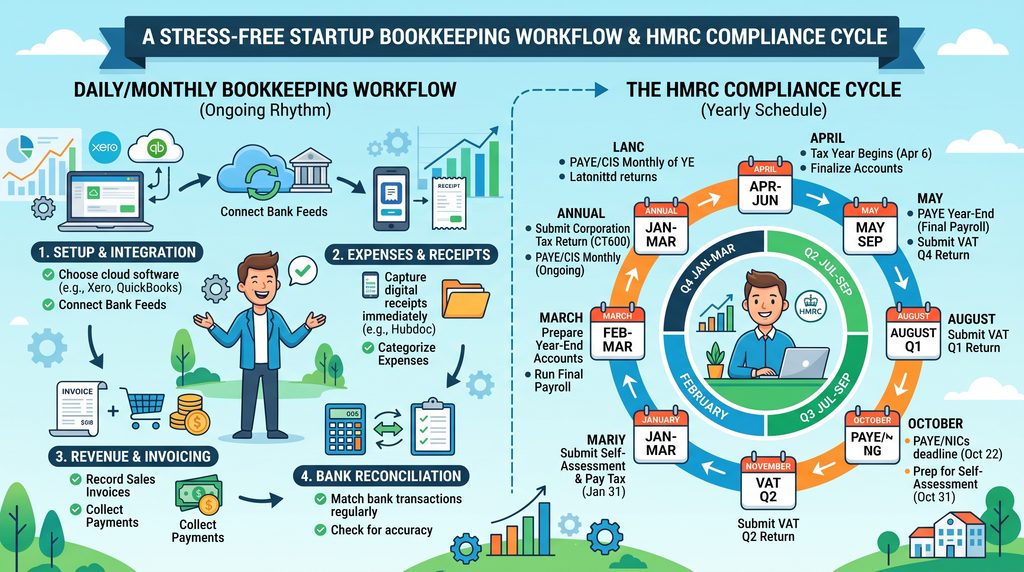
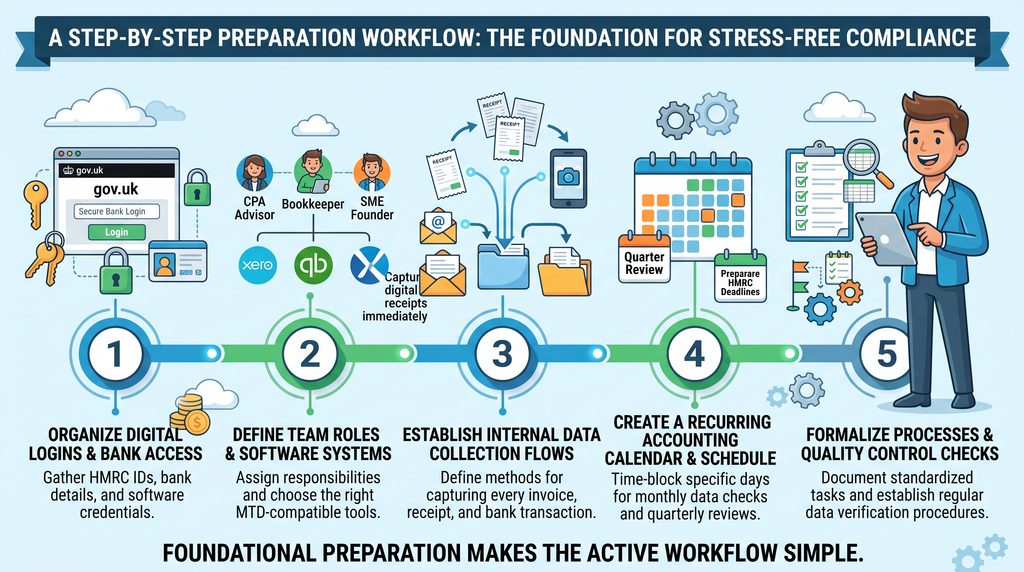
If you are determined to handle your bookkeeping in-house, you need a flawless, repeatable workflow. You cannot leave three months of administration to the weekend before the deadline. Here is the exact process you should follow every single month to prevent quarter-end panic:
- Capture Everything Immediately: Use receipt-scanning apps connected to your primary software. The moment you buy a coffee for a staff meeting or pay for a software subscription, snap a picture. Let the software read the receipt and extract the data automatically.
- Reconcile Weekly: Do not wait for three months to pass. Sit down every Friday afternoon for twenty minutes to match your live bank feeds to your digital receipts. Frequent reconciliation keeps your numbers accurate and your mind at ease.
- Review the Exceptions: Look for anomalies. Did a supplier forget to charge tax when they should have? Did you accidentally post a personal supermarket expense to the business account? Catch these errors early while they are fresh in your memory.
- Run a Draft Return: Two weeks before the quarter ends, run a draft VAT return in your software to project your upcoming liability. This gives you valuable time to ensure the cash is sitting safely in your bank account, ready for HMRC to collect.
The Solution: Outsource and Breathe
You do not have to navigate this complicated system alone. In fact, attempting to do it all yourself is often a massive false economy. The precious hours you spend fighting with spreadsheets, categorizing receipts, and stressing over HMRC guidelines could be spent acquiring new clients, improving your product, or spending time with your family.
Handing your paperwork over to a professional bookkeeping service in London is the smartest investment you can make for your mental health and your business growth.
Outsourcing your tax compliance guarantees that your submissions are perfectly accurate and always on time. This completely eliminates the risk of costly HMRC penalties and keeps you firmly off the audit radar. More importantly, it buys back your weekends. It gives you the clarity and peace of mind to focus on what actually matters as a business owner.
Why Choose ASK Accountants UK Ltd?
At ASK Accountants UK Ltd, we understand exactly what you are going through. We are not just number crunchers; we are dedicated business growth partners.
Our expert team has spent the last 15 years helping SMEs, ambitious startups, and independent contractors in Wimbledon and across South-West London navigate the tricky world of UK compliance. We know the local business landscape intimately, and we know exactly what HMRC is looking for during compliance checks.
When you partner with us, we handle the HMRC headaches entirely. We implement robust digital workflows, manage your cloud accounting software, ensure every single penny of eligible tax is legally reclaimed, and guarantee your accounts are filed long before the deadline.
Book Your Free Consultation Today
It is time to stop stressing late into the night. Let our expert team take the heavy lifting off your shoulders so you can get back to running your business.
Call us today at 020 8543 1991, reach out via our contact page, or visit our office at 178 Merton High St to book a completely free, no-obligation consultation. Let us build a stress-free tax strategy that works for you.
Frequently Asked Questions (FAQs)
What happens if I cannot pay my VAT return on time?
If you submit your VAT return but simply cannot afford the physical payment due to cash flow issues, you must contact HMRC immediately. You should do this before the deadline passes. You can often negotiate a “Time to Pay” arrangement, allowing you to pay the debt in manageable monthly installments. Ignoring the debt is the absolute worst thing you can do, as it will result in daily interest charges, aggressive debt collection agencies, and severe financial penalties.
Do I still need to submit a return if my business made no sales this quarter?
Absolutely. If you are a registered business, you must submit a nil VAT return even if you had zero income and zero business expenses during that specific quarter. Failing to file this empty report will still earn you a late submission penalty point under the new MTD rules. You cannot just ignore a quarter because there was no trading activity.
What software is actually approved for Making Tax Digital?
HMRC requires all businesses to use software that connects directly to their secure systems via an API link. You can no longer use simple Excel spreadsheets unless they are connected to specialized, third-party bridging software. The most popular approved external options on the market include Xero and QuickBooks. If you choose to work with ASK Accountants UK Ltd, we will ensure you are set up on fully compliant, cloud-based software from day one.