You are staring at a pile of crumpled receipts on your desk, or perhaps scrolling through endless digital invoices on your phone. It is late, you are exhausted, and the last thing you want to think about is your upcoming tax bill. As a small business owner, startup founder, or landlord, you already juggle a hundred different tasks every single day. Tracking every penny spent can easily fall to the bottom of your priority list. But understanding your Tax Deductible Expenses UK is one of the most effective ways to keep more of your hard-earned money in your own pocket.
Every legitimate expense you claim reduces your taxable profit. That means you pay less tax. However, the rules can feel incredibly confusing. Figuring out exactly what you are allowed to claim without crossing invisible lines can be a major source of stress.
We know how overwhelming it feels. That is exactly why we put together this plain-English guide. We will break down the rules, highlight what you can safely claim, and show you how to manage your records without pulling your hair out.

Understanding the Core Rules for Tax Deductible Expenses UK
Before you start claiming every coffee you buy, you need to understand the golden rule established by HM Revenue & Customs (HMRC). For an expense to be considered part of your allowable business expenses, it must be incurred “wholly and exclusively” for the purposes of your trade.
If you buy a laptop strictly to run your graphic design software and manage client emails, that is a clear business expense. If you buy a laptop primarily so your kids can do their homework and you occasionally check a work email, that fails the test.
When there is a dual purpose (like using your mobile phone for both personal calls and business networking), you can often claim a proportion of the cost. You just need a reasonable method to calculate the business portion. Understanding these boundaries helps improve accuracy when it is time to file your Self Assessment tax return.
Making Tax Digital and Deadlines
The landscape of tax reporting is changing rapidly in the UK. Most VAT-registered businesses must now keep digital records and submit returns using compatible software under the official Making Tax Digital rules. While there are some limited exemptions, the push towards digital record-keeping applies to the vast majority of trading businesses.
You also need to be acutely aware of deadlines. Filing your HMRC tax return late or paying your tax bill late has strict financial consequences. Late-payment interest begins accruing on day 1 of a missed deadline. If the balance remains unpaid, a first penalty usually arises at day 15, and those penalties increase if the debt is still outstanding at day 30. It pays to have your expenses organized long before January 31st rolls around.
What Counts as Tax Deductible Expenses UK?
Let us look at some of the most common categories you can claim to help maximize your small business tax relief. Knowing these categories can reduce administrative burden when you organize your paperwork.
Office, Property, and Equipment
Whether you rent a commercial space or work from a spare bedroom, you have allowable business expenses.
- Commercial spaces: You can claim rent, utility bills, property insurance, and security costs.
- Home offices: If you work from home, you can claim a proportion of your heating, electricity, Council Tax, and internet. You can calculate this using a simplified flat rate based on your hours worked, or by working out the exact proportion of your home used for business.
- Equipment: Computers, printers, software subscriptions, and office furniture are generally deductible.
Travel and Accommodation Expenses
If you have to travel for work, many of those costs will fall under your Tax Deductible Expenses UK. This includes train tickets, flights, hotel rooms for overnight business trips, and parking fees. However, your standard daily commute from your home to your regular place of work is never deductible.
Financial and Professional Fees
Running a business requires professional support. The good news is that these costs are usually deductible. This includes:
- Bank fees on your dedicated business account.
- Insurance policies (like public liability or professional indemnity).
- Fees paid to professionals like solicitors and, of course, your accountants for services like business advice or a dedicated bookkeeping service.
Complex Tax Deductible Expenses UK: Proceed with Caution
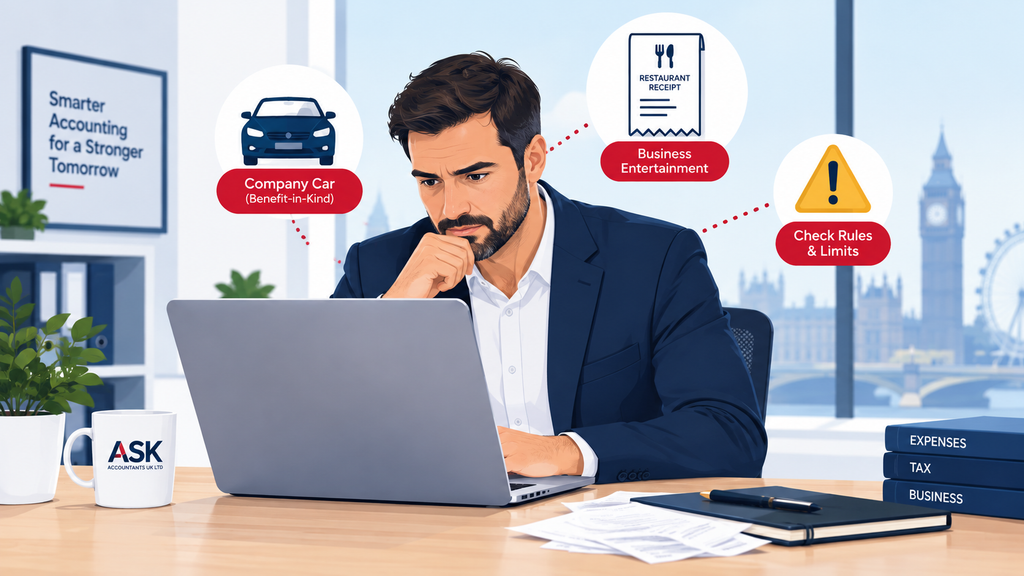
Some expense categories are notoriously complex. When dealing with the following areas, we strongly recommend seeking specific advice because the rules are highly nuanced and subject to exceptions or partial recovery rules.
Business Entertainment
Taking a prospective client out for an expensive lunch might feel like a vital business activity, but HMRC rarely allows you to claim business entertainment as a tax deduction. Entertaining clients, suppliers, or professional contacts is generally excluded. However, entertaining your own employees (like an annual Christmas party) is allowable up to a strict limit of £150 per head per year.
Company Vehicles and Mileage
Vehicle expenses are complicated. If you are a sole trader using your personal car for business trips, you can usually claim the official HMRC flat rate per mile (currently 45p for the first 10,000 miles). Alternatively, you can claim a percentage of your actual running costs (fuel, insurance, repairs) based on your business mileage. Buying a company car introduces complex benefit-in-kind rules, and the tax relief depends heavily on the vehicle’s CO2 emissions. Always consult a professional before buying a vehicle through your business.
Common Errors with Tax Deductible Expenses UK
Even well-intentioned business owners make mistakes. Unfortunately, poor record-keeping can lead to inaccurate tax returns. Here are three common errors and record-keeping risks you need to avoid to stay compliant and minimize the risk of HMRC investigations.
1. Mixing Personal and Business Finances
Using a personal debit card to buy printer ink, and a business credit card to buy your weekly groceries, creates a chaotic paper trail. This makes it incredibly difficult to accurately identify your sole trader expenses at the end of the year. It also increases the risk of claiming personal items by mistake. Always use a dedicated business bank account.
2. Failing to Keep Receipts
You cannot simply guess your expenses or rely solely on a line item on your bank statement. HMRC expects you to keep detailed records (invoices and receipts) for at least five years after the 31 January submission deadline of the relevant tax year. Relying on paper receipts in a shoebox is a massive risk because ink fades and paper gets lost.
3. Claiming Non-Allowable Items
It is a common record-keeping risk to assume that anything bought through the business account is automatically deductible. As we noted with client entertainment or everyday clothing, making incorrect assumptions can lead to inaccurate tax calculations and potential adjustments by HMRC later on.
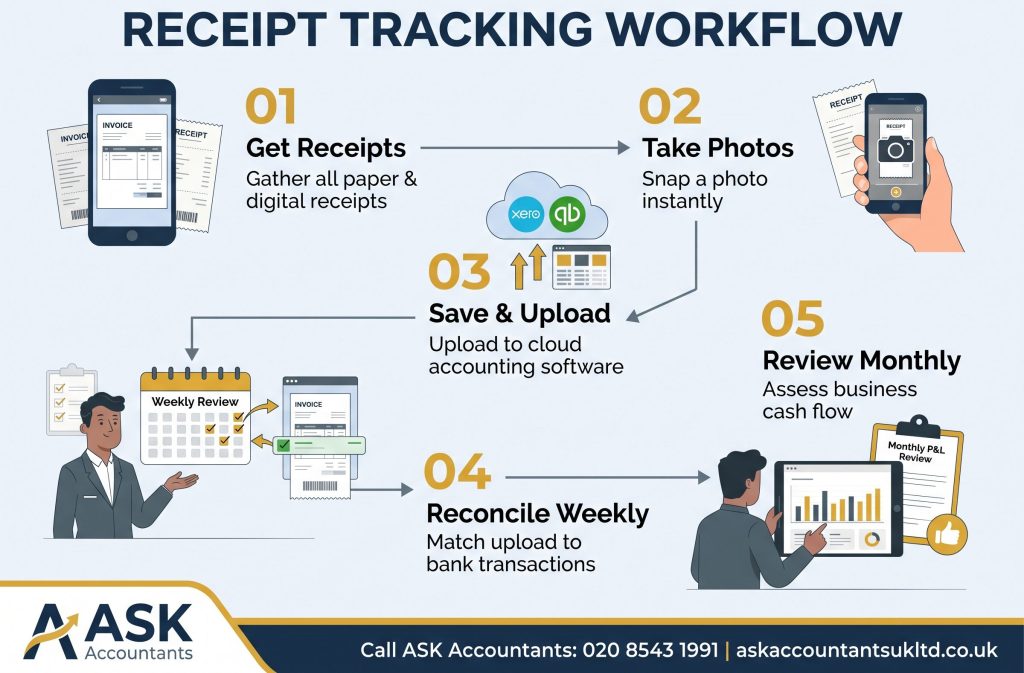
Managing Tax Deductible Expenses UK: A Workflow
To stay compliant and keep your stress levels low, you need a system. Here is a practical, actionable workflow you can implement today to manage your Tax Deductible Expenses UK.
- Step 1: Separate Your Money. Open a dedicated business bank account immediately if you have not already. Route every single item of business income and expenditure through this account.
- Step 2: Go Digital. Download a reputable cloud accounting app to your phone. We highly recommend HMRC-recognized tools like Xero or QuickBooks.
- Step 3: Snap as You Spend. Make it a strict habit to take a photo of every receipt the moment a transaction occurs. Upload it directly to your accounting software. Do not stuff it in your wallet to deal with later.
- Step 4: Reconcile Weekly. Set aside 15 minutes every Friday afternoon to match your uploaded receipts to the transactions on your digital bank feed. This prevents a massive backlog from forming.
- Step 5: Review Monthly. Look over your profit and loss statement at the end of each month. This helps you understand your cash flow and ensures all expenses are categorized correctly while the purchases are still fresh in your mind.
Outsourcing Your Tax Deductible Expenses UK
Managing your own books might seem like a good way to save money in the short term. However, the time you spend agonizing over spreadsheets is time you are not spending growing your business, serving your customers, or relaxing with your family.
Outsourcing this task to a professional can reduce your administrative burden significantly. Working with a qualified accountant helps improve accuracy across your records and mitigates the risk of errors on your final tax return. A professional will know exactly which Tax Deductible Expenses UK you are entitled to claim, ensuring you do not miss out on valuable tax relief while keeping your records fully compliant with current regulations.
Let ASK Accountants UK Ltd Help You
At ASK Accountants UK Ltd, we understand the unique pressures you face. With over 15 years of experience helping SMEs, startups, and landlords in Wimbledon and South-West London, we take the stress out of tax season. We do not just crunch numbers. We provide clear, empathetic, and strategic advice to help your business thrive.
Whether you need help navigating Making Tax Digital, categorizing your allowable business expenses, or filing your year-end accounts, our expert team is ready to support you.
Stop letting receipts keep you awake at night. Let us handle the compliance so you can get back to doing what you do best.
Ready to simplify your accounting? Call us today at 020 8543 1991, visit our Contact Page, or drop by our office at 178 Merton High St for a chat.
Frequently Asked Questions (FAQs)
1. How long do I need to keep records of my Tax Deductible Expenses UK?
If you are self-employed or a sole trader, you must generally keep your business records for at least 5 years after the 31 January submission deadline of the relevant tax year. Limited companies must keep records for 6 years from the end of the last company financial year they relate to. Keeping digital copies in cloud software is the safest way to meet this requirement. You can read more about this directly on the official GOV.UK record keeping guide.
2. Can I claim my daily lunch as a business expense?
In most cases, no. Everyday food and drink do not qualify as allowable business expenses because everyone has to eat to live, meaning it fails the “wholly and exclusively” test. However, if you are traveling outside of your normal working pattern on an overnight business trip, you can usually claim reasonable costs for your meals.
3. Do I need original paper receipts, or are digital copies enough?
Digital copies are perfectly acceptable and are actually encouraged under Making Tax Digital guidelines. As long as the digital copy is legible, captures all the information from the front and back of the receipt, and cannot be easily altered, HMRC will accept it. Using a dedicated app to capture receipts as soon as you get them is the best way to maintain accurate records.