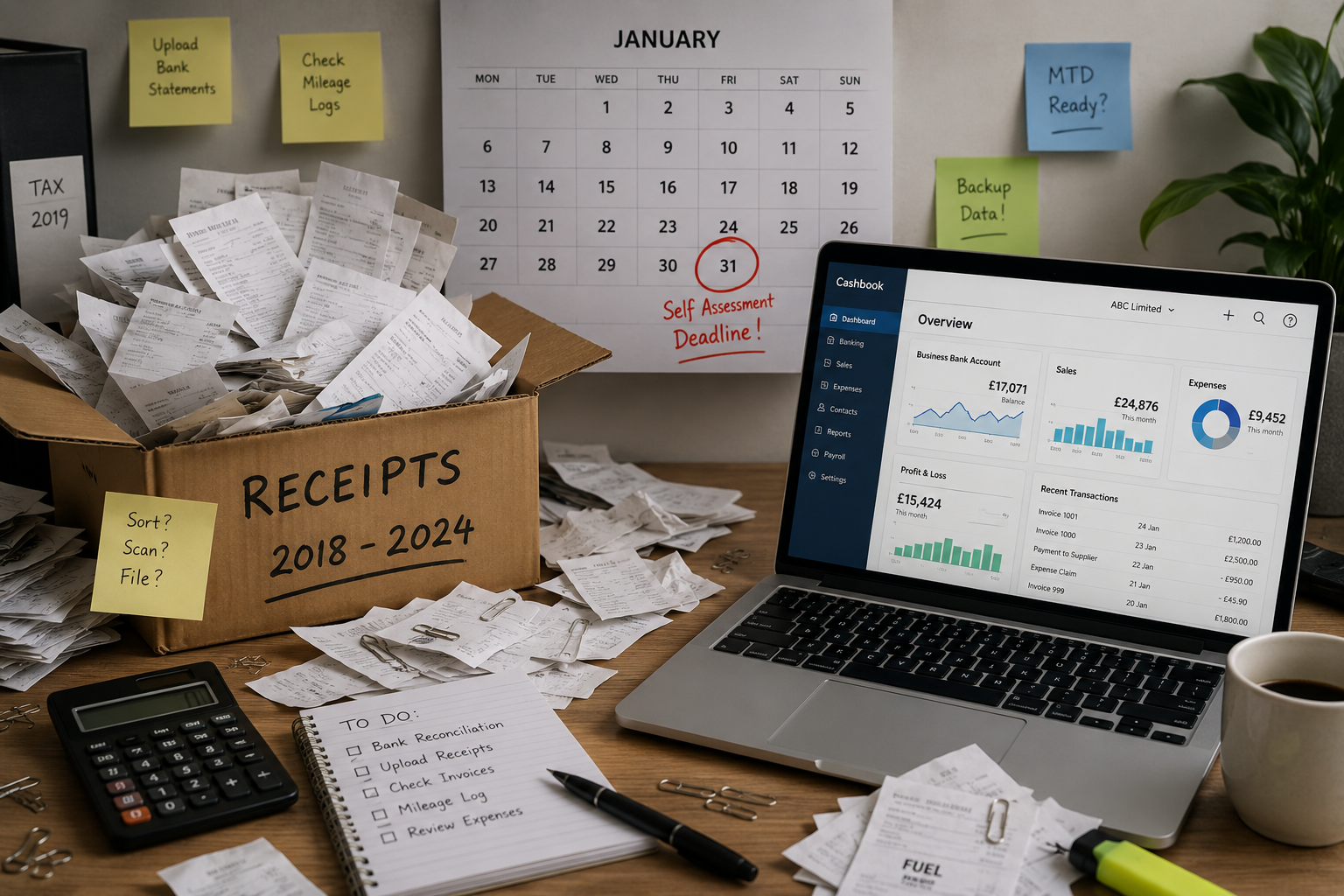
How long should you keep accounting records? Somewhere in a filing cabinet, loft, or long-forgotten Dropbox folder sits the answer most business owners get slightly wrong. Sole traders and partnerships must keep their accounting records for at least five years after the 31 January Self Assessment deadline. Limited companies need six years from the end of the accounting period. That’s the floor, not the ceiling — late returns, HMRC compliance checks, long-life assets, and VAT quirks can all stretch the clock much further.
Below, I’ll show exactly where the lines sit, what counts as a genuine accounting record versus mere clutter, and why so many small business owners get this wrong in ways that only bite them years later.
The five-year rule for accounting records nobody explains properly
If you’re self-employed — sole trader, freelancer, running a partnership, whatever your invoices say — the Self Assessment deadline governs your obligation, not the tax year itself. That’s the bit people miss.
Filed your 2024–25 return by the 31 January 2026 deadline? Your accounting records for that tax year need to survive until 31 January 2031. Not five years from when you earned the money. Five years from when you told HMRC about it. It’s a subtle distinction. It matters if you tidy your paperwork every spring — you might be tossing things out a full year too early.
This applies to the full sweep of what feeds your self assessment tax return: invoices raised, expenses claimed, bank statements, till rolls if you’re retail, mileage logs, the lot. HMRC’s own guidance on keeping your pay and tax records lays out the categories in more detail, and it’s worth a skim if you’ve never actually read it (most people haven’t — I don’t blame them).
Quick gut-check: if you’re unsure whether something counts as an accounting record, ask yourself “could this change the tax I owe?” If the answer’s even a maybe, keep it. Deleting first and rationalising later is how compliance checks go badly.
Limited companies: why six years of accounting records isn’t always the finish line
Run a limited company? The rules get stricter, and the maths gets slightly more annoying. Companies Act legislation demands six years of accounting records from the end of the last company financial year they relate to — not from when you filed, from when the year ended.
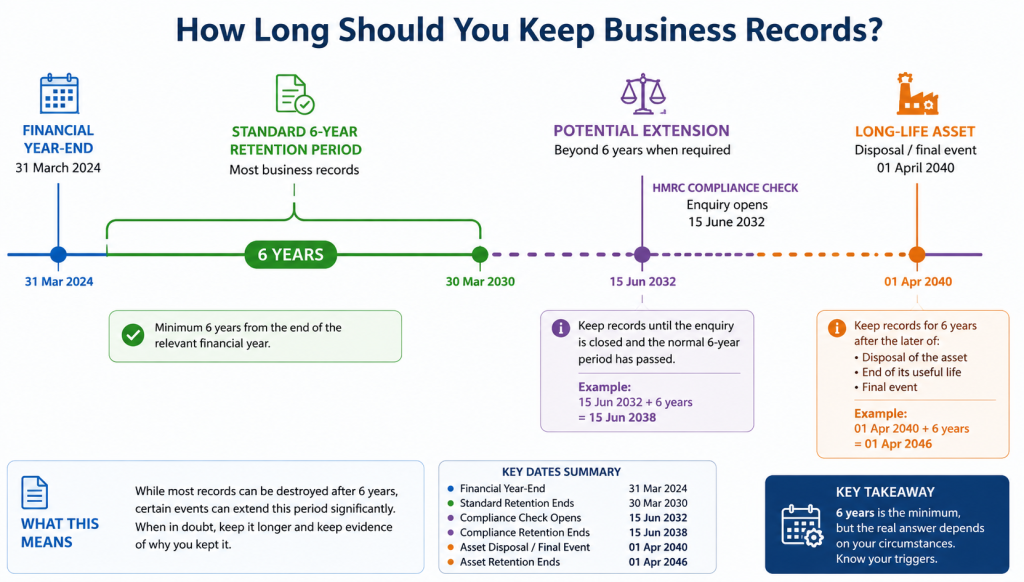
So a company with a year-end of 31 March 2025 needs those records kept until roughly 31 March 2031. Straightforward enough, until one of these shows up:
- Your company tax return was filed late
- HMRC opens a compliance check into that return (in which case, keep everything until the check is fully closed — sometimes years longer than the standard window)
- The records relate to an asset the company expects to keep for more than six years, like machinery or equipment (retain until six years after it’s disposed of, not from when you bought it)
- A single transaction spans more than one accounting period
A separate, often overlooked obligation covers statutory registers, board minutes, and certain company records under the Companies Act. Some of these need a longer shelf life, occasionally ten years. It’s a genuinely different regime from your bog-standard invoices and receipts, and directors often conflate the two. If you’re navigating a corporate tax return deadline or you’ve recently had a run-in with HMRC over a late filing, double-check which retention clock actually applies to you.
The retention periods, laid out properly
| Business type | Minimum retention period | Clock starts from |
|---|---|---|
| Sole trader / self-employed | 5 years | 31 January Self Assessment deadline for the relevant tax year |
| Partnership | 5 years | 31 January Self Assessment deadline |
| Limited company | 6 years | End of the relevant company financial year |
| VAT-registered business | 6 years (generally) | End of the relevant VAT period |
| PAYE / payroll records | 3 years minimum | End of the tax year they relate to |
| Long-life business assets | 6 years after disposal | Date the asset was sold, scrapped, or disposed of |
Figures reflect standard HMRC and Companies Act minimums as of 2026. Under compliance check, treat these as the floor, not the answer.
VAT, payroll, and the records that play by their own rules
VAT has its own retention quirks, mostly because Making Tax Digital changed how VAT records need to be kept — digitally, with a compliant software link between your bookkeeping and your VAT return. Generally you’re looking at six years for VAT accounting records, though there are shorter windows for some specific document types. If VAT feels like its own separate universe of rules, that’s because it kind of is — our guide to VAT accounting compliance breaks down what actually needs keeping and in what format.
Payroll sits differently again. If you employ staff, PAYE records generally need keeping for at least three years from the end of the tax year they relate to — shorter than the main accounting records rule, which trips people up because they assume “keep everything for six years” is a blanket policy. It isn’t. Different document types genuinely do have different clocks.
CIS records for contractors and subcontractors follow the same broad logic as standard accounting records, but if you’re chasing a refund, you’ll want your deduction statements to hand regardless of the statutory minimum — see our piece on claiming a CIS deduction refund for the documents HMRC actually asks for.
What actually counts as an accounting record (and what’s just paper)
This is where I get slightly opinionated, because I’ve seen businesses keep the wrong things religiously while binning the ones that mattered.
Keep these, properly:
- Sales invoices and till records
- Purchase invoices, receipts, and expense claims
- Bank and credit card statements
- Payroll records, P60s, P45s
- VAT returns and the workings behind them
- Records of business assets bought and sold
- Mileage logs and travel expense evidence
- Stock and inventory valuations at year-end
- Loan agreements, lease documents, and anything tied to a long-term liability
Genuinely less critical (but still worth a tidy digital copy):
- Marketing materials and old website copy
- General correspondence that isn’t tax-relevant
- Superseded drafts of documents you’ve since finalised
I’ll be honest — I’ve had clients keep every single email chain about a supplier negotiation for six years while shredding the actual VAT invoice that mattered. Wrong way round. If you’re ever unsure what “counts,” the useful litmus test is whether the document supports a figure on a tax return. If it does, it’s an accounting record. If it’s just background noise, it isn’t.
For a more exhaustive breakdown by document type, our article on what records you actually need for a tax return goes further than most generic checklists floating around online.
The digital shift in accounting records nobody asked for (but everyone’s better off with)
Making Tax Digital has quietly rewritten the record-keeping conversation. VAT-registered businesses have needed digital record-keeping and MTD-compliant software since April 2022. MTD for Income Tax is now phasing in for sole traders and landlords earning over the relevant threshold from April 2026. The “shoebox of receipts” approach isn’t just inconvenient anymore — for a growing number of businesses, it’s genuinely non-compliant.
Which formats HMRC still accepts
| Format | Still acceptable to HMRC? | Notes |
| Paper originals | Yes, generally | Fine for most sole traders outside MTD scope, for now |
| Scanned/photographed copies | Yes | Must be clear and legible — a blurry receipt photo won’t cut it |
| Cloud accounting software | Yes, and increasingly required | Mandatory link required under Making Tax Digital for VAT and, soon, Income Tax |
| Spreadsheets alone | Only with bridging software for MTD purposes | A plain spreadsheet isn’t automatically MTD-compliant on its own |
Why switching now beats switching later
If you’re still keeping accounting records in a mix of paper receipts and a Word document, switch before the deadline forces your hand. We’ve written more on why so many London businesses are making the switch to cloud accounting and what the transition actually looks like day to day. Spoiler: it’s less painful than people expect, and mostly just a habit change.
What happens if you bin your accounting records too soon
Here’s the bit that tends to concentrate minds. If HMRC opens an enquiry and you can’t produce the records to back up a figure on your return, they don’t just shrug and move on. They can issue a “determination” — essentially their own estimate of what you owe, usually not in your favour — plus penalties if they judge the record-keeping failure careless or, worse, deliberate.
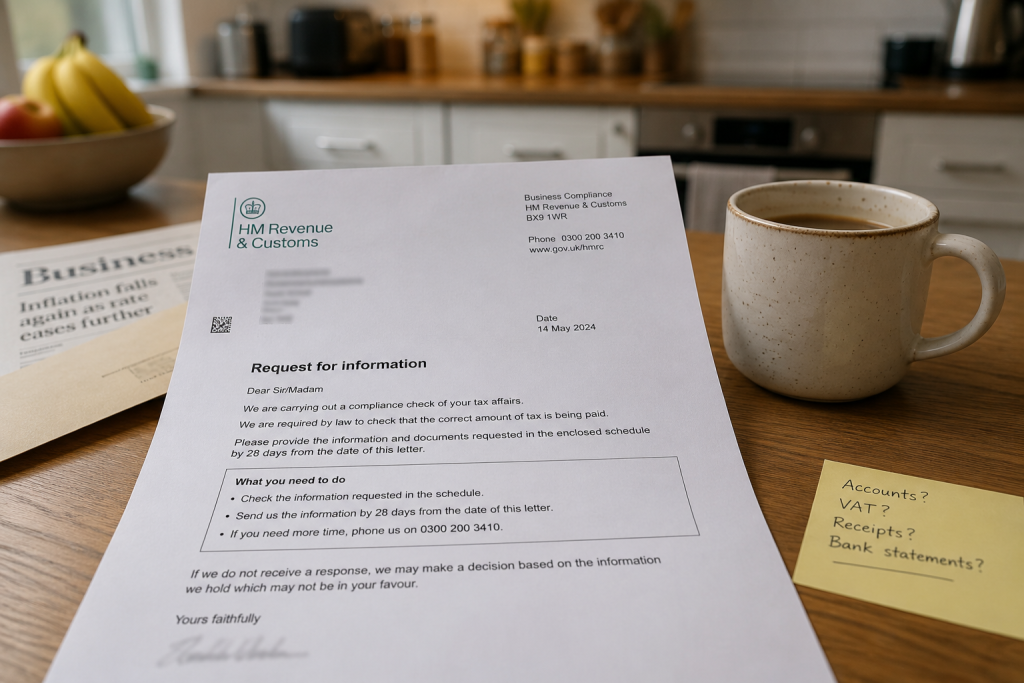
I’ve seen this play out with a landlord client who genuinely lost paperwork in a house move, not through any dodgy intent, just bad luck. HMRC accepted records we rebuilt from bank statements and supplier confirmations, but the back-and-forth dragged on for months. Better original record-keeping would have avoided it entirely. Reconstruction is possible. It’s rarely pleasant.
If you’re at all worried about what an investigation actually involves, our guide to what UK businesses need to know about an HMRC tax investigation covers the practical steps, and it’s a far less frightening process once you know what to expect.
A few accounting records scenarios worth knowing about
You’re closing the business. The retention clock doesn’t stop just because you’ve stopped trading — you still need to keep accounting records for the standard period (five or six years, depending on structure), counting from the closure date or the relevant filing deadline.
You’ve been the subject of a late filing penalty. Late returns can effectively extend how long HMRC is entitled to look back and query things, which in turn means your practical retention period should stretch to match. If you’ve had a brush with corporate tax return penalties, treat your record-keeping for that period as extended, not standard.
You’re a landlord. Rental income has its own documentation quirks — mortgage interest restrictions, allowable repairs versus capital improvements, the lot. Our piece on reporting rental income to HMRC is worth reading alongside this one if property’s involved.
You’ve bought equipment that’ll last years. As mentioned above, anything expected to outlive the standard six-year window (specialist machinery, for instance) needs records kept until six years after disposal — which for some assets could mean fifteen, twenty years of paperwork. Not glamorous, but necessary.
When you can finally let go of old accounting records
Assuming none of the above scenarios apply — no ongoing enquiry, no late filing, no long-life assets still in use — you can generally destroy accounting records securely once the relevant retention window closes. “Securely” carries real weight here: shred physical documents and permanently delete (not just archive) digital ones, especially anything containing bank details or personal data. Data protection law runs alongside your tax obligations, not instead of them.
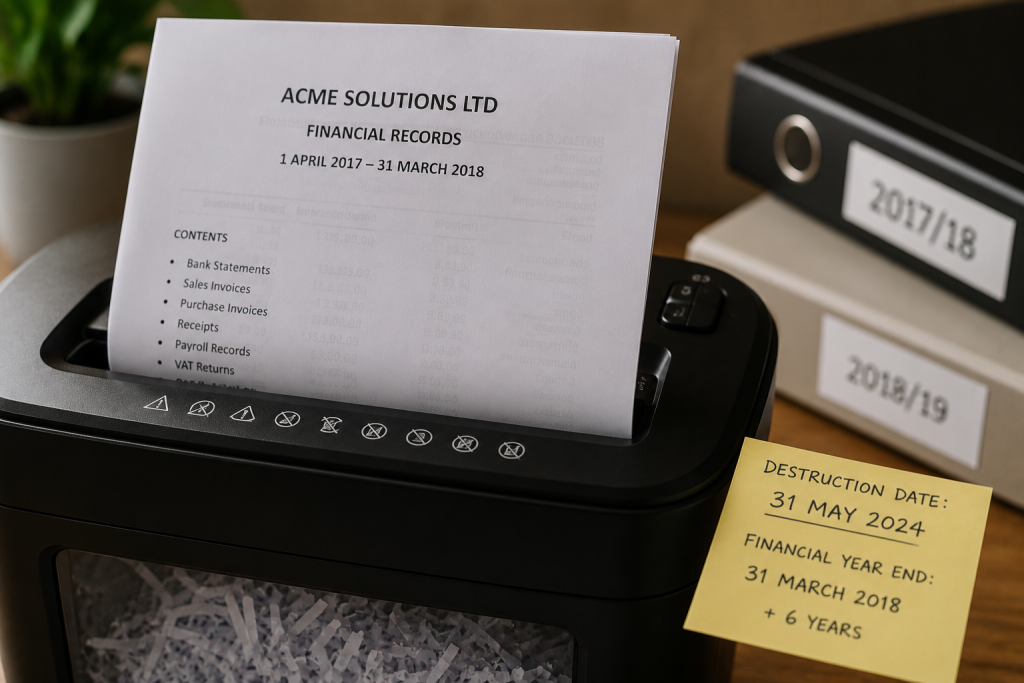
A rolling system helps enormously here. Rather than doing an anxious annual purge, note the destruction date when you file each year’s records, and let old ones drop off a standing list as their date arrives. It sounds obsessive. It also means you’ll never again find yourself frantically searching for a receipt from four years ago that you weren’t sure you were allowed to bin.
Frequently asked questions about keeping accounting records
Do I need to keep paper receipts if I’ve scanned them?
No — HMRC accepts clear scanned or photographed copies as valid accounting records, provided the original information stays fully legible. Keep the digital file backed up and organised by tax year.
What’s the accounting records retention period for a dormant company?
A dormant limited company must still keep its accounting records for six years from the end of the relevant financial year, the same as a trading company. Companies House and HMRC obligations don’t pause just because there’s no trading activity.
Can HMRC ask for records older than six years?
In most routine cases, no. But suspected careless or deliberate error changes things — HMRC’s look-back period can stretch to 20 years for deliberate non-disclosure. Keeping records to the exact statutory minimum and not a day longer carries some risk if there’s any doubt about historic accuracy.
Do accounting records need to be kept in the UK?
No blanket legal rule forces physical records to sit on UK soil. HMRC does need reasonable access on request, though, so cloud storage with UK/EU accessibility remains the practical standard most businesses use.
How long should a sole trader keep bank statements?
The same five-year rule that governs all other accounting records applies to bank statements: five years after the 31 January Self Assessment deadline for the tax year they relate to.
If working out exactly how long to keep accounting records for your specific situation feels like more admin than it should be, that’s genuinely what a decent accountant is for. Ask Accountants UK Ltd, based at 178 Merton High St, London SW19 1AY, handles this kind of practical compliance question daily alongside bookkeeping, self assessment, tax compliance, and HMRC investigation support — worth a call on 020 8543 1991 if you’d rather hand the record-keeping headache to someone else and get back to actually running the business.