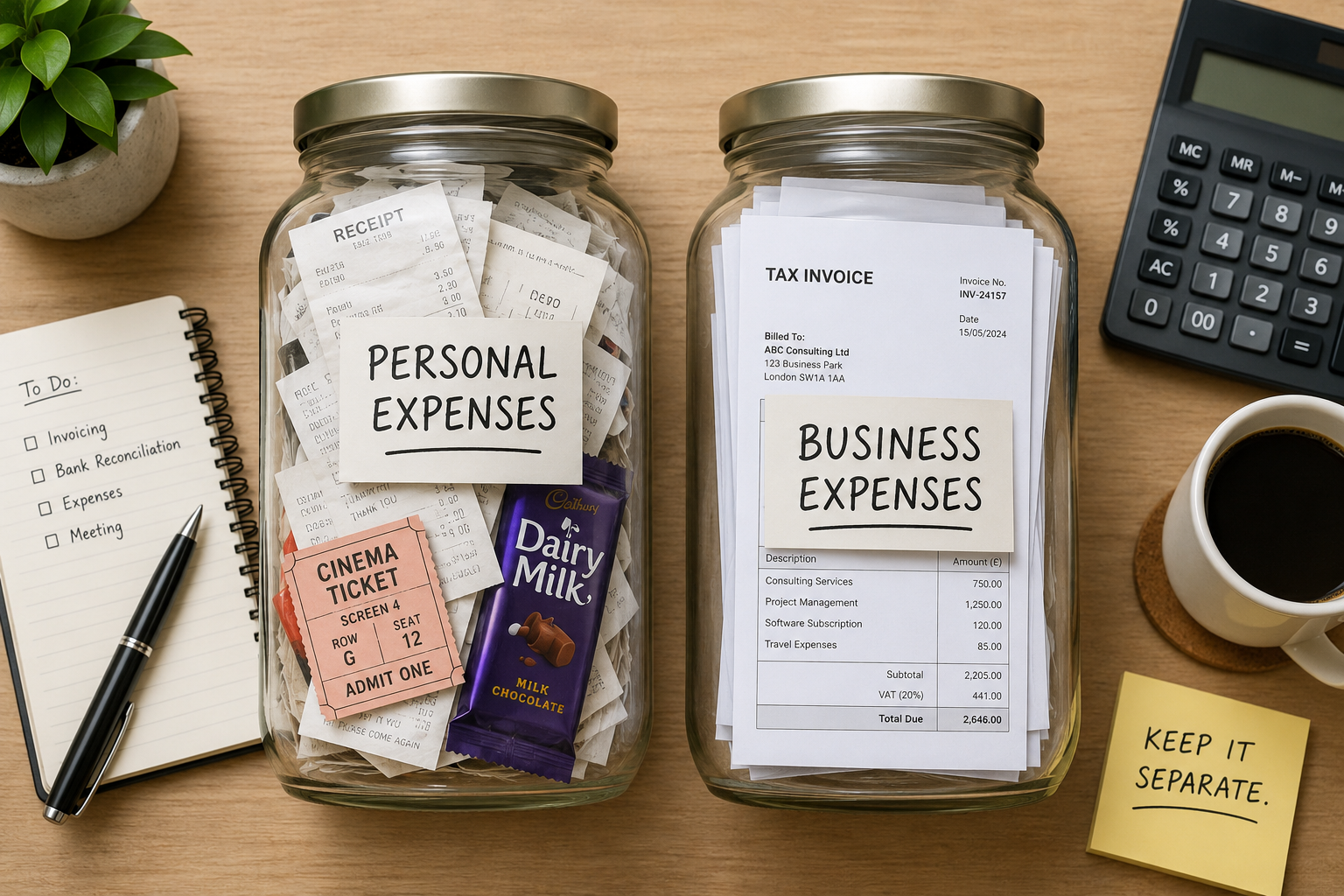
Let me start with a confession. The first time I asked myself can I use a personal account for business expenses, I’d already been doing it for months. When I set up my first side hustle years ago, I paid for everything — stock, a dodgy laptop, an embarrassing number of late-night takeaways I tried to pass off as “client research” — straight out of my normal current account. The one with my Netflix and my gym direct debit. And for a while, nothing bad happened. Which is exactly the problem.
So if you’re sitting there wondering can I use a personal account for business expenses without the sky falling in, here’s the short version up front: yes, you usually can if you’re a sole trader, and no, you really shouldn’t if you run a limited company. That single distinction is the whole ballgame, and most people don’t realise it until an accountant (hello) or HMRC gently points it out.
Stick with me, because the difference between “allowed” and “advisable” is where people lose money, sleep, and occasionally their evenings to a shoebox of receipts.
Sole trader or limited company? Your business structure changes everything
Before we go any further, you need to know which camp you’re in, because the rules genuinely split here.
If you’re a sole trader, you and your business are, in the eyes of the taxman, the same person. HMRC treats you and your business as a single entity for tax purposes. There’s no legal wall between your money and the business’s money — it’s all just your money, taxed through Self Assessment. That’s why there’s no rule forcing you to open a separate account.
If you run a limited company, the picture flips completely. Your company is its own legal “person.” You’ll need to file your business and personal taxes separately if you’re the director of a limited company. The business must file annual accounts with HMRC and pay Corporation Tax on any profits for the financial year. The money in the company belongs to the company — not to you, even if you own every share. Treating it as your personal piggy bank is where things get sticky.
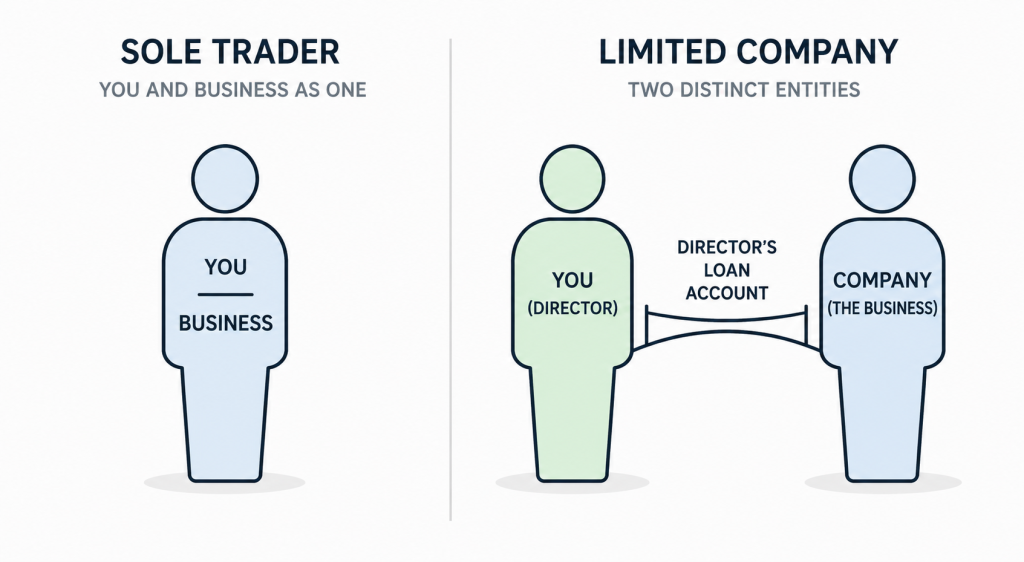
Same applies to LLPs, by the way. Different beast, separate account, no shortcuts.
A quick reality check: Being allowed to do something and it being a good idea are two very different things in tax. Keep that in your back pocket for the rest of this read.
Can I use a personal account for business expenses as a sole trader?
Right, sole traders — this is your section, and it’s mostly good news with a sting in the tail.
There is no HMRC requirement for sole traders to have a business account, but it does expect accurate record-keeping. So technically, can I use a personal account for business expenses as a sole trader? Yes. Plenty of people do, especially at the start when revenue is more “hopeful” than “actual.”
But here’s the sting. HMRC doesn’t care which account you use — it cares whether you can prove what you spent and earned. And when your business coffee, your personal coffee, your mortgage, and your client invoices are all sloshing around in one account, proving anything becomes a Sunday-evening nightmare with a calculator and a grudge.
What you can actually claim is governed by one ruthless little phrase: wholly and exclusively. HMRC only allow you to claim tax relief on expenses “wholly and exclusively” incurred in the course of running your business. A personal account doesn’t break that rule — but it makes the line between business and personal blurry, and blurry is precisely what triggers questions.
Some classics that are not allowable, no matter how creatively you frame them: everyday clothing, holidays, private phone calls, private streaming subscriptions and routine grocery costs fall outside allowable expenses for sole traders. (Yes, I’ve watched someone try to claim a family Disney+ account as “market research.” It did not go well.)
For mixed-use stuff — your phone, your broadband, the corner of the spare room you call an office — HMRC expects clear apportionment, which means you must calculate the business percentage and apply it consistently. Try doing that fairly when every transaction lives in one chaotic feed.
If you want the full rundown of what counts, our guide to Self Assessment walks through the categories without the jargon, and HMRC’s own self-employed record-keeping rules are worth a skim.
Why HMRC is suddenly paying much closer attention
Here’s something that’s changed recently, and it matters. HMRC is increasing its focus on taxpayers who use their business accounts to pay for personal expenses in their Self Assessment returns.
This isn’t a vague threat. The tax office is smarter than it used to be. They compare your costs with others in your sector, look for unusual spikes from one year to the next, and examine whether a claimed expense actually matches the description. A sudden jump in home-working costs with no change in how you work? A fat subsistence claim from someone who barely leaves their desk? Flags go up.
And often it isn’t even the number that gets you. It is the absence of a clear calculation that raises the flag, not just the figure itself. Mixed accounts make clean calculations almost impossible. You see the trap forming.
If you ever do find yourself on the receiving end of a letter, our breakdown of HMRC investigations explains what actually happens and why panicking is optional.
Limited company directors: this is where you must be careful
Okay, directors, no more gentle warm-up. For you, casually paying for business stuff from your personal account — or worse, paying for personal stuff from the company card — isn’t just messy. It can chip away at the very thing your company structure is supposed to protect.
If you’re a company director, blurring the lines may weaken the protection of limited liability — making you more exposed if things go wrong. That’s the bit people forget. The whole point of “limited” is that line between you and the business. Smudge it repeatedly and you hand anyone who’s unhappy with your company a thread to pull.
But — and this is the part directors love once they get it — there is a proper, perfectly legal mechanism for the times you spend your own money on the business. It’s called the director’s loan account.
What a director’s loan account actually does
Think of it as an IOU ledger between you and your company. It simply tracks the money that moves between you, the director, and your company — specifically, any money that isn’t part of your salary, a dividend payment, or a direct reimbursement for a business expense.
So when you front the cash for, say, a £400 piece of equipment from your personal card because the company card was in your other coat, you haven’t done anything wrong. You’ve lent the company £400. If you have paid business expenses personally, you can pay yourself back using the company bank account. The transaction gets logged, the company repays you, everyone’s happy, HMRC has a clean trail.
So, if your director’s loan account is a debit balance because you owe your company money, and you use your own money to pay a business expense, the amount that you owe is reduced. It’s genuinely flexible — but the magic word is documentation. Every limited company has a DLA for each director under the Companies Act 2006, whether the balance is zero or not.
Get this wrong and the consequences aren’t trivial. If the account swings the other way — you owing the company — there’s Section 455 tax, benefit-in-kind territory above £10,000, and a knot of rules that catch people out every single year. This is firmly “phone your accountant” land, and our corporate tax planning and company secretarial services exist for exactly this reason.
A side-by-side look at who can do what
Here’s the lay of the land at a glance. (I’ve kept it deliberately plain — the nuance lives in the paragraphs above.)
| Question | Sole Trader | Limited Company |
|---|---|---|
| Legally required to have a separate business account? | No | Yes — it’s a separate legal entity |
| Can you legally use a personal account for business spend? | Yes (but messy) | No — funds belong to the company |
| How you reclaim money you spent personally | N/A — it’s all your money anyway | Via the director’s loan account |
| Main risk of mixing accounts | Record-keeping chaos, missed claims | Weakened liability protection, tax traps |
The real-world headaches nobody warns you about
Let me lay out what actually goes wrong when you mix accounts — and I’ve made this next table a little rough around the edges on purpose, because that’s how this stuff lands in real life: not in tidy rows, but in scattered annoyances.

| The Problem | Why it bites | Roughly how bad |
|---|---|---|
| Lost / missed expenses | You forget the £30 here and £12 there — and pay more tax than you needed to | Annoying & expensive |
| Year-end takes forever | Your accountant has to comb personal statements line by line | Higher fees |
| Cloud software can’t help you | Bank feeds pull in your groceries alongside genuine costs | Defeats the point |
| HMRC scrutiny | Mixed accounts make claims harder to defend | Potentially very bad |
That third row is worth dwelling on. Modern cloud accounting software is brilliant — it connects to your bank, categorises spending, practically does your bookkeeping while you sleep. But feed it a personal account and you’ve handed it a fruit salad when it wanted apples. If your personal and business transactions are mixed up, you won’t be able to make use of these useful integrations.
So what should you actually do?
Here’s my honest advice, the same I’d give a friend across the kitchen table.
If you’re a sole trader just starting out and money’s tight, using your personal account for a few weeks won’t land you in prison. But open a separate account the moment you can. It makes your business look more professional, and many high street banks offer free banking services for the first year. You don’t even need a fancy “business” account at first — a second personal account, used only for the business, is miles better than one big mixing bowl.
If you run a limited company, this isn’t optional. Separate account, day one, no debate. And make friends with your director’s loan account rather than fearing it.
⚠️ The mistake I see most often: People treat “I’m allowed to” as “I’m fine.” You can be entirely within the law and still be quietly losing money, inviting scrutiny, and building a mess that costs more to untangle later than a separate account ever would have cost to run.
A bit of solid bookkeeping from the start saves a frankly silly amount of grief later. If you’re not sure which side of the sole-trader-vs-company line you should even be on, that’s a conversation worth having before you pick an account — our business advice team has it daily.
Can I use a personal account for business expenses? Your FAQs answered
Can I use a personal account for business expenses if I’m a brand-new sole trader? Yes. There’s no legal requirement to have a business account as a sole trader. But “yes you can” and “yes you should” are different sentences. Separate as soon as it’s practical.
What happens if I, as a director, accidentally pay for a business cost from my personal card? Nothing terrible, if you record it. It goes onto your director’s loan account as money the company owes you, and the company repays you. The danger is doing it without documenting it.
Will HMRC fine me just for using a personal account? Not for the account itself. The risk is downstream — poor records, unprovable claims, and the heightened scrutiny that comes with mixed finances. The penalty, when it comes, is usually about what you couldn’t prove, not which bank logo was on the statement.
Is it ever genuinely fine to mix them long-term? For a tiny, occasional sole trade with a handful of transactions a year? Arguably. For anything growing, anything VAT-registered, anything with a company structure? No. Your future self will thank you.
Need a hand drawing the line cleanly?
If your accounts are currently more “creative jazz” than “clean ledger,” that’s fixable — and it’s exactly what we do. So the next time you wonder can I use a personal account for business expenses and what it’ll cost you later, you’ll already know the answer. Ask Accountants UK Ltd sorts out the personal-versus-business tangle for sole traders and directors across London every week, from first-time Self Assessment filers to limited companies wrestling with their director’s loan accounts.
Pop in or give us a ring — no jargon, no judgement about the shoebox of receipts.
📍 178 Merton High St, London SW19 1AY 📞 020 8543 1991