
Summarize this blog post with: ChatGPT | Perplexity | Claude | Grok
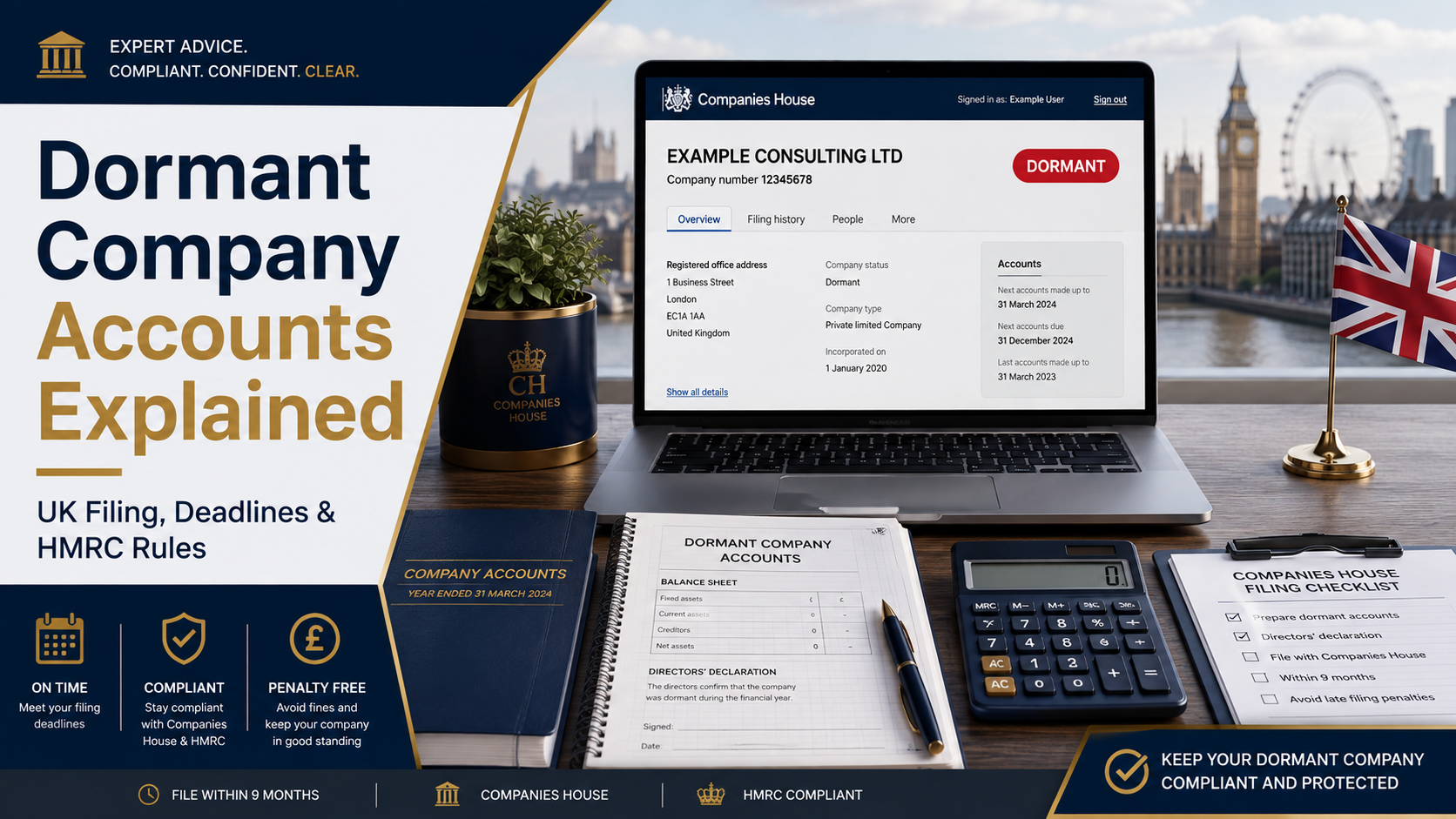
You may think your limited company has nothing to report if it never traded. You may also assume a company that stopped trading has no further duties. Dormant companies still have filing obligations, and Companies House and HMRC use different rules. This guide explains dormant company accounts, filing deadlines, tax duties, common mistakes and your next steps.
Key Takeaways
- Dormant company accounts cover companies with no significant accounting transactions during the financial year.
- Dormant companies still file annual accounts and confirmation statements with Companies House.
- Companies House and HMRC use different dormancy rules, so one status does not remove every filing duty.
- Dormant accounts follow normal Companies House deadlines for the company.
- Late filing can lead to Companies House penalties, even when the company has never traded.
- VAT, PAYE and Corporation Tax need separate checks when a company becomes dormant.
- A company that starts trading again must update its tax and accounting position.
What Are Dormant Company Accounts?
Dormant company accounts are annual accounts for a company with no significant accounting transactions. Companies House requires limited companies to file accounts even when they do not trade.
For example, you may form a company for a future business idea. You then leave it unused for a year. If it has no significant transactions, it may qualify for dormant accounts.
Dormant does not mean compliance-free. You still need to meet the company’s Companies House obligations.
What Makes a Company Dormant for Companies House?
Companies House treats a company as dormant when it has no significant transactions during its financial year. Some transactions do not count when Companies House assesses dormancy.
These excluded transactions include:
- Companies House filing fees
- Late-filing penalties
- Certain payments for shares when the company formed
For example, paying a Companies House filing fee does not automatically make your company active.
The key test is whether the company has significant accounting transactions.
Why Does a Dormant Company Still Need to File Accounts?
A dormant company still files accounts because Companies House requires limited companies to submit annual accounts. The company must also file its confirmation statement.
For example, a company with zero sales can still have an annual filing deadline.
Dormancy reduces some reporting requirements, but it does not remove them.
You can also review our guide to accounting for small companies if you want to understand the wider accounts requirements.
Do Dormant Companies Need to File a Confirmation Statement?
Dormant companies still need to file a confirmation statement. The statement confirms that Companies House holds accurate information about the company.
For example, you should check your registered office, directors and people with significant control before filing.
What Is the Difference Between Dormant for Companies House and Dormant for Corporation Tax?
Companies House dormancy and Corporation Tax dormancy are separate statuses. A company can therefore have different obligations with Companies House and HMRC.
Companies House focuses on significant accounting transactions. HMRC focuses on whether the company remains active for Corporation Tax.
| Area | Companies House | HMRC |
|---|---|---|
| Main concern | Company accounts | Corporation Tax |
| Dormancy test | Significant transactions | Tax activity |
| Annual accounts | Generally required | Not the main filing |
| Confirmation statement | Required | Not applicable |
| Corporation Tax return | Not applicable | Depends on HMRC status |
| VAT and PAYE | Separate | Separate |
For example, telling HMRC that your company is dormant does not cancel your Companies House filing duties.
Never treat Companies House dormancy and HMRC dormancy as the same status.
You can also read our guide to Corporation Tax returns for more information.
Who Can File Dormant Company Accounts?
A company can file dormant accounts when it meets the Companies House dormancy rules. This can include a company that never traded or one that stopped trading.
For example, a new company may remain dormant while its owner prepares to launch the business.
A previously active company needs more care. You should check when trading stopped and whether any significant transactions continued after that date.
Can a Company That Previously Traded Become Dormant?
Yes, a previously trading company can become dormant. The company must first stop its significant accounting activity.
For example, a company may stop trading on 30 June. If no significant transactions follow, it may qualify as dormant for the relevant period.
The date trading stopped matters when preparing the accounts.
What Do Dormant Company Accounts Include?
Dormant company accounts contain less information than accounts for an active trading company. Qualifying dormant companies generally file a balance sheet rather than a full trading profit and loss account.
For example, a dormant company may show share capital and other relevant balance-sheet figures.
The accounts still need the correct company information. A director must also sign the balance sheet.
Do Dormant Companies Need an Audit?
Qualifying dormant companies can usually benefit from audit exemption. Companies House confirms that a dormant company that also qualifies as small can file dormant accounts without an auditor’s report.
For example, a small company that has remained dormant may not need a statutory audit.
Audit exemption does not remove the need to file accounts.
When Are Dormant Company Accounts Due?
Dormant company accounts follow the normal Companies House filing deadlines. A private company normally files annual accounts within nine months of its financial year end.
For example, a private company with a 31 December year end normally has until 30 September to file its annual accounts.
A company’s first accounts can have a different deadline. Private companies generally have up to 21 months from incorporation when their first accounts cover more than 12 months.
Dormant status does not give your company an automatic filing extension.
How Do You File Dormant Company Accounts With Companies House?
You can file dormant company accounts through the Companies House filing service. First, check that the company qualifies as dormant. Then prepare the correct accounts and submit them before the deadline.
Follow these steps:
- Check the company’s transactions.
- Confirm the accounting reference date.
- Prepare the dormant accounts.
- Check the company’s details.
- Submit the accounts to Companies House.
- Save the filing confirmation.
For example, you can review the company record before filing to make sure the registered information remains accurate.
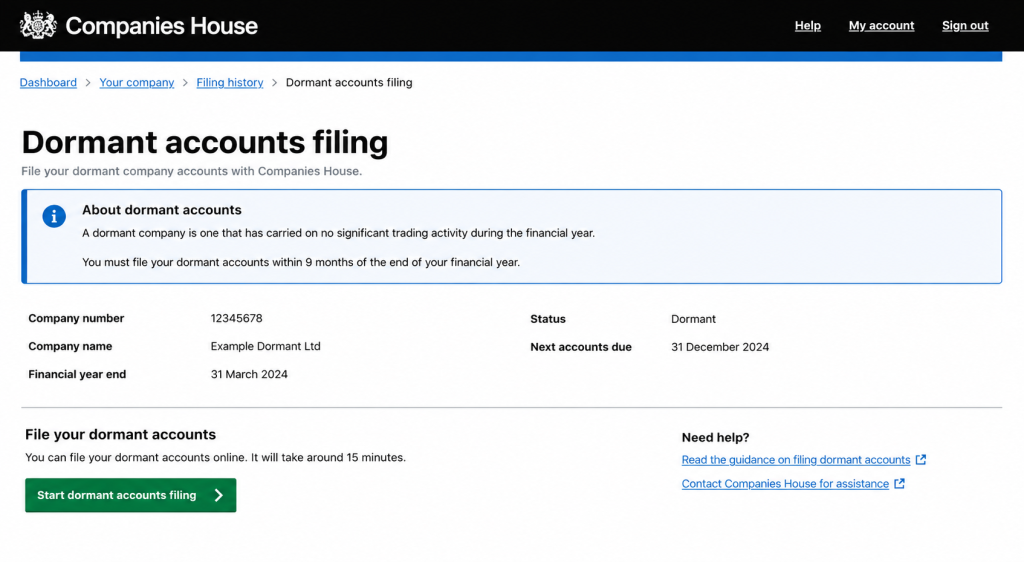
Keep the filing confirmation with your company records.
Does a Dormant Company Need to File a Corporation Tax Return?
A dormant company may not need to file another Corporation Tax return after HMRC accepts its dormant status. However, HMRC can still issue a notice requiring a return.
For example, a company that stops trading can tell HMRC it has become dormant for Corporation Tax.
You should still check whether the company has received a notice to file. If HMRC asks for a return, you must follow that notice.
Do not ignore an HMRC filing notice because the company is dormant.
Does a Dormant Company Need to Pay Corporation Tax?
A genuinely dormant company will generally have no Corporation Tax liability for its dormant period. However, the position can change when the company becomes active again.
For example, a dormant company that starts selling services can become active for Corporation Tax.
The company must then deal with its Corporation Tax registration and reporting duties.
Do Dormant Companies Need to Register for or Deregister From VAT?
VAT follows separate rules from Companies House dormancy. A VAT-registered company must review its VAT position when it stops trading.
For example, a company that expects to restart soon may need to keep its VAT registration.
A company that no longer needs VAT registration may need to deregister instead.
Do not assume that dormant status automatically cancels VAT obligations.
What Happens If Dormant Company Accounts Are Filed Late?
Late dormant accounts can trigger Companies House penalties. Companies House applies the same late-filing rules to dormant accounts as other company accounts.
For example, a director who misses the deadline can face a penalty even when the company had no sales.
You should therefore record the filing deadline and prepare the accounts early.
Zero trading does not protect a company from late-filing penalties.
What Happens When a Dormant Company Starts Trading Again?
A dormant company must return to the relevant active-company reporting process when it starts trading again. HMRC requires the company to register for Corporation Tax again.
For example, a company that starts selling products in May should not continue treating itself as dormant.
HMRC says the company must register for Corporation Tax and prepare statutory accounts and Company Tax Returns when required.
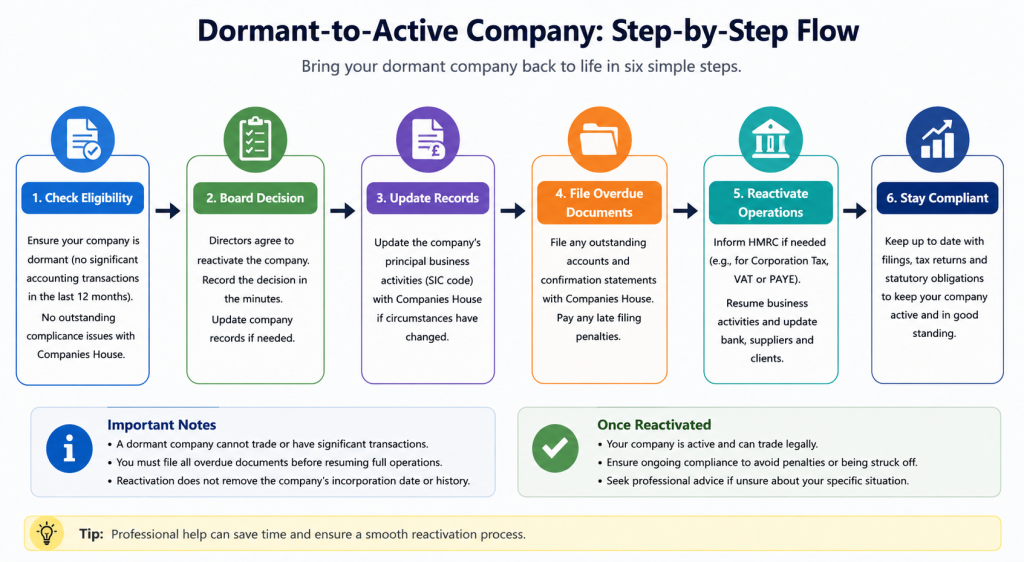
Trading activity changes the company’s compliance position.
What Are the Most Common Dormant Company Mistakes?
The biggest dormant-company mistake is assuming that no trading means no filing. Companies House still expects annual accounts and a confirmation statement.
Other common mistakes include:
- Missing the Companies House deadline
- Confusing HMRC and Companies House dormancy
- Ignoring an HMRC notice
- Forgetting confirmation statements
- Failing to review VAT
- Continuing to treat the company as dormant after trading starts
For example, a company can have no sales but still have tax or filing obligations.
A simple annual compliance check can prevent most dormant-company errors.
Do You Need an Accountant for Dormant Company Accounts?
You do not always need an accountant to file dormant accounts. Companies House allows directors to handle their own filings.
However, professional help can make sense when the company previously traded or has unclear transactions.
For example, an accountant can review the transaction history and confirm whether dormant accounts fit the company’s position.
Should You Keep a Company Dormant or Close It?
Keeping a company dormant can make sense when you plan to use it later. Closing the company may make more sense when you no longer need it.
For example, an entrepreneur planning a new business next year may keep the company dormant. Someone who has abandoned the project may prefer to close it.
Consider these three options:
- Keep it dormant if you expect to use the company later.
- Restart it when you are ready to trade.
- Close it if you no longer need the company.
The best option depends on your future plans and the company’s current obligations.
What Should You Do Next With a Dormant Company?
The next step is to check your company’s current status and upcoming deadlines. Start with Companies House, then review the company’s HMRC position.
Use this quick checklist:
- Check the accounting reference date.
- Check the next accounts deadline.
- Review company transactions.
- Confirm whether dormant accounts apply.
- Prepare and file the accounts.
- Check the confirmation statement deadline.
- Review Corporation Tax status.
- Review VAT and PAYE obligations.
- Keep copies of all filing confirmations.
For example, completing this review once a year can help prevent missed filings.
If your company’s status remains unclear, professional advice can help you avoid unnecessary penalties and filing work.
Conclusion
Dormant company accounts are annual accounts for companies with no significant accounting transactions. Companies House still requires dormant companies to file annual accounts and confirmation statements.
The most important point is simple: Companies House dormancy and HMRC dormancy are different. You should review each obligation separately.
Your company may not trade, but its compliance duties continue. Keep your deadlines organised, review your tax position and seek professional help when the company’s history is unclear.
A dormant company can be easy to maintain when you keep its filings up to date.
Written by ASK Accountants UK Ltd Editorial Team — UK accounting and company compliance content specialists.
Reviewed by ASK Accountants UK Ltd Tax & Accounting Review Team — UK company accounts, Corporation Tax and compliance specialists.
Disclaimer: This article was initially drafted using AI assistance. However, the content has undergone thorough revisions, editing, and fact-checking by human editors and subject matter experts to ensure accuracy.