

Running a business in the UK is incredibly rewarding. It can also be incredibly stressful when things do not go to plan. Whether you are a startup founder pouring capital into a new idea or a seasoned SME owner weathering a tough economic season, making a loss is sometimes just part of the journey. The good news is that a tough trading year does not have to be a total financial disaster. By understanding Company loss relief, you can turn a difficult financial period into a strategic advantage.
Company loss relief allows you to offset your current losses against past or future profits. This process can generate a much-needed cash refund from HMRC or reduce your future tax bills. When cash flow is tight and you are trying to keep the lights on, reclaiming previously paid taxes can be a true lifeline.

Understanding the basics of Company loss relief
Before you can claim any tax back, you need to understand how corporation tax losses actually work. Your accounting profit is the number you see at the bottom of your profit and loss statement. However, HMRC calculates your tax based on your taxable profit. These two numbers are rarely the same.
To find your taxable profit, you must adjust your accounting figures. You will add back certain expenses that HMRC does not allow for tax purposes. You will also deduct specific tax allowances. If this final adjusted figure is less than zero, you have generated a trading loss.
It is vital to be precise here. When calculating these figures, keep in mind that the rules surrounding business entertainment or company vehicles are highly nuanced. There are strict exceptions and partial recovery rules at play. You should always seek specific advice before assuming these costs are fully deductible.
Once you have a confirmed trading loss, HMRC loss relief rules provide several options to help your business recover.
Applying Company loss relief against previous profits
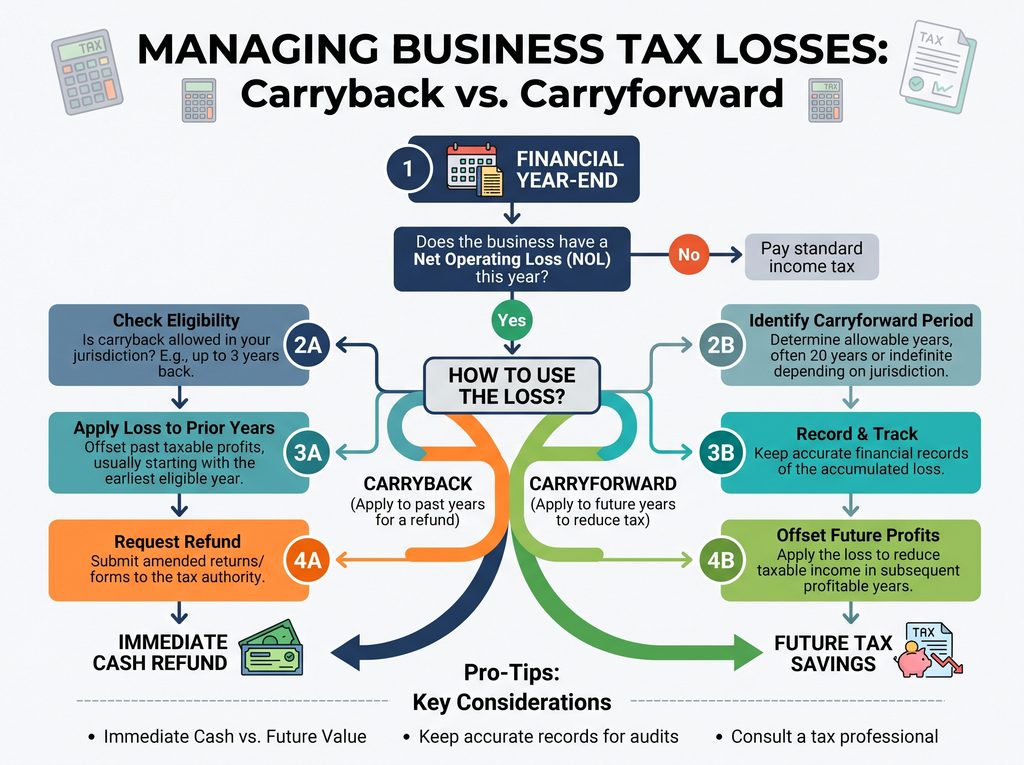
One of the most powerful tools for a struggling business is the ability to look backwards. If your company was profitable in the previous accounting period and you paid corporation tax, you can use your current loss to offset that past profit.
This strategy is formally known as a carry back claim. You can typically carry a loss back to the preceding 12-month accounting period. By doing this, you effectively rewrite last year’s tax return. Since you are lowering the profit from the previous year, HMRC will refund the corporation tax you already paid on that amount.
For a business experiencing a sudden downturn, this cash injection is invaluable. Instead of waiting for future profitable years to see a tax benefit, you get a refund now. You can use this money to pay suppliers, retain staff, or invest in new marketing campaigns.
Using Company loss relief to carry forward trading losses
Not every business has past profits to rely on. If you are a new startup, your first few years might be entirely focused on growth and customer acquisition. It is completely normal to run at a loss during this phase.
If you cannot carry your loss backwards, you will rely on another strategy. You can use your Company loss relief to carry forward trading losses. This means your current loss is banked and saved for the future.
When your startup eventually turns a corner and becomes profitable, you will apply these banked losses to your new profits. This will significantly reduce your future corporation tax bill. In some cases, it can wipe out your tax liability entirely for that year. It is a fantastic way to protect your hard-earned profits once your business finally takes off.
Exploring terminal loss relief for closing businesses
Sometimes a business simply reaches the end of the road. Making the decision to close your company is emotionally draining and financially complex. However, the tax system does offer a specific mechanism to help you during this difficult time.
If your company ceases trading permanently, you can claim terminal loss relief. This specific rule allows you to carry back any trading losses made in your final 12 months of operation. Unlike the standard rule, you can carry these terminal losses back for up to three years.
This extended timeline allows you to reclaim corporation tax paid over a much longer period. The resulting refund can be used to pay off final creditors, settle outstanding director loan accounts, or simply ease the financial burden of winding up the company.
How capital allowances interact with Company loss relief
Many business owners assume that a loss only happens when sales are terrible. This is a misconception. You can actually have a fantastic year in terms of revenue but still generate a loss for tax purposes. This usually happens when you invest heavily in your business infrastructure.
When you purchase large assets like machinery, computers, or commercial vehicles, you can claim capital allowances. The Annual Investment Allowance allows you to deduct the full cost of qualifying assets from your profits in the year you buy them.
If you spend heavily on equipment, these deductions can push a profitable business into a tax loss position. This is actually a highly efficient tax planning strategy. It allows you to upgrade your operations while simultaneously utilizing Company loss relief to secure a tax refund.
Common errors and record-keeping risks
Managing tax strategy is complex, and mistakes can be costly. When small business owners try to navigate these rules alone, they frequently fall into a few predictable traps. Here are the most common errors and record-keeping risks to avoid.
- Missing statutory deadlines: You do not have unlimited time to claim your relief. If you want to carry a loss backward to claim a refund, you must generally make the claim within two years of the end of the accounting period in which the loss occurred. If you miss this window, the opportunity is gone forever.
- Failing to maintain compliant digital records: The UK tax system is rapidly digitizing. Most VAT-registered businesses must keep digital records and use compliant software like Xero or QuickBooks under the Making Tax Digital initiative. While there are limited exemptions, maintaining pristine digital records helps improve accuracy for your tax return and ensures you have the evidence to back up your loss claims.
- Miscalculating allowable expenses: Accurately calculating your taxable profit is the foundation of any loss claim. If you make an error on your tax return that leads to underpaid tax, HMRC will apply charges. Late-payment interest begins on day 1; first penalties arise at day 15 and increase at day 30. It is absolutely vital to get these calculations right the first time to avoid these costs.

A step-by-step workflow for claiming your relief
If you are ready to process your losses, you need a clear plan of action. Follow this structured workflow to ensure your claim is handled correctly and efficiently.
- Finalise your commercial accounts: Ensure your bookkeeper has reconciled all bank feeds, logged all receipts, and closed out the financial year in your accounting software.
- Adjust for tax purposes: Take your commercial profit and apply all necessary tax adjustments. Add back non-allowable expenses and deduct your eligible capital allowances.
- Choose your strategy: Look at your financial history. Decide if it is more beneficial to carry the loss backward for an immediate cash refund or to carry forward trading losses to protect future profits.
- Submit the CT600 tax return: Update your corporate tax return with the correct loss figures. Ensure you fill in the specific supplementary pages required for loss claims.
- Monitor your HMRC account: Once submitted, keep a close eye on your digital tax account. If you are due a refund, it will be processed and deposited directly into your business bank account.
Why outsourcing this task is a smart investment
As a business owner, your time is your most valuable asset. Spending hours reading through dense HMRC technical manuals is not the best use of your expertise. Your focus should be on driving sales, improving your product, and leading your team.
Outsourcing this specific task to a professional can reduce administrative burden and mitigate the risk of errors. An experienced accountant understands exactly how to optimize your claim. They will review your asset purchases, analyze your historical profits, and determine the most financially advantageous route for your specific situation.
By partnering with a professional, you gain peace of mind. You know that your tax return is being handled by someone who understands the nuances of the legislation. You can get back to doing what you do best, knowing the financial side of your business is secure.
Let ASK Accountants UK Ltd help you today
Navigating corporation tax losses does not have to be a solo journey. At ASK Accountants UK Ltd, we have spent the last 15 years helping SMEs, startups, and landlords across Wimbledon and South-West London achieve financial clarity.
We understand the stress that comes with a difficult trading year. Our team is dedicated to providing you with clear, actionable advice tailored to your unique business goals. We will handle the complex tax calculations so you can focus on building a stronger, more resilient company.
If you are ready to explore your options regarding Company loss relief, we are here to help. Reach out to our friendly team today.
- Call us directly: 020 8543 1991
- Visit our office: 178 Merton High St, London
- Explore our services: Discover our bookkeeping services or reach out via our contact page.
Frequently Asked Questions about Company loss relief
Who qualifies for Company loss relief in the UK?
Any UK limited company that pays corporation tax can potentially qualify. If your allowable business expenses and capital allowances exceed your taxable business income for the accounting period, you have generated a qualifying trading loss.
Can I claim Company loss relief on property income?
Yes, but the rules are slightly different. If your company manages property and your expenses exceed your rental income, you generate a property business loss. Generally, you can only carry this specific type of loss forward to offset against future property income. It cannot usually be offset against general trading profits. For detailed reading on property rules, you can review the GOV.UK property income guidance.
How long does HMRC take to process a Company loss relief refund?
Once you submit your amended CT600 tax return to claim a carry back refund, the processing time can vary. In many straightforward cases, HMRC processes these refunds within four to eight weeks. However, during busy periods or if your claim is particularly complex, it can take longer. Having pristine digital records and a professionally prepared return will help prevent unnecessary delays.