

If you have ever stared at your accounts at midnight wondering what your company is worth, you are not alone. Whether you run a Wimbledon café, lead a tech startup, or manage a rental portfolio, understanding business valuation methods UK owners rely on can feel overwhelming. Buyers throw around unfamiliar acronyms. HMRC applies strict rules to tax-related share transfers. One wrong assumption can cost you tens of thousands of pounds. Take a breath. Let us break down how valuations work in plain English so you can make confident decisions.

Why Understanding Business Valuation Methods UK Matters Right Now
Knowing how to value a business UK style is not just for owners preparing to sell. You need a defensible figure for many everyday milestones. Perhaps you are bringing on a new shareholder. Maybe you are issuing staff share options, settling a divorce, or moving shares into a family trust.
In every one of those situations, guessing a round number will not hold up. Lenders, investors, and HMRC expect figures backed by clean records and recognised accounting principles. A realistic valuation also gives you a clear benchmark for business advice and long-term growth planning. It helps you see what genuinely drives value inside your company.
HMRC Rules, Digital Records, and Compliance Deadlines
Before you pick a valuation formula, you need to understand how HMRC views company worth. Whenever a transaction involves connected parties (such as transferring shares to a family member or incorporating a sole trade), HMRC generally applies the market value rule. The same rule applies when a transfer triggers Capital Gains Tax (CGT) or Inheritance Tax (IHT). An agreed nominal price on paper does not override market value in those cases.
Working with HMRC Shares and Assets Valuation (SAV)
For unquoted companies, HMRC operates a specialist unit called Shares and Assets Valuation (SAV). They review valuations declared on tax returns and handle Post Transaction Valuation Checks via form CG34. If you plan to use the CG34 process after a disposal, submit the form at least three months before your Self Assessment deadline. That gives HMRC enough time to review your supporting accounts.
Digital Record-Keeping and Making Tax Digital (MTD)
Clean, up-to-date digital records form the backbone of any credible valuation. Under HMRC’s Making Tax Digital rules, most VAT-registered businesses must keep digital records and file returns using MTD-compatible software. Limited exemptions apply for those who are digitally excluded or meet specific criteria.
Similarly, MTD for Income Tax is rolling out in stages for sole traders and landlords, again with narrow exemptions available. Using cloud accounting tools like Xero or QuickBooks keeps your profit and loss statements accurate. It also ensures your books are ready for buyer or HMRC scrutiny.
Late-Payment Interest and Penalty Timelines
When a valuation feeds into a Capital Gains Tax, Corporation Tax, or VAT bill, missing payment deadlines creates avoidable costs. Under HMRC’s harmonised penalty rules, late-payment penalties follow a clear timeline:
- Day 1: Late-payment interest begins accruing immediately from the first day a payment is overdue.
- Day 15: If tax remains unpaid after 15 days, a first late-payment penalty of 2% applies. This is payable if settled between day 16 and day 30, or if a Time to Pay arrangement is agreed.
- Day 30: Any tax still unpaid at day 30 triggers an additional 2% charge (4% in total). A second daily penalty also accrues at 4% per year from day 31 onward.
The Main Business Valuation Methods UK Owners Use
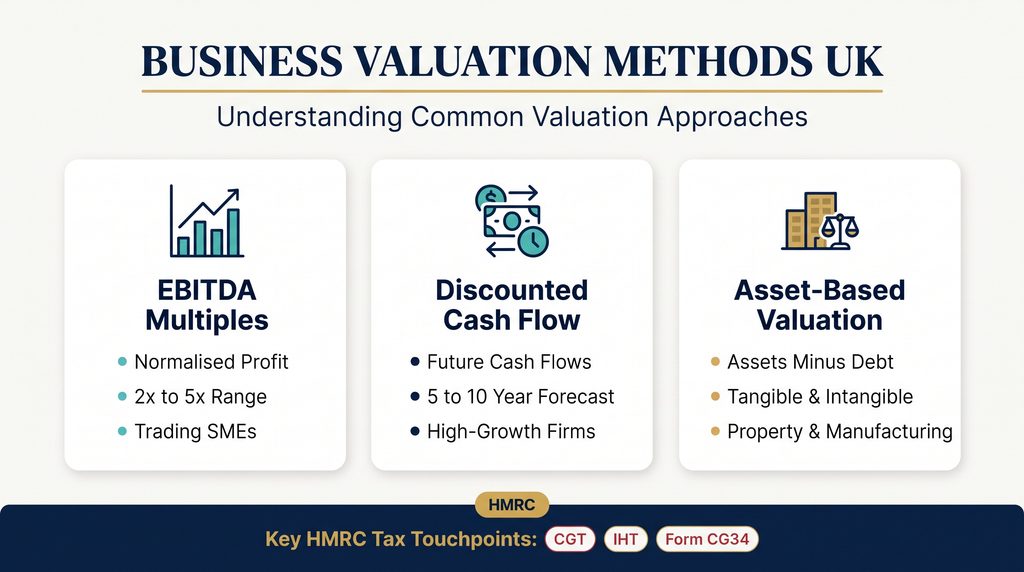
There is no single magic formula that fits every company. A local consultancy in Wimbledon, an ecommerce store, and a buy-to-let SPV will each be judged differently. Below are the core business valuation methods UK advisers and buyers use most often, as outlined in ICAEW valuation research.
1. EBITDA Valuation Multiple (Earnings-Based)
For profitable trading SMEs, the EBITDA valuation multiple is the most common approach. EBITDA stands for Earnings Before Interest, Taxes, Depreciation, and Amortisation. It shows the core operating cash profit your business generates before financing and accounting adjustments.
Buyers take your normalised EBITDA and multiply it by an industry multiple. Normalised EBITDA adjusts your profit for one-off costs and market-rate director salaries. For small UK businesses, multiples often sit between 2x and 5x. The exact figure depends on sector stability, recurring revenue, and customer concentration. A business with long-term contracts usually commands a higher multiple than one relying on one-off sales.
2. Discounted Cash Flow Valuation
A discounted cash flow valuation (DCF) looks forward rather than backward. It estimates the free cash flow your business will generate over the next five to ten years. It then discounts those future cash flows back to today’s value using a risk-adjusted rate (often called WACC).
DCF works well for high-growth startups, subscription platforms, or firms undergoing major expansion. In those cases, past profits rarely reflect future potential. However, DCF is very sensitive to small changes in growth assumptions and discount rates. Buyers treat it cautiously unless your forecasts are backed by solid contracts and historical data.
3. Asset-Based Business Valuation
An asset-based business valuation calculates what a company owns minus what it owes. You take the fair market value of tangible assets (property, machinery, stock, and cash) plus identifiable intangible assets. You then subtract all liabilities.
This method suits asset-heavy firms like manufacturers, construction contractors, or property companies managed through property accounting. It is rarely suitable on its own for profitable service businesses. Why? Because it ignores goodwill and the ongoing earning power of your team.
4. Revenue Multiples and Market Comparables
Early-stage tech firms or agencies with high turnover but thin margins sometimes use a times-revenue method. Meanwhile, market comparables look at what similar UK private companies actually sold for recently. In practice, experienced advisers blend two or three business valuation methods UK buyers trust to triangulate a realistic price range.
Common Errors and Record-Keeping Risks in Business Valuations
Even strong businesses lose value during due diligence because of avoidable mistakes. Looking at these as common errors and record-keeping risks helps you fix weak areas early.
Mistake 1: Mixing Personal and Business Expenses
Many SME directors put personal costs or discretionary perks through the company. Later, they try to “add them back” during a sale to boost EBITDA. That is where things get tricky.
Rules around expenses such as business entertainment and company vehicles are highly nuanced. Strict exceptions and partial recovery rules apply for VAT and Corporation Tax. Trying to overstate add-backs without clear invoices creates record-keeping risks and erodes buyer trust. You should always seek specific advice from a qualified accountant before adjusting these items.
Mistake 2: Ignoring Connected-Party Market Value Rules
Transferring shares to a spouse, child, or holding company at a nominal £1 per share can create unexpected tax bills. HMRC does not simply accept the price written on a stock transfer form between connected persons. Without a formal valuation supported by three years of accounts, you risk disputes over Capital Gains Tax or Inheritance Tax liabilities later on.
Mistake 3: Relying on Outdated or Messy Spreadsheets
Walk into a negotiation with unreconciled bank feeds, missing receipts, or a tangled director’s loan account, and buyers will quickly reduce their offer. Poor bookkeeping signals operational risk. Worse, if you cannot substantiate your balance sheet figures, completing tax compliance checks or agreeing a CG34 valuation with HMRC becomes far slower.
Step-by-Step Workflow: How to Choose Between Business Valuation Methods UK
If you want a smooth valuation process, follow this practical workflow before approaching buyers, investors, or HMRC:
- Clarify the purpose of your valuation: Decide whether the figure is for a third-party sale, bank finance, shareholder exit, or HMRC reporting. The required standard of value can differ for each purpose.
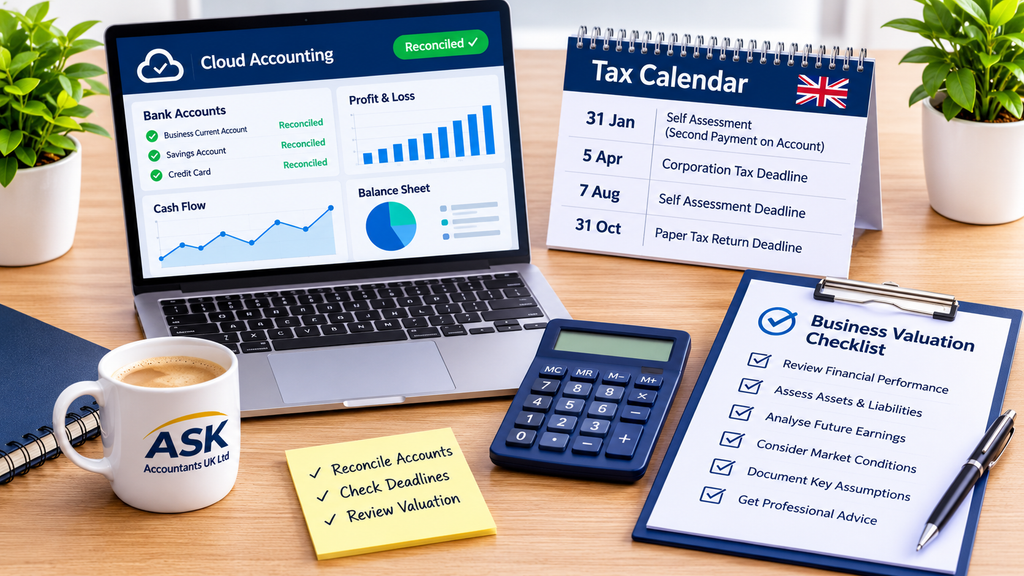
- Reconcile your cloud accounting records: Ensure at least three full years of profit and loss statements, balance sheets, and bank reconciliations are up to date.
- Normalise your earnings: Identify genuine one-off legal fees, non-recurring grants, and above-market or below-market director pay. This ensures your adjusted EBITDA reflects true trading performance.
- Document intangible value: Gather signed client contracts, intellectual property registrations, supplier agreements, and lease terms. These prove your revenue is transferable to a new owner.
- Review tax implications early: Model potential Capital Gains Tax, Business Asset Disposal Relief, and corporate tax planning options before signing heads of terms.
- Check HMRC filing timelines: If a post-transaction check (CG34) is needed, factor in the three-month HMRC review window ahead of your Self Assessment deadline.
Why Outsourcing Your Valuation Prep Makes Financial Sense
Trying to value your own business while running daily operations is exhausting. Emotional attachment almost always clouds judgment. Founders naturally focus on the sweat and late nights they invested. Buyers, on the other hand, only pay for verifiable future cash flows and clean assets.
Working with a qualified financial consultant or Chartered Certified Accountant helps improve accuracy and gives your numbers independent credibility. A professional team can reduce administrative burden during due diligence and prepare HMRC-ready valuation reports. Outsourcing also mitigates the risk of errors in tax calculations, helping you avoid unnecessary friction with buyers or HMRC.
How ASK Accountants UK Ltd Can Help
At ASK Accountants UK Ltd, we have spent 15 years supporting SMEs, startup founders, and landlords across Wimbledon and South-West London. As Chartered Certified Accountants, we do not just crunch historical numbers. We sit down with you, understand where your business is heading, and apply the business valuation methods UK buyers, lenders, and HMRC expect to see.
Whether you need help cleaning up your MTD for VAT records, planning an exit, or managing Corporation Tax efficiently before a restructure, our local team is ready to help. Give us a call on 020 8543 1991, pop into our office at 178 Merton High St, Wimbledon, London SW19 1AY, or contact us online to book a friendly, no-obligation chat.
Frequently Asked Questions About Business Valuation Methods UK
1. What is the most common way to value a small business in the UK?
For most profitable trading SMEs, an EBITDA valuation multiple is the standard starting point. Buyers look at your adjusted operating profit and multiply it by a sector-specific figure (often between 2x and 5x for smaller UK companies). Asset-heavy businesses, such as property companies or manufacturers, more commonly use an asset-based business valuation instead.
2. Does HMRC have to approve my business valuation?
Not for an arm’s-length sale between unrelated third parties, where the agreed sale price usually sets the market value. However, for transactions between connected parties, share schemes, or Inheritance Tax estates, HMRC’s Shares and Assets Valuation team can review and challenge your figures. You can submit form CG34 after a Capital Gains Tax disposal to request a Post Transaction Valuation Check before filing your return.
3. How far back do financial records need to go for a valuation?
Buyers and HMRC typically ask for at least three years of full annual accounts, alongside current year-to-date management figures and cash flow forecasts. Keeping clean records in cloud software helps speed up this process and gives buyers greater confidence in your numbers.