

Keeping track of the landlord tax return deadline can feel overwhelming. You are already juggling tenant queries, property repairs, and rising mortgage costs. Whether you own one buy-to-let flat in South-West London or run a growing portfolio, January sneaks up fast. Missing a date on your Self Assessment tax return adds unnecessary stress and financial pressure.
Thankfully, staying compliant does not mean spending your weekends buried in spreadsheets. You just need to know the exact HMRC dates and how digital rules affect your rental income. A simple monthly routine makes tax season much easier to handle. Here is what UK landlords need to know to stay ahead.

Key HMRC Dates for the Landlord Tax Return Deadline
HMRC sets several milestones across the tax year. Knowing which ones apply to you is the first step toward calm, stress-free compliance. For the 2025/26 tax year (6 April 2025 to 5 April 2026), the GOV.UK Self Assessment deadlines follow a clear calendar.
Here are the critical dates you need in your diary:
- 5 October 2026: Register for Self Assessment by this date if you are a new filer. This also applies if you received new untaxed rental income during 2025/26.
- 31 October 2026: Paper tax returns must reach HMRC by 11:59pm. Most landlords now file online, which gives you three extra months.
- 30 December 2026: File online by this date if you want HMRC to collect tax through your PAYE code. Your bill must be under £3,000 to use this option.
- 31 January 2027: This is the main online landlord tax return deadline. You must submit your 2025/26 return and pay any balancing tax owed by 11:59pm.
- 31 July 2027: Make your second Payment on Account by this date if your bill exceeds £1,000. This goes toward your next tax year’s bill.
You can check a full breakdown of 2025/26 Self Assessment tax return key dates on our blog. It helps ensure no filing milestone slips through the cracks.
How Much Rental Income Triggers a Tax Return?
Not every property owner needs to complete a return. Under GOV.UK rules on paying tax on rental property, the Property Allowance gives you a £1,000 tax-free buffer. If your gross property income is £1,000 or less, you do not need to report it.
If your gross rental income sits between £1,000 and £2,500, contact HMRC. They can tell you whether to pay through PAYE or register for Self Assessment. Once your rental income exceeds £2,500 after allowable expenses, or £10,000 before expenses, you normally must file a return.
Understanding HMRC Late Filing and Payment Penalties
Knowing how HMRC calculates charges helps you plan your cash flow calmly. Missing the 31 January online filing date triggers an automatic £100 fixed penalty. This applies even if you owe zero tax or have already paid.
For unpaid tax, HMRC’s penalties and interest framework works in clear stages:
- Day 1: Late-payment interest begins accruing on unpaid tax the day after the payment deadline.
- Day 15: Under the reformed penalty regime (applying to VAT and Making Tax Digital), no penalty applies within 15 days. First penalties arise at day 15 at 2% of the unpaid tax.
- Day 30: Penalties increase at day 30, adding another 2% (4% total) on remaining balances. From day 31, a daily 4% per annum penalty also applies.
For traditional annual Self Assessment accounts outside the reformed system, 5% surcharges apply at 30 days, 6 months, and 12 months. Struggling to pay on time? Contact HMRC early to set up a Time to Pay plan and help mitigate extra charges.
Making Tax Digital and the Landlord Tax Return Deadline
The biggest shift for UK property owners is Making Tax Digital for Income Tax (MTD for ITSA). Instead of one annual January return, eligible landlords move to quarterly digital updates.
According to GOV.UK guidance on Making Tax Digital for Income Tax, the rollout depends on your combined gross property and self-employment income:
- From 6 April 2026: Most landlords and sole traders earning over £50,000 must keep digital records and send quarterly updates.
- From 6 April 2027: The qualifying income threshold lowers to £30,000.
- From 6 April 2028: The threshold drops further to £20,000.
Limited exemptions do exist. Digitally excluded individuals (due to age, disability, or location), certain trusts, and non-resident landlord companies may qualify. Similarly, while most VAT-registered businesses must follow Making Tax Digital for VAT rules, limited exemptions apply there too.
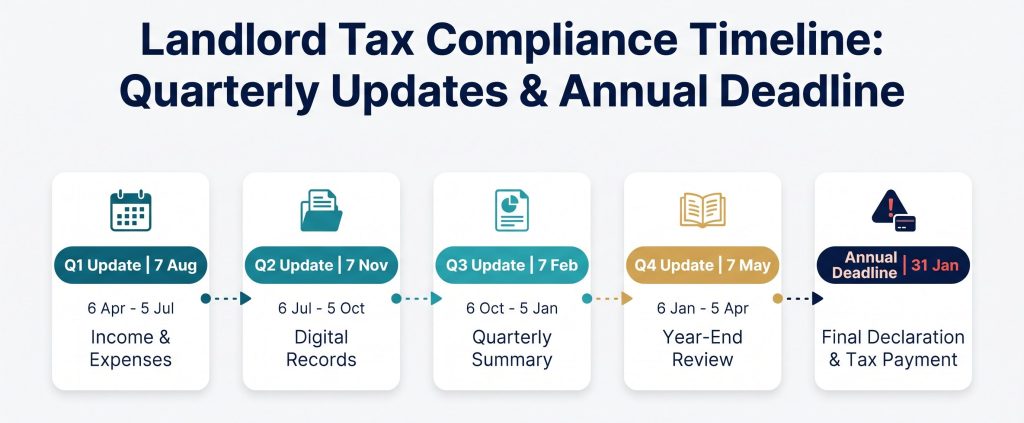
If you meet the threshold, you send quarterly summaries by 7 August, 7 November, 7 February, and 7 May. You then submit a Final Declaration by 31 January. Read our guide on Making Tax Digital for landlords to check your qualifying income and prepare early.
Choosing Compatible Software for Your Rental Portfolio
Paper notes and standalone spreadsheets will not meet MTD rules without bridging software. Cloud platforms like Xero for landlords or QuickBooks connect directly to your bank feed. They categorise transactions and prepare your quarterly summaries automatically.
Comparing platforms? Check out our walkthrough on QuickBooks for landlords in the UK. We also offer tailored cloud accounting services to get your bank feeds set up cleanly.
Common Errors and Record-Keeping Risks for Landlords
Even experienced property owners and SME founders make slips when rushing. Instead of worrying about myths, focus on avoiding these three common errors and record-keeping risks.
1. Mixing Personal and Property Finances
Collecting rent in your personal current account creates messy bookkeeping. When groceries sit next to boiler repairs on your bank statement, things get missed. You can easily overlook legitimate allowable expenses or claim a personal cost by mistake.
Opening a dedicated bank account for your properties solves this immediately. It creates a clean digital trail and saves hours of sorting every January.
2. Misunderstanding Nuanced Expense and Relief Rules
Landlords often confuse capital improvements with everyday repairs. Replacing a broken roof tile is usually an allowable revenue expense. Adding a loft conversion is a capital cost that affects Capital Gains Tax when you sell.
Other expense rules carry even more complexity. Costs like business entertainment, mileage, or company vehicles are highly nuanced. Strict exceptions and partial recovery rules apply depending on your structure and private use. Always seek specific advice before claiming them. You can review QuickBooks UK’s guide on landlord allowable expenses or our post on how to report rental income to HMRC for the essentials.
3. Overlooking Section 24 Finance Cost Restrictions
Many individual landlords still get caught out by Section 24 mortgage interest rules. You cannot deduct mortgage interest directly from your rental income before calculating profit. Instead, you pay tax on your full rental profit and claim a 20% basic rate tax credit.
Failing to factor this in can push you into a higher tax bracket. That shift can affect your Personal Allowance and Child Benefit.
Step-by-Step Workflow to Meet the Landlord Tax Return Deadline
You do not need to dread tax season. Break the work into small monthly habits using this checklist to hit every landlord tax return deadline:
- Separate Your Bank Accounts: Route all rent receipts, agent statements, and property bills through one dedicated account.
- Digitise Receipts Monthly: Photograph invoices for repairs, safety checks, and insurance right away. Cloud apps store them safely for HMRC’s five-year retention period.
- Reconcile Rent and Finance Costs: Match bank transactions against tenancy agreements and annual mortgage interest statements.
- Check Your MTD Threshold: Review your gross property and self-employment income each spring to confirm if Making Tax Digital for Income Tax applies.
- Run an Autumn Review: Check draft figures by October or November. You will know your January bill and July Payment on Account well ahead of time.
- Submit Early and Schedule Payment: File before the December rush. This gives you breathing room to verify numbers and budget for 31 January.

Why Outsourcing Helps You Beat the Landlord Tax Return Deadline
Running a business or managing tenancies takes enough energy already. Your time is better spent growing your portfolio than reading HMRC manuals. Outsourcing your property accounting and bookkeeping is a smart investment.
Working with a qualified accountant brings clear, practical benefits:
- Can reduce administrative burden: Hand over monthly reconciliations, receipt tracking, and quarterly MTD updates instead of losing your evenings to admin.
- Helps improve accuracy: A trained eye checks that Section 24 credits, replacement of domestic items relief, and allowable expenses are applied correctly.
- Mitigates the risk of errors: Clean, well-documented records lower the chance of missed dates and unexpected tax bills.
Want to see how professional support fits your wider goals? Read our guide on tax on rental income for UK landlords or explore our tax compliance services.
How ASK Accountants UK Ltd Supports Wimbledon and London Landlords
At ASK Accountants UK Ltd, we have spent 15 years supporting SMEs, startup founders, and landlords across Wimbledon and South-West London. As Chartered Certified Accountants, we speak plain English and keep things straightforward. We help you prepare for every landlord tax return deadline without the last-minute panic.
Need help with a personal tax return in Wimbledon? Want to set up Xero or QuickBooks for MTD? Our team is right here on your doorstep.
Ready to take the stress out of your next return? Call us today on 020 8543 1991 or contact us online. You can also visit our office at 178 Merton High St, Wimbledon, London SW19 1AY for a friendly chat.
Frequently Asked Questions About the Landlord Tax Return Deadline
What happens if I miss the landlord tax return deadline by one day?
Missing the 31 January online filing date triggers an automatic £100 late-filing penalty, even if you owe no tax. On the payment side, late-payment interest begins on day 1 after the deadline. Under the reformed penalty system, first late-payment penalties arise at day 15 and increase at day 30. Traditional annual Self Assessment accounts face 5% surcharges at 30 days, 6 months, and 12 months. Check your exact position on the GOV.UK Self Assessment penalties page.
Do I still need to file a return if my rental property made a loss?
Yes, if you are registered for Self Assessment or your gross rental income exceeds HMRC thresholds, you still must file. Reporting a rental loss is actually helpful. You can normally carry that loss forward to offset future profits from the same UK property business.
Can I claim mortgage repayments on my property tax return?
No, you cannot claim the capital repayment portion of a mortgage as an expense. Individual landlords also cannot deduct mortgage interest directly from rental profits. Instead, Section 24 rules give you a 20% basic rate tax credit on eligible finance costs. Since company-owned buy-to-let properties follow different rules, speak with an accountant to claim the right reliefs.