Here’s something nobody tells you when you first go self-employed: you’ll spend roughly 14% of your working week thinking about money you don’t have yet, money HMRC wants from you, or receipts you’ve definitely lost. That’s not an official statistic (I made it up), but ask any freelancer and they’ll nod knowingly.
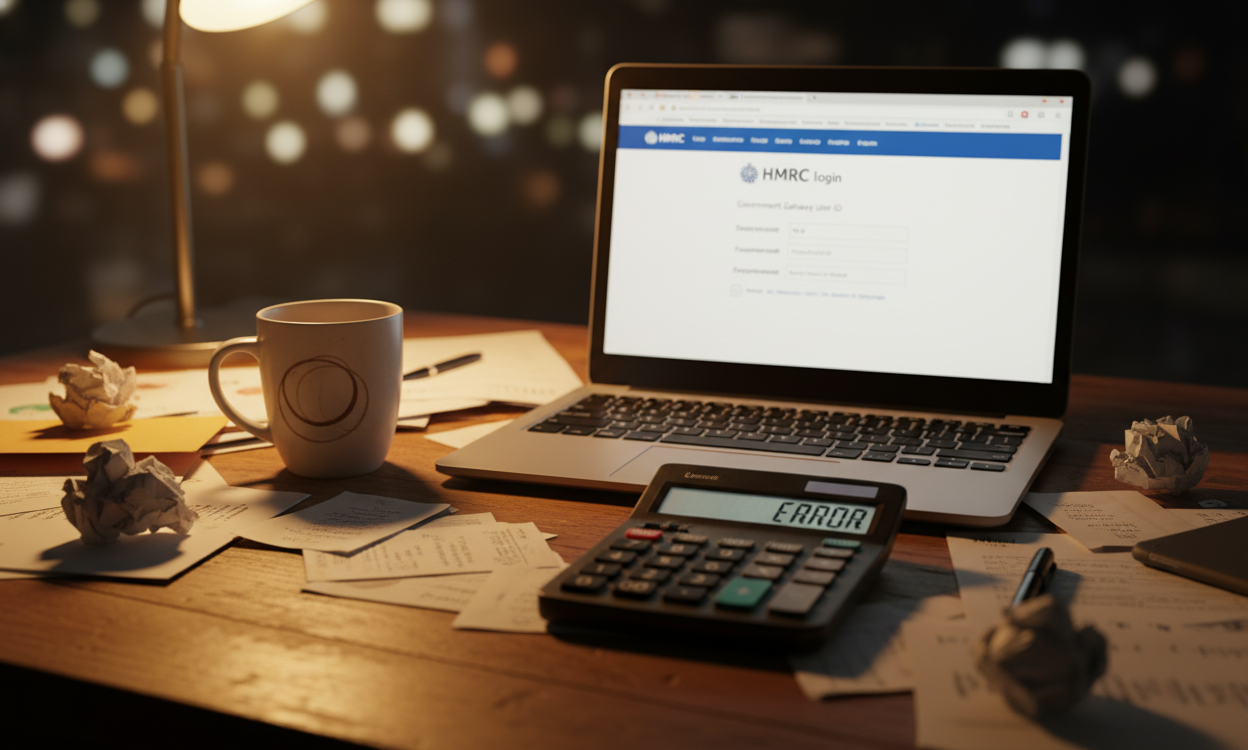
The romance of being your own boss wears thin around your second Self Assessment deadline. You’re staring at a spreadsheet at 11:47 PM on 30 January, wondering if your coffee purchases count as business expenses (they don’t, mostly), and whether that £200 invoice from March ever got paid (it didn’t).
This is precisely where an accountant for self employed workers stops being a luxury and becomes something else entirely—a business decision that actually pays for itself. Not through magic, but through the decidedly unmagical work of keeping your financial house in order whilst you get on with whatever it is you do for a living.
Why Most Self-Employed People Wait Too Long
There’s a pattern here. You register as self-employed, feeling quite capable and organized. You’ve got a notebook, maybe even a spreadsheet. First year? Dead easy. Second year? Manageable. Third year? You’re spending your weekends reconciling bank statements and questioning your life choices.
The pivot point usually arrives when one of three things happens: you miss a deadline and get fined, you realize you’ve been overpaying tax for two years straight, or your income suddenly jumps and you’ve got no earthly idea how to plan for the tax bill that’s coming. By this point, hiring an accountant for self employed professionals isn’t a decision—it’s an emergency.
Reality Check: The average sole trader spends 8-12 hours per year on tax returns alone. That’s not counting bookkeeping, invoice chasing, or the mental load of wondering whether you’re doing everything right. If your hourly rate is £50, you’ve just spent £400-£600 of your time. Most accountants charge less than that for a full Self Assessment service.
The Stuff They Actually Do (Beyond Tax Returns)
Let’s shatter the main misconception right here: accountants don’t just fill in forms once a year. That’s like saying a GP only writes prescriptions.
They spot the money you’re leaving on the table
Allowable expenses are brilliant—when you actually claim them. Most self-employed people claim the obvious stuff (office supplies, software subscriptions) but miss the less intuitive ones. Working from home? You can claim a proportion of your utilities, council tax, even mortgage interest in some cases. Use your mobile for business calls? That’s claimable. Professional subscriptions, training courses, industry publications—all potentially deductible.
The kicker? HMRC doesn’t remind you about these. They’re perfectly happy to accept whatever figure you submit. An accountant, however, will ask questions. Lots of them. “Do you use your car for business meetings?” “Have you attended any conferences this year?” “What about that new laptop?”
| Commonly Missed Expense | Why People Miss It | Typical Annual Saving |
|---|---|---|
| Home office expenses (detailed method) | Simplified flat rate seems easier | £300-£800 |
| Professional indemnity insurance | Feels too “personal” to claim | £200-£500 |
| Bank charges and interest | Genuinely forget it’s allowable | £50-£150 |
| Proportion of mobile/broadband | Mixed personal/business use confusion | £150-£300 |
| Training and professional development | Assume it doesn’t count if not “essential” | £200-£600 |
| Travel to temporary workplaces | Misunderstand “temporary” definition | £300-£1,200 |
They translate HMRC’s special language
HMRC has a peculiar way with words. They’ll send you a letter saying you need to “regularise your tax position”—which sounds vaguely threatening but actually just means “please tell us how much you earned.” Or they’ll reference “payments on account” without explaining that this is basically prepaying next year’s tax based on last year’s earnings.
A decent accountant for self employed individuals becomes your translator. When HMRC sends cryptic correspondence (and they will), you forward it to your accountant, who responds with: “Don’t worry, they’re just asking for your UTR number. Here’s what you need to send back.”
They prevent the expensive mistakes
Here’s the thing about tax mistakes: they compound. Miss claiming an expense this year, you lose that deduction forever. Miscalculate your Class 4 National Insurance, you might underpay—which means penalties plus interest. Get your accounting period wrong, and suddenly you’re filing two tax returns in one year.
The cost of an accountant is tax-deductible (because it’s a business expense). The cost of screwing up your tax return isn’t deductible—it’s just money you don’t get back.
But What About [Insert Accounting Software Here]?
Right, let’s talk about this. Yes, QuickBooks exists. So does Xero, FreeAgent, and about seventeen others. They’re genuinely useful tools, particularly for invoicing and expense tracking. Cloud accounting has revolutionized small business finance.
But here’s what software can’t do: it can’t tell you whether forming a limited company would save you £3,000 a year. It can’t negotiate with HMRC when they query something on your return. It can’t advise you on pension contributions or explain why paying yourself dividends might be more tax-efficient than straight salary.
Software is excellent at organizing information. Accountants are excellent at making decisions with that information. You want both, frankly.
Pro Tip: Many accountants now include cloud accounting software in their service package. At Ask Accountant, we integrate modern bookkeeping tools with personalized advisory, giving you the best of automation and human expertise. It’s like having a calculator that occasionally tells you you’re being an idiot—in the nicest possible way.
The Price Question Nobody Wants to Ask
How much does an accountant for self employed people actually cost? Depends who you ask, which is supremely unhelpful, so let me give you actual numbers.
| Service Level | What You Get | Typical Annual Cost |
|---|---|---|
| Self Assessment Only | Annual tax return, basic advice | £200-£400 |
| Self Assessment + Bookkeeping | Monthly bookkeeping, quarterly reviews, tax return | £800-£1,500 |
| Full Service | Everything above plus VAT returns, payroll, proactive tax planning, unlimited advice | £1,500-£3,000 |
| Limited Company Package | Corporation tax, director’s personal tax, accounts, company secretarial | £1,200-£2,500 |
Now, before you baulk at those numbers, consider this: if your accountant for self employed services identifies just £5,000 in additional allowable expenses you weren’t claiming, that saves you £1,000-£2,250 in tax (depending on your tax bracket). They’ve paid for themselves, and you still get all the other benefits—time saved, stress reduced, compliance assured.
What To Actually Look For When Hiring
Not all accountants are created equal. Some specialize in property, others in construction, some work exclusively with creatives. You want someone who’s seen your type of business before.
Questions worth asking:
- “How many self-employed clients do you have in my industry?” – You want someone familiar with your specific expenses and income patterns.
- “What’s included in your fee?” – Some quote low then charge extra for VAT returns, phone calls, or email queries. Get everything in writing.
- “How do you communicate?” – If you’re a “text me at 7 PM” person and they’re a “phone appointments only between 9-5” firm, that’s not going to work.
- “What happens if HMRC investigates me?” – A good accountant has tax investigation insurance and will handle it. A bad one will send you a separate bill.
- “Can you give me a recommendation from someone in my situation?” – If they can’t, that’s… peculiar.

Red flags to avoid:
Someone who promises to “get you a huge refund” before seeing any paperwork is either incompetent or dishonest. Possibly both. An ethical accountant will never guarantee a specific refund amount—they can only work with the expenses and income you actually have.
Also, steer clear of anyone who suggests claiming personal expenses as business ones. Yes, Karen from the pub says her accountant claims her entire Netflix subscription because “she watches business documentaries sometimes.” Karen is going to get investigated eventually, and it won’t be pretty.
“The best accountants don’t just reduce your tax bill—they sleep better at night knowing yours is bulletproof.”
When Self-Employed People Actually Need An Accountant
Some situations scream “get professional help.” Not in a concerning way, just in a “this is beyond DIY territory” way:
Your income just jumped significantly. Congratulations! Also, you’re about to enter a higher tax bracket, possibly need to register for VAT, and definitely need to start making payments on account. An accountant can plan for this rather than letting you discover it via a nasty letter in January.
You’re thinking about going limited. This isn’t a decision to make based on a forum post you half-read. There are tax advantages, yes, but also increased complexity and costs. An accountant for self employed traders can run the numbers and show you the breakeven point.
HMRC has written to you about anything. Even if it seems routine. Forward it. Let someone who deals with HMRC daily handle it. This is what you pay them for.
You’re paying more tax than your similarly-earning friends. Either they’re lying about their income (possible), doing something dodgy (also possible), or they have better financial advice than you (most likely).
The MTD Factor: Making Tax Digital for Income Tax is rolling out from April 2026 for sole traders and landlords with income over £50,000 (dropping to £30,000 the year after). This means quarterly digital reporting to HMRC. If you’re not already working with an accountant, this might be your prompt to start.
The Stuff They Won’t Tell You (But I Will)
Most accountancy firms are lovely. But they’re also businesses, which means some have… interesting practices.
Some will quote you a monthly fee, then charge extra for “year-end work” as if preparing your annual accounts wasn’t obviously part of the service. Others have hidden fees for things like Companies House filings or confirmations statements. Always ask for a complete breakdown.
The cheapest accountant isn’t always the worst, but there’s a reason they’re cheap. Either they’re just starting out (not necessarily bad—everyone has to start somewhere), they’re taking on too many clients (very bad—you’ll get ignored), or they’re cutting corners (catastrophically bad).
The most expensive isn’t always the best either. Some fancy London firms charge premium rates because they can, not because they’re offering premium service. You’re paying for their Mayfair rent, not superior expertise.
What An Accountant Definitely Can’t Do
Let’s manage expectations here. Your accountant cannot:
- Make you profitable if your business model doesn’t work
- Claim expenses you haven’t actually incurred (well, they can, but they won’t if they’re any good)
- Magically reduce your tax bill to zero (you made money, you pay tax, that’s the deal)
- Force you to keep decent records (that’s still on you, I’m afraid)
- Predict the future (though some try)
What they can do is make the whole business of being self-employed less terrifying and more profitable. Which, honestly, is worth quite a lot.
The Self-Assessment Survival Guide
Even with an accountant for self employed professionals handling your tax return, you’ve got responsibilities. Here’s what you actually need to do:
Keep records. Not just receipts (though yes, those too). Bank statements, invoices sent and received, mileage logs if you claim car expenses, records of any cash transactions. HMRC can ask to see records going back five years, sometimes six. “I’ll remember” is not a filing system.
Don’t mix personal and business money. Get a separate business bank account. Doesn’t have to be fancy or expensive, it just needs to exist. Trying to separate business transactions from your personal account is like trying to unbake a cake—technically possible but extremely annoying.
Set aside money for tax. Unlike PAYE workers, nobody’s doing this for you. A rough rule: save 25-30% of your net profit. Yes, that means after expenses. Yes, it’s painful. No, you can’t spend it on a holiday because “it’s been a tough year.”
Drowning in receipts and HMRC correspondence?
Ask Accountant specializes in supporting self-employed professionals across London and beyond. From Self Assessment to strategic business advice, we handle the financial complexities so you can focus on your actual work.
Location: 178 Merton High St, London SW19 1AY
Phone: +44(0)20 8543 1991
Beyond Tax Returns: The Strategic Stuff
Once you’re past the “please just file my tax return without me getting fined” phase, accountants become genuinely interesting. They start asking questions about your business structure, your growth plans, whether you’re planning to hire anyone.
This is where business advisory comes in. Good accountants see patterns. They’ve worked with hundreds of businesses like yours. They know what success looks like, what failure looks like, and what “you’re doing okay but could be doing better” looks like.
They might suggest things like:
- Incorporating as a limited company once your profits hit a certain threshold
- Setting up a pension (which reduces your tax bill whilst securing your future—rare win-win)
- Restructuring how you invoice to improve cash flow
- Registering for VAT earlier than required if most of your clients are VAT-registered
These aren’t earth-shattering revelations. They’re just… informed decisions based on actual financial data rather than vibes and guesswork.
The CIS Situation (For Tradespeople)
If you work in construction, you’re probably familiar with CIS—the Construction Industry Scheme. Your contractors deduct tax at source, you get a statement, and theoretically you claim it back via your tax return.
In practice? It’s a mess. The deductions don’t always match what you actually owe. The statements go missing. You forget to register properly and get taxed at the higher rate. It’s genuinely one of the more frustrating bits of UK tax law.
An accountant for self employed construction workers handles CIS claims and refunds professionally. They track your deductions, match them against your actual tax liability, and reclaim any overpayment. Given that many construction workers are owed money they don’t know about, this often pays for itself immediately.
Frequently Asked Questions (That Actually Get Asked)
Can I claim my accountant’s fees as a business expense?
Yes! This is one of the few genuinely free lunches in the tax system. Your accountant’s fees are fully deductible as business expenses, which means they reduce your taxable profit. So if you’re a higher-rate taxpayer, that £500 accountant bill only really costs you £300 after tax relief.
Do I need an accountant if I earn less than £20,000?
Not legally required, no. But consider the time-versus-money calculation. If you’re spending 10 hours a year on bookkeeping and tax returns, and your time is worth £25 an hour, that’s £250 of your time. Many accountants charge similar amounts for basic services and save you those hours.
What if I’ve messed up my tax returns for previous years?
First: don’t panic. Second: tell your accountant immediately. HMRC has a voluntary disclosure service for correcting mistakes. It’s far better to proactively fix errors than wait for HMRC to find them. The penalties are lower, and you might avoid investigation entirely.
Can my accountant help with payroll management if I hire people?
Absolutely. Once you become an employer, the complexity multiplies. PAYE, National Insurance calculations, pension auto-enrolment—it’s a lot. Most accountancy firms offer payroll services, often bundled with their main offering.
What’s the difference between a bookkeeper and an accountant?
Bookkeepers handle day-to-day record-keeping: recording transactions, invoicing, expense tracking. Accountants do the higher-level stuff: tax returns, financial planning, compliance, strategic advice. You might need both, or you might find an accountant who includes basic bookkeeping in their service.
Should I use a local accountant or go online-only?
Purely personal preference. Online accountants are often cheaper and very efficient. Local ones offer face-to-face meetings, which some people prefer for complex discussions. At Ask Accountant in Merton, we offer both—modern cloud-based tools with the option of actual human contact when needed.
The Bottom Line (Finally)
Look, hiring an accountant for self employed work isn’t about ticking a box or following some supposed rule. It’s about recognizing that financial management is a genuine skill that takes time to develop and maintain.
You became self-employed to do whatever it is you do—design websites, fit bathrooms, write copy, take photographs. You didn’t go independent because you dreamt of mastering HMRC’s Self Assessment portal or understanding the finer points of Class 4 National Insurance contributions.
An accountant lets you outsource the bits you’re not good at (or actively hate doing) to someone who is good at them. They save you time, reduce your stress, often save you money, and—crucially—let you sleep at night knowing your tax affairs are in order.
The best time to hire an accountant was probably when you first went self-employed. The second-best time is now, before the January deadline panic sets in or before you make an expensive mistake you can’t undo.

At Ask Accountant, we’ve spent years working with self-employed professionals across every industry imaginable. We’ve seen the common mistakes (claiming your entire broadband bill when you only use it 40% for business), the expensive ones (missing the VAT registration threshold), and the completely avoidable ones (not claiming expenses because you didn’t realize you could).
We offer comprehensive support—from personal tax planning to accounts and tax preparation, and even specialized services like inheritance tax planning. Whatever your situation, we’ve probably seen it before and know how to handle it.
Call us on +44(0)20 8543 1991 or pop into our office at 178 Merton High St if you’re local. We’ll have a proper conversation about your business, your concerns, and whether we’re the right fit for you. No hard sell, no obligation—just straightforward advice from people who’ve been doing this long enough to know what works.
Because ultimately, being self-employed should feel liberating, not like you’re constantly one HMRC letter away from a breakdown.