
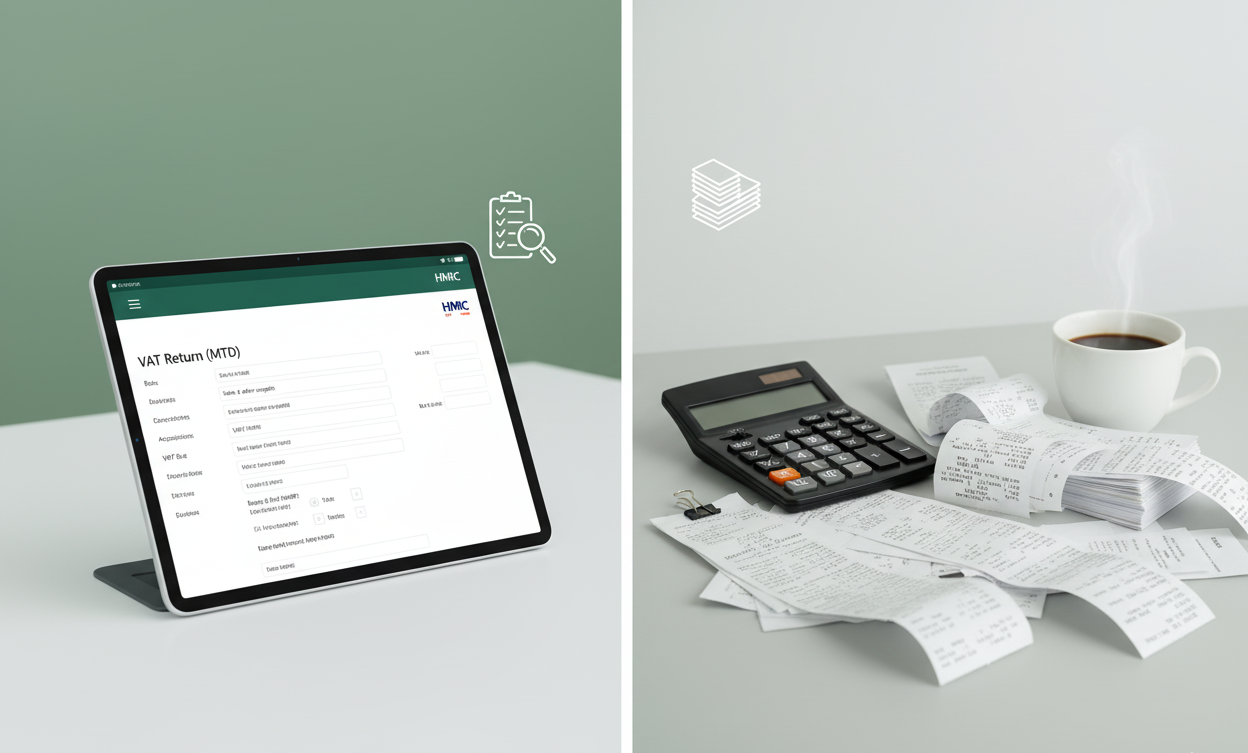
Here’s something nobody tells you when you first start thinking about VAT: the £90,000 threshold isn’t a finish line you’re racing toward. It’s more like a trapdoor that opens beneath you when you least expect it.
I’ve watched countless business owners celebrate their first £90k in turnover, only to realise – usually around 3am on a Tuesday – that they’ve just signed themselves up for quarterly paperwork, digital record-keeping requirements, and a whole new relationship with HMRC. Not exactly the success milestone you imagined, is it?
But VAT accounting in the UK doesn’t have to feel like you’ve accidentally enrolled in an advanced maths course taught entirely in riddles. (Though sometimes it does feel exactly like that.) Whether you’re approaching the registration threshold, already drowning in VAT returns, or just trying to work out if registering voluntarily might actually save you money, understanding how VAT accounting works can mean the difference between smooth sailing and… well, let’s just say “spirited discussions” with HMRC.
At Ask Accountant, we’ve guided hundreds of businesses through VAT registration, helped them choose the right schemes, and – perhaps most importantly – prevented them from making expensive mistakes that would have cost far more than our fees. Because whilst VAT might seem straightforward on paper (you charge it, you reclaim it, you pay the difference), the reality involves Making Tax Digital requirements, multiple scheme options, and enough special cases to fill a small library.
So let’s talk about how VAT accounting actually works when you’re running a real business with real cash flow concerns, not just ticking boxes on a compliance checklist.
The £90,000 Question Nobody Asks Correctly
Everyone asks “Do I need to register for VAT?” when their turnover hits £90,000. The better question? “Should I have registered six months ago?”
The VAT registration threshold currently sits at £90,000, having increased from £85,000 in April 2024 – which means roughly 28,000 fewer businesses need to be VAT registered compared to the old threshold. The deregistration threshold landed at £88,000, creating a small buffer zone that prevents businesses from ping-ponging in and out of the system.
But here’s where it gets interesting. That £90,000 isn’t about your annual accounts or your tax year. It’s about rolling 12-month periods. You’re meant to be monitoring your taxable turnover constantly, looking backwards over the previous 12 months. Hit £90,000? You’ve got 30 days to register. Miss that deadline and HMRC will be delighted to charge you penalties and backdate the VAT you should have collected.
Fun fact: the UK now has the highest VAT registration threshold in the OECD alongside Switzerland, more than double the EU and OECD averages. So whilst British businesses complain about VAT complexity (and they do, loudly), at least we’re not forced into the system as early as businesses in France or Germany.
When Voluntary Registration Isn’t Actually Voluntary
There’s a strange corner of VAT accounting where registering before you hit the threshold can save you serious money. I’m talking about businesses that:
- Sell mainly to other VAT-registered businesses (who can reclaim your VAT anyway)
- Have significant VAT-able expenses (equipment, stock, property costs)
- Want to look more established (because a VAT number does add a certain gravitas)
A client of mine ran a consultancy firm with maybe £40,000 in turnover but £8,000 in annual office equipment and software subscriptions. She registered voluntarily and immediately reclaimed £1,600 in VAT. That’s not pocket change – that’s a holiday, or several months of software subscriptions, or frankly anything more fun than paying HMRC unnecessarily.
The catch? Once you’re in, you can’t just deregister whenever you fancy it. You need to stay below £88,000 and convince HMRC you’ll remain below it. It’s a bit like joining a gym – easy to sign up, surprisingly complicated to leave.
How VAT Accounting Actually Happens (The Bits They Don’t Put in the Brochures)
Standard VAT accounting follows a deceptively simple formula: charge VAT on what you sell, reclaim VAT on what you buy, pay HMRC the difference. Except it’s never quite that simple, is it?
First, there’s the matter of when you account for VAT. Under standard (invoice-based) accounting, you owe VAT the moment you issue an invoice – regardless of whether your client has actually paid you. Issue a £10,000 invoice on March 29th and your client pays it in June? Congratulations, you’re paying HMRC £2,000 in April that you haven’t actually received yet.
This is why so many businesses discover cash flow management matters after their first VAT return creates an unexpected financial squeeze.
The Three VAT Rates You Need to Know (And the Ones You Don’t)
The current VAT rates in the UK are 20% standard rate, 5% reduced rate and 0% zero rate. Most businesses only deal with the standard 20% rate, which applies to basically everything unless there’s a specific exception.
The 5% reduced rate covers things like children’s car seats, home energy, and certain renovations. Zero-rated items – including most food, books, children’s clothing – are technically taxable but at 0%. (Yes, this matters. Zero-rated businesses can reclaim input VAT; exempt businesses can’t. Welcome to VAT logic.)
Then there are exempt supplies – financial services, insurance, education – where no VAT applies at all. If you’re dealing with exempt supplies, VAT accounting becomes approximately 10 times more complicated, involving partial exemption calculations that make quantum physics look straightforward.
Here’s a quick reference table for VAT rates:
| VAT Rate | Percentage | Common Examples | Can Reclaim Input VAT? |
|---|---|---|---|
| Standard | 20% | Most goods and services, professional fees, electronics | Yes |
| Reduced | 5% | Domestic fuel, children’s car seats, mobility aids | Yes |
| Zero-rated | 0% | Most food, books, newspapers, children’s clothing | Yes |
| Exempt | N/A | Insurance, finance, education, health services | No (usually) |
Making Tax Digital: Because Paper Returns Were Too Easy
Remember when you could just fill in a VAT return online and be done with it? Those days ended. From April 2022, Making Tax Digital for VAT became mandatory for all VAT-registered businesses, regardless of their turnover.
What does this actually mean? You need MTD-compatible software that connects directly to HMRC’s systems. Your old spreadsheet? Not good enough anymore – unless you’ve got “bridging software” to connect it to HMRC’s API. Your manual records? Definitely not acceptable.
The theory behind MTD is lovely: digital records reduce errors, create audit trails, make everything more efficient. The reality? Many small businesses had to invest in accounting software they didn’t previously need, learn new systems whilst running their actual business, and ensure every transaction creates an unbroken digital chain from source document to VAT return.

When you register for VAT, HMRC now automatically signs you up for MTD. No separate registration needed – which sounds convenient until you realise you’re being automatically enrolled in something you might not be ready for.
Digital Links: The Requirement Everyone Forgets About
Here’s something that catches people out constantly: MTD doesn’t just require digital records. It requires digital links between different parts of your system. Email a spreadsheet to your accountant? That’s a broken digital link. Manually type figures from your till into your accounting software? Another broken link.
The acceptable methods include:
- Software that handles everything in one place
- XML, CSV, or API transfers between systems
- Cloud-based systems that sync automatically
Copying and pasting? Nope. Typing figures across? Nope. Taking a photo of a receipt and entering the data manually? Still nope. HMRC wants an unbroken trail of digital data, and they’re surprisingly specific about what counts as “digital”.
VAT Schemes: Choose Your Own Administrative Adventure
Standard VAT accounting isn’t the only option. HMRC offers several schemes designed to simplify (ha!) VAT for different business types. Choosing the right one can save you time, money, or both. Choosing poorly can do the opposite.
The Flat Rate Scheme: Simple on Paper, Complicated in Practice
The Flat Rate Scheme allows smaller businesses to pay a flat percentage of gross turnover to HMRC instead of calculating VAT on individual transactions. You still charge your customers the full 20% VAT (or whatever rate applies), but you pay HMRC a lower percentage based on your industry.
For example, an accountancy firm pays 14% of gross turnover. So on £10,000 of invoices (including VAT), they’d charge customers £2,000 in VAT but only pay HMRC £1,400. The business keeps the £600 difference – which sounds brilliant until you realise you also can’t reclaim any VAT on expenses (except capital purchases over £2,000).
Flat Rate Scheme Quick Facts:
- Join if your turnover is £150,000 or less
- Leave if it exceeds £230,000
- Industry rates range from 4% to 16.5%
- Limited cost traders pay a punitive 16.5% rate (if costs are under 2% of turnover or under £1,000 annually)
The limited cost trader rule – introduced in 2017 – basically killed the scheme for many service businesses. If you’re a consultant with minimal expenses, you’re probably paying 16.5% instead of your industry’s lower rate. Not such a bargain anymore.
Cash Accounting: For When Your Clients Are Reliably Unreliable
The Cash Accounting Scheme means you only pay VAT when your customers actually pay you, rather than when you issue the invoice. For businesses dealing with slow-paying clients, this is genuinely transformative.
Standard accounting means you can end up paying HMRC before you’ve been paid – which is particularly painful if you’re dealing with 30-day, 60-day, or (shudder) 90-day payment terms. Cash accounting aligns your VAT liability with your actual cash flow.
The downside? You also can’t reclaim input VAT until you’ve paid your suppliers. If you’re sitting on unpaid purchase invoices, you’re waiting to claim that VAT back.
Cash Accounting Eligibility:
- Join if expected turnover is £1.35 million or less
- Must leave if turnover exceeds £1.6 million
- Can’t use if you’re already on the Flat Rate Scheme
- Automatic bad debt relief (since you never paid VAT on unpaid invoices)
Annual Accounting: One Return to Rule Them All
The Annual Accounting Scheme lets you submit one VAT return per year instead of four quarterly ones. You make advance payments throughout the year (either nine monthly or three quarterly instalments) based on last year’s liability, then submit a single return at year-end to settle any difference.
This saves significant administrative time – who doesn’t prefer doing one return instead of four? But there’s a catch: those advance payments. If your business is growing, you’ll end up with a big balance payment at year-end. If it’s shrinking, you’re overpaying throughout the year.
| VAT Scheme | Best For | Turnover Limit | Main Benefit |
|---|---|---|---|
| Standard | Most businesses, especially those with high VAT-able costs | Any turnover | Full input VAT reclaim |
| Flat Rate | Service businesses with minimal costs | £150k (join) / £230k (leave) | Simplified admin, potential savings |
| Cash Accounting | Businesses with slow-paying customers | £1.35m (join) / £1.6m (leave) | Improved cash flow |
| Annual Accounting | Businesses wanting less frequent returns | £1.35m (join) / £1.6m (leave) | Reduced paperwork |
The VAT Return: Nine Boxes of Varying Complexity
Every VAT-registered business in the UK fills in the same form: the VAT return. It’s nine boxes. How complicated can nine boxes be?
(Extremely complicated, it turns out.)
Box 1: VAT due on sales – The output tax you’ve charged customers. Straightforward enough, unless you’ve got mixed rates, exempt supplies, or EU transactions.
Box 2: VAT due on acquisitions – Only relevant if you’re importing from Northern Ireland or acquired goods from EU countries. Most businesses ignore this box entirely.
Box 3: Total VAT due – Add boxes 1 and 2. This is the maths HMRC trusts you with.
Box 4: VAT reclaimed – All the input tax on your business purchases. This is where things get interesting, because not everything qualifies (entertainment, most cars, and about 500 other exceptions).
Box 5: Net VAT to pay – Box 3 minus Box 4. If this is negative, HMRC owes you money. If positive, you owe them.
Boxes 6-9: The turnover boxes – Your total sales and purchases, excluding VAT. These need to match your VAT calculations, and HMRC uses them to spot errors, fraud, or just general incompetence.
What You Can’t Reclaim (The Frustrating Bits)
Input VAT isn’t always reclaimable. The main exclusions include:
- Business entertainment – Unless you’re entertaining staff (and even then, it’s complicated)
- Most cars – Unless it’s a commercial vehicle, pool car, or taxi
- Personal expenses – Shocking, I know
- Blocked VAT – Specific items like lease cars where recovery is restricted
There’s also the thorny question of mixed-use items. Your mobile phone that’s 50% business, 50% personal? You can claim 50% of the VAT. Except HMRC might challenge your 50% estimate. And suddenly you’re deep in a discussion about phone records and usage patterns that nobody wants to have.
Common VAT Accounting Mistakes (That Cost Real Money)
Missing the Registration Deadline
This is expensive. Really expensive. If you submit your UK VAT return late, you’ll receive a penalty point, and once you reach a penalty point threshold, you’ll be fined £200. Plus, HMRC backdates your registration and expects you to collect VAT you never charged. Ouch.
Claiming VAT Without Proper Invoices
HMRC is very particular about VAT invoices. Need the supplier’s name, address, VAT number, description of goods, VAT rate… missing any element and technically you can’t reclaim that VAT. In practice, HMRC is sometimes lenient, but “sometimes” isn’t a great strategy when it’s your money on the line.
At Ask Accountant, we see this constantly: businesses with drawers full of credit card receipts wondering why they can’t claim all that VAT back. Because your Tesco receipt doesn’t count as a VAT invoice, that’s why.
Mixing Up Standard and Zero-Rated Supplies
Zero-rated sounds like “exempt”, but it’s completely different. Zero-rated businesses are taxable, they just charge 0%. They can reclaim input VAT. Exempt businesses can’t reclaim input VAT (usually). Get this wrong on your return and HMRC will be writing you stern letters.
Forgetting About Partial Exemption
If you make both taxable and exempt supplies, you might not be able to reclaim all your input VAT. Welcome to partial exemption calculations, where you’ll spend delightful hours working out recovery percentages and standard methods.
Unless your exempt income is below the “de minimis” limits (currently about 5% of total income and less than £625 per month), you’re into partial exemption territory. This is where most businesses decide that paying an accountant is cheaper than the mistakes they’ll inevitably make.
Filing Your VAT Return (And Actually Getting It Right)
The deadline for UK VAT submissions is one calendar month and seven days following the end of the previous accounting period. For most businesses on quarterly returns, that means four deadlines per year: 7th May, 7th August, 7th November, and 7th February.
Payment is due the same day as the return. HMRC doesn’t do grace periods. Late payment attracts a 2% penalty if you’re 16+ days overdue, increasing to 4% beyond 31 days.
The actual submission process is straightforward – assuming your software is MTD-compliant and you’ve got all your digital links properly set up. Click submit, the software talks to HMRC’s API, and you get confirmation within seconds.
But getting to that point? That requires:
- Reconciled records – Every sale and purchase properly recorded
- Correct VAT treatment – Right rates applied to everything
- Supporting documentation – VAT invoices for everything you’re claiming
- Digital links – Unbroken chain from source to submission
- Accurate calculations – Because HMRC’s software checks your arithmetic
Miss any of these elements and your return is either wrong (penalties incoming) or you’re losing out on legitimate reclaims (which is somehow even more annoying).
When to Get Professional Help (Before the Mistakes Happen)
Look, I run an accounting firm. Of course I’m going to suggest that professional VAT advice saves you money. But here’s the thing: it actually does.
A client came to us last year, six months into VAT registration, convinced they were doing everything right. Turned out they’d been using the wrong scheme (costing them £200 per quarter), misclaiming VAT on their car lease (another £300), and had never properly reconciled their returns (leading to a slowly growing discrepancy that HMRC would definitely have noticed eventually).
We fixed everything, claimed back overpaid VAT from previous quarters, and moved them to the right scheme. Our fees for the year were less than they’d overpaid in just three quarters.
You need professional help if:
- You’re approaching the registration threshold and wondering about voluntary registration
- You’re choosing between different VAT schemes and the decision actually matters
- You’re dealing with international transactions, partial exemption, or capital goods scheme adjustments
- You’ve received a VAT inspection notice from HMRC
- Your VAT returns don’t quite make sense and you’re not sure why
That last one is more common than you’d think. VAT returns should tell a story about your business – if the numbers look odd, something’s probably wrong.
The Future of VAT Accounting in the UK
VAT accounting is getting more digital, more automated, and more immediate. HMRC’s long-term vision involves real-time reporting, where they know about your transactions almost as soon as they happen.
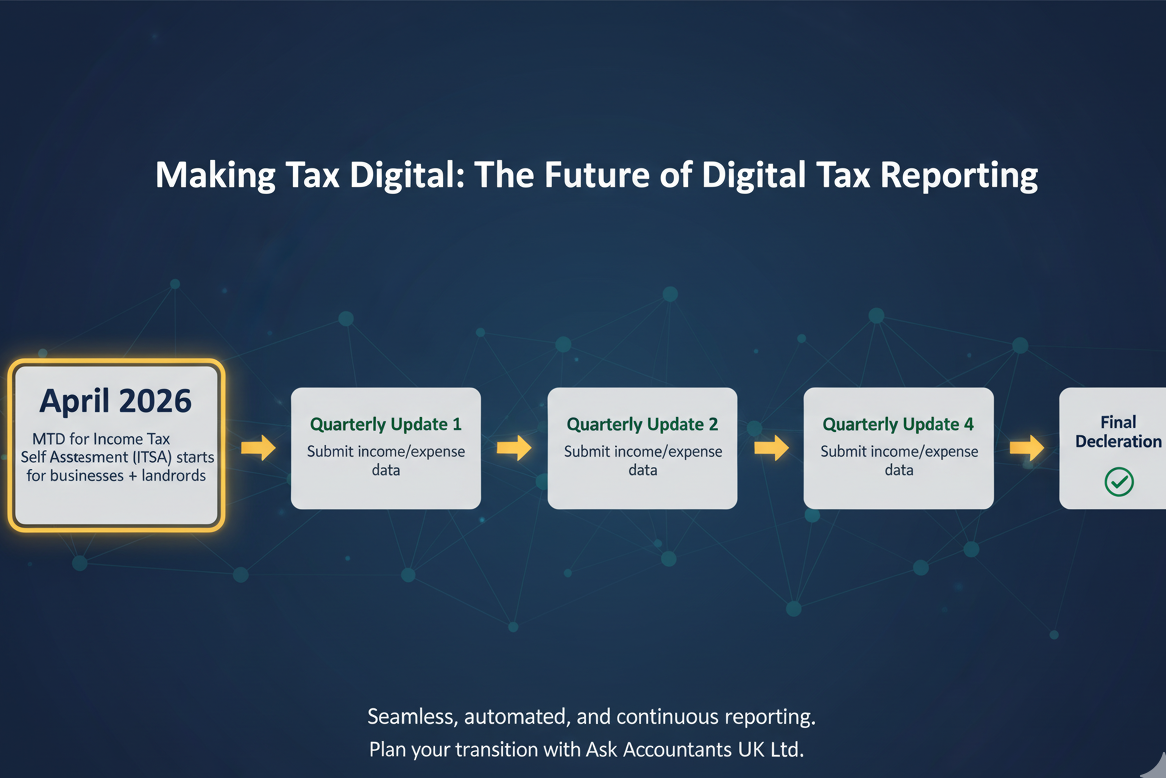
We’re not there yet. But Making Tax Digital for Income Tax (MTD for ITSA) begins in April 2026, requiring quarterly reporting of income and expenses. The same technology infrastructure that powers MTD for VAT will extend to income tax, capital gains, and eventually (probably) everything else.
For businesses, this means:
- Better software becomes non-negotiable
- Digital processes need to work smoothly
- Real-time compliance replaces retrospective filing
- Errors get spotted faster (sometimes before you even make them)
Whether this actually makes life easier or just creates new ways to make compliance mistakes… well, ask me again in five years.
Practical Tips for Surviving VAT Accounting
Start your digital records now. Don’t wait until you hit the threshold. Get your systems set up, your software chosen, and your processes working whilst the stakes are still low.
Check your turnover monthly. Don’t wait for a nasty surprise. If you’re approaching £90k, start planning for registration at £75k.
Choose the right scheme. The wrong one costs money every single quarter. The right one might actually save you money whilst reducing admin.
Keep proper VAT invoices. That drawer full of receipts isn’t going to help you claim VAT. You need proper invoices with all required elements.
Reconcile before you submit. Your VAT return should make sense. If Box 1 is huge but Box 6 is tiny, something’s wrong.
Pay on time. Penalties add up fast. Set reminders, use direct debit, do whatever it takes to avoid late payment charges.
Get help before the VAT inspection. HMRC’s VAT officers are polite but thorough. Having an accountant handle the inspection is money incredibly well spent.
If you’re in London and need help with VAT accounting, tax advisory, or just want someone to explain why your VAT return doesn’t make sense, Ask Accountant can help. We’re based at 178 Merton High St, London SW19 1AY, and you can reach us at +44(0)20 8543 1991. We specialise in small business accounting services that actually make sense to humans, not just to spreadsheets.
Frequently Asked Questions About VAT Accounting
Do I have to register for VAT if my turnover is under £90,000?
No – but you can register voluntarily if it benefits you. Many businesses register early to reclaim VAT on startup costs or to appear more established to clients.
How often do I need to submit VAT returns?
Most businesses submit quarterly, though some larger businesses (VAT liability over £2.3 million annually) must submit monthly. The Annual Accounting Scheme lets you submit just once per year.
Can I switch VAT schemes after I’ve registered?
Yes, though there are specific rules and timings for switching. You’ll need to ensure you meet the eligibility criteria for your new scheme and notify HMRC properly.
What happens if I miss the VAT registration deadline?
HMRC will backdate your registration to when you should have registered, expect you to have collected VAT on all sales since then, and likely charge penalties. Miss this deadline and it gets expensive very quickly.
Is MTD for VAT really mandatory?
Yes, for all VAT-registered businesses except those with digital exclusion exemptions (age, disability, religious grounds, or remoteness). You need MTD-compatible software to submit returns.
Can I reclaim VAT on purchases made before I registered?
Sometimes. You can generally reclaim VAT on goods purchased up to four years before registration (if you still have them) and services purchased up to six months before registration. But the rules are specific and you’ll need proper VAT invoices.
What’s the difference between zero-rated and exempt?
Zero-rated supplies are taxable at 0% – you charge no VAT but can reclaim input VAT. Exempt supplies have no VAT at all, and you usually can’t reclaim input VAT. It’s a crucial distinction that trips up many businesses.






Corazon
December 24, 2025Hey! This post could not be written any better! Reading this post reminds me of my previous
room mate! He always kept chatting about this.
I will forward this article to him. Fairly certain he will have a good read.
Many thanks for sharing!
Sherrie
December 24, 2025Wow, incredible blog layout! How long have you been blogging for?
you made blogging look easy. The overall look of your site is great, let
alone the content!
Jamison
December 24, 2025Hi! This post could not be written any better! Reading through this post reminds me
of my old room mate! He always kept chatting about this.
I will forward this page to him. Pretty sure he
will have a good read. Thanks for sharing!