

There’s a particular kind of dread that hits new employers around week three of hiring their first member of staff. You’ve sorted the desk, the laptop, maybe even a half-decent welcome mug — and then someone mentions PAYE registration, and the colour drains from your face a bit. What is it? Do you need it? Did you need it already? That last question tends to be the one that keeps people up at night, and fair enough.
PAYE registration is the process that tells HMRC, formally, that your business is going to be paying someone a wage and deducting income tax and National Insurance before the money lands in their bank account. Simple enough on paper. Where it gets murky is knowing exactly when the obligation kicks in — because contrary to what a lot of first-time employers assume, it’s not always the moment you hire your first person.
So What Actually Triggers PAYE Registration?
Let’s clear up the biggest misconception first: you don’t need PAYE registration simply because you’ve started a business. Plenty of sole traders operate for years without ever touching it. The trigger is paying someone — and “someone” includes yourself, if you’re a director drawing a salary through your own limited company.
You need to register for PAYE if any of the following apply to an employee (including a director):
- They earn £123 or more a week (the Lower Earnings Limit for the 2025/26 tax year)
- They already have another job
- They’re receiving a pension alongside their wages
- They get benefits or expenses from you on top of their pay
- You provide workplace benefits like a company car or private healthcare
Miss any one of those boxes and PAYE registration becomes non-negotiable — not optional, not “when you get round to it.” I’ve seen small business owners assume that because someone’s only working eight hours a week, none of this applies. It might not. But the moment weekly pay creeps past that Lower Earnings Limit, the clock starts.
The Timing Bit Nobody Explains Properly
Here’s where things get genuinely tricky, and where a fair number of businesses trip up without realising: you must register before your first payday, but not more than two months before you start paying anyone. HMRC recommends allowing up to five working days for your PAYE reference to come through, though in practice it can land quicker.
That window matters. Register too early and you might be sitting with an unused PAYE scheme for weeks. Register too late — after the first payslip’s already gone out — and you’re technically non-compliant, even if the actual tax owed is correct. I know, it feels like a paperwork technicality. HMRC doesn’t always see it that way, particularly if it happens repeatedly.
For businesses juggling this alongside everything else that comes with running a growing team, a lot of our clients ask us to sort payroll and PAYE registration together, precisely so the timing doesn’t become a guessing game. It’s one of those things that’s genuinely easier delegated than DIY’d, especially in month one of employing anyone.
Do Directors-Only Companies Need PAYE Registration?
Yes — and this catches out more one-person limited companies than you’d think. If you’re the sole director and you pay yourself any salary (rather than taking everything as dividends), PAYE registration applies to you exactly as it would to a business with fifty staff on the books.
There is a narrow exception: if your salary sits below the Lower Earnings Limit and you have no other PAYE-triggering circumstances (no second job, no benefits, no pension), you might not need to register. But most accountants, ourselves included, would encourage directors to register anyway, because it protects your National Insurance record and keeps things tidy if your circumstances change mid-year.
How Do You Actually Register?
Registration happens through HMRC’s online service, and you’ll need:
- Your business name and address
- Your Unique Taxpayer Reference (UTR), if you have one
- The date you started (or will start) paying employees
- Confirmation of how many people you expect to employ
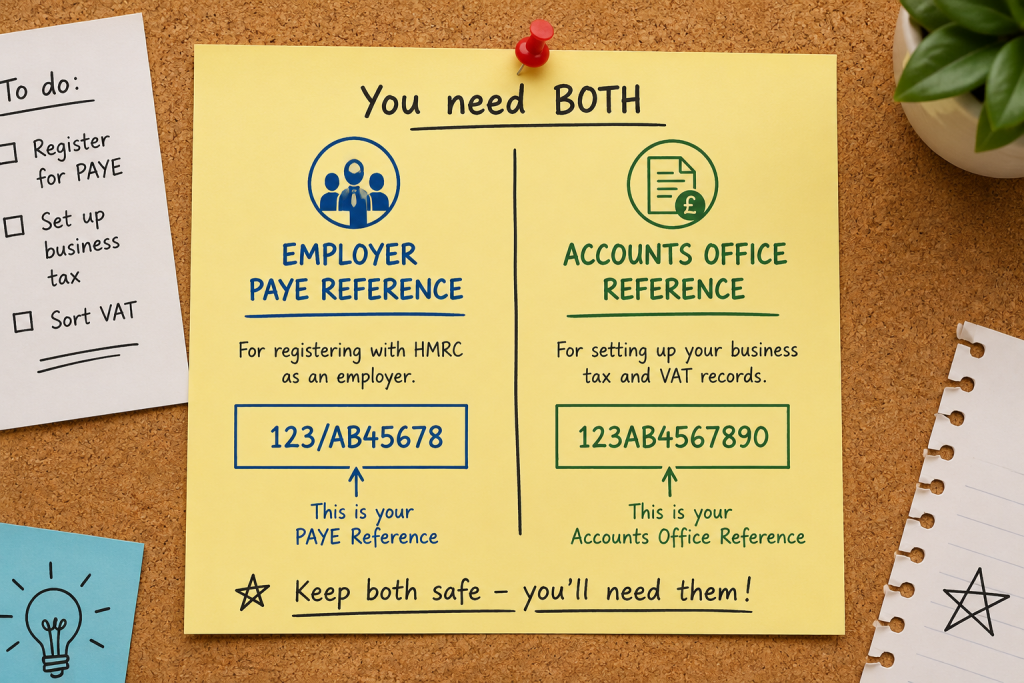
Once submitted, HMRC issues an Employer PAYE Reference Number and an Accounts Office Reference — two entirely separate numbers, both of which you’ll need constantly, so write them down somewhere you won’t lose. <div style=”background:#eef6ff; border-left:4px solid #2563eb; padding:14px 18px; margin:20px 0;”> <strong>Slightly unglamorous tip:</strong> Save both reference numbers in the same place as your Companies House login. You’ll be typing them into payroll software, pension providers, and HMRC’s own portals more often than seems reasonable. </div>
What Happens If You Skip PAYE Registration (Or Just Forget)
I’ll be honest — this is the section clients least want to read and most need to. Late PAYE registration doesn’t trigger an automatic fine the way late Self Assessment does, but HMRC can and does issue penalties if it decides the delay was avoidable, particularly where tax has gone unpaid as a result. Penalties are calculated as a percentage of the tax that should have been deducted, and they scale with how long the failure continued and whether HMRC considers it deliberate.
Beyond the financial risk, there’s a quieter cost: employees not being taxed correctly from day one, National Insurance records with gaps in them, and a payroll history that’s a nightmare to reconstruct months later. None of it is impossible to fix. All of it is more expensive to fix than to avoid.
PAYE Registration vs Other Business Registrations — A Comparison
It’s worth seeing PAYE registration next to the other registrations businesses tend to confuse it with, because the overlap in terminology causes more confusion than the actual rules do.
| Registration Type | Who Needs It | When Required | Where To Register |
|---|---|---|---|
| PAYE Registration | Any business paying an employee above the Lower Earnings Limit, or with other PAYE triggers | Before first payday, up to 2 months in advance | HMRC online service |
| Self Assessment Registration | Sole traders, partners, company directors with untaxed income | By 5th October following the tax year you started | HMRC online service |
| VAT Registration | Businesses with taxable turnover above £90,000 | Within 30 days of exceeding the threshold | HMRC online service |
| Automatic Enrolment (Pensions) | Employers with at least one eligible worker | From the employee’s first day, staging date applies | The Pensions Regulator |
And here’s the second table — a rougher one, admittedly, because this is closer to how the information actually sits in most business owners’ heads: half-remembered, slightly out of order, occasionally contradictory.
| Situation | PAYE registration needed? | Notes |
|---|---|---|
| Paying yourself £600/month as sole director | Depends | Below LEL — check other triggers first |
| New employee, £1,200/month, no other job | Yes | |
| Freelancer invoicing you as self-employed | No | They handle their own Self Assessment — not your PAYE responsibility |
| Part-timer, £400/month, has a second job elsewhere | Yes | Second job status triggers it regardless of pay level |
Where PAYE Registration Meets CIS — A Quick Detour
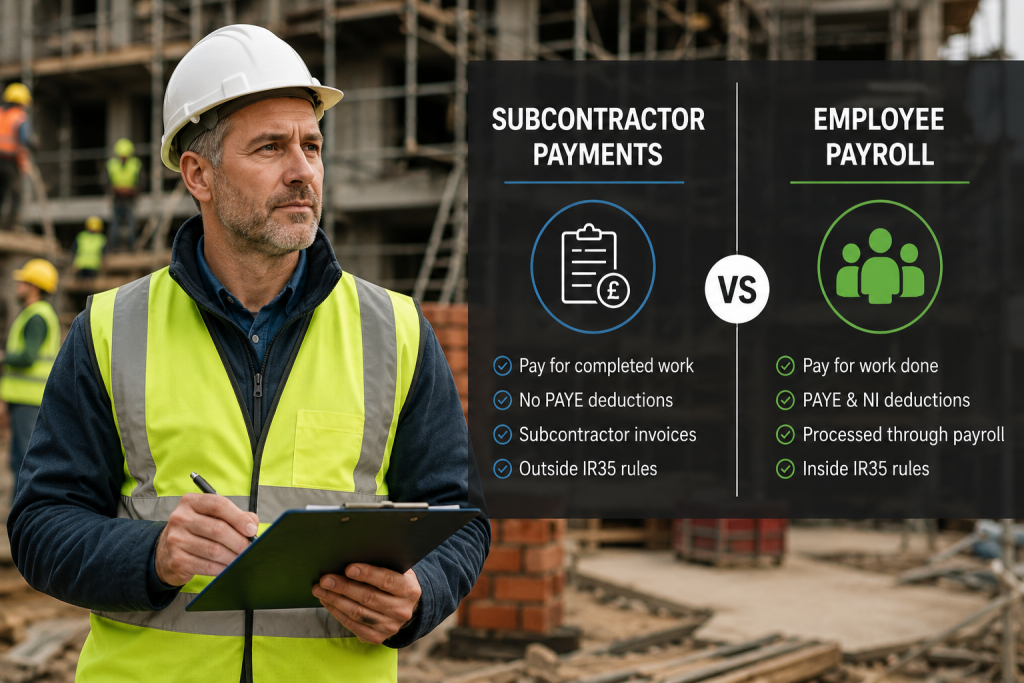
If you’re in construction, you’re likely already familiar with the Construction Industry Scheme, and it’s worth flagging that PAYE registration and CIS are not the same thing, even though businesses running both often assume one covers the other. CIS deals with payments to subcontractors; PAYE deals with employees. It’s entirely possible — common, even — for a construction firm to need both running side by side, with entirely separate reporting obligations to HMRC for each.
Frequently Asked Questions About PAYE Registration
Does a business need PAYE registration if it has no employees yet? No. PAYE registration is only required once you’re actually paying someone who meets the qualifying criteria. Plenty of businesses trade for years as sole traders with zero PAYE obligation.
Can PAYE registration be backdated? HMRC allows registration up to two months before the first payday, but not retrospectively once payments have already started — this is exactly the scenario that leads to compliance headaches, so it’s worth avoiding altogether.
Is PAYE registration free? Yes, registering for PAYE with HMRC costs nothing. The ongoing cost tends to come from running payroll itself — software, or an accountant’s time — rather than the registration step.
How long does PAYE registration take? HMRC states it can take up to five working days, though many businesses report their reference numbers arriving sooner.
What’s the difference between an Employer PAYE Reference and an Accounts Office Reference? The PAYE reference identifies your scheme; the Accounts Office reference is used specifically when making payments to HMRC. You’ll need both, and they look similar enough to mix up if you’re not paying attention.
Getting It Right From The Start
PAYE registration isn’t complicated in isolation — it’s the surrounding decisions (when to hire, how to pay, whether directors count) that make it feel harder than it is. Most of the businesses we’ve helped through this at Ask Accountants UK Ltd weren’t struggling with the concept itself; they were struggling with timing it correctly alongside everything else that comes with taking on staff — auto-enrolment duties, payroll software, first payslips, the lot.
If your business is approaching that first hire, or you’re a director wondering whether your own salary needs registering, it’s worth getting the sequence right before the first payday rather than untangling it afterwards. We handle PAYE registration and ongoing payroll for businesses across London and beyond, alongside the automatic enrolment side that tends to land at the same time. If you’d rather talk it through than read another article about it, our office at 178 Merton High St, London SW19 1AY is a short call away on 020 8543 1991.