

Summarize this blog post with: ChatGPT | Perplexity | Claude | Grok
If you work as a contractor, you probably already know that accounting for contractors involves keeping track of invoices, expenses and tax. However, your business structure, VAT position, allowable expenses and IR35 responsibilities can all affect what you actually need to do. In this guide, we explain accounting for contractors in the UK, including bookkeeping, tax, expenses, software and when professional support may help.
Key Takeaways
- Contractor accounting covers income, expenses, taxes, financial transactions and reporting obligations.
- Business structure affects how contractors manage tax, reporting, accounting and profit extraction.
- Allowable expenses can reduce taxable profits when they meet the relevant HMRC rules.
- Accurate bookkeeping helps contractors monitor cash flow, prepare tax information and meet deadlines.
- Contractor taxes can include Income Tax, National Insurance, Corporation Tax, Dividend Tax, VAT, PAYE and IR35-related obligations.
- Accounting software can simplify invoicing, expense tracking, bank reconciliation and record keeping.
- Professional accounting support can reduce administration and help contractors manage complex tax and compliance requirements.
What Is Accounting for Contractors?
Accounting for contractors is the process of recording and managing a contractor’s income, expenses, taxes, financial transactions and reporting obligations. It combines everyday bookkeeping with tax management, financial planning and compliance.
Moreover, accounting for contractors can involve invoicing, expense tracking, bank reconciliation, VAT, payroll, tax returns, year-end accounts and tax planning. The exact responsibilities depend on whether you operate as a sole trader or through a limited company.
For example, an IT contractor operating through a limited company may need to record client invoices, reconcile the company bank account, process salary through PAYE, calculate Corporation Tax and consider dividends.
Furthermore, contractor bookkeeping involves recording income and business expenses, reconciling financial transactions, maintaining supporting records and keeping accounts up to date. Good records give you the information needed to understand your business performance and prepare accurate tax information.
Contractor accounting connects day-to-day bookkeeping with wider tax and financial management.
Why Is Accounting Important for Contractors?
Good accounting helps contractors maintain accurate records, monitor cash flow, prepare tax returns, meet reporting deadlines and make better financial decisions. It also gives you a clearer picture of how much your business earns and spends.
In addition, cash flow management is important because contractor income can fluctuate between projects. A contractor who invoices £8,000 in one month and £3,000 in another needs reliable records to understand what money is available for expenses and future tax bills.
Moreover, accurate accounting can help you identify qualifying business expenses and avoid incorrectly claiming personal expenditure. Keeping your records updated throughout the year is generally easier than reconstructing transactions shortly before a tax deadline.
For example, recording a £600 professional subscription when you pay it is much simpler than searching through months of bank transactions later.
Good contractor accounting turns financial records into useful information for business decisions.

How Does Accounting for Contractors Work in the UK?
Accounting for contractors in the UK works by recording income and expenses, reconciling transactions, monitoring tax liabilities and preparing the necessary financial and tax reports. A consistent process helps prevent small bookkeeping errors from becoming larger problems.
How Should Contractors Record Income and Invoices?
First, contractors should record each invoice issued and payment received with enough information to identify the client, service, date and amount. VAT information should also be recorded where applicable.
For example, if a consultant invoices a client £5,000 in June and receives payment in July, their records should clearly connect the invoice with the subsequent bank receipt.
Next, contractors should regularly review unpaid invoices. An overdue invoice can affect cash flow even though the work has already been completed.
How Should Contractors Track Business Expenses?
Second, record business expenses regularly rather than waiting until the end of the tax year. Depending on your circumstances, relevant costs may include:
- Professional subscriptions
- Accounting fees
- Business insurance
- Office costs
- Equipment
- Software
- Qualifying business travel
- Relevant training
For example, a contractor paying £80 each month for business software should keep the invoices and record the payments consistently.
Why Should Contractors Reconcile Bank Transactions?
Third, bank reconciliation compares your accounting records with actual bank transactions. It helps identify missing, duplicated or incorrectly categorised entries.
For example, if your accounting records contain ten supplier payments but the bank statement shows eleven, reconciliation can reveal the missing transaction before accounts are prepared.
Regular bookkeeping makes accounting for contractors easier throughout the year.
What Taxes Do Contractors Need to Pay?
The taxes a contractor may need to consider depend on their business structure and circumstances and can include Income Tax, National Insurance, Corporation Tax, Dividend Tax, VAT, PAYE and IR35-related obligations.
What Tax Does a Sole Trader Contractor Pay?
First, a sole trader generally pays Income Tax and National Insurance based on taxable business profits and other relevant income.
For the 2026–27 tax year, the standard Personal Allowance is £12,570, while the main Income Tax rates in England, Wales and Northern Ireland are 20%, 40% and 45% across the relevant bands.
Moreover, self-employed contractors may need to make payments on account depending on their circumstances. Planning for these payments can help prevent an unexpected cash-flow problem.
What Tax Does a Limited Company Contractor Pay?
Second, a limited company normally pays Corporation Tax on its taxable profits. The contractor may then have personal tax obligations when extracting money from the company.
For 2026, the Corporation Tax small profits rate is 19% for companies with profits under £50,000, while the main rate is 25% for companies with profits above £250,000, subject to the relevant rules and marginal relief.
Furthermore, a contractor receiving dividends may have personal Dividend Tax to consider. The tax treatment depends on the individual’s total income and applicable dividend rates.
Do Contractors Need to Register for VAT?
Third, VAT registration depends on taxable turnover and the nature of the contractor’s supplies. A business generally must register when taxable turnover exceeds the applicable VAT registration threshold.
For example, a contractor approaching the VAT threshold should monitor turnover rather than waiting until the end of the accounting year to consider registration.
VAT registration is based on taxable turnover and circumstances, not simply on whether someone describes themselves as a contractor.
How Does IR35 Affect Contractor Accounting?
IR35 refers to the off-payroll working rules that determine whether certain contractors working through intermediaries should be taxed similarly to employees.
Moreover, the responsibility for determining employment status can depend on the client and the circumstances of the engagement. Public-sector clients and many medium or large private-sector clients generally have responsibilities for determining whether the off-payroll rules apply.
For example, two IT contractors working through limited companies could receive different tax treatment because their contracts and working arrangements differ.
IR35 focuses on the circumstances of an engagement rather than simply the contractor’s job title.
What Expenses Can Contractors Claim?
Allowable expenses are business costs that meet the relevant tax rules and can generally be deducted when calculating taxable business profits. The rules differ depending on whether you are a sole trader or operating through a limited company.
First, common contractor expenses may include professional subscriptions, accounting fees, business insurance, office costs, equipment, software and qualifying business travel.
For example, a contractor paying £1,000 for business insurance may be able to claim the cost where it relates wholly to the business and meets the relevant tax rules.
However, personal expenditure cannot automatically become a business expense simply because it was paid from a business bank account. Contractors should retain receipts, invoices and evidence showing the business purpose of expenditure.
An expense should be recorded because it qualifies under the relevant tax rules, not simply because the business paid for it.
Should a Contractor Operate as a Sole Trader or Limited Company?
A sole trader and limited company are different business structures with different tax, reporting, legal and administrative responsibilities. Neither structure is automatically better for every contractor.
| Area | Sole Trader | Limited Company |
|---|---|---|
| Legal structure | Individual business owner | Separate legal entity |
| Main taxes | Income Tax and National Insurance | Corporation Tax and personal taxes |
| Administration | Generally simpler | Generally more formal |
| Profit extraction | Business profits belong to owner | Salary, dividends or other permitted methods |
| Accounting | Usually simpler | Usually more detailed |
| IR35 | Relevant depending on circumstances | Particularly relevant to intermediary arrangements |
| Professional support | Useful as complexity grows | Often valuable because of additional obligations |
First, sole trader status can suit contractors who want a simpler structure and whose commercial and tax circumstances support that approach.
Second, a limited company can provide a different legal and accounting structure, but it also brings additional reporting and administration.
For example, an established contractor with significant turnover, multiple contracts and payroll requirements may have different needs from someone starting occasional freelance work.
Business structure should be chosen according to your circumstances rather than a blanket tax-saving claim.
Which Accounting Software Is Best for Contractors?
Contractor accounting software helps manage invoices, expenses, bank transactions, records and financial reporting information. The best software depends on your business structure, transaction volume, VAT requirements and preferred workflow.
Moreover, useful features can include:
- Bank feeds
- Invoice creation
- Expense categorisation
- Receipt capture
- Bank reconciliation
- VAT reporting
- Cash-flow monitoring
- Accountant access
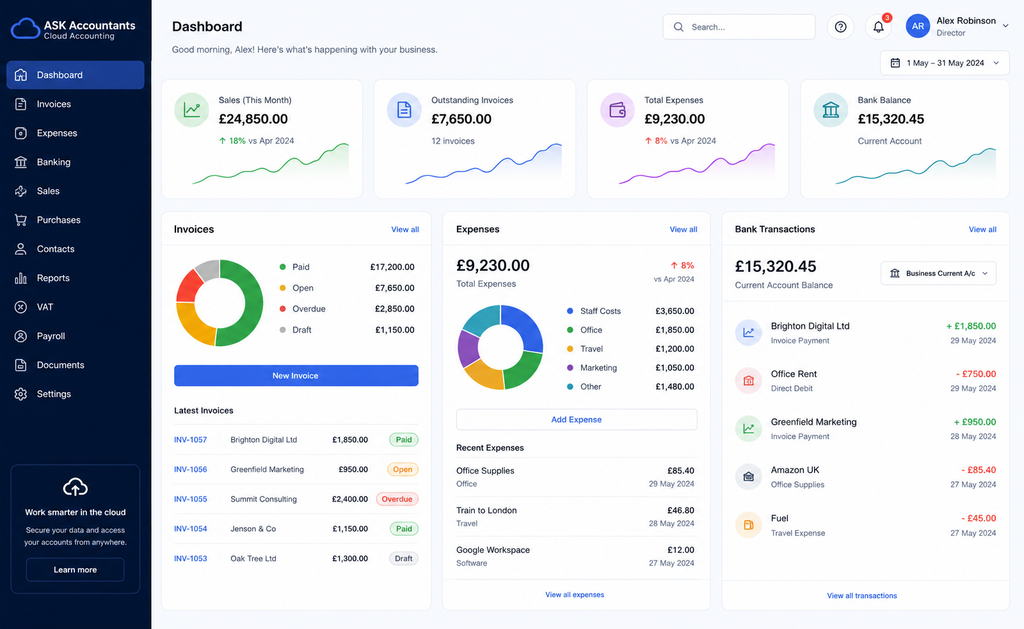
For example, a contractor could connect their business bank account, categorise transactions weekly and give their accountant access to review the records.
In addition, spreadsheets can work for very small operations, while cloud accounting may become more practical as transactions, VAT obligations and reporting requirements increase.
Accounting software can reduce repetitive bookkeeping work, but it does not replace professional accounting judgement.
What Records Does a Contractor Need to Keep?
Contractor records provide the evidence needed to calculate profits, complete tax reporting and support financial transactions. Useful records can include sales invoices, purchase invoices, receipts, bank statements, mileage information where relevant, VAT records and payroll information.
First, create a consistent system for storing records digitally. This could involve separate folders for income, expenses, bank statements, tax documents and company records.
For example, saving a supplier invoice immediately after purchase makes it easier to find when preparing accounts.
Moreover, contractors should review records regularly rather than relying entirely on year-end preparation.
Well-organised records make contractor accounting faster, clearer and easier to check.
Do Contractors Need an Accountant?
Contractors do not always need an accountant, but professional support can become valuable when tax, VAT, payroll, company or IR35 responsibilities become more complicated.
First, a contractor accountant can potentially help with bookkeeping, tax returns, company accounts, Corporation Tax, VAT, payroll and tax planning, depending on the services offered.
For example, a limited company contractor may need to manage company accounts, Corporation Tax, payroll, dividends and IR35 considerations simultaneously.
How Much Does an Accountant Cost for a Contractor?
Second, accountant fees vary according to business structure, transaction volume, services and complexity. A sole trader with straightforward accounts may require fewer services than a VAT-registered limited company contractor with payroll.
Therefore, compare the services included in the fee, not just the advertised monthly price.
When Should a Contractor Hire an Accountant?
Third, consider professional accounting support when bookkeeping takes too much time, tax responsibilities become difficult to understand or the potential cost of an error becomes significant.
For example, forming a limited company, registering for VAT, employing staff or dealing with complex IR35 questions can all increase the value of specialist advice.
How Can Contractors Reduce Their Accounting Workload?
Contractors can reduce their accounting workload by creating a consistent financial routine and dealing with transactions throughout the year. The aim is to make accounting a manageable weekly task rather than a stressful year-end exercise.
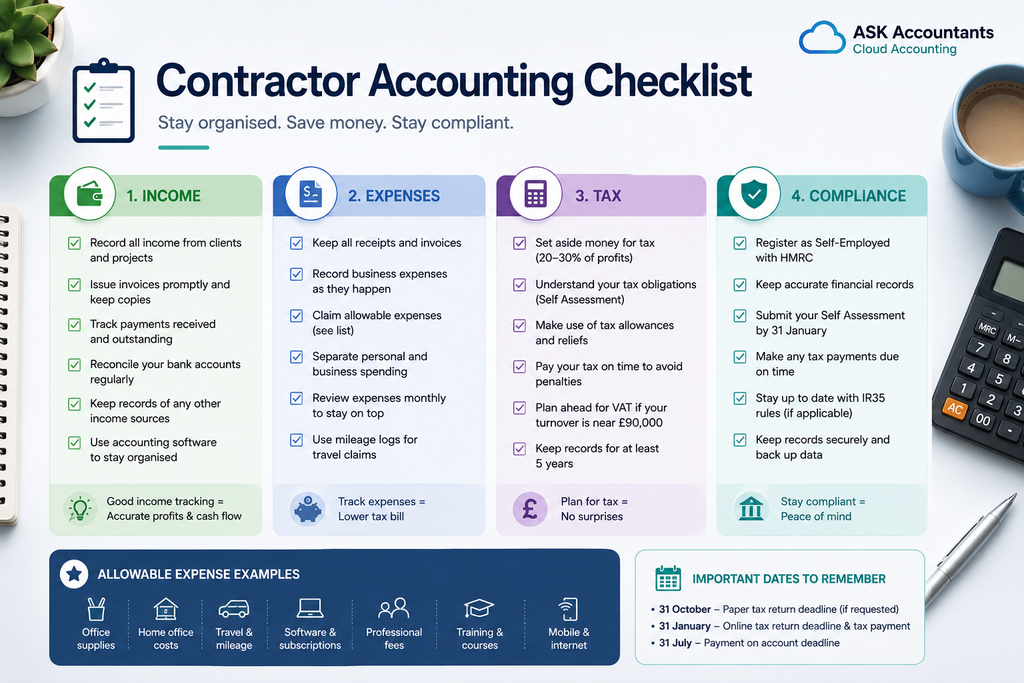
First, use this practical checklist:
- Choose an appropriate business structure.
- Separate business and personal transactions where practical.
- Issue invoices promptly and track outstanding payments.
- Record business expenses regularly.
- Keep digital copies of receipts and invoices.
- Reconcile bank transactions frequently.
- Set money aside for expected tax liabilities.
- Review VAT and IR35 requirements when circumstances change.
- Monitor cash flow throughout the year.
- Seek professional advice when your accounting becomes more complex.
Furthermore, Making Tax Digital for Income Tax is now relevant to qualifying sole traders and landlords under the staged rollout. Contractors who also have qualifying self-employed income should check whether the rules apply to them.
Digital record keeping is becoming increasingly important for UK contractors.
What’s Next for Managing Your Contractor Accounts?
The next step in accounting for contractors is to create a financial system that matches your business structure, income and compliance responsibilities.
First, review your current business structure and determine whether operating as a sole trader or limited company remains appropriate.
Second, make sure your bookkeeping system captures every invoice, payment and qualifying business expense and that supporting records are retained.
Third, review your tax position throughout the year instead of waiting until a return is due. Regular reviews can help you anticipate liabilities and manage cash flow.
Fourth, check whether VAT, PAYE, IR35 or Making Tax Digital requirements apply to your circumstances.
Finally, consider professional support if accounting is taking valuable time away from your contracting work.
Conclusion
Accounting for contractors is about more than filing a tax return at the end of the year. It involves managing income, expenses, cash flow, tax obligations, records and reporting requirements throughout the year.
Moreover, the right accounting approach depends on your circumstances. Sole traders, limited company contractors, VAT-registered businesses and contractors affected by IR35 can all have different responsibilities.
Therefore, establish good bookkeeping habits early, keep your records organised, monitor your tax position and review your financial processes regularly. When your contracting business becomes more complex, specialist contractor accounting services can help you stay organised and spend less time dealing with administration.
Good accounting for contractors gives you greater control over your finances, your tax obligations and your business decisions.
Written by ASK Accountants UK Ltd — Chartered Certified Accountants specialising in UK accounting, taxation, bookkeeping and small-business financial management.
Reviewed by ASK Accountants UK Ltd