

Running a small business, scaling a startup, or managing a property portfolio in the UK comes with countless late nights and stressful decisions. When it is finally time to sell some equipment, offload property, or step away from your company entirely, you expect to enjoy the financial reward of your hard work. However, calculating the tax on business asset sale transactions often brings a fresh wave of anxiety.
You might be wondering how much of your profit will actually end up in your pocket. Will you face a massive tax bill? Have you kept the right records? If you are feeling overwhelmed, you are certainly not alone. The UK tax system is incredibly complex. Between changing relief rates, shifting deadlines, and complicated digital reporting rules, it is very easy to make a mistake.
This guide will break down everything you need to know in plain English. We will cover the core rules, relief options, and the hidden traps that catch many founders off guard. By the end of this post, you will have a clear roadmap to help you stay compliant, properly file your returns, and keep more of your hard-earned money.
The Core Rules of a tax on business asset sale
When you sell something that belongs to your business, HMRC requires you to report it. A business asset can be anything from a piece of heavy machinery and office furniture to commercial property or shares in your own limited company. The way you are taxed depends entirely on your business structure and what exactly you are selling.
If you are a sole trader or a partnership, you will generally be dealing with Capital Gains Tax on business assets. When you sell a qualifying asset for more than you paid for it, you make a capital gain. You are required to report this gain to HMRC on your Self Assessment tax return. You will then pay tax on the profit rather than the total sale price.
If you operate as a limited company, the rules are different. Companies do not pay Capital Gains Tax. Instead, they pay Corporation Tax on asset sales. Any profit your company makes from selling an asset must be included in your annual company accounts and your Company Tax Return. This profit will be taxed at the applicable Corporation Tax rate. If you are unsure how this impacts your broader financial strategy, professional corporate tax planning can provide much-needed clarity.
Asset Sale vs. Share Sale
If you run a limited company, there is a fundamental difference between selling the physical assets of the company and selling the shares of the company itself.
If the company sells its machinery, property, or client list, the money belongs to the company. The company pays Corporation Tax on those sales. If you then want to extract that money for your personal use, you will face a second layer of tax (usually in the form of dividend tax or Income Tax).
On the other hand, if you sell your shares in the company, you are selling the business entity itself. In this scenario, the money goes directly to you as an individual. You will then be subject to Capital Gains Tax on business assets. Structuring the sale correctly from the very beginning is crucial to avoid paying more tax than necessary.
Regardless of your structure, calculating the exact profit is rarely as simple as subtracting the purchase price from the sale price. You are allowed to deduct certain allowable costs. These might include the fees you paid to solicitors or estate agents during the sale. You can also deduct the cost of any permanent improvements you made to the asset while you owned it. If you manage multiple buildings, engaging with expert property accounting services can help you track these deductible costs accurately over the years.
Keeping meticulous records of every purchase, improvement, and sale is vital. Good record-keeping helps improve accuracy and mitigates the risk of errors when it is time to calculate your final bill.
Business Asset Disposal Relief (BADR) Explained
If there is one term every UK business owner should know regarding a tax on business asset sale, it is Business Asset Disposal Relief. Previously known as Entrepreneurs’ Relief, this scheme is designed to reward you for building and investing in your business. It is a fantastic way to lower your tax burden.
Normally, Capital Gains Tax on business assets can take a significant bite out of your proceeds. Depending on your income tax band, you might pay up to 24 percent on your gains. However, if you qualify for Business Asset Disposal Relief, your tax rate is significantly reduced.
As of the 2026/27 tax year, the relief rate stands at 18 percent. While this is higher than the historical 10 percent rate, it still represents a highly valuable saving for business owners who are stepping away from their enterprises.
Eligibility Conditions
To qualify for this relief, you must meet a strict set of conditions for at least two years leading up to the sale.
If you are selling all or part of your sole trader business or partnership, you must have owned the business for those two full years. The business must also be a trading business rather than an investment company or a passive property rental business.
If you are selling shares in your personal company, the rules are slightly different. You must be an employee or a director of the company. The company must be a trading company. You must also hold at least 5 percent of the share capital and 5 percent of the voting rights. Additionally, you must be entitled to at least 5 percent of the profits and assets.
It is important to remember that this relief comes with a lifetime limit. Currently, you can claim the relief on up to 1 million pounds of qualifying capital gains over your entire lifetime. Because these rules are so precise, seeking professional advice is highly recommended. Working with an expert can reduce administrative burden and ensure you meet all qualifying criteria.
Beware the capital allowances balancing charge
One of the most easily overlooked aspects of selling a business asset is the capital allowances balancing charge. This concept frequently catches out even the most experienced SME owners and landlords.
When you originally bought equipment or machinery for your business, you likely claimed capital allowances. This allowed you to deduct the cost of the asset from your taxable profits. This lowered your tax bill for that year. However, HMRC remembers this deduction. When you eventually sell that asset, you have to square the books.
To understand a balancing charge, it is helpful to understand how capital allowances are pooled. When you buy equipment, its value is often added to a general tax pool. Each year, you claim a percentage of that pool as a deduction. When you sell an item from the pool, you must deduct the sale price from the pool’s remaining balance.
If the sale price is higher than the remaining balance of the pool, the pool goes into a negative figure. This negative figure is your capital allowances balancing charge. It is immediately added to your taxable trading profits. This means HMRC is reclaiming some of the tax relief you claimed previously.
This is a highly complex area of tax law. Things become especially tricky when you are dealing with specific types of expenses. For example, the rules regarding business entertainment or company vehicles are highly nuanced. There are exceptions and partial recovery rules that dictate exactly how much relief you can claim and how much you must pay back upon sale. Because of this complexity, you should always seek specific advice before calculating balancing charges on vehicles or entertainment-related assets.
Common errors and record-keeping risks with a tax on business asset sale
When dealing with a tax on business asset sale, mistakes can be costly. We want to help you stay compliant and avoid unnecessary stress. Here are three common errors and record-keeping risks you should actively avoid.
1. Missing Strict Deadlines
Many business owners miss crucial reporting deadlines. If you sell a commercial property, you might assume you can wait until your annual Self Assessment is due. However, certain property sales have separate and much shorter reporting windows (often 60 days). Missing a deadline has immediate consequences. HMRC is very strict about late payments. Late-payment interest begins on day 1 of a missed deadline. Furthermore, the first penalties arise at day 15 and increase at day 30.
2. Miscalculating Allowable Costs
Business owners often miscalculate their allowable costs. It is very common to forget to include the legal fees associated with the sale. It is also common to wrongly include general maintenance costs as capital improvements. Routine repairs cannot be deducted from your capital gain, but permanent upgrades can. Keeping clear and separate records for repairs and improvements helps improve accuracy and keeps you compliant.
3. Ignoring Digital Reporting Rules
Failing to adapt to digital reporting standards is a major risk. Making Tax Digital (MTD) is transforming how HMRC collects information. Most VAT-registered businesses must now keep digital records and use compatible software to submit their returns, though there are limited exemptions for specific circumstances. Trying to manage complex asset sales using outdated spreadsheets makes it incredibly difficult to calculate balancing charges correctly. Upgrading to modern cloud accounting software mitigates the risk of errors and ensures you are ready for future digital tax phases.

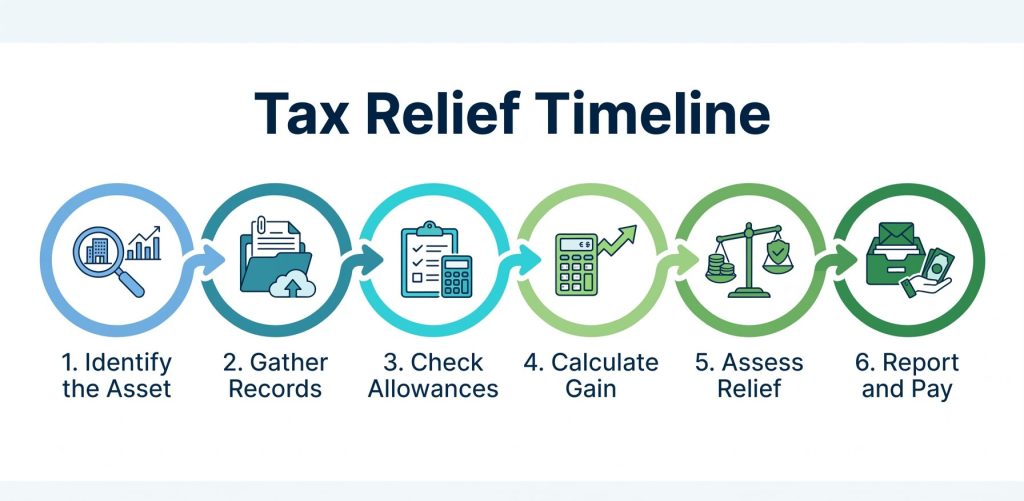
A Step-by-Step Workflow for your tax on business asset sale
Managing the sale of a business asset does not have to be a chaotic experience. Follow this simple workflow to stay organised and compliant.
- Identify the Asset: Clearly define what you are selling. Is it a piece of machinery, a company vehicle, a commercial building, or company shares? The type of asset dictates the specific tax rules you must follow.
- Gather Your Historical Records: Find the original purchase invoice. Locate all receipts for legal fees, stamp duty, and permanent improvements made to the asset over its lifetime.
- Check for Capital Allowances: Review your previous tax returns. Did you claim capital allowances on this asset? If so, you need to prepare for a potential capital allowances balancing charge.
- Calculate the Gain: Subtract your allowable costs from the final sale price. This will give you your raw capital gain.
- Assess Relief Eligibility: Review the two-year ownership and trading conditions to see if you qualify for Business Asset Disposal Relief. If you do, apply the relief to lower your tax rate.
- Report and Pay on Time: Ensure the sale is accurately recorded in your digital accounting software. Submit your tax return before the deadline. Remember that late-payment interest begins on day 1, so arrange your payment well in advance.
Why Outsourcing is a Smart Investment
Handling a tax on business asset sale internally can take hours away from running your actual business. It also forces you to interpret complex HMRC guidance on your own. Outsourcing this task to a professional accounting firm is a highly strategic investment.
A qualified accountant understands exactly how Capital Gains Tax on business assets and Corporation Tax on asset sales interact. We look at the bigger picture of your financial health. If you are planning to sell multiple assets or close down your business entirely, we can help you structure those sales over different tax years to maximise your annual tax-free allowances. We can also advise you on whether a formal liquidation procedure might be a more tax-efficient route for closing your solvent company.
Professional advice helps improve accuracy and ensures you are utilising every legitimate relief available to you. We use modern, HMRC-recognized software to track your assets digitally from the day you buy them to the day you sell them. Whether you want to switch to QuickBooks UK today or set up Xero, relying on an expert can reduce administrative burden, mitigates the risk of errors, and provides you with total peace of mind.
About ASK Accountants UK Ltd
If you are planning to sell a business asset, you do not have to navigate the complex tax rules alone. At ASK Accountants UK Ltd, we have spent the last 15 years helping SMEs, startups, and landlords across Wimbledon and South-West London manage their finances with confidence.
We pride ourselves on offering clear, human, and legally compliant advice tailored to your unique situation. Whether you need help calculating a balancing charge, applying for BADR, or just getting your digital books in order, our expert team is here to support you.
Do not let tax confusion eat into your hard-earned profits. Reach out to us today to see how we can assist you. Call us directly on 020 8543 1991 or visit our office at 178 Merton High St, London. You can also learn more about our tailored solutions by visiting our Bookkeeping Service page or getting in touch via our Contact Page.
Frequently Asked Questions (People Also Ask)
How is a tax on business asset sale calculated?
The calculation starts with the final sale price. You then deduct the original purchase price and any allowable costs (such as legal fees or the cost of permanent improvements). The remaining amount is your taxable profit. If you are a sole trader, you pay Capital Gains Tax. If you operate a limited company, you pay Corporation Tax. Always check if you need to apply a capital allowances balancing charge.
What is the current rate for Business Asset Disposal Relief?
For the 2026/27 tax year, the rate for Business Asset Disposal Relief is 18 percent. This relief allows eligible business owners to pay a reduced rate of tax on qualifying gains, up to a lifetime limit of 1 million pounds. You must meet specific ownership and trading conditions for at least two years prior to the sale to qualify. For full details on current rules, you can always review the official GOV.UK Business Asset Disposal Relief guidance.
Do I have to pay tax if I sell my company vehicle?
Yes, selling a company vehicle usually has tax implications. However, the rules surrounding company vehicles and business entertainment are highly nuanced. There are exceptions and partial recovery rules depending on how the vehicle was used and its emissions rating. Because a sale can trigger a complex balancing charge, you should always seek specific advice from an accountant before finalising the sale to ensure you remain fully compliant.