

Managing a property portfolio in the UK can feel like a relentless balancing act. Between fixing leaky roofs at odd hours and finding reliable tenants, the administrative side often takes a back seat. However, keeping accurate track of your rental property expenses is absolutely essential for your peace of mind and your financial health. When January rolls around, scrambling to find receipts is the last thing you want to do.
If you are a stressed SME owner, a startup founder diversifying into real estate, or a career landlord, you already know that property accounting takes time. The tax rules constantly shift, deadlines loom, and the pressure to remain compliant can keep you awake at night. This guide will walk you through the essential rules, common mistakes, and the smartest ways to handle your rental property expenses moving forward.
Understanding your rental property expenses
When we talk about rental property expenses, we are referring to the day-to-day costs of running and maintaining your property business. These are costs you can deduct from your rental income to calculate your taxable profit. By recording every eligible expense, you ensure you only pay tax on your true profit.
Tracking your rental property expenses accurately can reduce administrative burden later on. It keeps your cash flow visible and ensures you are fully prepared long before the tax deadline approaches.

The core HMRC landlord tax rules
The foundation of managing your property finances is understanding exactly what HMRC expects from you. If you own property personally (rather than through a limited company), you generally calculate your profits using the cash basis. This means you record income when it is received and expenses when they are paid. However, if your rental income exceeds £150,000 a year, you must use traditional accrual accounting.
We also need to look ahead to the new digital rules. Most VAT-registered businesses must comply with Making Tax Digital, and soon many landlords will join them. Under Making Tax Digital for Landlords, those earning over £50,000 annually will be mandated to keep digital records and submit quarterly updates starting in April 2026. Those earning over £30,000 will follow in April 2027. There are limited exemptions available for specific circumstances, but the vast majority of landlords will need to adapt.
Comprehensive allowable expenses for landlords
Not all outgoings are treated equally by HMRC. To maximise your tax efficiency, you need to know exactly what counts as an allowable expense. The general rule is that the expense must be incurred “wholly and exclusively” for the purposes of renting out the property.
Here are the most common allowable expenses for landlords:
- General maintenance and repairs: Fixing a broken boiler, replacing a smashed window, or mending a leaky pipe all count. These are considered revenue expenses.
- Utility bills: If you pay the gas, electricity, or water bills on behalf of your tenants (and do not charge them separately for it), you can claim these costs.
- Council tax and ground rent: You can claim council tax while the property is empty and available to let. Ground rent and service charges are also fully deductible.
- Property insurance: Premiums for landlord insurance, building insurance, and contents insurance are all allowable.
- Letting agents and management fees: Any fees you pay to an agency to find tenants or manage the property are fully deductible.
- Professional fees: This includes accountancy fees for preparing your rental accounts, as well as legal fees for drawing up tenancy agreements (for leases under one year) or evicting a tenant.
- Cleaning and gardening services: If you pay for routine cleaning or garden maintenance at the rental property, you can claim these costs.
- Direct costs: Costs like phone calls, stationery, and advertising for new tenants are also allowable.
The nuance of buy-to-let tax rules
Some expenses require much closer attention because the buy-to-let tax rules are quite specific.
Mortgage interest (Section 24) You can no longer simply deduct mortgage interest from your rental income to reduce your tax bill. Instead, you receive a 20% basic rate tax credit on your finance costs. This rule affects higher-rate taxpayers significantly. Understanding this restriction is crucial when projecting your true cash flow.
Company vehicles and travel You might assume you can claim all travel to and from your rental properties. However, the rules around claiming vehicles or travel expenses are highly nuanced. There are exceptions and partial recovery rules to consider based on where your business base is located. You should always seek specific advice before claiming motor expenses to ensure you remain fully compliant.
Business entertainment Taking a letting agent or a tenant out for lunch is generally not an allowable expense for landlords. Business entertainment costs are strictly scrutinized, and claiming them incorrectly can lead to complications.
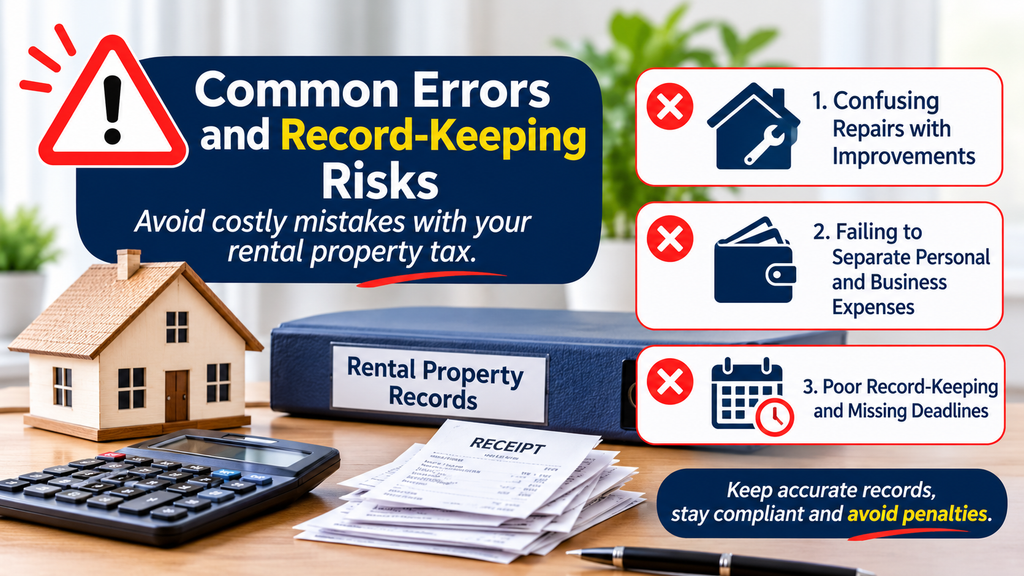
Common errors and record-keeping risks
Even the most diligent landlords can slip up. Property taxation is complex, and innocent mistakes are common. Being aware of these pitfalls helps improve accuracy and mitigates the risk of errors in your tax return.
1. Confusing repairs with capital improvements
This is perhaps the most frequent error landlords make. A repair restores an asset to its original condition (like fixing a broken roof tile). An improvement makes the asset better than it was before (like adding a brand new conservatory). Repairs are allowable rental property expenses that you deduct against your income. Improvements are capital expenses that you can only offset against Capital Gains Tax when you eventually sell the property. Misclassifying an improvement as a repair will artificially lower your tax bill and can cause significant compliance issues.
2. Failing to separate personal and business expenses
Many landlords use their personal bank accounts to pay for rental expenses. This makes untangling the finances at year-end incredibly difficult. It also increases the risk that you might accidentally claim a personal expense against your rental income. If you buy a tin of paint for your own house and a tin for the rental property on the same receipt, you must strictly apportion the cost.
3. Poor record-keeping and missing deadlines
Relying on a shoebox of faded receipts in January is a dangerous game. When dealing with HMRC, missing a deadline can be costly. Late-payment interest begins on day 1. Furthermore, first penalties arise at day 15 and increase at day 30. Keeping clean, digital records ensures you never miss a filing date or a payment window.
A step-by-step workflow for managing rental property expenses
Taking control of your rental property expenses does not have to be overwhelming. By implementing a simple, repeatable workflow, you can save hours of administrative work and eliminate the January panic.
- Open a dedicated bank account: Keep your property finances entirely separate from your personal money. This single step will save you (and your accountant) hours of forensic work.
- Adopt cloud accounting software: Use cloud accounting platforms like Xero or properly configure QuickBooks for landlords to track your income and outgoings. This prepares you perfectly for the upcoming digital tax changes.
- Digitise receipts immediately: Do not let paper pile up. Use receipt-scanning apps to take a photo of your invoices the moment you receive them.
- Categorise expenses monthly: Set aside 30 minutes at the end of each month to reconcile your bank feed. Tag your costs as repairs, professional fees, or insurance.
- Review with a professional: Before the tax year ends, review your categorized expenses with a qualified accountant. They can spot missed opportunities and ensure your classifications are correct.
Why outsourcing is a smart investment
As a busy property owner, your time is your most valuable asset. Spending hours agonizing over spreadsheets takes you away from growing your portfolio or enjoying your personal life.
Outsourcing your bookkeeping and tax preparation to a professional is a highly strategic move. A chartered certified accountant understands the nuances of HMRC landlord tax inside and out. They can help you identify legitimate allowable expenses that you might have otherwise missed. More importantly, having an expert handle your compliance mitigates the risk of errors and ensures you are fully prepared for the digital tax revolution.
When you hand over the paperwork, you gain back your evenings and weekends. You also gain the confidence that your portfolio is structured in the most tax-efficient way possible.
Let us manage your rental property expenses
At ASK Accountants UK Ltd, we have over 15 years of experience helping SMEs, startup founders, and landlords across Wimbledon and South-West London. We understand the local property market and the specific pressures you face.
Our team of Chartered Certified Accountants will handle the heavy lifting of your property compliance. We can help you transition to cloud software, optimize your expenses, and ensure your Self Assessment is filed accurately and on time.
Do not wait until the tax deadline is looming. Get in touch with us to explore our Bookkeeping Services and see how we can reduce your administrative burden today.
Call us on 020 8543 1991 or visit our office at 178 Merton High St, Wimbledon, London. You can also reach out via our Contact Us page.
Frequently Asked Questions
What are the most commonly missed rental property expenses?
Many landlords forget to claim for direct costs like mileage for property inspections, small administrative costs like stamps and stationery, and the professional fees paid to accountants or letting agents. Tracking these small items digitally ensures you capture every eligible deduction.
Can I claim the cost of replacing furniture in my furnished rental?
Yes, under the Replacement of Domestic Items Relief, you can claim the cost of replacing movable furniture, appliances, and kitchenware provided for the tenant. However, you cannot claim the initial cost of furnishing the property for the first time. For detailed guidance, you can refer to the GOV.UK property income manual.
How will Making Tax Digital (MTD) affect my rental property expenses?
From April 2026, landlords earning over £50,000 annually must keep digital records and submit quarterly summaries to HMRC using compatible software. This means manual spreadsheets and paper receipts will no longer meet the compliance standards for reporting your income and outgoings. Moving to cloud accounting now is the best way to prepare.