

If you are running a small business, launching a startup, or managing rental properties in the UK, you probably know that sinking feeling when your bank balance does not match your sales. You work late, invoices go out, and revenue looks healthy, yet cash still feels tight. In many cases, the missing piece of the puzzle is your gross profit margin. Understanding this single number helps you see whether your core trading activity actually makes money before rent, software, and admin bills eat into your cash.

What Is Gross Profit Margin and Why Does It Matter?
Your gross profit margin shows the percentage of revenue your business keeps after paying the direct costs of producing your goods or delivering your services. In accounting terms, those direct costs are known as your cost of goods sold (COGS) or cost of sales.
Unlike your net profit margin, which deducts every overhead such as office rent, insurance, and marketing, this metric focuses purely on your day-to-day trading efficiency. According to Xero UK’s guide on gross profit margin, tracking this figure shows whether your core business model is sustainable and guides your pricing decisions.
For UK landlords, contractors, and retail founders alike, watching this percentage each month gives you an early warning system. If supplier prices creep up or a project takes twice as long as quoted, your margin shrinks immediately. Catching that dip in week two rather than month twelve gives you time to adjust prices or renegotiate with suppliers.
The Gross Profit Margin Formula Explained
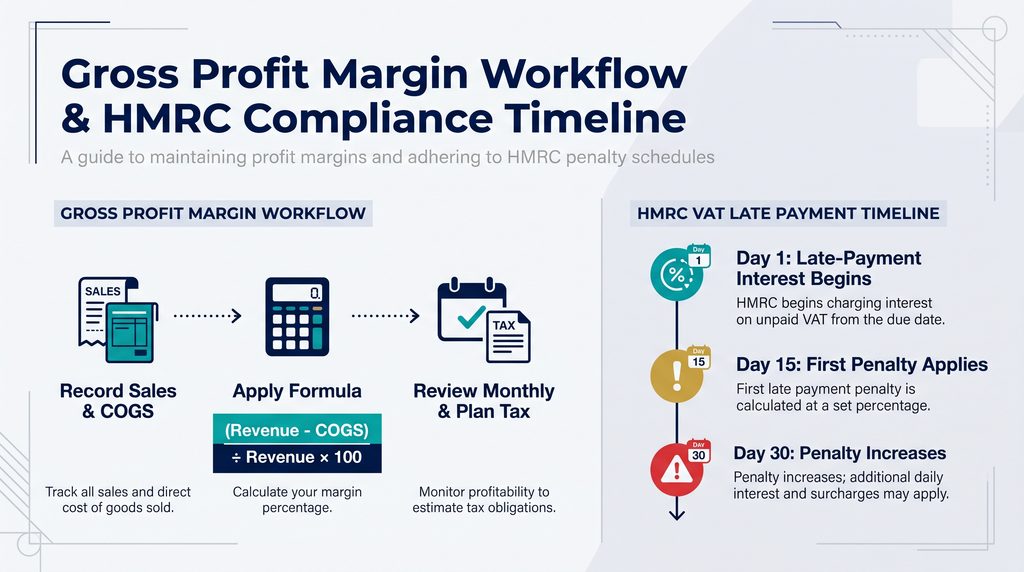
You do not need complex spreadsheets to work out where you stand. The gross profit margin formula has two simple steps:
- Subtract your cost of goods sold from your total revenue (excluding VAT if you are VAT-registered) to find your gross profit in pounds.
- Divide that gross profit figure by your total revenue, then multiply by 100 to get a percentage.
Here is a quick example. Suppose your Wimbledon retail shop sells £100,000 worth of goods (excluding VAT) over a quarter, and those items cost you £60,000 to buy from wholesalers. Your gross profit is £40,000. Divide £40,000 by £100,000 and multiply by 100, and your gross profit margin is 40%.
As QuickBooks UK’s guide on gross profit ratio notes, comparing this ratio over time helps you see how effectively you control direct production or purchasing costs.
HMRC Core Rules, Digital Records, and Deadlines
Tracking your gross profit margin is not only good commercial practice. Accurate records of your sales and direct costs are also a legal requirement under UK tax law. In fact, HMRC’s own Enquiry Manual (EM3082) notes that the gross profit rate is the most commonly used business ratio when HMRC examines accounts.
Record-Keeping Rules for Sole Traders, Landlords, and Limited Companies
Your exact record-keeping duties depend on your business structure:
- Sole traders and partnerships: Under GOV.UK self-employed record-keeping rules, you must record all sales, income, and business expenses, and keep supporting proof such as invoices and bank statements. You normally need to keep these records for at least 5 years after the 31 January submission deadline for the relevant tax year.
- Limited companies: Directors must keep detailed financial and accounting records under GOV.UK company record rules, including all money received and spent, stock lists, and year-end valuations. Limited companies generally must keep accounting records for 6 years from the end of the financial year they relate to.
- VAT-registered businesses: You must maintain a VAT account and keep copies of all invoices issued and received, as outlined in GOV.UK VAT record-keeping guidance.
Keeping these numbers clean in cloud accounting software makes calculating your margins effortless at any point in the year. You can also read our detailed breakdown of what records you need for a UK tax return.
Making Tax Digital (MTD) and Limited Exemptions
Digital compliance is now central to UK bookkeeping. Under Making Tax Digital for VAT, most VAT-registered businesses must keep digital VAT records and submit returns using MTD-compatible software. However, there are limited exemptions. For example, businesses can apply for an exemption under GOV.UK MTD exemption guidance if it is not reasonably practical for them to use digital tools due to age, disability, remoteness, or religious grounds.
Landlords and sole traders also face upcoming changes under Making Tax Digital for Income Tax. Self-employed individuals and landlords with qualifying income over £50,000 must follow MTD rules from April 2026, followed by those with income over £30,000 from April 2027. If your qualifying income is £20,000 or less, you are automatically exempt under current rules. If you need help preparing your systems, explore our Making Tax Digital VAT services.
Exact HMRC Penalty and Interest Timelines
Missing a filing or payment deadline puts unnecessary pressure on your cash flow and your net profit margin. Knowing the exact timeline helps you plan ahead and stay in control.
For VAT payments, HMRC’s late payment interest guidance states that late-payment interest begins accruing from day 1 after the due date until you pay in full. Under GOV.UK VAT late payment penalty rules, the first penalty arises at day 15 if the payment remains unpaid, and penalties increase at day 30 with an additional charge plus a daily penalty rate thereafter. Paying on time, or contacting HMRC early to arrange a Time to Pay plan, helps you avoid escalating costs.
Common Errors and Record-Keeping Risks
Even diligent founders make bookkeeping slips when they are juggling sales, staff, and suppliers. Rather than worrying about scare stories, it helps to view these mistakes as common errors and record-keeping risks that distort your gross profit margin and create extra work at year end.
1. Mixing Cost of Goods Sold With Operating Overheads
One of the most frequent errors we see is dumping every expense into a single general category. If you put office Wi-Fi, software subscriptions, or accountancy fees into your cost of goods sold, your margin will look artificially low. Conversely, if you leave direct subcontractor labour or raw materials in general overheads, your gross profit margin will look stronger than it really is.
Clear separation between direct costs and fixed overheads is essential. Our bookkeeping services help business owners map their chart of accounts cleanly from day one.
2. Misclassifying Nuanced Expenses Like Entertainment and Vehicles
Business owners often assume that any receipt paid from the company card belongs in the same tax bucket. In reality, rules around business entertainment and company vehicles are highly nuanced.
For instance, client entertaining is generally not an allowable deduction for Corporation Tax or VAT recovery, whereas staff entertaining can follow different rules. Similarly, company cars, vans, and fuel carry complex Benefit in Kind rules, capital allowances, and partial VAT recovery exceptions depending on commercial use and CO2 emissions. Because exceptions and partial recovery rules apply in both areas, you should always seek specific advice from a qualified accountant before claiming. You can also check our overview of what expenses a limited company can claim.
3. Ignoring Stock Valuations and Unrecorded Discounts
If you hold physical inventory, forgetting to count year-end stock or failing to record supplier rebates skews your cost of goods sold calculation. Overstating closing stock inflates your profit on paper, which could lead to paying more tax than necessary. Understating stock hides your true gross profit margin and makes it harder to spot shrinkage or waste.
Consistent monthly stock checks and proper accounts and tax preparation reduce these record-keeping risks significantly.

Step-by-Step Workflow to Monitor Your Gross Profit Margin
You do not need an entire finance department to keep a close eye on your numbers. Follow this practical monthly workflow to stay on top of your gross profit margin and keep your books ready for HMRC:
- Step 1: Reconcile your bank feeds weekly. Match every incoming payment and supplier bill inside Xero or QuickBooks so nothing slips through the cracks.
- Step 2: Tag direct costs accurately. Assign raw materials, wholesale stock, delivery packaging, and direct project subcontractors strictly to your cost of goods sold codes.
- Step 3: Exclude VAT from margin calculations. If you are VAT-registered, always use net figures (excluding VAT) when running the gross profit margin formula.
- Step 4: Run a monthly Profit and Loss report. Compare this month’s margin percentage against the last three months to spot rising supplier costs early.
- Step 5: Review your pricing and product mix. Identify which products, services, or rental units deliver the strongest margin and where small price adjustments make sense.
- Step 6: Set aside tax reserves monthly. Transfer a realistic percentage of your net profit into a separate savings pot so VAT and Corporation Tax deadlines never catch you off guard.
For property investors, pairing this routine with dedicated property accounting keeps rental yields and repair costs crystal clear.
Why Outsourcing Your Bookkeeping and Margin Tracking Makes Sense
When you are wearing every hat in a growing company, late-night spreadsheet sessions drain your energy. Outsourcing your bookkeeping and management reporting to a Chartered Certified Accountant is a smart investment that frees up your time for customers and strategy.
Working with a dedicated team can reduce administrative burden, helps improve accuracy across your monthly reports, and mitigates the risk of errors before returns reach HMRC. Instead of guessing whether you can afford to hire a new staff member or take on a larger lease, you get reliable numbers every month.
Professional support also connects your daily margins to broader corporate tax planning and business advice, helping you make confident decisions all year round.
Work With ASK Accountants UK Ltd in Wimbledon
At ASK Accountants UK Ltd, we have spent 15 years helping SMEs, startup founders, and landlords across Wimbledon and South-West London turn messy numbers into clear growth plans. As Chartered Certified Accountants, we speak plain English and tailor our VAT services and tax compliance support to fit how you actually work.
Whether you need help setting up Xero, cleaning up your cost of goods sold, or reviewing your gross profit margin before your next tax deadline, our local team is here to help.
Call us today on 020 8543 1991, visit our office at 178 Merton High St, Wimbledon, London SW19 1AY, or send us a message through our contact page to book a friendly, no-obligation chat.
Frequently Asked Questions About Gross Profit Margin
What is a good gross profit margin for a UK small business?
There is no single benchmark that fits every sector. Service-based businesses with low direct material costs often aim for 50% to 70%, while retail, hospitality, and construction firms typically see lower percentages due to higher stock and labour costs. You can compare your figures against your own historical trends and explore Xero UK’s profit margin guide for further context.
What is the difference between gross profit margin and net profit margin?
Your gross profit margin measures profitability after deducting only direct production or purchasing costs (cost of goods sold). Your net profit margin goes further by subtracting all operating overheads, such as rent, utilities, marketing, salaries, and tax, showing the final percentage of revenue your business keeps.
Should I include VAT when calculating my gross profit margin?
If your business is VAT-registered, you should always exclude VAT from both revenue and direct costs when calculating your margins. VAT is collected on behalf of HMRC and does not represent business income or a direct cost. If you are not VAT-registered, you use the gross amounts paid and received, including any VAT charged by your suppliers.