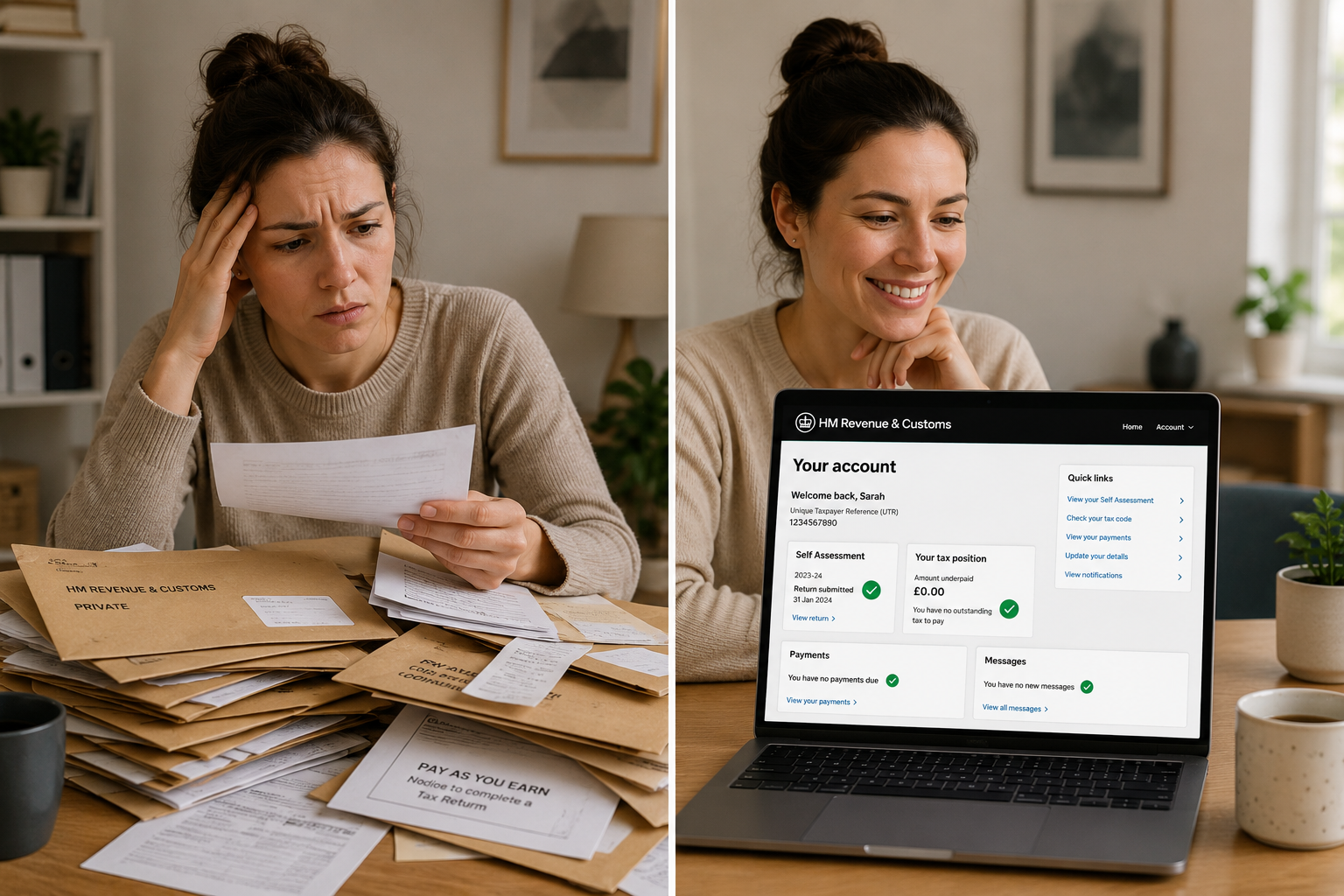
Here’s a confession most people won’t make: they’ve received letters from HMRC, logged into some government portal in a mild panic, clicked around a bit, and then quietly closed the tab — none the wiser. If that sounds familiar, you’re not alone. The concept of a tax account sounds simple enough on the surface. But in practice, it sits in this odd territory where it’s technically accessible to everyone, yet genuinely understood by very few.
So let’s fix that.
A tax account — specifically your Personal Tax Account or Business Tax Account held with HMRC — is a centralised online record of your entire tax relationship with the UK government. It’s where your income details live, where your National Insurance contributions are tracked, where you can file a Self Assessment tax return, and where HMRC will flag if they think you owe them money (or, occasionally, if they owe you some back). Think of it less as a bank account and more as a file — a living, breathing digital file that follows you around your entire working life.
And yet, most people treat it like a drawer they only open when something goes wrong.
The Two Flavours: Personal vs. Business
There isn’t one single type of tax account. Which one matters to you depends almost entirely on how your income is structured.
Your Personal Tax Account is exactly what it sounds like. Accessed through HMRC’s Government Gateway, it consolidates your PAYE records, any Self Assessment returns you’ve filed, state pension forecasts, child benefit details, and your tax code history. If you’ve ever wondered why your employer is deducting a strange amount from your pay packet — the answer is almost certainly sitting there, in your tax code, on this very page.
Business Tax Accounts, on the other hand, are built around the entity rather than the individual. A limited company, sole trader, or partnership each has its own tax account through which corporation tax, VAT obligations, PAYE for employees, and other liabilities are managed. If you run any kind of business, this isn’t optional — it’s the infrastructure through which you communicate with HMRC.
Worth knowing: Since the rollout of Making Tax Digital (MTD), the expectation from HMRC is that businesses and landlords will increasingly manage their tax obligations digitally — through compatible software that feeds directly into their tax account. This isn’t a future thing. MTD for VAT has been live for years, and MTD for Income Tax is now on the horizon for many self-employed people and landlords.
What Can You Actually Do With It?
More than you’d think.
Inside your Personal Tax Account, you can:
- Check your tax code — and actually challenge it if it looks wrong (this happens more often than HMRC would probably like to admit)
- View your National Insurance record — and identify any gaps that might affect your state pension
- Claim a tax refund — if you’ve overpaid, which many PAYE employees do without ever realising
- File and manage your Self Assessment return — including payments on account
- Update your personal details — contact information, marriage allowance claims, and so on
- Check your state pension forecast — arguably one of the most useful things most people never bother to do
For businesses, the range expands considerably. Through a Business Tax Account you can submit VAT returns, manage PAYE schemes, handle CIS returns, and deal with any correspondence relating to HMRC investigations — which, if you’ve ever been on the receiving end of one, you’ll know is not the time to be fumbling around trying to find login credentials.
Setting One Up: Less Terrifying Than It Sounds
| Step | What you’ll need | Time required |
|---|---|---|
| Create a Government Gateway account | Email address, National Insurance number | 10–15 minutes |
| Verify your identity | UK passport or driving licence, or recent payslip/P60 | 5–10 minutes |
| Set up two-step verification | Mobile phone number | 2 minutes |
| Access your Personal Tax Account | Log in via gov.uk/personal-tax-account | Immediate |
| Add a business tax (if applicable) | UTR number, company registration details | 15–20 minutes (may need postal activation) |
One thing that catches people out: for some business taxes — Corporation Tax in particular — HMRC will post you an activation code to your registered address. This takes up to seven working days, which is fine unless you’ve left it until the deadline. (Don’t leave it until the deadline.)
When Your Tax Account Lies to You
Sounds alarming. But it happens.
Your tax account is only as accurate as the information feeding into it. If your employer has submitted incorrect figures through PAYE, if a bank has filed inaccurate interest data, or if you’ve had multiple jobs and HMRC has applied the wrong tax code across them — your tax account will faithfully record all of it. Incorrectly.
This is actually one of the most important reasons to check your tax account regularly rather than treating it as a set-and-forget situation. Common errors people discover when they actually look include:
- Tax codes containing old deductions — relating to benefits in kind from a previous employer, long since left
- Missing National Insurance years — often caused by periods of low income, self-employment gaps, or time abroad
- Overstated or understated income — particularly when you have both employed and self-employed income in the same tax year
- Incorrect marriage allowance — applied to the wrong partner, or not applied at all
None of these are disasters in isolation. But ignored for years, they add up to either nasty bills or money left firmly in HMRC’s pocket when it should be in yours.
The Self-Employed Situation (It’s Complicated)
For sole traders and freelancers, the tax account takes on a different weight entirely. Unlike employees, where PAYE does most of the heavy lifting, self-employed individuals use their tax account as the direct channel for everything: registering for Self Assessment, filing annual returns, making payments (including those slightly baffling payments on account), and managing any outstanding balances.

The Self Assessment return itself is submitted through your tax account — or, increasingly, through cloud accounting software that connects directly with HMRC’s systems. This latter route is becoming not just convenient but mandatory as MTD for Income Tax phases in.
If you’re self-employed and haven’t yet registered for Self Assessment — or haven’t told HMRC about a new income stream — your tax account won’t automatically know. HMRC’s systems are getting smarter (they receive data from banks, investment platforms, and property portals now), but they’re not telepathic. You are still expected to tell them. And the penalties for not doing so tend to be considerably more painful than the tax itself.
Hidden Features Most People Never Use
| Feature | What it does | Useful for |
|---|---|---|
| State Pension forecast | Shows projected pension based on NI record | Anyone within 30 years of retirement |
| Buy voluntary NI contributions | Fill gaps in your NI record (there are deadlines for this) | Career breaks, low-income years, expats returning to UK |
| Marriage allowance transfer | Transfer unused Personal Allowance to a spouse | Couples where one earns below the Personal Allowance |
| Tax-free childcare | Manage childcare account linked to tax system | Working parents with children under 12 |
| PAYE underpayment alerts | HMRC notifies you if they think you’ve underpaid | Anyone switching jobs or with multiple income sources |
| Claim a refund | Request overpaid tax back directly | PAYE employees who’ve stopped working mid-year |
The marriage allowance one in particular is chronically underused. Around four million couples are eligible for it in the UK, and the majority have never claimed it. That’s potentially £252 per year, for a five-minute job.
Agents, Accountants, and Why Delegation Makes Sense
You don’t have to manage your tax account entirely alone.
HMRC allows you to authorise a tax agent — an accountant or tax adviser — to act on your behalf. This means they can view your records, submit returns, correspond with HMRC, and represent you during any enquiries, all without you needing to be involved in every individual interaction. The authorisation is set up through your tax account itself, and you can revoke it at any time.
For businesses especially, this kind of arrangement is less a luxury and more a structural necessity. The number of obligations running through a business tax account — payroll filings, VAT returns, corporation tax deadlines, CIS submissions if you’re in construction — is substantial. Mistakes carry real financial penalties. And HMRC’s online systems, while functional, are not exactly designed with the occasional user in mind.

A firm like Ask Accountants UK Ltd, based in Merton, South West London, handles exactly this kind of ongoing tax account management for businesses and individuals. Their services span everything from bookkeeping and Self Assessment through to personal tax planning, HMRC investigations, and company secretarial work — the kind of support that means your tax account stays accurate, compliant, and not a source of late-night anxiety.
The Penalties for Ignoring It
This is the part nobody wants to talk about.
A tax account you never look at is a tax account that can quietly accumulate problems. HMRC issues penalties for late filing, late payment, and inaccurate returns — and “I didn’t know” is not a defence they’re particularly sympathetic to. The penalty regime is tiered:
- £100 immediately for a Self Assessment return filed even one day late
- Additional daily penalties after three months (£10 per day, up to 90 days)
- 5% surcharges on unpaid tax at 30 days, 6 months, and 12 months
- Interest — currently running at base rate plus 2.5% — accruing from the payment deadline
For businesses, the complexity multiplies. Corporation Tax returns have their own penalty schedules. VAT mistakes can trigger surcharges. And if HMRC opens a formal investigation, the costs — both financial and in terms of time — can be significant.
The better path is obvious, even if it requires more effort upfront: keep your tax account up to date, check it regularly, and get professional help when the complexity starts to exceed what you can confidently manage yourself.
Frequently Asked Questions About Tax Accounts
Do I automatically have a tax account with HMRC? Not exactly. HMRC holds records about you from the moment you start paying tax, but you need to actively register for the Government Gateway to access your Personal Tax Account online. It takes about 15 minutes the first time.
What’s the difference between a Personal Tax Account and a Self Assessment account? Your Personal Tax Account is the broader dashboard — it covers your PAYE, NI record, and general tax position. Self Assessment is a specific obligation within that account, used when your income is more complex than standard employment.
Can my accountant access my tax account? Yes, with your authorisation. You grant them agent access through your tax account, specifying what they’re allowed to see and do. You remain in control and can remove access at any time.
What if my tax account shows the wrong tax code? You can challenge your tax code directly through your Personal Tax Account. If it’s been wrong for multiple years, HMRC may adjust your liability accordingly — sometimes in your favour.
Is my online tax account secure? HMRC uses Government Gateway with two-factor authentication. It’s as secure as these things get, but you should use a strong, unique password and never share your login credentials.
What happens if I ignore my tax account? Penalties, mostly. HMRC will issue fines for late filing and late payment whether you’ve engaged with your account or not. Ignorance doesn’t pause the deadlines.
Do I need a tax account if I’m employed and pay tax through PAYE? Technically no — your employer handles the mechanics. But it’s still worth accessing your account to check your tax code, verify your NI record, and claim any refunds you’re owed.
A Final Thought
The tax account isn’t glamorous. Nobody’s going to tell you it changed their life. But it is one of those things — like having a will, or reading your payslips — where a little bit of engagement now saves a disproportionate amount of grief later.
If you’ve never logged in, this week is a reasonable time to start. And if you look at what’s in there and feel immediately out of your depth, that’s what accountants exist for.
You can reach the team at Ask Accountants UK Ltd at 178 Merton High St, London SW19 1AY, or by calling 020 8543 1991. They offer tax compliance, personal tax planning, cloud accounting, and a full range of business services — the kind of firm where “I don’t know what my tax account says” becomes someone else’s problem to sort out.