
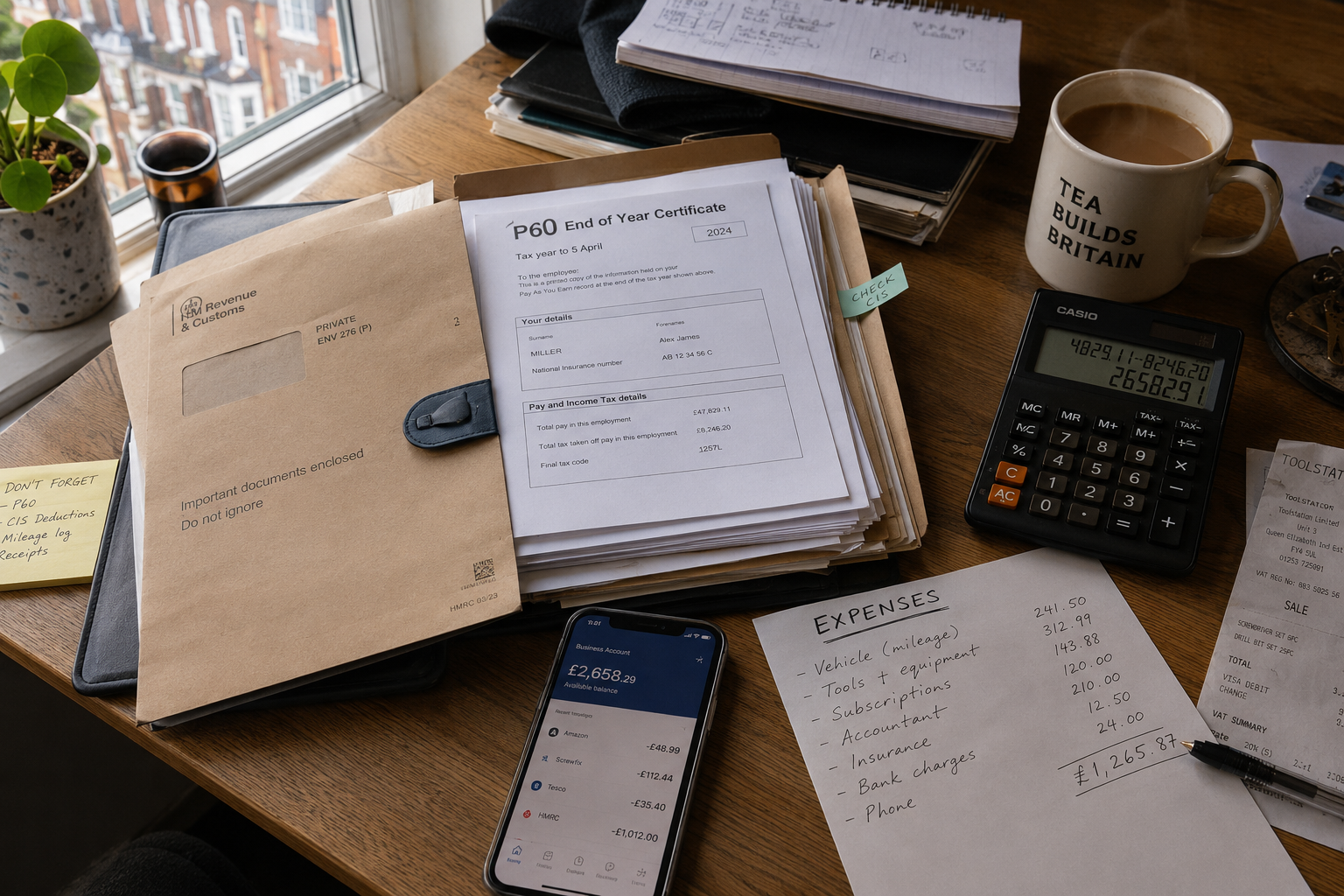
Right, let’s be honest for a second. Nobody wakes up excited about their tax return. Nobody. If you do, please write to me — I’d love to know your secret (and possibly borrow some of whatever you’re drinking in the morning).
But here’s the thing. The dread most people feel about Self Assessment isn’t really about the maths. It’s about the paperwork. That sinking feeling when you realise your “system” for keeping receipts is actually a Tesco bag stuffed under the spare room bed. Or that the P60 you absolutely promised yourself you’d file properly is now somewhere between a takeaway menu and a birthday card from 2022.
So if you’ve found yourself googling what records do I need for a tax return, breathe out. You’re not alone, and the answer is genuinely simpler than HMRC’s website makes it look. I’ve spent years helping people in London — students, landlords, contractors, the lot — figure this exact thing out, often the night before the deadline (please don’t be that person, but if you are, hello, kindred spirit). At Ask Accountants UK Ltd, we see the same pattern every January: smart people, missing one or two key documents, and a panic that could’ve been avoided with a half-decent folder.
This guide pulls all of it apart. The receipts. The forms with cryptic letters. The stuff you didn’t even realise counted as income. By the end, you’ll know exactly what to dig out, what to bin, and how long HMRC expects you to hang on to the lot.
Why HMRC Cares About Your Paper Trail (And Why You Should Too)
HMRC isn’t asking for records because they enjoy reading bank statements. They want proof. Proof that the income you declared is the income you earned, and proof that the expenses you claimed actually happened.
When you file Self Assessment, you don’t usually send receipts in. Surprised? Most people are. You just enter the totals. But — and this is a fairly enormous but — if HMRC ever decides to take a closer look, they’ll ask to see everything. And “I think I had a coffee meeting in Croydon back in March” doesn’t cut it.
The penalties for shaky records can sting. We’re talking up to £3,000 per tax year for failing to keep adequate records, on top of any tax owed. Worth knowing before you toss that fuel receipt in the bin.
Quick tip from someone who’s seen it go wrong: If you can’t picture handing a folder to a tax inspector tomorrow morning and feeling calm about it, your records aren’t ready. They don’t have to be pretty. They have to exist.
The Identity Bits — Boring, Vital, Often Missing
Before you can file anything, HMRC needs to know it’s actually you. So the foundation of any tax return is a small pile of personal admin most people forget about until they’re staring at a login page at 11pm on the 30th of January.
You’ll need:
- Your Unique Taxpayer Reference (UTR) — ten digits, sent to you when you registered for Self Assessment. Lose it and you can request a new one, but it takes time HMRC won’t refund you in deadline grace.
- Your National Insurance number. You probably know this one already.
- Your Government Gateway user ID and password. Forgot it? Reset it now, not at midnight before the deadline. Trust me.
- Bank details — for any refund coming your way.
If you’re new to all this, setting up your personal tax account with HMRC is genuinely worth doing properly the first time. It saves you grief later.
Income: The Bit Where Most People Forget Something
Here’s where the question of what records do I need for a tax return gets real. Income is where mistakes happen — usually because people forget about a source they had for three months in October, or assume something didn’t count.
Spoiler: it probably counted.
If You’re Employed (Even Partially)
Your employer should give you these. If they haven’t, ask. Politely. Then less politely.
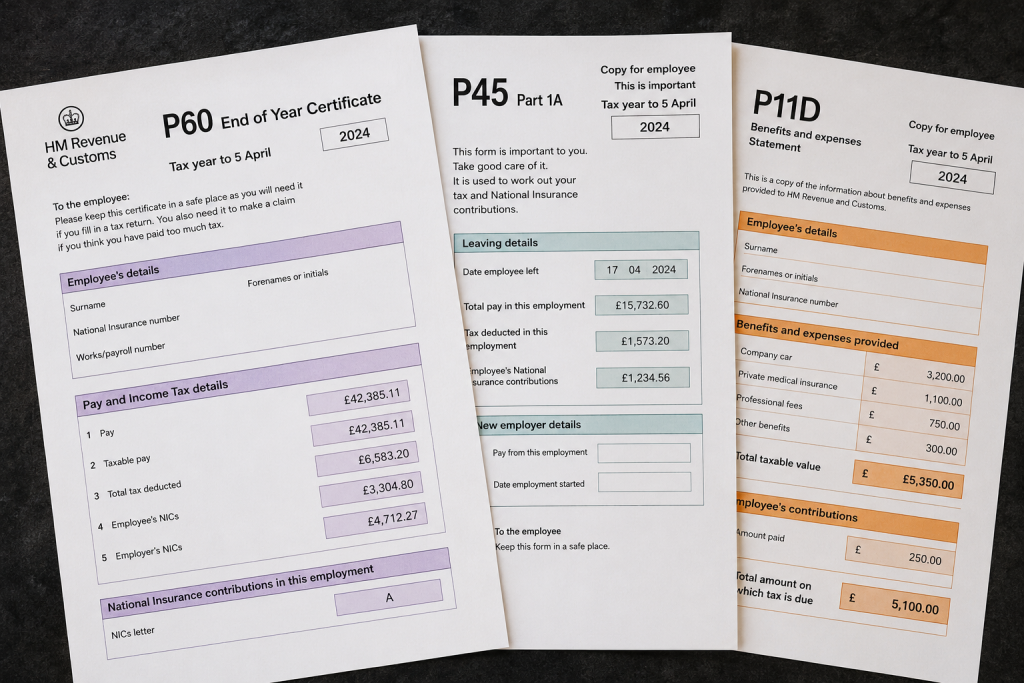
- P60 — your end-of-year summary, showing total pay and tax deducted. Issued by 31 May.
- P45 — if you left a job during the tax year.
- P11D — covers benefits in kind. Company car, private medical, that sort of thing. Often forgotten because it lands later.
- Payslips — handy for cross-checking, even if you don’t strictly need them.
If You’re Self-Employed
This is where bookkeeping discipline pays for itself. You’ll need:
- All sales invoices and records of money in
- Records of cash takings (yes, even the £20 jobs)
- A list of business expenses with receipts
- Mileage logs if you drive for work
- Bank statements for any account used for business
- Records of money you took out of the business for personal use
If you’re under the Construction Industry Scheme, you’ll also want your CIS deduction statements from contractors. These are gold for refund claims and should never, ever be thrown out before the year ends.
Property Income
Landlords, this one’s for you. The rules tightened significantly under Section 24, and Making Tax Digital is creeping in too. You’ll need:
- Rental income statements (from agents or tenants directly)
- Mortgage interest statements
- Letting agent fees and invoices
- Repair and maintenance receipts
- Insurance, ground rent, service charges
- Records of any periods the property was empty
Investment and Savings
- Dividend vouchers from shares
- Interest statements from banks and building societies
- Records of any cryptoassets sold or exchanged (HMRC treats these as taxable disposals — many people are still catching up to this)
- Capital gains paperwork: contract notes, completion statements for property sales, documentation of acquisition costs
Pensions and Benefits
- State pension and private pension statements
- Records of taxable benefits (Jobseeker’s Allowance, Employment and Support Allowance)
- Any pension contributions you’ve made personally — these affect your tax bill in surprisingly chunky ways
A Cheat Sheet for the Document Hunter
Here’s a quick reference for matching the situation to the paperwork. I’ve made this one a bit messy on purpose because real tax life is messy.
| Your Situation | Documents You Must Have | Often Forgotten |
|---|---|---|
| Employed (PAYE) | P60, payslips | P11D for benefits, P45 from previous job |
| Self-employed sole trader | Sales invoices, expense receipts, bank statements, mileage log | Use of home as office calculations |
| Landlord | Rental statements, mortgage interest certificate, repair receipts | Agent fees, void period documentation |
| CIS subcontractor | CIS deduction statements, invoices, expense receipts | Tools, protective clothing receipts |
| Investor / dividends | Dividend vouchers, broker statements | Crypto disposal records, foreign dividend tax |
| High earner with pension | Pension contribution statements, P60 | Annual allowance taper calculations |
If your situation hits more than one row — say you’re a teacher who also rents out a flat in Dulwich — you need everything from each line. Don’t pick and choose.
Expenses: The Receipts You Wish You’d Kept
When people ask what records do I need for a tax return, they almost always under-think the expense side. Which is a shame, because this is where you actually save money.
For the self-employed and landlords, expenses reduce your taxable profit. Every quid you can legitimately claim is a chunk of tax you don’t pay. So that crumpled receipt from the train you took to a client meeting? Worth something. The Zoom subscription? Worth something. The accountant’s fee? Definitely worth something — and yes, that’s a slightly self-interested observation.
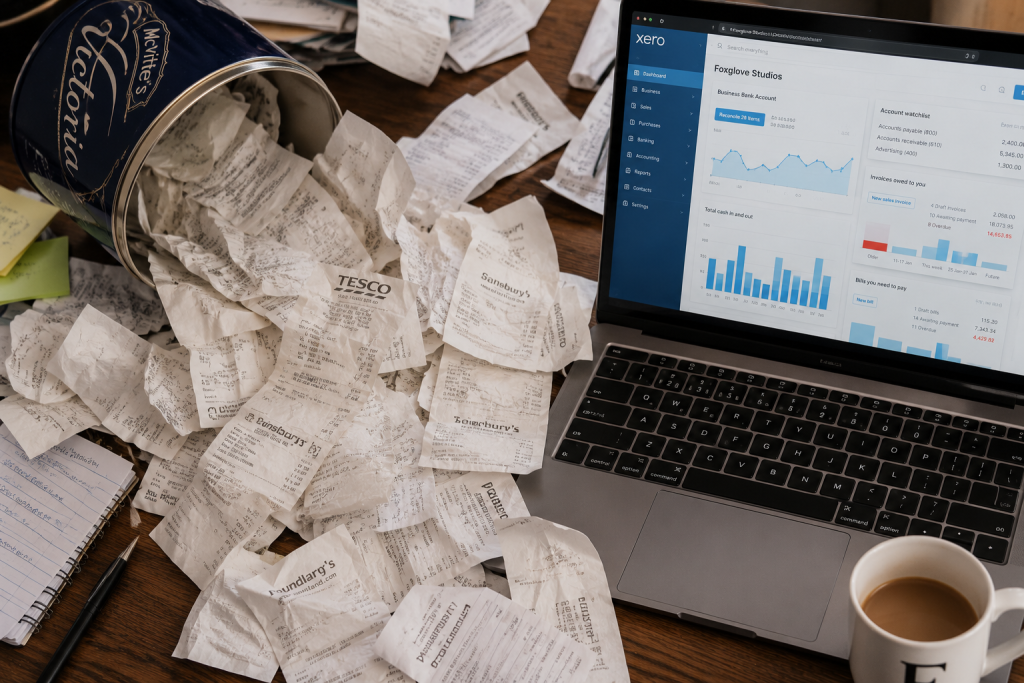
What to keep:
- Travel and subsistence — train tickets, fuel receipts, mileage logs (HMRC’s approved rate is 45p per mile for the first 10,000 business miles, then 25p)
- Office costs — rent, utilities, broadband, stationery
- Use of home — the simplified flat rate or proportionate calculations
- Marketing — website costs, business cards, social media ads
- Professional fees — accountant, solicitor, trade body memberships
- Equipment and tools — laptops, machinery, specialist kit
- Stock and materials
- Staff costs — wages, subcontractor payments, employer NI
- Bank charges and interest on business accounts
The golden rule: if it’s wholly and exclusively for the business, it’s claimable. Mixed use? You can usually claim a fair proportion.
The Things Almost Nobody Remembers
A short list of things I’ve seen people miss, often costing them money:
- Charity donations under Gift Aid — higher-rate taxpayers can reclaim the difference
- Marriage Allowance transfers — small but free money
- Student loan repayments through PAYE
- Pension contributions to private schemes — affects tax relief
- Capital losses carried forward — these reduce future capital gains tax bills
- Foreign income, even if it’s been taxed abroad
- Side hustle earnings — the £1,000 trading allowance only goes so far
That last one is becoming a giant headache, by the way. Etsy sellers, eBay flippers, Vinted resellers, AirBnb hosts — HMRC now receives data directly from these platforms. They know. Get your records straight.
The Digital Question — Paper or Pixel?
Here’s something a lot of people don’t realise: HMRC accepts digital copies of almost everything. Snap a photo of your receipt, save it to a folder, and that’s a valid record. The exception is documents that contain “stamps or marks” specific to the original — fairly rare these days.
This matters because come April 2026, Making Tax Digital for Income Tax Self Assessment kicks in for the self-employed and landlords with income over £50,000. From that point, you’ll be expected to keep digital records and submit quarterly updates. The threshold drops to £30,000 in April 2027.
In other words: if you’re still using a shoebox and a prayer, your time’s up.
Cloud accounting genuinely changes the game here. I was sceptical for years (genuinely, I used to be a paper-and-spreadsheet bloke), but the ability to snap a receipt on your phone and have it categorised automatically is the kind of small thing that compounds. People who switch tend to find their year-end is forty minutes instead of three weekends.
How Long Must You Hang On to All This?
Different rules for different people, which is HMRC’s way of keeping us all sharp.
| Taxpayer Type | Minimum Retention Period |
|---|---|
| Employed/non-business | 22 months after end of tax year |
| Self-employed | At least 5 years after the 31 January submission deadline |
| Landlord | At least 5 years after the 31 January submission deadline |
| Company directors filing Self Assessment | 5 years after 31 January, plus company records for 6 years |
Under HMRC enquiry? Keep everything until the enquiry closes, even if it pushes past the standard period.
A warning that has nothing to do with anyone in particular: If HMRC opens an enquiry and you can’t produce records, they don’t shrug and walk away. They estimate your liability — and their estimates are rarely generous. The cost of poor records isn’t theoretical.
What Happens When the Records Aren’t There?
Sometimes you genuinely can’t find something. A bank that’s closed, an old employer who’s vanished, a receipt that faded in the sun. HMRC understands this — to a point. You can:
- Request copies of P60s and P45s from former employers (they’re legally required to provide them)
- Use HMRC’s online services to view PAYE and pension info via your personal tax account
- Request bank statement reprints (often a small fee)
- Reconstruct expense records from bank and credit card statements where receipts have walked
If a chunk is genuinely lost, declare it honestly. Estimates with explanation are far better than blank silence.
When to Bring in a Human
Look — sometimes the answer to what records do I need for a tax return is too tangled to handle alone. Multiple income streams. A property abroad. A capital gain you don’t fully understand. A letter from HMRC that made your stomach drop.
This is where having someone in your corner matters. Our team handles everything from straightforward Self Assessment returns to messy HMRC investigations and personal tax planning for people whose situations have grown beyond a single tax form. We’ve also written a step-by-step guide to filling in your Self Assessment return if you want to give it a go yourself first.
If you’re in south-west London, you can find us at 178 Merton High St, Wimbledon, SW19 1AY. Or pick up the phone — 020 8543 1991. Worst case, we tell you you’ve got it sorted and send you off for a coffee. Best case, we save you a chunk.
The Deadlines — Because You’ll Ask
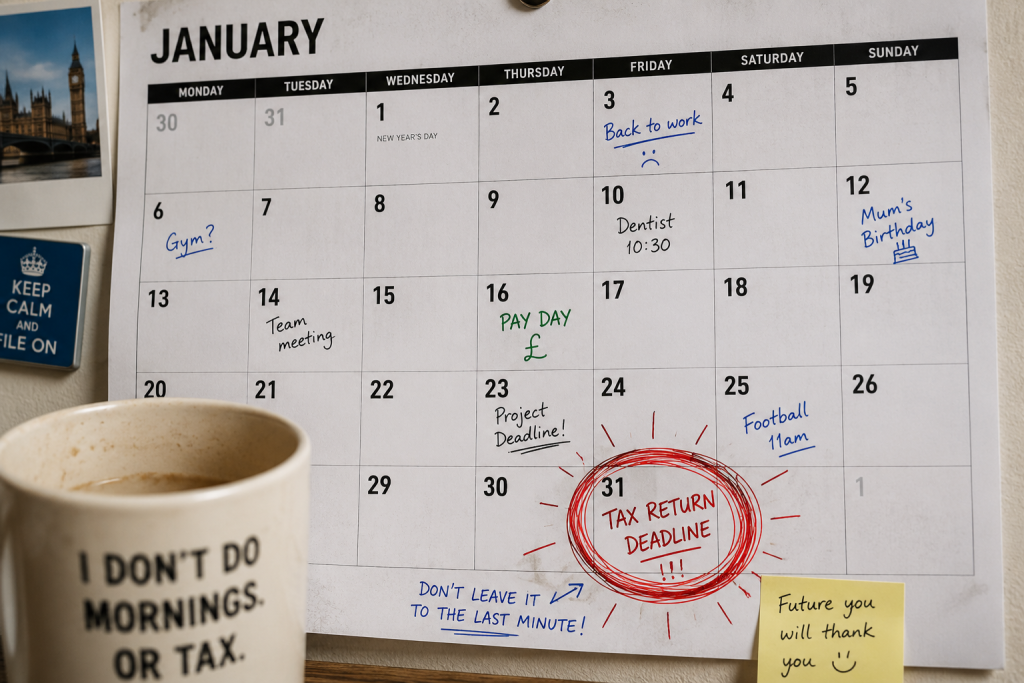
Mark these on something. A wall calendar, your phone, your partner’s wrist:
- 5 October — register for Self Assessment if you’re new
- 31 October — paper return deadline (if you still file by post, why?)
- 31 January — online return deadline AND payment deadline for the previous tax year
- 31 July — second payment on account, if you make them
The full breakdown is in our Self Assessment key dates guide for 2025/26. Bookmark it.
Frequently Asked Questions
Do I need to keep paper receipts or are digital copies fine?
Digital is fine for nearly everything. HMRC accepts scans, photos and electronic invoices. The key is that the copy is legible and complete. If you’re going digital, back up properly — losing your phone shouldn’t mean losing six years of records.
What records do I need for a tax return if I’m only employed?
Less than you’d think. Your P60 is the headline document. Add a P45 if you changed jobs, a P11D if you receive benefits, and records of any other income (savings interest above £1,000, dividends, side income). For most PAYE-only employees who don’t earn over £150,000, you may not even need to file Self Assessment.
Can HMRC ask to see records from years ago?
Yes — and they do. Standard enquiries can go back four years. If HMRC suspects “carelessness”, that extends to six years. For deliberate behaviour, twenty. Keep records longer than the minimum if anything’s complicated.
What if I lose a document I need?
Reconstruct what you can. Request copies. For PAYE income, your personal tax account often holds the figures HMRC already has. Be honest about gaps and estimate reasonably — far better than guessing wildly or omitting income.
Do I need to keep records if I use an accountant?
Yes, absolutely. Your accountant prepares the return; the legal responsibility for records still sits with you. A good bookkeeping service will help organise things, but the underlying documents must exist somewhere you can produce them.
Are there records specific to landlords filing Self Assessment?
Yes. Beyond rental income, you need mortgage interest statements, agent fees, repair invoices (with the distinction between repairs and improvements clearly recorded), insurance, periods of vacancy, and capital expenditure records. Landlords face the most enquiry interest of any individual taxpayer category, so be tight.
What records do I need for a tax return when claiming CIS refunds?
Your CIS deduction statements from every contractor you worked under, your invoices, expense receipts (tools, PPE, travel), and proof of any materials you supplied. Without proper CIS statements, refund claims stall. Many subcontractors leave hundreds owed because of missing paperwork.
Is there a minimum income before I need to file?
You usually need to file Self Assessment if you earned over £1,000 from self-employment, received untaxed income over £2,500, had income from property, or earned over £150,000 in total. The trading allowance, the property allowance, and various thresholds all interact — when in doubt, ask.
A Final Word, Then I’ll Stop
The honest answer to what records do I need for a tax return is more than you think, but less than you fear. Most people fall somewhere in between “missing a couple of key documents” and “drowning in receipts they don’t actually need”. The fix is the same either way: a system, however basic, that you actually use.
Pick a folder. Pick an app and pick a shoebox if you must. Just commit to putting things in it as they arrive, not the night before the 31st of January. Future you will be deeply, deeply grateful.
And if it’s all a bit much — that’s what we’re here for. A short conversation often clears things up faster than an evening of internet rabbit-holes. Pop over, give us a ring, or drop us a line. No judgment, even about the shoebox.