
Knowing the signs you need a new accountant could genuinely save you thousands of pounds — and a great deal of unnecessary stress. Not because most accountants are dishonest, but because the wrong fit, or a firm that’s quietly coasting, costs you in ways that are easy to miss: penalties you didn’t know were coming, reliefs you never claimed, conversations that never happened. If something about your current arrangement feels off, this guide is worth your time.
The relationship between a business owner and their accountant is one of those professional pairings that often gets assessed far less rigorously than it deserves. People change their energy supplier with more due diligence than they apply to the person handling their tax affairs. And the result — years into a comfortable but underperforming arrangement — is that small businesses and individuals end up compliant but not particularly well-served.
Whether you’re a sole trader, a limited company director, a landlord, or simply someone with a complicated tax situation, these are the signals worth paying attention to.
Signs You Need a New Accountant: Starting With the Most Obvious One
Missed deadlines. It sounds almost too simple to be worth listing, but a pattern of late HMRC filings is one of the clearest signs you need a new accountant — and one of the most financially damaging.

A self-assessment return filed after 31 January brings an immediate £100 penalty. At three months, further daily charges kick in. At six and twelve months, additional percentage-based penalties apply. The same escalating structure applies to Corporation Tax returns. HMRC’s penalties guidance lays this out plainly, and the numbers add up fast.
Good accounting firms build deadline management into their practice as a basic operational function. Reminders go out weeks in advance. Information requests to clients happen early. The filing itself has breathing room. When deadlines are consistently tight or occasionally missed, that’s not bad luck — it reflects how the firm is run.
One late filing with a genuine explanation: forgivable. A recurring pattern: a concrete sign your accountant needs replacing.
The Silence Between Annual Bills
Here’s a pattern that catches people off guard. The accounts get filed. The invoice arrives. And then — nothing, until almost exactly twelve months later when the cycle repeats.
Some business owners assume this is standard. It isn’t. Or rather, it’s standard for firms doing the minimum, but it’s not what a genuinely engaged accountant looks like.
Tax legislation moves constantly. Corporation Tax rates, dividend allowances, Making Tax Digital timelines, National Insurance thresholds, capital gains changes — the landscape shifts every Budget cycle. If something in the legislation affects your situation, a proactive accountant will tell you unprompted. Not with a spam newsletter, but with a specific, relevant message.
⚠️ Case in point: Making Tax Digital for Income Tax applies from April 2026 to those with qualifying income above £50,000. If this affects you and your accountant hasn’t raised it, that’s a telling silence.
Signs You Need a New Accountant: They Can’t Answer Direct Questions
Ask your accountant this: “What’s the most tax-efficient way to take money out of my company right now?” Then wait.
A knowledgeable accountant gives you substance. The salary/dividend balance, pension contributions as a pre-tax wrapper, the interaction with your personal allowance, timing of year-end bonuses. Not a definitive answer in thirty seconds — but an engaged, considered response that draws on actual knowledge of your situation.
A concerning response is vague. “It depends.” Full stop. Or a promise to look into it that never gets followed up.
This matters particularly around areas where the gains from good advice are real and specific:
- R&D tax credits — missed entirely by many eligible SMEs
- CIS refund claims for construction contractors, which can run to thousands per year
- Annual Investment Allowance for capital-intensive businesses
- Section 24 mortgage interest relief implications for property investors
If your accountant consistently deflects or stalls on questions like these, they’re not delivering the value a good firm should.
When the Numbers in Your Accounts Don’t Look Right
This might be the most unsettling sign: you look at your accounts and something seems wrong. A figure that’s larger than expected. A tax liability that doesn’t match your rough understanding of what you earned that year.
Your instinct here deserves to be taken seriously.
Errors in submitted accounts and tax returns happen — but they carry consequences that fall on you, not your accountant. An HMRC query triggered by an inconsistency in your filed figures becomes your problem to manage, your professional records under scrutiny. The error was theirs; the investigation is yours.
What matters is how your accountant responds when you flag something questionable. A clear explanation — or a prompt correction — is professional. Defensiveness, dismissal, or evasion suggests something you don’t want to ignore.
If you’re consistently catching errors your accountant didn’t spot before filing, that’s one of the clearer signs you need a new accountant. Urgently.
| Typically Included in Annual Fee | Usually Billed Separately | Red Flag if Charged Extra |
|---|---|---|
| Annual accounts preparation | Bookkeeping services | Answering basic questions |
| Corporation Tax return (CT600) | Payroll management | Responding to HMRC standard letters |
| Companies House filing | VAT registration and returns | Providing copy of filed accounts |
| Basic tax planning advice | R&D tax credit claims | Explaining your own tax bill |
| Director’s self-assessment (some firms) | HMRC investigation support | Correcting their own errors |
You’re Paying But You Don’t Know What For
Transparency about scope is a professional standard — not a bonus feature that only premium firms offer. You should be able to say, clearly, what services your annual fee covers.
Does it include payroll? Bookkeeping? VAT returns? Director’s self-assessment? What triggers an additional charge? These are not difficult questions. A properly run accountancy firm provides an engagement letter that spells this out before any work begins.
Fee surprises — invoices that arrive without prior discussion, charges for things you assumed were included — are a flag. Not always a dealbreaker in isolation, but combined with other concerns on this list, they form a pattern worth recognising.
Your Business Has Changed — But Their Service Hasn’t
Many people find their first accountant when starting out: a sole trader, a modest limited company, perhaps a property purchase generating rental income. The accountant who helped set up and file those early returns was exactly right for that moment.
Businesses grow. One property becomes a portfolio. A freelance consultancy hires staff. A side project becomes a company with real turnover. The question worth asking honestly is whether your accountant’s expertise has kept pace with your situation — or whether they’re still treating you like a £40,000-turnover startup when you’re now dealing with payroll, VAT, and corporation tax planning on a different scale.
Some smaller practices genuinely cover the full range well — offering everything from cloud accounting and bookkeeping through to business advice, personal tax planning, and HMRC investigation support. Others have a ceiling. Neither is inherently wrong, but the fit needs to match where you are now.
If your accountant has never mentioned CIS refund claims and you work in construction, or hasn’t discussed automatic enrolment obligations since you hired staff — that gap in service is a sign worth taking seriously.
Signs You Need a New Accountant: Poor Handling of HMRC Contact
HMRC makes contact with active businesses relatively routinely. A query about a return, a request for information, a routine compliance check — none of these are necessarily alarming on their own.
What matters is the response.
When an HMRC letter arrives, your accountant should contact you promptly, explain what’s happening and what it means, and manage the correspondence on your behalf with clear communication throughout. You should never feel like you’re chasing your own accountant during an HMRC process.
Slow or disorganised responses to HMRC queries can escalate what would otherwise be a routine check into something considerably more involved. The five stages of a tax investigation move fast once HMRC decides to look deeper. An accountant who doesn’t handle initial contact sharply increases that risk.
They’re Not Using Technology — And Neither Are You
Cloud accounting is no longer a forward-thinking novelty. It’s the operational baseline for accurate, accessible financial management — and HMRC’s Making Tax Digital programme is progressively making it a regulatory expectation too.
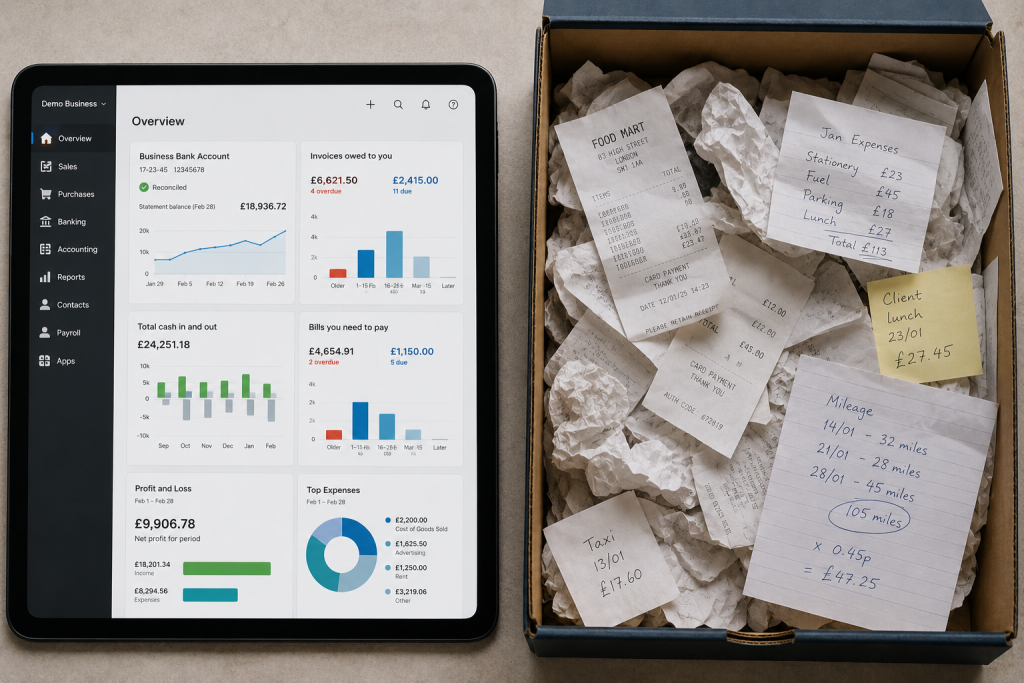
If your accountant is still relying on spreadsheets, emailing PDFs back and forth, and asking you to post physical receipts — that’s worth a direct conversation. Platforms like Xero and QuickBooks, properly implemented, give you real-time visibility of your financial position, automate bank reconciliation, simplify VAT filing, and make bookkeeping substantially less painful. Firms that have genuinely embedded these tools into their workflow deliver better, faster, more accurate work.
This doesn’t require your accountant to chase every new platform. But if technology has never come up in your relationship — if your monthly records still feel like archaeology rather than accounting — it’s reasonable to ask whether there’s a more effective way.
When Tax Planning Is Never Discussed — A Key Sign You Need a Different Accountant
There’s a meaningful gap between tax compliance (filing what you owe, on time, accurately) and tax planning (structuring your affairs to reduce what you owe, within the law). A good accountant does both. Some only do the first.
The reliefs available in the UK tax code are intentional. Pension contributions, capital gains timing, dividend strategy, income splitting between spouses where applicable, use of annual allowances — these are not loopholes. Accessing them requires active advice, and a good accountant provides that advice without you having to specifically ask.
Personal tax planning shouldn’t feel like pulling teeth. If every conversation about tax efficiency is met with vagueness or a conspicuous change of subject, your accountant is leaving money on the table. Yours, specifically.
The same applies on the corporate side. Corporation tax planning, capital allowances strategy, timing of expenditure — these conversations should happen without you having to initiate them every time.
You Just Don’t Trust Them
This one sounds unscientific. It isn’t.
If you’ve worked with the same accountant for years and still hesitate before sending them information — if you feel a low-grade anxiety when HMRC correspondence arrives because you’re not sure how it will be handled — that feeling is data. Professional relationships in accounting are built on trust. You’re sharing sensitive financial information, relying on someone’s competence, and facing real financial exposure if things go wrong.
A general sense of unease isn’t proof of wrongdoing. Sometimes it’s a communication style mismatch rather than a competence failure. But in either case, that’s still a problem worth resolving. Quiet, persistent dissatisfaction with a professional relationship rarely improves on its own.
| Warning Sign | What It Suggests | Urgency Level |
|---|---|---|
| Missed or late HMRC deadlines | Poor systems / capacity issues | High |
| No proactive contact between filings | Reactive rather than advisory role | Medium |
| Vague or delayed answers to questions | Knowledge gaps or disengagement | Medium |
| Errors in accounts you spotted yourself | Accuracy or attention problems | High |
| Can’t explain what’s in your annual fee | Opaque engagement, poor transparency | Medium |
| HMRC letters handled slowly or badly | Risk of escalation or further penalties | High |
| No technology or cloud tools in use | Likely not MTD-ready | Lower (for now) |
| Tax planning never raised proactively | Compliance-only mindset, missed savings | Medium |
| Service hasn’t grown with your business | Expertise ceiling reached | Medium |
| Persistent gut feeling of unease | Trust breakdown — rarely self-corrects | Medium–High |
How to Switch Accountants Without the Drama
Less complicated than most people expect. The process follows a clear sequence:
- Find your replacement first. Have the new firm confirmed before giving notice. Look for someone with recognised qualifications (ICAEW, ACCA, or CIMA membership), relevant experience, and a clear written proposal of what they’ll charge.
- Notify your existing accountant formally. A straightforward letter or email ending the engagement suffices. Professional firms accept this as a normal part of business.
- Professional clearance takes care of the handover. Your new accountant writes to your previous one requesting transfer of relevant records and information — filed accounts, tax returns, working papers. This is standard practice and your previous firm is obliged to cooperate.
- Gather your own records too. Recent filed accounts, HMRC correspondence, login details for any portals or software platforms.
Timing matters modestly. Switching after one year-end and before the next is cleanest. If an active HMRC query is in progress, your new firm will advise whether to wait for resolution — though in some cases, a change of accountant mid-query is perfectly manageable.
What to Look for When Choosing a Replacement
Qualifications first. The term “accountant” carries no legal protection in the UK — anyone can use it. The meaningful credentials are ICAEW (ACA/FCA), ACCA, CIMA, or ICAS membership, each requiring ongoing professional development and subject to ethical regulation. Always verify membership status directly with the relevant body rather than relying on a website claim.
Breadth of services matters more than you might think. Even if you only need annual accounts today, having access to bookkeeping, payroll management, self-assessment, VAT, company secretarial work, and business plans under one roof removes the management overhead of multiple providers as your situation grows. See our full guide on finding a good accountant near you for more detail.
Technology setup tells you a lot. Do they use cloud accounting platforms? Are they Making Tax Digital ready? Can you see your financial position in real time, or do you wait for the year-end accounts to know where you stand?
Fee structure. Fixed monthly fees are increasingly common and generally preferable to hourly billing — they remove the anxiety around whether a quick phone call will appear on the next invoice. A good firm provides a written proposal before any engagement begins.
Frequently Asked Questions About Switching Accountants
What are the most common signs you need a new accountant? Missed deadlines, HMRC penalties, vague answers to straightforward questions, errors in your accounts, no proactive communication between annual filings, and an unclear sense of what you’re paying for. If three or more of those apply, a conversation with an alternative firm costs nothing.
Is it hard to switch accountants mid-year? Not particularly. Professional clearance is managed by your incoming accountant. The main consideration is timing relative to your accounting year-end — your new firm will advise on the cleanest approach.
What should I ask when interviewing a new accountant? Start with: What qualifications do you hold? What does your fee cover? How do you stay in contact between annual filings? Are you familiar with Making Tax Digital for my income level? Do you have experience with businesses in my sector? See our questions to ask a tax advisor guide for a fuller list.
Can I claim compensation if my accountant made errors? Qualified accountants carry professional indemnity insurance. If their error caused you a quantifiable financial loss, there are formal complaint routes — through the firm directly and through their professional body. That said, the process is time-consuming; catching issues early is far better.
How much should a good accountant cost? For a small London limited company, expect to pay roughly £800–£3,000+ per year for a comprehensive package covering accounts, Corporation Tax, and director’s self-assessment. Sole traders with simpler affairs can often find quality service for less. See our full breakdown of accountant costs for limited companies.
Are there accountants who aren’t regulated at all? Yes — and this catches many people out. The title “accountant” is unprotected in the UK. Meaningful professional memberships to look for are ACA/FCA (ICAEW), ACCA, CIMA, and ICAS. Check membership directly on the relevant body’s website.
Pulling It Together
The signs you need a new accountant rarely arrive loudly. More often they accumulate quietly over months or years — a nagging suspicion here, a missed opportunity there, a deadline that required more chasing than it should have.
A good accountant does more than keep you compliant. They’re someone you trust, who contacts you when rules change, who helps you structure your affairs sensibly and access the reliefs you’re entitled to, and who makes HMRC feel manageable rather than menacing. That’s the baseline. If your current arrangement doesn’t meet it, the switch is worth making.
If you’re based in London and want to see what a more engaged accounting relationship looks like, Ask Accountants UK Ltd works with businesses and individuals across the full range — from everyday bookkeeping and self-assessment through to HMRC investigation support, CIS claims and refunds, personal tax planning, financial consulting, and cloud accounting setup. The team is at 178 Merton High St, London SW19 1AY and available on 020 8543 1991. Full details at askaccountantsukltd.co.uk.