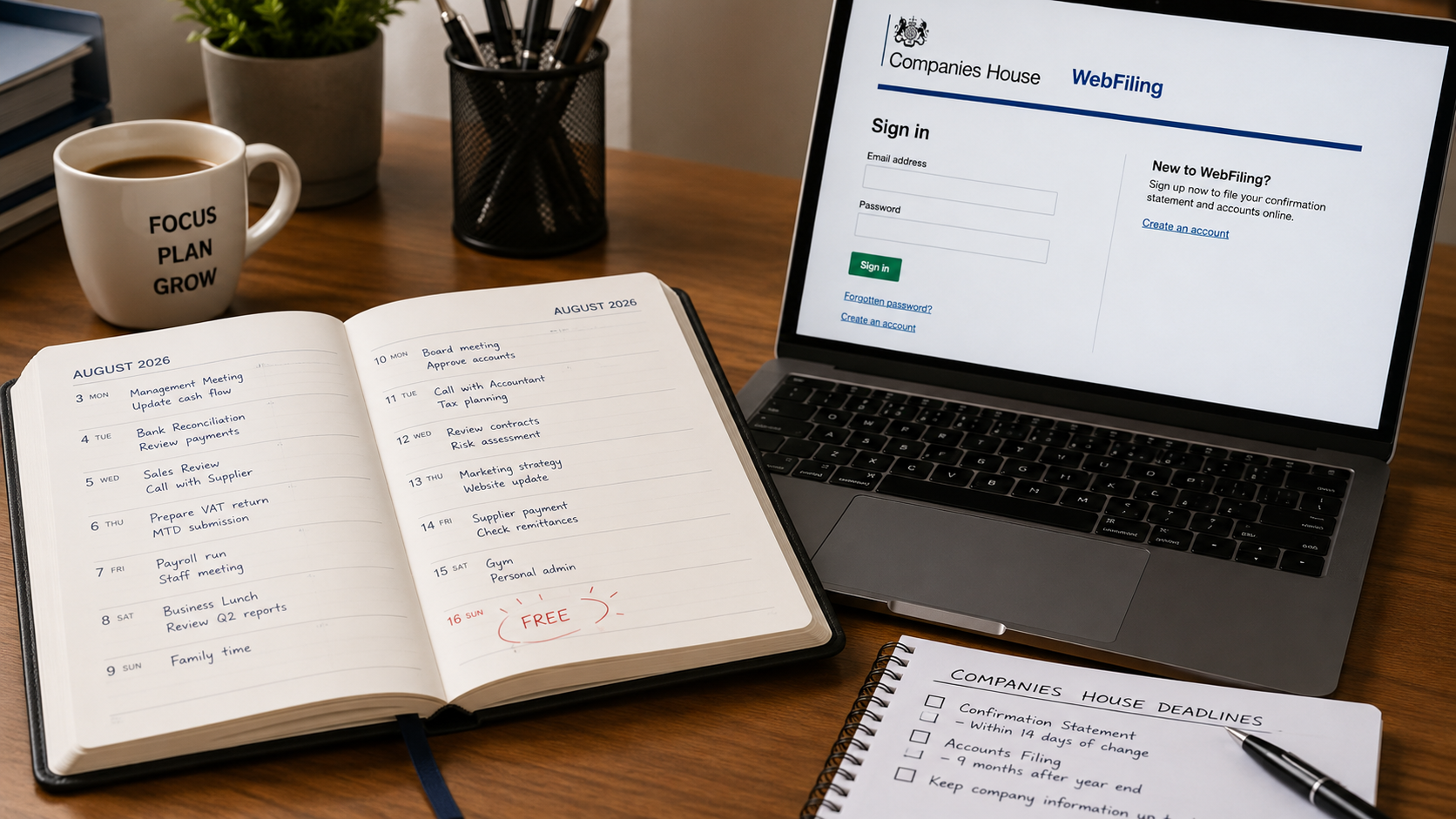
Somewhere on your calendar, quietly, there’s a date that could get your company struck off the register. Not your tax return. Not payroll. Your confirmation statement — the one filing almost every director forgets exists until Companies House emails a warning. It sounds bureaucratic, and honestly, it is. But it’s also one of the simplest, cheapest, least-forgivable things you can miss as a UK company director. Skip it long enough and Companies House can dissolve your business entirely, bank account and all.
So let’s take this apart properly. What a confirmation statement actually does, who has to file one, when it’s due, what it costs now that fees have gone up again, and what genuinely happens if you ignore the reminder emails (spoiler: nothing dramatic at first, then quite a lot).
So What Is a Confirmation Statement, Really?
Think of it less as a report and more as a snapshot. Once a year, every UK limited company and LLP has to confirm to Companies House that the information on the public register — directors, registered office, shareholders, people with significant control, SIC codes — is still accurate. Nothing changed? You still have to file. Dormant company doing precisely nothing? Still have to file. It’s confirmation, not disclosure of new activity, which trips people up constantly.
This replaced the old “annual return” back in 2016, and the change was more than cosmetic. The annual return asked you to restate everything from scratch each year. A confirmation statement just asks: is what we already hold still correct? If yes, tick the box. If something’s changed — a new director, updated shareholdings, a different SIC code — you report that separately (usually through a linked form) either before or alongside the statement itself.
One newer wrinkle worth flagging: since March 2024, companies must also confirm their intended future activities are lawful. It’s a single tickbox, but it’s now part of the standard confirmation statement process, so don’t be surprised when you see it.
Who Actually Has to File One
Every private limited company, every LLP and every public limited company. There’s no size exemption, no “we’re too small for this” clause, and dormant status doesn’t get you out of it either — dormant companies still file, they just usually have nothing to update. If you’ve registered a company with Companies House, a confirmation statement is coming for you, once every 12 months, forever, until the company is dissolved.
Sole traders and ordinary partnerships are the exception here, simply because they were never registered at Companies House in the first place. If you’re weighing up which structure suits your business, our beginner’s guide to accounting for small businesses in London covers what changes once you incorporate — this filing obligation being one of them.
The 12-Month Review Period (and Why It Isn’t a Fixed Date)
This is where people get genuinely confused, so slow down for a second. Your confirmation statement deadline doesn’t fall on a set calendar date like Self Assessment’s 31 January. It’s tied to your own company’s timeline.
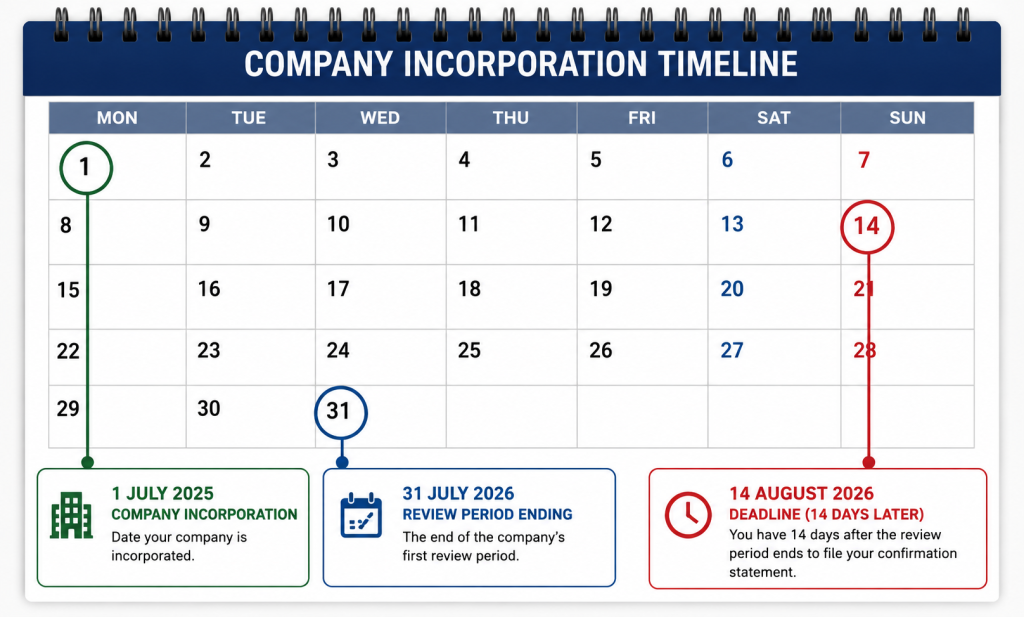
For a brand-new company, the review period begins on the day you incorporate and runs for 12 months. Once that ends, you have 14 days to file. For an existing company, the next review period simply starts the day after your last confirmation statement date, and runs another 12 months.
So a company incorporated on 1 March 2026 has a review period ending 28 February 2027, with the actual confirmation statement due by 14 March 2027. File early — say, after a big restructure — and you reset the clock; the next 12-month period starts running from that new date instead.
Quietly important tip: because the deadline moves every year, relying on memory is how directors end up overdue. Set a calendar reminder now, or sign up for Companies House’s free email alerts. It takes two minutes and it’s saved more than a few of our clients’ bacon.
What Actually Goes Into the Statement
Filing a confirmation statement means checking (and correcting where needed) several categories of information:
- Registered office address
- Directors and, where applicable, company secretary
- Statement of capital and shareholder information
- People with significant control (PSC register)
- SIC codes describing what the business actually does
- Registered email address
- The lawful-purpose statement mentioned earlier
From April 2026 onward, there’s an added identity-verification layer: directors need to have verified their identity with Companies House, and from your next confirmation statement you’ll typically need to provide a unique Companies House personal code as part of the process. This is part of a wider crackdown under the Economic Crime and Corporate Transparency Act, and it’s genuinely new territory for most small businesses — worth reading up on before your next filing window opens.
Filing Fees — And Yes, They’ve Gone Up Again
Here’s the bit that catches people off guard. From 1 February 2026, Companies House increased its fees across the board, and the confirmation statement wasn’t spared.
| Filing method | Fee before 1 Feb 2026 | Fee from 1 Feb 2026 |
|---|---|---|
| Online (WebFiling / software) | £34 | £50 |
| Paper (posted CS01 form) | £34 | £110 |
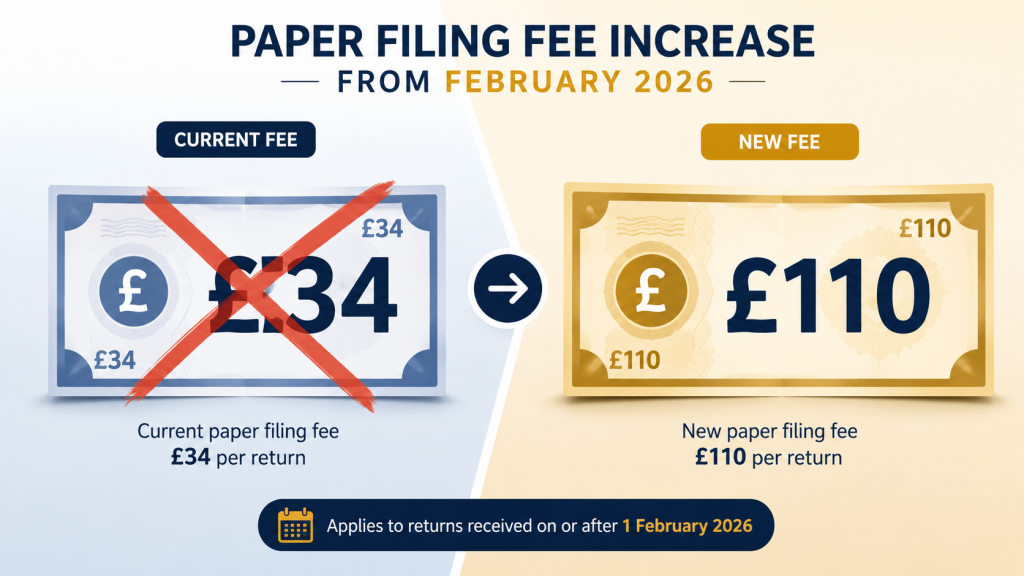
The good news, such as it is: the fee covers your entire 12-month payment period, not each individual filing. Update your details three times within that period and you only pay once. The bad news is that paper filing is now considerably more expensive than digital, which is Companies House’s not-so-subtle way of nudging everyone online.
Here’s a rougher table — the kind you might scribble on the back of an envelope when comparing what a first-year company actually spends on Companies House admin:
| Item | Cost | Notes |
|---|---|---|
| Digital incorporation | £100 | |
| Confirmation statement (online) | £50 | due 12 months later |
| Same-day incorporation (software) | £156 | optional, rarely needed |
| Voluntary strike-off | £13 online / £18 paper |
(A bit lopsided, admittedly — closing a company works out cheaper than opening one. There’s a lesson in there somewhere.)
When It’s Overdue: What Really Happens
There’s no automatic fine for a late confirmation statement — unlike, say, missing a Self Assessment deadline, where HMRC slaps on a penalty the next morning. That said, “no automatic fine” is not the same as “no consequences,” and this is where a lot of directors get complacent.
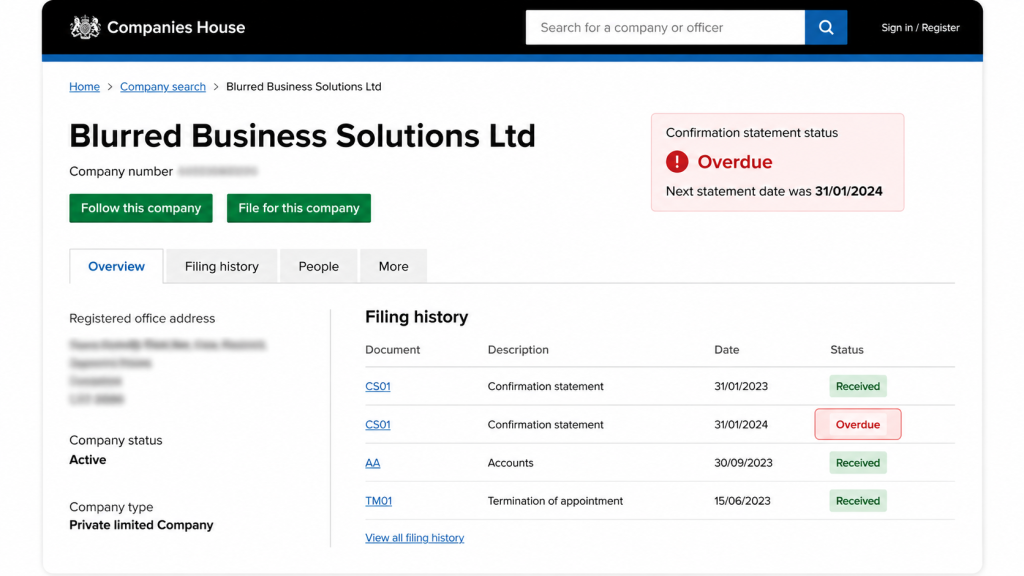
Miss the 14-day window and your company shows as overdue on the public register. Anyone — lenders, suppliers, a nosy competitor — can see it. It’s a small black mark, but a visible one, and it doesn’t exactly scream “well-run business” to anyone doing due diligence.
Ignore it further and Companies House assumes the company isn’t trading, and can begin compulsory strike-off proceedings. Continued non-compliance is a criminal offence, and directors can, in theory, be prosecuted or disqualified. Companies House has also gained new civil penalty powers under the Economic Crime and Corporate Transparency Act, so “there’s never been a fine before” is quickly becoming outdated advice. Nobody wants to find out the hard way that this year is the year that changes.
If your company’s confirmation statement has already lapsed, our guide on HMRC corporate tax return penalties covers the wider compliance picture — because a missed confirmation statement rarely travels alone; it’s often a symptom of admin falling behind more broadly.
Confirmation Statement vs Annual Accounts — Don’t Mix Them Up
This confuses new directors constantly, so it deserves its own section rather than a footnote. The confirmation statement and your annual accounts are entirely separate filings, with separate deadlines, separate fees, and separate consequences for lateness.
| Filing | Confirms | Deadline | Late filing penalty |
|---|---|---|---|
| Confirmation statement | Company structure, ownership, registered details | 14 days after review period ends | No automatic fine, but strike-off risk |
| Annual accounts | Company’s financial performance | 9 months after accounting reference date | Automatic escalating fine, starting at £150 |
If you’re juggling both deadlines alongside VAT, payroll and Self Assessment, it might genuinely be worth reading our piece on corporate tax return deadlines — seeing them laid out together tends to be the moment people finally set up a proper compliance calendar instead of relying on memory.
How Much Should You Actually Pay Someone to Handle This?
Plenty of directors file their own confirmation statement — it genuinely takes ten or fifteen minutes through Companies House WebFiling if your details haven’t changed. Where it gets fiddlier is when shareholdings have shifted, a director’s left, or the PSC register needs updating alongside the statement. That’s less “tick a box” and more “understand company law well enough not to file something incorrect,” which, frankly, is where a lot of small businesses quietly get it wrong without realising.
If you’d rather have someone else own the deadline entirely, this sits comfortably within company secretarial work — one of the services we handle at Ask Accountants UK Ltd, alongside bookkeeping, accounts and tax, and cloud accounting more broadly. It’s not glamorous work, admittedly, but forgetting it is expensive in ways that glamour never quite offsets. For a sense of what accountants typically charge for this kind of ongoing admin, our breakdown of the cost of an accountant for a limited company is worth a look before you decide whether to DIY it.
A Few Ways Directors Trip Themselves Up
- Assuming “nothing changed” means “nothing to file.” It doesn’t. You still confirm, every year, even with zero updates.
- Confusing the confirmation statement with updating company details. You can’t use the CS01 form to change your registered office or appoint a director — those go through separate forms first, then get reflected in the statement.
- Filing early “just to be safe” without realising it resets the clock. Sometimes that’s fine. Sometimes it means your next deadline creeps up faster than expected.
- Losing the authentication code. No code, no online filing, and requesting a replacement by post takes time you may not have if the deadline’s close.
Quick FAQ on Filing Your Confirmation Statement
Do dormant companies need to file a confirmation statement? Yes. Dormant or non-trading status doesn’t exempt a company from filing. It just usually means there’s nothing new to report.
How often do I need to file a confirmation statement? At least once every 12 months. There’s no limit on filing more often within a payment period if your details change frequently.
What’s the current confirmation statement fee? £50 online or £110 by post, effective from 1 February 2026.
Can I file a confirmation statement myself? Yes, through Companies House WebFiling or the newer online filing service, provided you have your authentication code.
What happens if I never file at all? Companies House can begin compulsory strike-off proceedings, and directors risk prosecution in persistent cases.
Is the confirmation statement the same as an annual return? No — the annual return was replaced by the confirmation statement in 2016. The confirmation statement is generally simpler and faster to complete.
None of this is complicated, really. It’s just easy to forget, precisely because nothing dramatic happens the first week you’re late. That gap between “technically overdue” and “actually a problem” is exactly where confirmation statements slip through the cracks — right up until they don’t. If your company’s confirmation statement date is coming up, or you’re honestly not sure when it’s due, checking your entry on the Companies House public register takes two minutes and settles the question outright. And if you’d rather it simply be handled — filed correctly, on time, without you having to remember — that’s precisely the sort of thing we do at Ask Accountants UK Ltd, 178 Merton High St, London SW19 1AY, 020 8543 1991.