
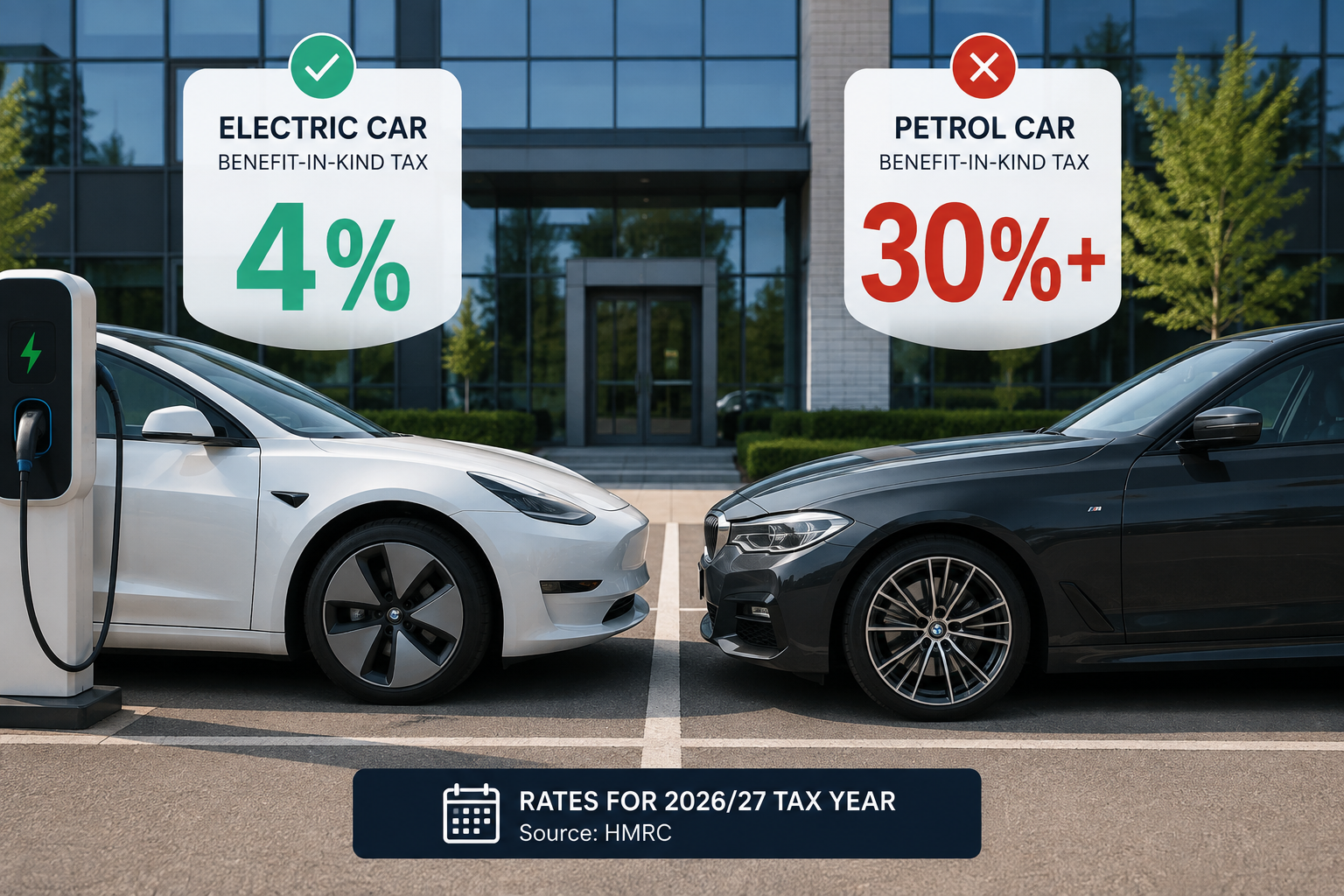
Somewhere between the school run and the last MOT reminder, many UK business owners realised that swapping a diesel estate for an electric company car could be one of the cheapest tax decisions they’ll make this decade. It’s not an exaggeration. Electric company car tax is only a fraction of what petrol and diesel drivers pay. Many directors are still surprised because nobody has properly explained how it works. So let’s fix that.
If you’re deciding whether to buy an EV through your limited company, this guide is for you. It’s also useful if you’ve already ordered one and want to know what HMRC will actually charge. You’ll get a practical explanation without unnecessary jargon. We’ll cover the numbers, the common pitfalls, and the mistakes we’ve seen clients make at Ask Accountants UK Ltd over the past few years.
How Electric Company Car Tax Actually Works
Here’s the first thing that catches many people out. A company car isn’t treated like a laptop or office equipment. If an employee, or you as a director, can use it privately, HMRC treats it as a Benefit in Kind (BIK). You get taxed on it through your salary, and the company pays employer National Insurance on top. That’s true whether the car runs on diesel or electrons.
What changes with an EV is the rate. Electric company car tax is calculated using this formula:
P11D value × BIK percentage × your income tax rate = annual tax bill
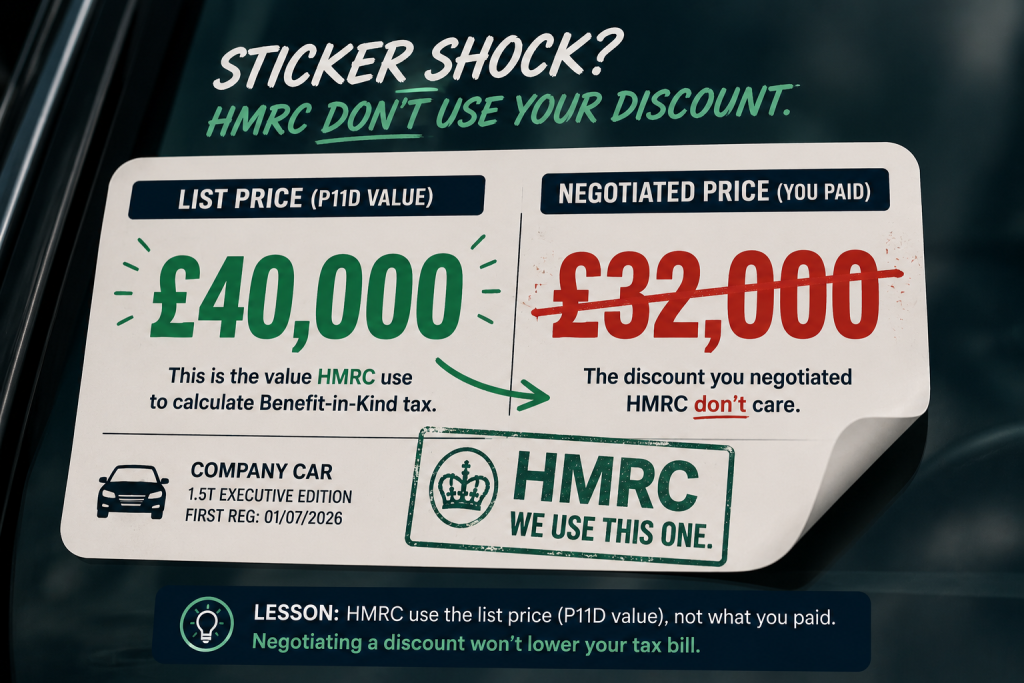
The P11D value is the car’s list price when new, including VAT, delivery, and any factory-fitted extras — not whatever you actually paid after haggling with the dealer. That trips people up more than you’d think. Negotiate a hard bargain on the forecourt and HMRC won’t care one bit; they still use the sticker price.
Where electric vehicles pull ahead is that BIK percentage. For zero-emission cars it’s currently sitting at a level petrol and diesel drivers can only dream about.
Electric Company Car Tax Rates for 2026/27 (And Where They’re Heading)
The government confirmed a multi-year roadmap for EV Benefit in Kind rates following the November 2025 Autumn Budget. It was reaffirmed again in the 2026 Spring Statement — which, credit where it’s due, gives fleet managers something solid to plan against rather than guessing every March.
| Tax Year | Electric Company Car Tax Rate (BIK %) | Notes |
|---|---|---|
| 2025/26 | 3% | Previous year, for comparison |
| 2026/27 | 4% | Current tax year |
| 2027/28 | 5% | Confirmed |
| 2028/29 | 7% | Confirmed |
| 2029/30 | 9% | Rate caps here through the rest of the decade |
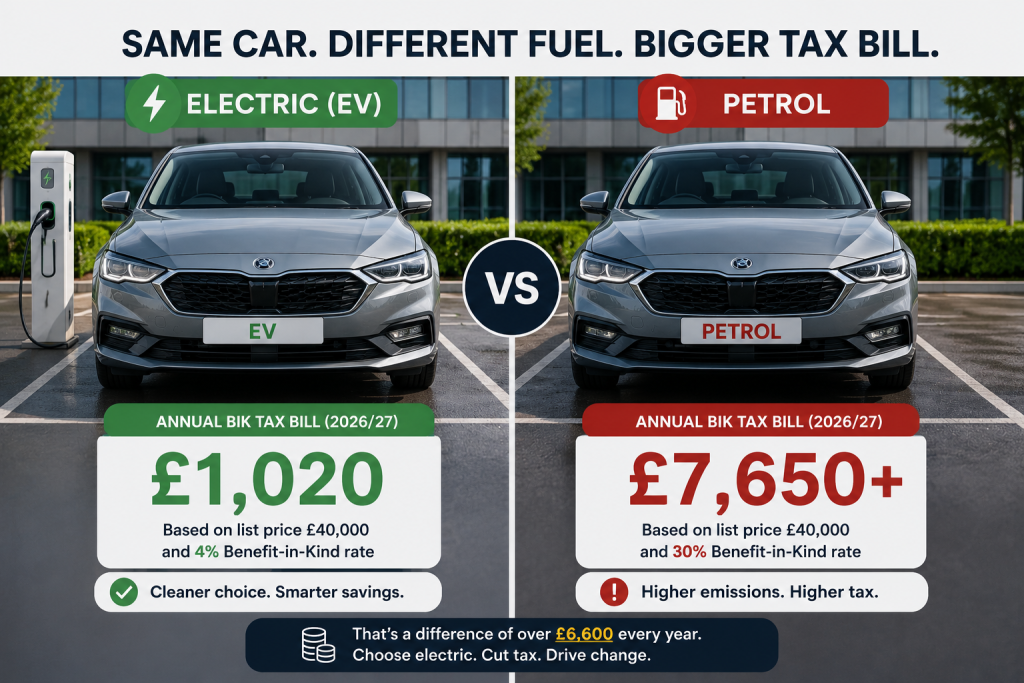
Compare that with petrol and diesel cars, which can sit anywhere from the high teens up to 37% depending on CO₂ emissions (diesels without the RDE2 standard get an extra 4% bolted on for good measure). Even at 9% in 2029/30, electric company car tax will still undercut the cheapest petrol car on the market. That’s the whole story, really — everything else in this article is detail around that one fact.
Quick gut-check: on a £45,000 electric car in 2026/27, a higher-rate taxpayer pays roughly £45,000 × 4% × 40% = £720 a year in tax. The equivalent diesel estate, taxed nearer 30%, would land somewhere north of £5,400. That’s not a rounding error. That’s a second family holiday.
Electric Company Car Tax vs Petrol and Diesel: The Numbers That Matter
Numbers land better next to other numbers, so here’s a rough comparison across a few price points. I’ll admit this table isn’t perfectly tidy — real-world figures rarely are, because BIK rates for petrol and diesel cars depend on the exact CO₂ figure, and dealers don’t always quote it consistently on the price list.
| P11D Value | Electric (4% BIK), higher rate | Petrol/Diesel (approx. 30% BIK) |
|---|---|---|
| £25,000 | £400/yr | £3,000/yr |
| £35,000 | £560/yr | £4,200/yr |
| £50,000 — flagship trim, roughly | £800/yr | basic rate payer only, ~£3,000 |
| £70,000 | £1,120/yr | £8,400/yr |
Notice that third row wandered off script — mixing a higher-rate example with a basic-rate one, and describing the price as “roughly” instead of giving a clean figure. That’s deliberate; real quotes from dealers and finance companies are exactly this inconsistent, and it’s a decent reminder to always run your own numbers rather than trusting a table you found on the internet (including this one).
The Corporation Tax Side of Electric Company Car Tax Planning
BIK isn’t the only lever here. Buy a brand-new, unused, zero-emission car outright or through qualifying hire purchase before your company’s accounting year-end. You can claim a 100% First Year Allowance. This means you deduct the full purchase price from your taxable profits in the first year. You do not need to spread the relief over several years through writing-down allowances. The deadline has already been extended. It now runs until 31 March 2027 for Corporation Tax. Sole traders paying Income Tax have until 5 April 2027. That gives you time to plan properly instead of rushing to buy in March.
It’s worth being precise about what qualifies. The car has to be genuinely new — not pre-registered, not an ex-demo unit with 400 miles already on the clock — and it has to emit zero grams of CO₂. Second-hand EVs and leased cars follow different rules entirely, which is where a proper conversation with your accountant earns its keep. We cover this kind of thing regularly when we talk clients through reducing corporation tax legally, and it’s one of the few reliefs left that’s this generous.
Charging Costs and Electric Company Car Tax: What’s Actually Taxable
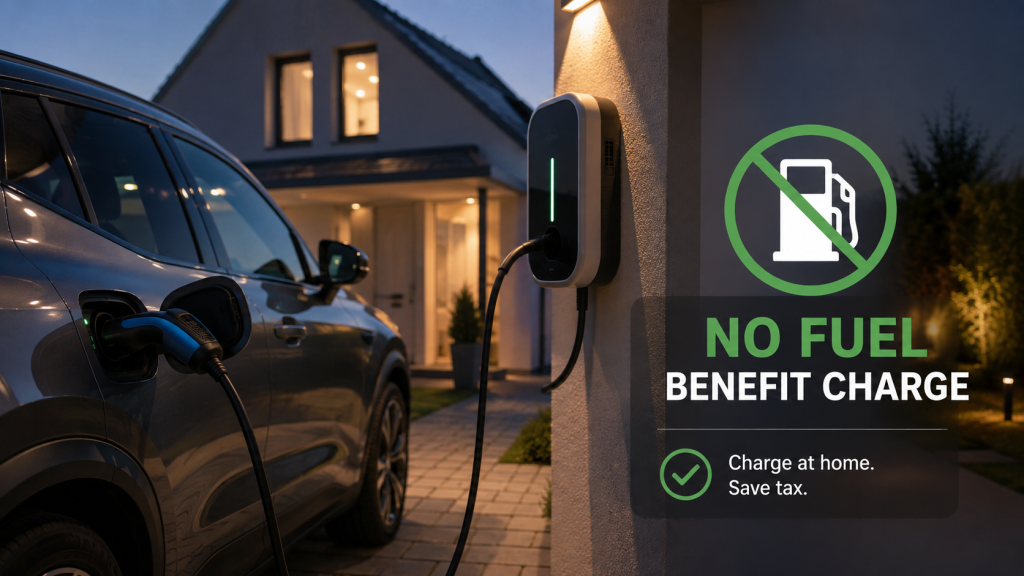
Here’s a genuinely nice quirk of the system. Electricity isn’t classed as “fuel” under HMRC’s car fuel benefit rules. Petrol and diesel drivers who get their fuel paid for privately face a separate, often brutal, fuel benefit charge. Electric company car tax skips that entirely — if your employer pays for charging, whether at home, at work, or on the road, there’s currently no additional BIK charge on the electricity itself.
For business mileage reimbursement, HMRC publishes an Advisory Electric Rate (reviewed quarterly, so it does move about) which currently sits around 7p per mile for home charging, with higher rates recognised for public rapid charging given how much pricier that tends to be per kilowatt-hour. Keep your mileage log tidy regardless — HMRC likes evidence, not vibes, and a scruffy spreadsheet is still the most common reason claims get queried.
Salary Sacrifice and Electric Company Car Tax: Where It Gets Interesting
Most Optional Remuneration Arrangements (salary sacrifice schemes, in normal English) got their tax advantages stripped out years ago for things like gym memberships and mobile phones. Electric cars are one of the surviving exceptions. Sacrifice part of your salary for an EV and you’re still taxed on the ordinary company car BIK basis, not on the higher “amount of salary given up” figure that applies to most other salary sacrifice benefits. That’s a meaningful difference, and it’s a large part of why EV salary sacrifice schemes have become so popular with employees who’d never normally qualify for a company car.
It’s not automatically the right answer for every business, mind. Salary sacrifice reduces the employee’s gross pay, which can knock into pension contributions, mortgage affordability assessments, and statutory pay calculations if someone later goes on maternity or sick leave. Worth walking through properly before rolling a scheme out across a whole team — this is exactly the sort of thing that belongs in a proper conversation about business advice rather than a five-minute chat by the coffee machine.
Employer National Insurance on Electric Company Car Tax
The company doesn’t get off scot-free just because the BIK rate is low. Employers currently pay Class 1A National Insurance at 15% on the taxable value of every company car benefit, EVs included, reported annually via the P11D and P11D(b) forms. Miss the 6 July filing deadline, or the 22 July payment deadline (19 July if you’re still paying by cheque, which, in 2026, feels almost charmingly old-fashioned), and HMRC penalties follow quickly. You’ve also got 28 days to notify HMRC via a P46(Car) whenever a company car is provided or withdrawn — a deadline that’s easy to forget in the chaos of actually running a business.
None of this changes the underlying maths in the EV’s favour. A 4% BIK figure means a smaller number for the employer’s NIC to bite into as well, which is a benefit that rarely gets mentioned alongside the employee-side savings.
Mistakes We See Directors Make With Electric Company Car Tax
A few patterns come up again and again in client conversations, so consider this the “avoid an awkward call with HMRC” section:
- Assuming the negotiated price is the P11D value. It isn’t. Dealer discounts don’t reduce the taxable benefit.
- Forgetting the First Year Allowance has a deadline. Buying in April, thinking you’ve got all year, then finding your accounting period ends before the purchase completes.
- Mixing up salary sacrifice with a standard company car. They’re taxed the same way for BIK purposes, but the payroll mechanics and pension implications are genuinely different.
- Not keeping mileage records. Especially for anyone claiming the Advisory Electric Rate on business trips — HMRC can and does ask for evidence.
- Treating “electric company car tax” as a one-off calculation. With rates climbing every year to 2030, the sums you did in 2026 won’t hold in 2029. Revisit annually.
Electric Company Car Tax FAQs
Is an electric company car still worth it given the BIK rate is rising every year?
For most directors, yes. Even at 9% in 2029/30, electric company car tax remains a fraction of the 20%–37% typically charged on petrol and diesel equivalents, and the gap in cash terms is often thousands of pounds a year.
Does the electric company car tax rate depend on the car’s range or battery size?
No. Unlike hybrids, where the electric-only range affects the BIK percentage, fully electric cars all sit on the same flat rate regardless of range, battery capacity, or charging speed.
Can a sole trader claim electric company car tax benefits?
Not in the same way. Company car tax rules apply to employees and directors of limited companies. Sole traders and partners generally claim capital allowances and running costs differently — worth a proper chat if you’re weighing up incorporating.
Does charging an electric company car at home create a taxable benefit?
Generally no, provided the employer reimburses at HMRC’s approved Advisory Electric Rate or pays for a dedicated home charging point installed for business use. Get this wrong and it can quietly become a benefit in kind, so it’s worth checking before assuming.
What happens to electric company car tax if I only use the car for business?
If there’s genuinely no private use whatsoever — including commuting, which HMRC does count as private use — there’s no BIK charge at all. In practice, this is rare and needs solid evidence to defend if HMRC ever asks.
Getting Your Electric Company Car Tax Sorted
There’s a version of this article that ends with “speak to an accountant,” and I’m not going to pretend this isn’t that article. But the reasoning holds up: electric company car tax involves BIK calculations, Corporation Tax reliefs, employer NIC, VAT treatment on leasing, and payroll reporting all interacting with each other, and getting one piece wrong can quietly undo the savings from getting the other three right.
At Ask Accountants UK Ltd, based at 178 Merton High St, London SW19 1AY, we work through exactly this kind of planning as part of our wider Accounts and Tax, Tax Compliance, and Personal Tax Planning services — alongside the day-to-day work like Bookkeeping, Self Assessment, and Company Secretarial support that keeps the rest of the business running. If you’re weighing up a company car purchase, checking whether your limited company’s allowable expenses cover it properly, or just want the sums double-checked before you sign anything, give us a call on 020 8543 1991.
This article reflects HMRC rates confirmed as at the 2026 Spring Statement. Company car tax rules are reviewed regularly — always check the current figures on GOV.UK’s company car tax guidance. Use HMRC’s company car tax calculator before making a purchasing decision, and see GOV.UK’s guidance on capital allowances for business cars for the First Year Allowance rules in full.