Right, let’s start with the bit nobody tells you at networking events: most small business owners in the UK are quietly overpaying tax. Not through fraud, not through some HMRC conspiracy — just through not knowing what tax relief they’re entitled to claim. It’s the financial equivalent of leaving a fiver on the pavement and walking past it because you didn’t look down.
This article is about the tax relief options that actually apply to ordinary small businesses — the plumber with two vans, the design agency with five staff, the café that’s finally turning a profit. Not the offshore stuff you read about in the financial pages. The everyday reliefs that get missed because nobody has time to read HMRC’s guidance between invoices.
The Equipment Trick Everyone’s Heard Of But Nobody Uses Properly
Start with the Annual Investment Allowance, because it’s the one most owners half-remember from somewhere. AIA lets a business deduct the full cost of qualifying plant and machinery — up to £1 million a year — straight from taxable profits in the year it’s bought. Not spread over five years. All at once.
New laptops, tools, machinery, even certain vans: these can usually be claimed in full. Cars are excluded, which trips people up constantly (ask your accountant before you buy the car through the company and assume it qualifies — it probably won’t).

Here’s the catch that gets missed: timing. Buy the equipment two days before your year-end and the full deduction lands in this year’s accounts. Buy it two days after, and you’re waiting twelve months for the benefit. This kind of tax relief rewards businesses that plan purchases rather than making them on impulse in January.
Payroll’s Best-Kept Secret
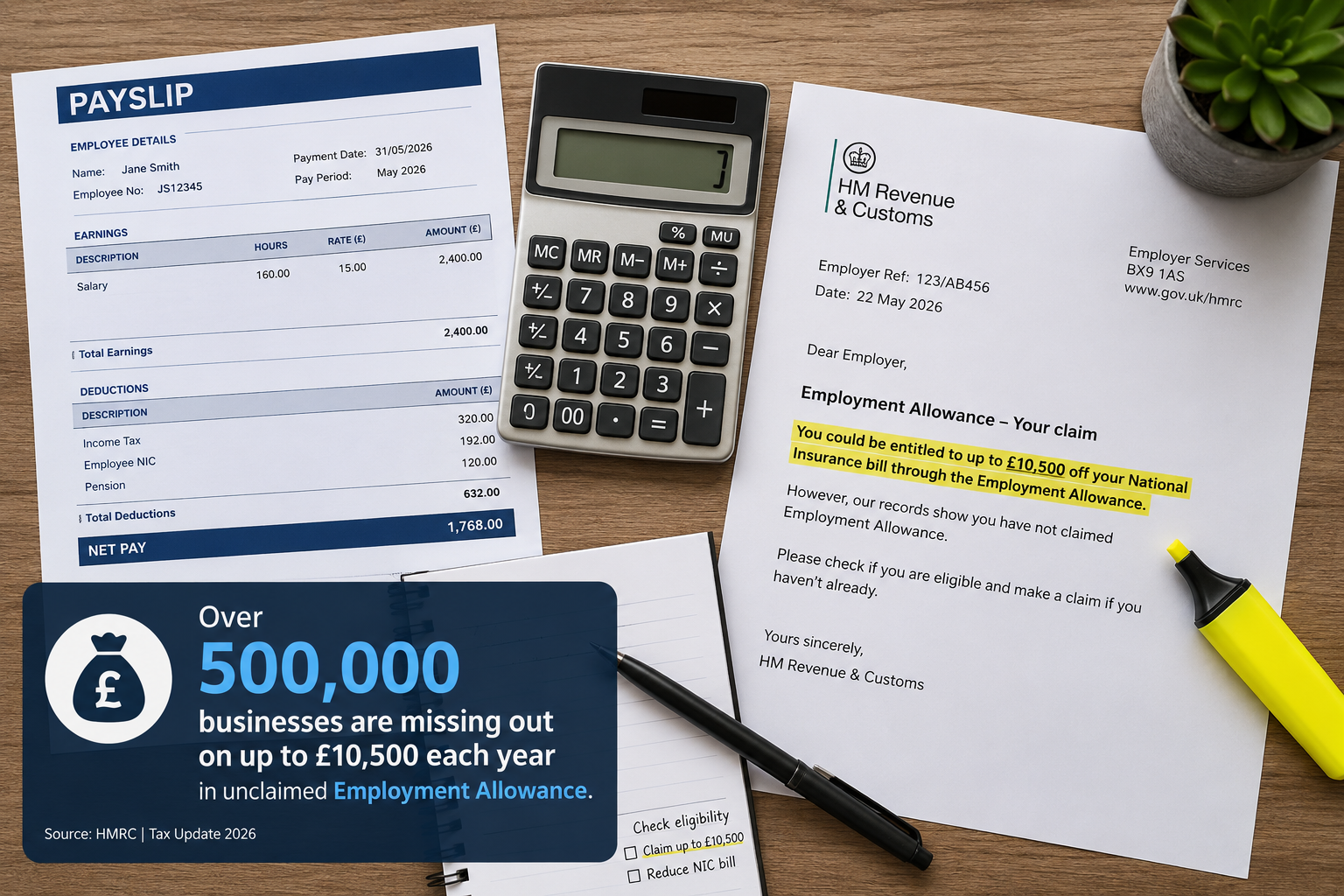
If a business employs staff, there’s a decent chance it’s sitting on unclaimed relief right now. The Employment Allowance lets eligible employers reduce their employer National Insurance bill by up to £10,500 a year. It has to be claimed — it isn’t automatic — through an Employer Payment Summary submission each tax year.
One rule catches out small companies constantly: a business with a single director and no other employee earning above the secondary threshold cannot claim it. Bring on a second employee, though, and the picture changes considerably. For a business running five or six staff, this single piece of tax relief can wipe out most of the employer NI bill for months.
I’ve genuinely lost count of the number of times I’ve reviewed a small business’s payroll and found this box unticked. It’s not glamorous. It’s also worth thousands.
When Losses Aren’t Entirely Bad News
Nobody sets out to make a loss. But if a business does, that loss doesn’t have to just sit there gathering dust in the accounts. Trading losses can often be carried back against profits from the previous year, generating a genuine cash refund from HMRC — which, for a business going through a rough patch, can matter enormously.
Losses can also be carried forward against future profits, reducing the tax bill in better years ahead. The relief exists precisely because tax should reflect a business’s overall journey, not just a single snapshot in time. It’s one of those bits of tax relief that’s rarely mentioned until an accountant brings it up, usually right when a client needs the good news most.
Research, Development, and the Word Nobody Thinks Applies to Them
“R&D relief? We’re not scientists.” That’s the most common objection, and it’s usually wrong. R&D tax relief isn’t reserved for people in lab coats. A business developing new software, improving a manufacturing process, or solving a technical problem that wasn’t obvious from the start may well qualify.
The relief works by increasing the amount of qualifying R&D spend that can be deducted from profits, sometimes generating a payable credit for loss-making companies. Rules have tightened considerably in recent years — HMRC scrutiny of R&D claims has increased sharply — so this is one area where a proper assessment matters more than a punt.
A Snapshot of the Main Reliefs
Here’s a table pulling the key options together — useful for a quick comparison before diving deeper into any single one.
| Relief | Who it’s for | What it does | Typical value |
|---|---|---|---|
| Annual Investment Allowance | Businesses buying equipment or machinery | 100% deduction on qualifying spend up to £1m | Up to £1,000,000/year |
| Employment Allowance | Employers with staff beyond a sole director | Reduces employer National Insurance | Up to £10,500/year |
| Trading Loss Relief | Businesses with a loss-making period | Carry back or forward against profits | Varies by profit history |
| R&D Tax Relief | Companies solving genuine technical problems | Extra deduction or payable credit | Varies, often significant |
| Small Business Rate Relief | Businesses with lower rateable value premises | Reduction or removal of business rates | Up to 100% reduction |
Rates, Rebates, and the Premises Nobody Talks About
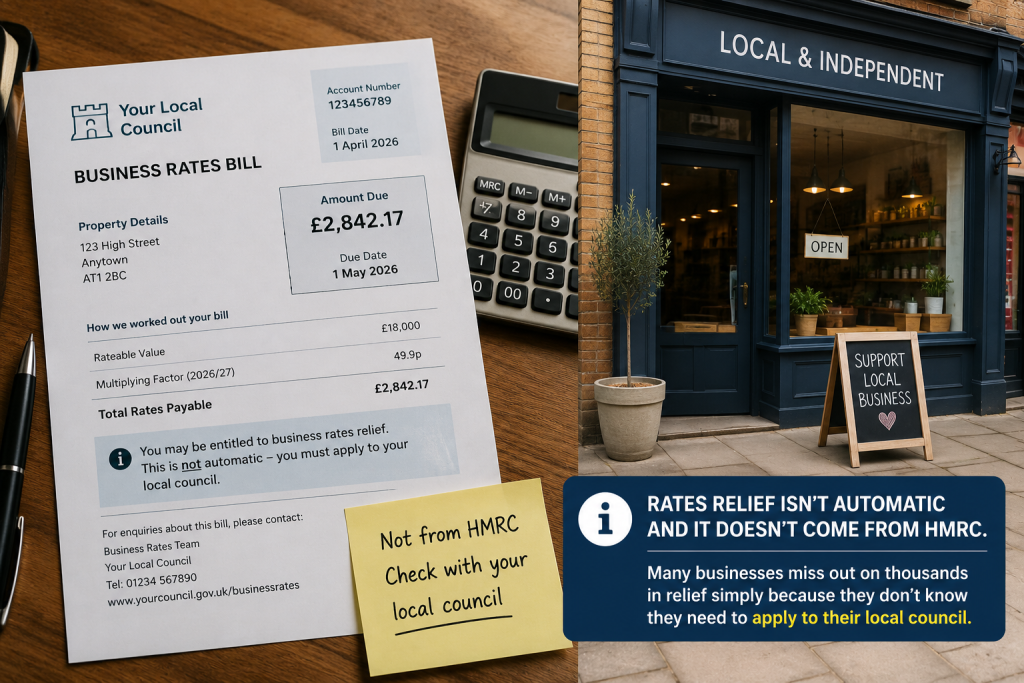
Business rates rarely get the attention they deserve, largely because they arrive as a council bill rather than an HMRC one — which means they don’t always feel like “tax.” But Small Business Rate Relief can significantly reduce or even eliminate the bill for businesses occupying smaller premises, depending on rateable value. It’s tax relief hiding in plain sight, and plenty of eligible businesses never apply because the paperwork sits with the local authority rather than HMRC.
CIS, Construction, and the Refunds That Pile Up
For anyone working under the Construction Industry Scheme, overpayment is practically baked into the system. Contractors deduct tax at source before subcontractors even see the money, which frequently means too much has been paid across the year. A properly prepared CIS deduction refund claim can return a meaningful sum, and it’s one of the more predictable forms of relief going — assuming the paperwork is filed correctly and on time.
More broadly, HMRC does hold overpaid tax for plenty of small businesses that simply haven’t got round to reclaiming it. If that sounds familiar, it’s worth reading through how SMEs recover overpaid tax from HMRC before assuming nothing’s owed.
Getting the Timing Right (Because Deadlines Wreck More Claims Than Ignorance Does)
Here’s an uncomfortable truth: a decent number of businesses that do know about a relief still miss it, simply because the claim window closed. Corporation Tax deadlines, in particular, catch people out — amendments to a return generally need to be made within twelve months of the filing deadline, and after that, the door mostly shuts.
| Relief type | Rough claim window |
| AIA / Capital Allowances | Within the relevant accounting period return |
| Employment Allowance | Claimed annually via payroll — must be re-claimed each tax year |
| CIS refunds | Generally after tax year end, backdatable a few years |
| R&D Relief | Usually within two years of the accounting period end |
(Yes, that second table is a bit rough round the edges — deliberately so. Real deadlines have exceptions, overlaps and edge cases that never fit neatly into a grid, and pretending otherwise does small business owners a disservice.)
For a fuller picture of the dates that matter, our guide to Corporation Tax return deadlines walks through the specifics, and the official position is always worth checking directly on GOV.UK’s Corporation Tax rates page.
Pensions, Directors, and a Relief That’s Easy to Forget
Employer pension contributions made on behalf of directors and staff are usually treated as a deductible business expense, reducing Corporation Tax while building retirement savings at the same time. It’s not flashy tax relief. It’s dependable, though, and for owner-managed companies it’s one of the more tax-efficient ways to extract value from the business without triggering higher personal tax bills.
Where Cloud Accounting Actually Helps With This Stuff
None of the reliefs above get claimed automatically — someone has to spot them, and spotting them usually depends on clean, current records. This is where cloud accounting earns its keep: real-time figures make it far easier to flag a capital purchase before year-end, or notice an employer NI bill that could be offset.
For businesses juggling automatic enrolment, pension compliance sits in a similar category — a legal obligation that, handled properly, opens the door to further relief and fewer HMRC headaches.
A Word on HMRC Scrutiny
Claiming tax relief isn’t about pushing the boundaries. HMRC has ramped up compliance checks across several relief categories in recent years, and businesses that overclaim — even accidentally — can face repayment demands, interest, and in some cases penalties. If a claim ever gets questioned, it helps enormously to have supporting evidence ready; our note on HMRC tax investigations covers what that process tends to look like.
The safest approach, frankly, is claiming everything a business is genuinely owed — no more, no less — and keeping the paperwork to prove it.
Frequently Asked Questions About Tax Relief
What is the easiest tax relief for a small business to claim? The Employment Allowance tends to be the simplest, provided a business has at least one employee beyond a sole director. It’s claimed through standard payroll software with no separate application process.
Can a small business claim more than one type of tax relief at once? Yes. Most reliefs are independent of one another. A business could, for example, claim AIA on new equipment, the Employment Allowance on payroll, and R&D relief on a development project, all within the same accounting period.
How far back can tax relief be backdated? It varies by relief. CIS refunds and some overpayment claims can often be backdated a few years; R&D claims are typically limited to two years from the end of the relevant accounting period. Checking specific time limits before assuming eligibility is essential.
Does every business need an accountant to claim tax relief? Not strictly, but most reliefs involve conditions that aren’t obvious from the legislation alone. A misjudged claim can trigger HMRC enquiries, so professional guidance is usually the cheaper option in the long run.
The Practical Bit
None of this is complicated once someone’s actually looked at the numbers — the trouble is finding the time to look. Ask Accountants UK Ltd, based at 178 Merton High St, London SW19 1AY, works through exactly this kind of review with clients regularly: accounts and tax, bookkeeping, CIS claims and refunds, HMRC investigations support, and general business advice, among other things. If a review of what’s currently being missed sounds useful, a call to 020 8543 1991 is a reasonable place to start.
Tax relief only helps the businesses that actually claim it. The rest just sits with HMRC, unclaimed, indefinitely.