
Summarize this blog post with: ChatGPT | Perplexity | Claude | Grok
Most consultants are focused on winning clients, delivering projects, and getting paid—not on spending hours managing accounting records. But without a reliable accounting system, it can be difficult to know how profitable your consultancy really is or how much tax you may owe. This guide explains how accounting for consultants works in the UK, which expenses to track, what tax obligations to consider, and how to build a simple system that keeps your finances under control.
Key Takeaways
- Consultant accounting covers bookkeeping, income, expenses, tax, invoicing, VAT, cash flow, and financial compliance for consulting businesses.
- Accurate bookkeeping helps consultants understand profitability, manage cash flow, prepare for tax bills, and maintain reliable financial records.
- Consultant expenses can include eligible professional fees, software, insurance, equipment, office costs, travel, and other legitimate business costs, subject to the applicable tax rules.
- Business structure affects accounting requirements, with sole traders and limited companies having different tax, reporting, and record-keeping responsibilities.
- Cloud accounting software can simplify invoicing, expense tracking, bank reconciliation, financial reporting, and record management.
- Regular tax planning helps consultants avoid unexpected liabilities by monitoring income, expenses, VAT obligations, and upcoming payments.
- Professional accounting support can help consultants stay compliant, improve financial visibility, and make informed decisions as their consultancy grows.
What Is Accounting for Consultants?
Accounting for consultants is the process of recording, organising, and managing a consultancy’s income, expenses, taxes, financial records, and reporting requirements. Consultant accounting combines bookkeeping, tax accounting, invoicing, VAT management, financial reporting, and cash-flow planning around the way a professional services business operates.
For example, an IT consultant might issue five client invoices in a month, pay for software subscriptions, professional indemnity insurance, travel, and an accountant, then need to calculate the profit available for tax.
Moreover, consultant accounting differs from simply keeping receipts in a folder because consultants need to understand both compliance and commercial performance. For more detail on the basics, bookkeeping for small businesses.
A reliable consultant accounting system combines regular bookkeeping, accurate invoicing, expense tracking, bank reconciliation, tax planning, and timely compliance. This approach gives you a clearer picture of what your consultancy earns, spends, owes, and retains.
What Accounting Records Should a Consultant Keep?
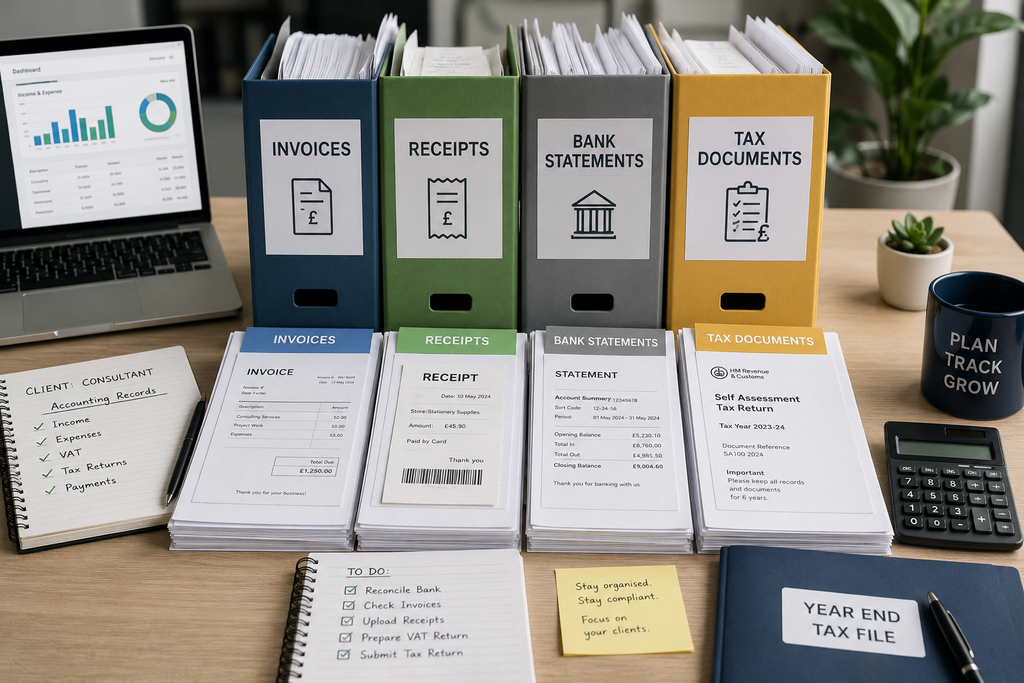
Consultants should keep accurate records of business income and eligible expenses and retain appropriate evidence to support their tax reporting. HMRC says self-employed people need records covering sales and income, business expenses, VAT records where applicable, PAYE records where they employ people, and relevant personal income.
For example, your records could include client invoices, bank statements, receipts, software bills, insurance documents, mileage records, and accounting reports.
Furthermore, self-employed consultants generally need to retain business records for at least five years after the relevant 31 January Self Assessment deadline.
Why Is Accounting Important for Consultants?
Good accounting helps consultants track profitability, manage cash flow, prepare for tax liabilities, and make informed business decisions. Accurate financial records turn individual invoices and expenses into useful information about the health of your consultancy.
For example, a consultant generating £8,000 of monthly revenue may initially think the business is highly profitable, but £2,000 of subcontractor costs, £500 of software and insurance, and other expenses can materially change the actual margin.
Moreover, accurate accounting helps you identify unpaid invoices before they become cash-flow problems. It also helps you forecast upcoming tax payments instead of treating a large tax bill as an unexpected expense.
At the same time, good records make tax reporting easier because your income and expenses are already organised. Consultants can then spend less time reconstructing transactions at year-end and more time running their businesses.
Accounting is not simply a compliance task; it is a financial management system for your consultancy.
How Does Accounting for Consultants Work?
Accounting for consultants works by establishing a consistent system for business structure, bookkeeping, income, expenses, bank reconciliation, VAT, tax reserves, filings, and financial reviews. The objective is to record transactions accurately throughout the year rather than fix everything at year-end.
1. Choose and Understand Your Business Structure
Your business structure determines many of your accounting and tax responsibilities. A consultant can commonly operate as a sole trader or through a limited company, although the right structure depends on individual circumstances.
For example, a sole trader generally reports business profits through Self Assessment, while a limited company has separate company accounts and Corporation Tax obligations.
The accounting requirements for a consultant depend largely on the business structure, with sole traders and limited companies having different tax and reporting responsibilities.
2. Separate Business and Personal Finances
Separating business and personal finances makes consultant bookkeeping easier and creates a clearer audit trail. A dedicated business bank account can help you identify client receipts, supplier payments, subscriptions, and other business transactions.
For example, paying a £60 professional software subscription from a dedicated business account makes the transaction easier to identify than finding it among dozens of personal purchases.
Moreover, separating transactions can reduce bookkeeping errors and make monthly reconciliation faster.
3. Record Income and Client Invoices
Consultant income should be recorded consistently whenever you raise invoices or receive payments, depending on the accounting method and circumstances. A good invoicing process records the client, invoice number, date, service, amount, VAT where applicable, payment terms, and payment status.
For example, if you issue a £5,000 consulting invoice with 30-day payment terms, your system should make it easy to see whether that £5,000 has been paid.
Unpaid invoices are especially important for consultants because professional services often involve project-based or milestone billing. Monitoring receivables helps you forecast when cash will actually enter the business.
4. Track Expenses and Keep Evidence
Consultants should record legitimate business expenses and retain supporting evidence. HMRC requires self-employed taxpayers to keep records that allow them to calculate profits and demonstrate figures if requested.
For example, a consultant might record a business software subscription alongside its invoice or receipt and the date it was purchased.
5. Reconcile Your Bank Transactions
Bank reconciliation means comparing accounting records against actual bank transactions to identify missing, duplicated, or incorrectly recorded entries. Monthly reconciliation is usually much easier than trying to correct an entire year’s transactions at once.
For example, a monthly review might identify a client payment that was received but incorrectly left as an unpaid invoice.
6. Monitor VAT Obligations
VAT obligations should be monitored continuously because registration can depend on taxable turnover and other circumstances. UK businesses generally must register for VAT when taxable turnover exceeds £90,000 over the previous 12 months, or when they expect it to exceed £90,000 in the next 30 days.
7. Set Aside Money for Tax
A tax reserve is money deliberately held back to meet future tax liabilities. Consultants with irregular income should treat tax saving as part of cash-flow management rather than waiting until a bill arrives.
For example, if a profitable quarter produces substantially more income than the previous quarter, increasing your tax reserve can prevent the higher liability from creating a cash shortage later.
8. Complete Required Filings
Required filings depend on whether you are a sole trader, limited company, employer, VAT-registered business, or another type of entity. Online Self Assessment returns for the 2025/26 tax year are due by 31 January 2027, with tax payments generally due by the same date.
For limited companies, annual accounts are normally due at Companies House nine months after the financial year ends, while Corporation Tax is generally due nine months and one day after the accounting period ends.
9. Review Financial Performance
Regular financial reviews show whether your consultancy is becoming more or less profitable. Useful measures include revenue, gross profit, operating costs, outstanding invoices, tax reserves, and cash available.
For example, a consultant may discover that a high-revenue client produces a lower margin because the project requires extensive subcontracting.
What Expenses Can Consultants Claim Against Tax?
Consultants can generally claim eligible business costs when they meet the applicable tax rules, but personal spending cannot simply be treated as a business deduction. The key question is whether the cost qualifies under the relevant rules for the consultant’s business structure and tax position.
Common consultant expenses may include:
| Expense category | Consultant example | What to consider |
|---|---|---|
| Software | Project management or accounting software | Must relate to the business |
| Professional fees | Accountant or professional adviser | Keep invoices and evidence |
| Insurance | Professional indemnity cover | Business purpose matters |
| Equipment | Laptop, monitor or office equipment | Consider applicable capital allowances |
| Office costs | Business premises or eligible home-working costs | Rules vary by circumstances |
| Marketing | Website, advertising or branding | Must relate to the consultancy |
| Training | Relevant professional training | Eligibility depends on the circumstances |
| Travel | Business travel to eligible locations | Personal journeys generally differ |
| Accommodation | Eligible business accommodation | Purpose and circumstances matter |
For example, a management consultant paying £80 a month for business accounting software has a clear record of the cost and its connection to the consultancy.
Can Consultants Claim Travel and Home Office Expenses?
Consultants may be able to claim certain travel and home-working costs when the relevant tax rules are satisfied. Travel expenses require particular care because the tax treatment can depend on the purpose and destination of the journey.
For example, travelling temporarily to a client’s premises for a qualifying business engagement may have different tax treatment from travelling regularly to a permanent workplace.
Similarly, working from home does not mean every household expense automatically becomes deductible. Consultants should calculate eligible costs using the applicable rules and retain evidence supporting the claim.
What Taxes Do Consultants Pay in the UK?
The taxes consultants pay in the UK depend primarily on their business structure, income, profits, VAT position, and other personal or business circumstances. Sole traders and limited companies should not assume that the same tax rules apply to both structures.
Sole Trader Consultant Tax
Sole traders generally report business profits through Self Assessment and may have Income Tax and National Insurance liabilities. A sole trader must send a Self Assessment return where, for example, self-employed income exceeds £1,000 before allowable deductions for the relevant tax year.
For example, a consultant earning £30,000 from freelance consulting activities would need to consider their Self Assessment obligations and the expenses and reliefs that apply to their circumstances.
Limited Company Consultant Tax
A limited company pays Corporation Tax on its taxable profits, while the director may have separate personal tax considerations when taking money from the company. From 1 April 2026, the Corporation Tax small profits rate is 19% for profits under £50,000, while the main rate is 25% for profits over £250,000, subject to the applicable rules and reliefs.
For example, a consultant operating through a limited company needs to consider company profits, Corporation Tax, salary, dividends, and the wider tax consequences of extracting money.
VAT for Consultants
VAT is a consumption tax that may apply to consulting services when registration requirements are met. The current UK VAT registration threshold is £90,000 of taxable turnover over the previous 12 months, or an expected taxable turnover above £90,000 in the next 30 days.
VAT can become particularly important for consultants approaching the threshold because invoices, pricing, VAT returns, and cash-flow planning may all need to change.
What Accounting Tools and Records Should Consultants Use?
The best accounting setup for consultants combines cloud accounting software, organised records, reliable invoicing, bank reconciliation, expense tracking, and appropriate professional support. The technology should reduce administrative work while keeping financial information accurate and accessible.
What Is the Best Accounting Software for Consultants?
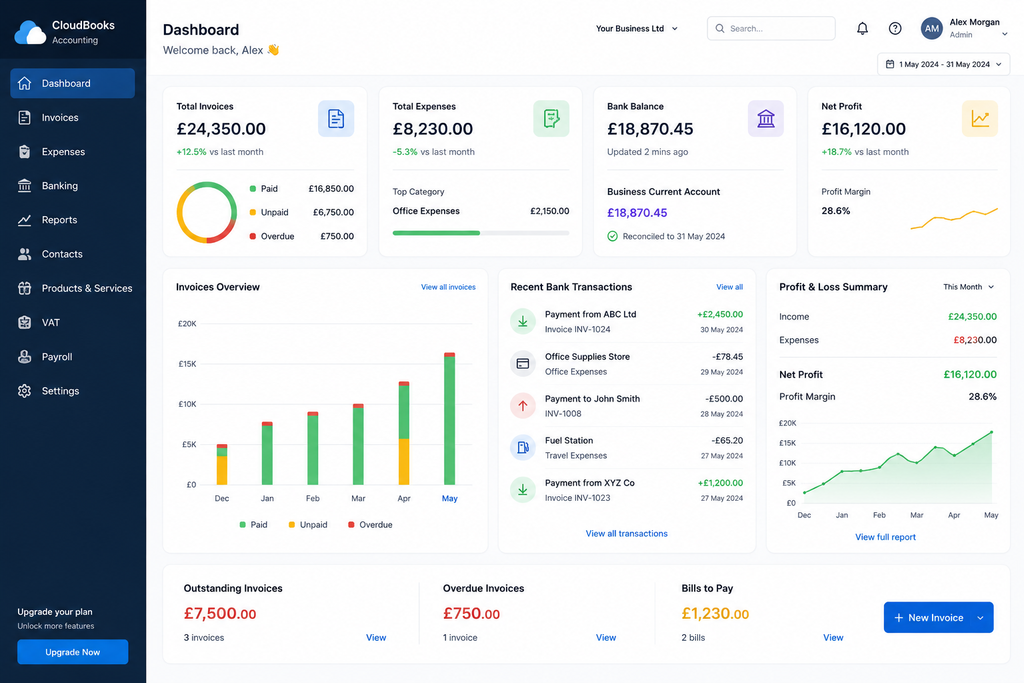
Cloud accounting software is software that stores accounting information online and can automate tasks such as invoicing, transaction categorisation, bank reconciliation, and reporting.
For example, a consultant can connect business banking transactions to accounting software, match a client payment against its invoice, attach a receipt to an expense, and review monthly profit without rebuilding the figures manually.
Free or low-cost alternatives such as structured spreadsheets can work for very small consultancies, but they usually require more manual control. As transaction volumes grow, dedicated accounting software can provide better automation and visibility.
How Should Consultants Manage Monthly Finances?
A simple monthly system can divide finances into four practical categories:
- Income: invoices raised, payments received, and outstanding balances.
- Expenses: software, insurance, professional fees, equipment, travel, and other eligible costs.
- Tax reserve: money held for expected tax and VAT liabilities.
- Cash flow: money available after considering upcoming costs and unpaid invoices.
For example, a consultant receiving £10,000 in a month could reconcile the bank, check unpaid invoices, categorise expenses, update the tax reserve, and review profitability before the next month begins.
What’s Next: How Can Consultants Improve Their Accounting?
Consultants can improve their accounting by creating a consistent financial routine that covers records, expenses, tax, cash flow, and regular reviews. Small monthly habits are usually easier to maintain than a major year-end bookkeeping exercise.
Start with this practical checklist:
- Open or maintain a separate business bank account where appropriate.
- Choose suitable accounting software or a structured bookkeeping system.
- Record every client invoice and payment promptly.
- Photograph or digitally store receipts and supporting documents.
- Review unpaid invoices every month.
- Reconcile business bank transactions regularly.
- Monitor taxable turnover for potential VAT registration.
- Create a separate savings pot for expected tax liabilities.
- Review revenue, expenses, profit, and cash flow monthly.
- Keep records for the required retention period.
- Review your business structure as the consultancy grows.
- Consider professional accounting support when transactions or tax requirements become more complex.
Moreover, consultants should not wait until a tax deadline to discover that records are incomplete. HMRC’s current guidance confirms that self-employed businesses must retain appropriate records to calculate and support their tax returns.
Finally, an accountant can become valuable when your consultancy has growing revenue, VAT obligations, payroll, a limited company, subcontractors, international clients, or increasingly complex tax decisions.
Conclusion
Accounting for consultants is the process of keeping financial records accurate while using those records to manage profitability, tax, cash flow, and business decisions. A reliable consultant accounting system gives you visibility over where your money comes from, where it goes, and what you may need to pay in tax.
Moreover, the right approach does not have to be complicated. By separating business finances, recording transactions regularly, tracking eligible expenses, reconciling accounts, monitoring VAT, and planning for tax, you can build a financial system that supports your consultancy rather than distracts from it.
If your consultancy is becoming more complex, professional accounting support can help you stay compliant while making better financial decisions. The goal is not simply to keep the books tidy—it is to build a consultancy that you understand financially and can grow with confidence.
Written by ASK Accountants UK Ltd — Chartered Certified Accountants specialising in UK accounting, taxation, bookkeeping and small-business financial management.
Reviewed by ASK Accountants UK Ltd
Disclaimer: This article was initially drafted using AI assistance. However, the content has undergone thorough revisions, editing, and fact-checking by human editors and subject matter experts to ensure accuracy.
Tax rules and thresholds can change and may depend on individual circumstances. The information in this article is for general guidance and should not replace professional tax or accounting advice.