
There’s a particular kind of quiet dread that hits around January. You know the one. The self-assessment deadline looms, your bank statements are scattered across three tabs, and you’re frantically Googling whether a client dinner from 14 months ago counts as a business expense. If you’re self-employed — freelancer, sole trader, contractor, consultant — this scene is probably painfully familiar.
Here’s the thing most people don’t want to admit: going self-employed is one of the most liberating decisions you can make, and simultaneously one of the most administratively demanding. You become the boss, the salesperson, the service provider and the finance director. That last role? It’s the one that quietly unravels people.
An accountant for self-employed professionals isn’t a luxury reserved for those billing six figures. It’s arguably the most practical decision you can make in your first year — and every year after that. This article digs into the genuine reasons why, without the cheerleading.
The Bit Nobody Tells You About Self-Employment Tax
When you leave employment, your tax life changes completely. And not in an obvious way. You go from PAYE — where everything happens automatically, almost invisibly — to a world where you are responsible for tracking income, calculating National Insurance, filing Self Assessment tax returns, and making payments on account.
Payments on account. Two words that catch almost every newly self-employed person completely off guard.
HMRC asks you to pay your estimated tax bill twice in advance — once in January and once in July. So if you earn more in your second year than your first, you might owe a surprising lump sum in addition to those payments. Many people genuinely aren’t aware this mechanism exists until they’re staring at a bill they can’t cover.
A good accountant for self-employed clients walks you through this from day one. Not just “here’s what you owe” but “here’s what’s coming, here’s when, here’s how to prepare.”
Expenses: The Grey Area Nobody Navigates Perfectly Alone
Everyone knows you can claim expenses. Fewer people know what qualifies, when it qualifies, and crucially — how to document it properly so it actually holds up if HMRC comes knocking.
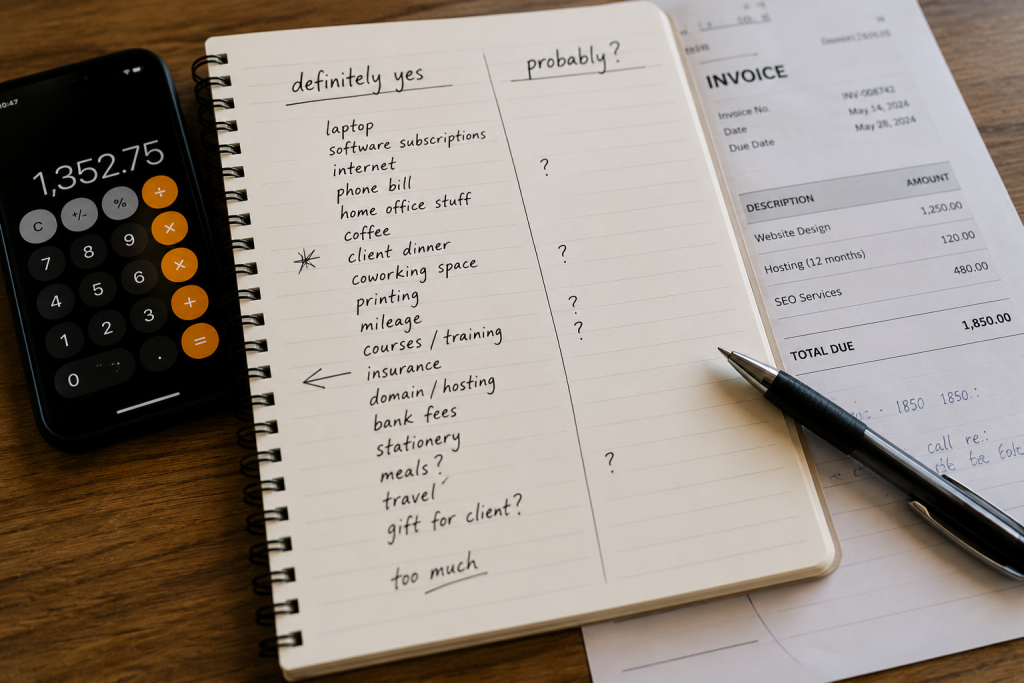
Use of home as office. Travel to client sites versus commuting. Equipment that’s partly personal and partly professional. Subscriptions. Training. The rules aren’t complicated exactly, but they’re specific — and they change.
Consider this:
- A graphic designer claims her home studio but includes the spare bedroom her partner uses as a gym. Disallowed.
- A consultant claims full mileage to a long-term client he visits weekly for years. Treated as commuting by HMRC. Disallowed.
- A photographer buys a camera and claims 100% — without splitting the personal use element. Red flag.
None of these people were trying to cheat the system. They simply didn’t know the rules precisely enough. An accountant for self-employed people is trained to spot exactly these issues — and to structure your claims so they’re defensible, not just optimistic.
Self Assessment Isn’t Just a Form — It’s a Financial Snapshot HMRC Scrutinises
Filing a Self Assessment tax return is, on the surface, filling in boxes. But what sits behind those boxes — your income categorisation, your declared allowances, the way you’ve treated capital expenditure versus revenue expenditure — tells a story. HMRC’s systems are sophisticated. They cross-reference data from banks, letting platforms, payment processors and Companies House.
The risk of getting it wrong isn’t just a fine. It’s an investigation.
HMRC investigations are stressful, time-consuming and potentially very expensive. They can look back up to six years for careless errors — and twenty years if fraud is suspected. The vast majority of people who face investigations are not fraudsters; they’re just self-employed people who made genuine errors without professional guidance.
Tip worth flagging: HMRC’s risk profiling system flags returns that look unusual compared to others in the same industry and income range. If your expenses look oddly high, or your income suspiciously low, that’s a trigger. A professional who prepares self-employed tax returns routinely knows where those thresholds typically sit.
What Does an Accountant for Self-Employed Actually Do Day to Day?
There’s a persistent myth that accountants are only useful at year-end. Hand over your receipts in a shoebox, they crunch numbers, everyone goes home. That’s bookkeeping (which, for what it’s worth, is also a genuinely valuable service — Ask Accountants UK Ltd offers dedicated bookkeeping services designed specifically for businesses that want their records clean and current, not retrospective).
But accounting for self-employed professionals goes much further:
Tax planning throughout the year — not just compliance after the fact. Timing income and expenses to fall in advantageous tax years. Planning pension contributions to reduce your taxable profit. Understanding when incorporation might start to make financial sense.
Making Tax Digital (MTD) compliance — HMRC’s ongoing digitalisation of tax means quarterly reporting is coming for more sole traders. The requirements are moving quickly, and the penalties for non-compliance are real.
Business advice at crossroads moments — Should you become a limited company? When’s the right time to register for VAT? How do you handle a sudden large contract? An experienced accountant isn’t just a tax technician; they’re a financial consultant who can help you think through decisions that have long-term consequences.
The Real Cost of DIY: What You Probably Don’t Account For
Here’s the honest maths. Say you spend 12 hours on your annual self-assessment return — gathering records, understanding the guidance notes, double-checking figures, filing, worrying you’ve got it wrong. If your time is worth £40 an hour (modest, for most self-employed professionals), that’s £480 in lost productive time.
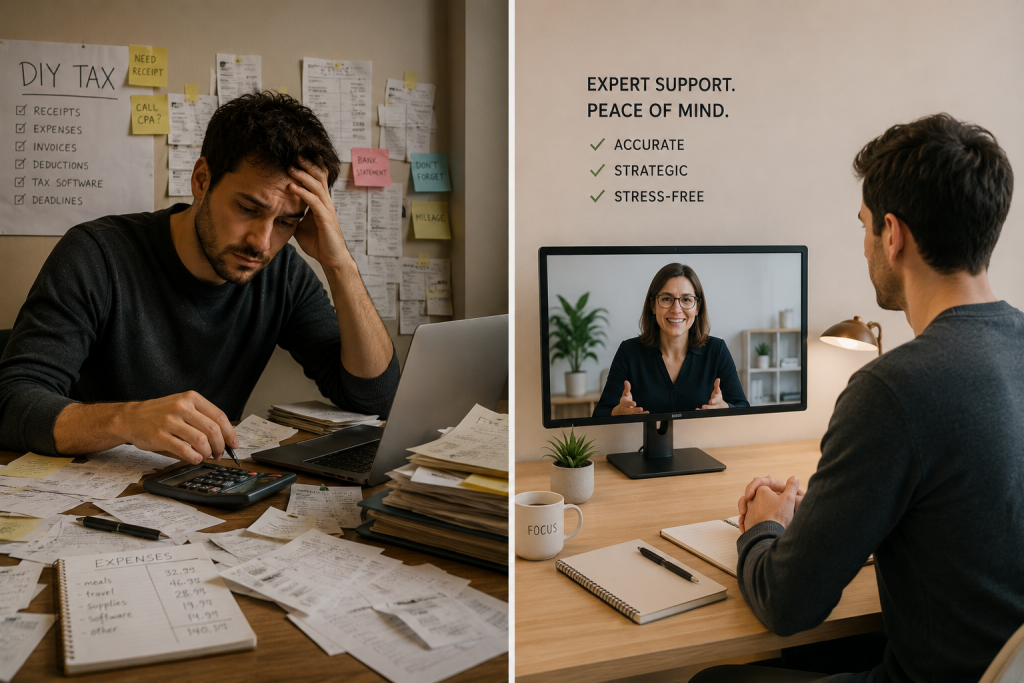
Now add the risk premium. One disallowed expense claim. One missed allowance — the trading allowance, the marriage allowance, pension tax relief you didn’t claim. One letter from HMRC requiring clarification that sends you into a spiral of digging through old emails.
| Approach | Annual Time Cost | Typical Risk Exposure | Tax Savings Identified |
|---|---|---|---|
| DIY Self Assessment | 10–20+ hours | High (errors, missed claims) | Low — you don’t know what you don’t know |
| Online Software Only | 6–12 hours | Medium (software doesn’t give advice) | Low–moderate |
| Professional Accountant | 1–2 hours (your input) | Low | Often exceeds accountant fee |
The accountant fee often pays for itself — not as a marketing slogan, but as a fairly consistent financial reality.
If You Work in Construction, the Rules Are Even More Complicated
CIS. Three letters that strike confusion into the hearts of subcontractors across the UK.
The Construction Industry Scheme requires contractors to deduct tax at source from payments made to subcontractors — either 20% or 30%, depending on registration status. If you’re a subcontractor, you’re likely having too much tax withheld. That means you’re owed a refund. Potentially a substantial one.
But claiming it back isn’t automatic. It requires a correctly filed Self Assessment return, proper records of your CIS deduction statements, and knowledge of which expenses legitimately reduce your taxable profit.
The team at Ask Accountants UK Ltd handles CIS claims and refunds as a specialist service — not as an add-on, but as a dedicated process that frequently results in contractors reclaiming thousands of pounds they were otherwise leaving on the table. Worth checking out if you’re in the trade.
When Your Business Starts Growing: The Decisions That Define Your Future
There comes a point in many self-employed careers where things get more complicated. You take on a member of staff. You start working with bigger clients who require formal accounts. You wonder whether trading as a sole trader is still the right structure — or whether a limited company might save you money.
These are significant decisions. They affect your tax liability, your legal exposure, your ability to raise finance, your pension planning. Getting them wrong — or simply not thinking about them at the right time — can cost you thousands.
Personal tax planning isn’t just about the current year’s bill. It’s about understanding your trajectory and making structural choices that compound over time. At Ask Accountants UK Ltd, their business advice service is designed precisely for this moment — when the self-employed professional is transitioning from “just getting by” to genuinely building something.
And if you’re considering setting up a limited company, company secretarial work — the paperwork, filings and compliance that come with incorporation — is something that’s easy to underestimate until you’re buried in it.
Cloud Accounting: The Tool That Changes the Relationship With Your Numbers
A brief aside on technology, because it genuinely matters.
The old model of accounting — hand over a cardboard folder once a year, wait for a bill — is more or less obsolete. Cloud accounting platforms like Xero and QuickBooks give self-employed professionals real-time visibility into their cash flow, expenses and tax position. More importantly, they let your accountant work with you continuously, not just retrospectively.
The combination of cloud tools and a professional accountant is genuinely powerful. Your accountant can spot a problem in March, not discover it in February the following year.
The Psychological Dimension Nobody Really Talks About
Money anxiety is real. And it’s disproportionately common among self-employed people — not because they earn badly, but because income is unpredictable, the rules feel opaque, and the consequences of getting things wrong feel serious.
A trusted accountant doesn’t just handle the admin. They remove a particular kind of background noise. The low-level worry about whether you’ve been doing it right. The vague dread every time a letter arrives from HMRC. The uncertainty about whether you’re actually making money or just moving it around.
That peace of mind has a value that doesn’t show up in any spreadsheet.
What to Look For When You Choose
Not all accountants are equal. Some are excellent at compliance but offer no proactive advice. Some are generalists who don’t know the specifics of your industry. Some charge flat fees; others bill by the hour with all the unpredictability that entails.
A few things worth checking:
- Are they a qualified accountant (ICAEW, ACCA, CIMA membership)?
- Do they have experience with clients in your sector?
- Do they offer a clear scope of service so you know exactly what you’re paying for?
- Will you have a named point of contact, or will your queries disappear into a helpdesk?
- Are they proactive — do they flag opportunities and issues before you have to ask?
For those in or around London, Ask Accountants UK Ltd (178 Merton High St, London SW19 1AY — reachable on 020 8543 1991) offers a comprehensive range of services that go considerably beyond basic tax filing: from tax compliance and accounts and tax to automatic enrolment and business plans. If you’re looking for an accountant for self-employed work who can grow with you rather than simply process your returns, it’s worth having a conversation.
A Second Look at the Numbers: What Sole Traders Are Commonly Missing
| Commonly Missed Tax Relief | Who It Applies To | Potential Saving | Notes |
|---|---|---|---|
| Pension contributions | All self-employed | Up to 45% tax relief | Often the single biggest lever |
| Capital allowances on equipment | Anyone buying tools, tech, vehicles | Varies significantly | Annual Investment Allowance often unclaimed |
| Use of home (simplified expenses) | Home-based workers | £312–£1,500+ per year | Flat rate or actual costs |
| Training & CPD costs | Most self-employed | Depends on spend | Must relate to existing trade |
| Bad debt relief | Anyone with unpaid invoices | Full amount of bad debt | Rarely claimed correctly |
(Note: tax reliefs and thresholds can change — always confirm current rules with a qualified professional.)
Frequently Asked Questions About Accountants for Self-Employed People
Do I legally need an accountant if I’m self-employed? No, there’s no legal requirement to use one. But the question isn’t really about legal obligation — it’s about whether you want to maximise what you keep, minimise your risk, and spend your time on the work you’re actually good at.
How much does an accountant for self-employed work cost? For a sole trader, expect anywhere from £300–£1,000+ per year depending on the complexity of your work, whether you need bookkeeping as well as tax returns, and the level of advice you want. Many find the tax savings alone more than cover it. See also: small business accountant cost guide.
What if I’ve already been doing my own tax returns for years? A good accountant will review your previous returns without judgment and identify whether anything needs correcting or amending. HMRC allows amendments within certain timeframes. Better to address it proactively than wait for them to find it.
Can an accountant help if I’m already under HMRC investigation? Yes — and this is arguably when professional help is most critical. Responding to HMRC investigations without professional guidance is a bit like representing yourself in court: technically possible, rarely wise. Read more on how to handle a tax investigation.
I’m just starting out — is it too early? Almost certainly not. Getting the structure right from the beginning — how you track income, how you separate business and personal finances, what you register for and when — sets you up properly. Retrofitting good habits is harder than starting with them.
What’s the difference between a bookkeeper and an accountant for self-employed use? Bookkeeping is the day-to-day recording of transactions. Accounting includes that, but also covers tax planning, financial analysis, compliance, and strategic advice. Both are valuable; they serve different purposes and often work best together.
The Bottom Line
Freedom is the point of going self-employed. But freedom without structure has a habit of creating its own traps. The tax system, the compliance demands, the planning decisions — they don’t disappear just because you’re your own boss. They become, in a very real sense, more your problem than they ever were.
An accountant for self-employed professionals is not the person who swoops in to rescue you at year-end. At their best, they’re the person who helps you earn more, keep more, plan better and stress less — throughout the year, at every stage of your journey.
That’s not nothing. That’s actually quite a lot.
Ask Accountants UK Ltd | 178 Merton High St, London SW19 1AY | 020 8543 1991 | askaccountantsukltd.co.uk