
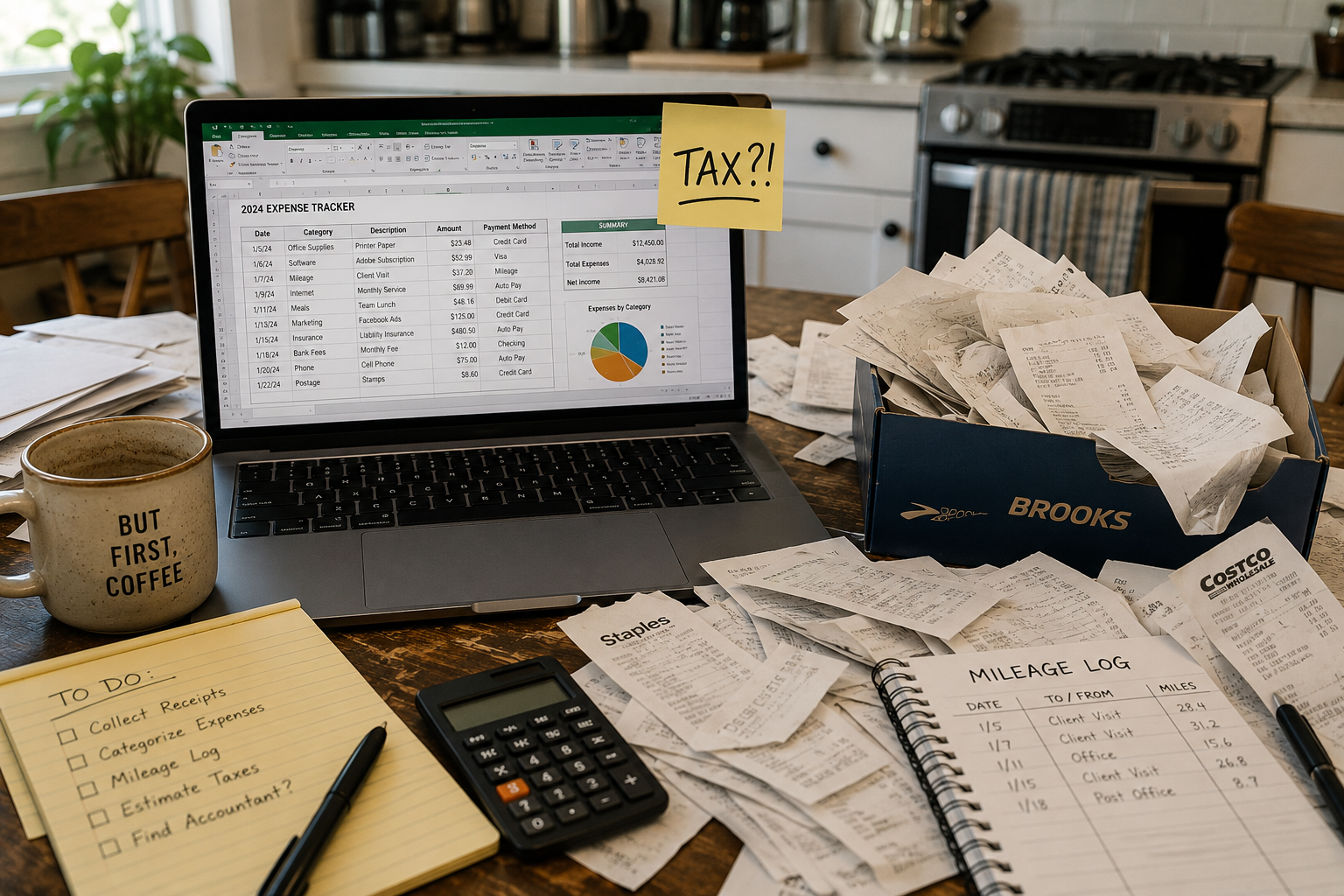
Nobody warns you about the receipts. You start out thinking sole trader tax is just “pay HMRC a bit of what you earn,” and then eighteen months in you’re standing in your kitchen at 11pm trying to work out whether a printer cartridge counts as an allowable expense. It does, by the way. Welcome to self-employment.
Here’s the thing that trips up almost every new sole trader in the UK: there’s no employer quietly sorting your tax in the background any more. No payroll department, no P60 landing in your inbox each May. You are the payroll department now. Sole trader tax is the collective term for everything you owe HMRC on your business profit — Income Tax, National Insurance, sometimes VAT — and getting it wrong doesn’t just cost money, it costs sleep. This guide walks through what sole trader tax actually involves, what you’ll pay, and how to stop it from ambushing you every January.
So, What Exactly Is Sole Trader Tax?
Strip away the jargon and it’s simple enough. As a sole trader, you and your business are legally the same entity — there’s no separate company hiding behind you, taking the blame if things go wrong. Every pound of profit you make is treated as your personal income, and you’re taxed on it accordingly.
That means sole trader tax isn’t really one tax. It’s a bundle:
- Income Tax on your profits above the Personal Allowance
- Class 4 National Insurance, calculated as a percentage of profit
- Class 2 National Insurance, now mostly automatic rather than a weekly bill
- VAT, but only once your turnover crosses the registration threshold
You report all of it once a year through Self Assessment (unless Making Tax Digital pulls you into quarterly reporting — more on that shortly). No payslip, no tax code doing the heavy lifting for you. Just you, your figures, and a deadline that doesn’t move for anyone.
Quick reality check: if you’re still deciding whether to trade as a sole trader or set up a limited company, tax treatment is only one piece of that decision — liability and administration matter too. It’s worth a proper conversation before you register anything.
The Numbers HMRC Actually Cares About
Right, the bit everyone skips to. For the 2026/27 tax year, the Personal Allowance sits at £12,570 — frozen again, as it has been for a few years now, which quietly drags more people into higher bands each year even though nothing “changed” on paper. Above that threshold, self-employed profits are taxed like any other income:
| Band | Taxable Profit | Rate |
|---|---|---|
| Personal Allowance | Up to £12,570 | 0% |
| Basic Rate | £12,571 – £50,270 | 20% |
| Higher Rate | £50,271 – £125,140 | 40% |
| Additional Rate | Over £125,140 | 45% |
If your total income creeps past £100,000, the Personal Allowance starts shrinking — £1 lost for every £2 earned above that line — and it disappears completely at £125,140. Freelancers who have a great year sometimes get caught out here, ending up with an effective tax rate well north of 40% on that slice of income. It’s not a penalty exactly. It just feels like one.
Sole trader tax, in other words, follows the same rate structure as employed income tax. The difference is how you pay it: in one lump (or two, thanks to payments on account) rather than smoothly across twelve payslips.
National Insurance: The Bill People Forget Exists
This is where a lot of first-time sole traders get a nasty surprise, because Income Tax isn’t the whole story. You also owe National Insurance on your profits, split into two classes.
Class 4 NI is the main one. It applies once your profits exceed £12,570, charged at 6% on everything between £12,570 and £50,270, then 2% on anything above that — full details on the current self-employed National Insurance rates are on GOV.UK if you want to check the up-to-date figures yourself. It’s calculated automatically as part of your Self Assessment bill — you don’t do a separate sum for it, but you absolutely need to budget for it.
Class 2 NI used to be a flat weekly charge. Since April 2024 it’s effectively voluntary: if your profits clear the Small Profits Threshold (£7,105 for 2026/27), you get a National Insurance credit toward your State Pension automatically, no payment required. Fall below that threshold and you can still pay voluntarily — £3.65 a week for 2026/27 — to protect your pension record. Skip it and your NI record has a gap. Whether that matters depends on your wider pension situation, which is exactly the sort of thing worth a proper conversation with an accountant rather than a guess.
Worked example: £35,000 profit
Take a freelance designer with £35,000 in trading profit for 2026/27. The first £12,570 is tax-free. The remaining £22,430 is taxed at the basic rate — 20% — coming to £4,486. Class 4 NI adds 6% on the £22,430 between £12,570 and £50,270, another £1,345.80. Total sole trader tax and NI bill: roughly £5,831.80, leaving take-home pay of around £29,168. That’s an effective rate of under 17%, even though the marginal rate on the last pound earned is 26%.
What Actually Counts as an Allowable Expense?
Here’s where opinions get personal, and mine is this: most sole traders under-claim, not over-claim, because they’re terrified of getting it wrong. The test HMRC applies is whether a cost is “wholly and exclusively” for business purposes. Simple in theory. Fuzzy in practice.
Commonly allowable costs include office supplies, a proportion of home utility bills if you work from a spare room, professional fees (hello, accountant), travel to client sites, marketed advertising spend, and equipment that’s genuinely used for the trade. A camera bought purely for client shoots? Fine. A car used for both the school run and site visits? You can only claim the business-use portion — and you’ll need a sensible way of proving the split if HMRC ever asks.
HMRC’s own page on expenses if you’re self-employed is worth bookmarking — it’s not thrilling reading, but it’s the definitive list.
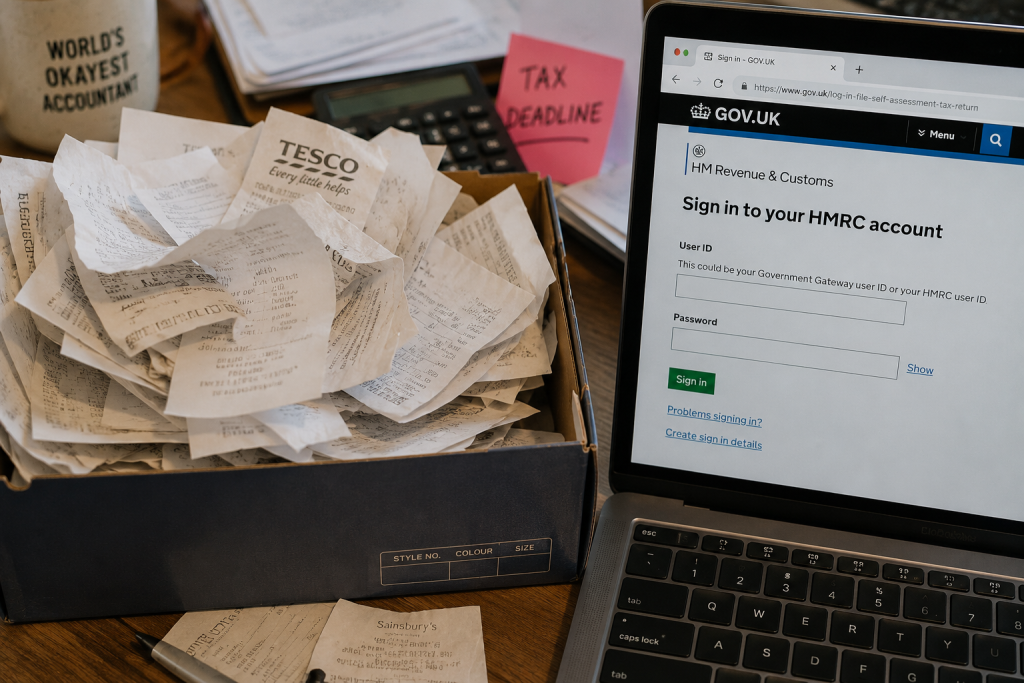
There’s also a Trading Allowance worth flagging: £1,000 a year that can be set against self-employment income instead of itemising actual expenses. Handy for side hustles with low costs. Less useful if your real expenses run higher than a grand, in which case itemising wins every time — you just can’t do both.
Warning nobody puts in bold enough: claiming an expense that isn’t genuinely business-related isn’t a grey area worth risking. It’s the exact thing that turns a routine check into a full sole trader tax investigation.
Payments on Account: The Sting in the Tail
This one catches out almost every sole trader in year two. If your Self Assessment bill comes to more than £1,000, HMRC assumes you’ll earn roughly the same next year and asks you to pay in advance — two “payments on account,” each 50% of the previous year’s bill, due 31 January and 31 July.
So your first proper tax bill isn’t just what you owe for the year just gone. It’s that, plus half of next year’s estimated bill, landing on the same date. For someone who’s budgeted carefully for “just” the tax owed, that second chunk can be genuinely painful. My advice, for what it’s worth: set aside 25–30% of every invoice from day one, in a separate account you don’t touch. It sounds excessive until the January bill arrives.
| Deadline | What’s Due | Applies If… |
| 31 January | Balancing payment + 1st payment on account | Bill was over £1,000 last year |
| 31 July | 2nd payment on account | Same as above |
| 5 October | Register for Self Assessment (if new) | First year trading |
| 31 Jan (online filing) | Submit return | Always — even if you owe nothing |
(Yes, that table’s a little rough round the edges — deadlines in tax life rarely line up neatly either, so it felt fitting.)
Making Tax Digital Is Coming Whether You’re Ready or Not
From April 2026, Making Tax Digital for Income Tax (MTD ITSA) became mandatory for sole traders and landlords with combined qualifying income above £50,000. Instead of one annual Self Assessment return, you’re now submitting quarterly digital updates through HMRC-compatible software, followed by a final declaration. The threshold drops to £30,000 in April 2027, and £20,000 in April 2028.
Spreadsheets aren’t banned outright, but they need to link to bridging software that talks to HMRC’s system directly. If your bookkeeping currently lives in a notebook or a shoebox (be honest), this is the moment to move to proper cloud accounting before the deadline forces the issue rather than after.
When HMRC Comes Knocking
Nobody wants to think about this one, but it happens more than people assume — and sole traders, with their less rigid record-keeping compared to limited companies, are statistically more likely to face a check. An HMRC investigation can be triggered by something as mundane as a figure that looks slightly off compared to industry norms, or entirely at random.
Understanding what happens during a tax investigation makes the whole thing considerably less frightening. HMRC will typically request records covering a specific period, ask questions about specific transactions, and — assuming everything checks out — close the enquiry with no further action. It’s the poor record-keepers who tend to have a rough time, not the honest ones. If you’re ever unsure how the tax investigation process actually unfolds, getting advice early, before you’ve replied to HMRC’s first letter, tends to save considerably more stress (and money) than waiting.
Registering and Staying on the Right Side of the Deadline
If you’re new to this, registration comes first. You need to register for Self Assessment with HMRC by 5 October following the end of the tax year in which you started trading — the same process covers registering as a sole trader itself. Miss that and you’re not automatically fined, but you’re cutting it fine for the January filing deadline that follows.
Once registered, three dates matter every single year:
- 31 January — online filing deadline, plus balancing payment and first payment on account
- 31 July — second payment on account, if applicable
- 5 October — deadline to register if you’re newly self-employed
Miss the filing deadline and it’s an automatic £100 penalty, even if you owe nothing at all. Miss it by longer and the penalties escalate sharply, plus interest accrues on anything unpaid. Sole trader tax doesn’t forgive lateness easily — HMRC’s systems are entirely automated on this point, and there’s very little wiggle room once a deadline has passed.
Frequently Asked Questions
Do I need an accountant as a sole trader? Not legally, no — you can file your own Self Assessment return. Plenty of people do, especially in the early, simpler years. But once expenses get complicated, profits climb into higher tax bands, or Making Tax Digital pulls you into quarterly reporting, professional support tends to pay for itself many times over in time saved and mistakes avoided.
How much sole trader tax will I actually pay? It depends entirely on your profit level, but as a rough guide, someone earning £35,000 in trading profit for 2026/27 would pay roughly £5,800 combined in Income Tax and Class 4 National Insurance — an effective rate under 17%, even though the marginal rate on the top slice is higher.
Is sole trader tax the same as self-employed tax? Yes — “sole trader tax” and “self-employed tax” describe the same thing. Sole trader is simply the legal structure; the tax obligations that come with it (Income Tax, National Insurance, potentially VAT) are what people mean when they say self-employed tax.
What happens if I can’t pay my sole trader tax bill on time? Contact HMRC before the deadline, not after. A Time to Pay arrangement can spread the cost, and it’s considerably better than simply missing the date and letting penalties and interest build up silently.
Can I switch from sole trader to limited company later? Yes, and plenty of people do once profits grow enough that the tax treatment of a limited company becomes more favourable. It’s a decision worth planning ahead of time rather than mid tax year, ideally with proper advice on timing.
Where This Leaves You
Sole trader tax isn’t complicated so much as it’s unforgiving — small oversights compound if nobody’s checking the figures. If your bookkeeping is a shoebox and a prayer, or you’ve just registered and have no idea what a payment on account even is, Ask Accountants UK Ltd works with sole traders across London on exactly this: Self Assessment, personal tax planning, bookkeeping, and — should it ever come to it — HMRC investigation support. Based at 178 Merton High St, London SW19 1AY, they’re reachable on 020 8543 1991 for anyone who’d rather have a proper conversation than another Google search at midnight.