

Running a small business in the UK comes with incredible challenges and constant financial pressure. As a founder or landlord, it is completely normal to face unexpected personal bills or temporary cash flow gaps. Sometimes, you might need to borrow money from your own limited company. However, the exact moment you take money out of your business that is not a salary, a dividend, or a legitimate business expense, you create a complex tax situation. This is where understanding director loan interest becomes absolutely critical for your financial health.
When you borrow money from your company, HM Revenue & Customs (HMRC) legally views the company and you as separate entities. The money belongs to the business. If you borrow it, HMRC expects you to pay for that privilege. Managing this incorrectly can create severe stress and trigger unexpected tax liabilities at the end of your financial year. We understand how overwhelming it feels to juggle growing a business while trying to decipher strict tax legislation.
This guide is designed to remove the confusion. We will walk you through the core HMRC rules, highlight common record-keeping risks, and provide a clear workflow to help you stay compliant.

Understanding Director loan interest rules
To put it simply, if you borrow money from your limited company, the company must charge you interest. If your company charges you an interest rate that is lower than the official HMRC rate, or if it charges you no interest at all, HMRC classifies this as a benefit in kind.
You must stay updated with the current official rates by checking the GOV.UK official interest rates page. This official rate is the baseline HMRC uses to determine if you have received a taxable benefit.
If the balance of your overdrawn directors loan account exceeds £10,000 at any point during the tax year, the director loan interest rules apply in full. At this stage, your company must report the benefit in kind on a P11D form. You will personally owe income tax on this benefit, and your company will be liable to pay Class 1A National Insurance contributions.
Calculating director loan interest accurately helps improve accuracy in your year-end accounts and mitigates the risk of errors when submitting your tax returns.
The Core Rules: Section 455 and strict timelines
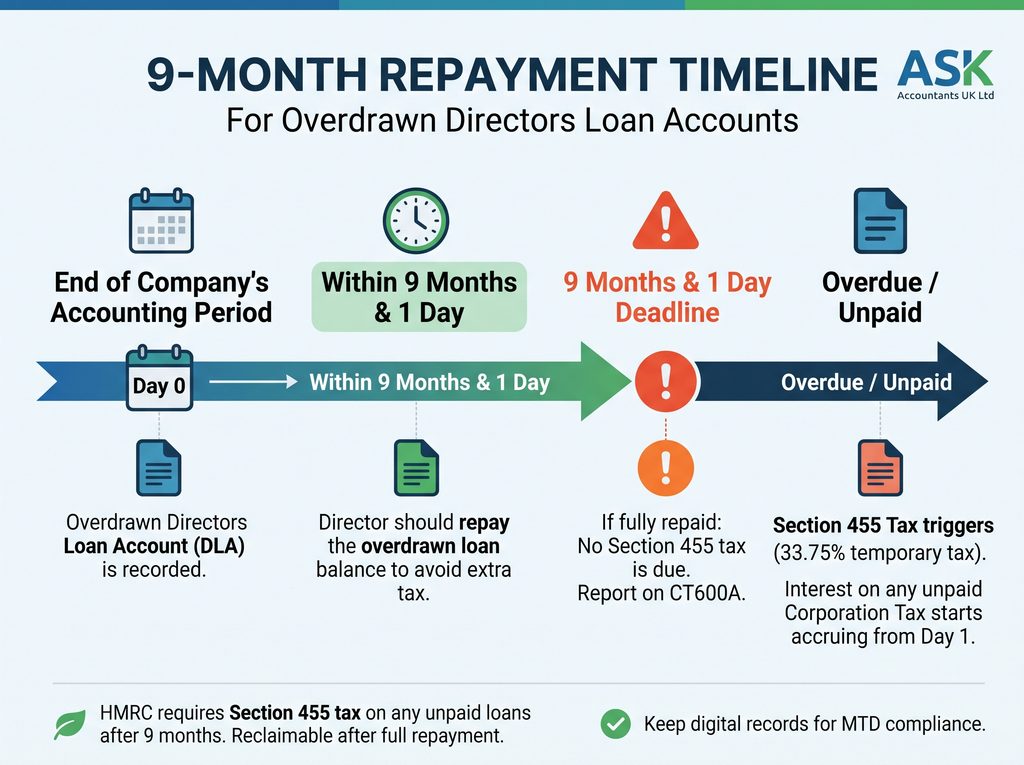
The rules surrounding director borrowing are tightly regulated. If your directors loan account remains overdrawn at the end of your company accounting period, a strict timer begins. You have exactly nine months and one day from the end of your accounting period to repay the borrowed amount in full.
If you fail to repay the loan by this deadline, your company becomes liable for Section 455 tax. This is a temporary corporation tax charge calculated at a rate of 33.75% on the outstanding loan balance. HMRC requires this payment to prevent business owners from using their companies as tax-free personal bank accounts.
While your company can reclaim this Section 455 tax after the loan is eventually repaid, HMRC can take a significant amount of time to process the refund. This delay can severely impact your business cash flow.
Furthermore, you must be incredibly careful with HMRC payment deadlines. If you miss a payment deadline for corporation tax or Section 455 tax, the consequences are immediate. Late-payment interest begins on day 1. First tax penalties arise at day 15 and increase at day 30.
Most VAT-registered businesses must also comply with Making Tax Digital rules, meaning your digital records need to be precise. Having robust corporate tax planning in place can reduce administrative burden and help you map out your loan repayments safely.
How to calculate director loan interest correctly
To calculate your director loan interest accurately, you must track the daily balance of your loan across the entire tax year. This requires highly accurate bookkeeping.
You need to identify exactly when the loan exceeded the £10,000 threshold and apply the official HMRC interest rate for the exact number of days the balance was outstanding. You must then compare this figure against any interest you actually paid to the company.
It is important to note that you cannot simply add the interest to your loan balance. You must physically transfer the interest payment from your personal bank account into the business bank account. The business must then declare this received interest as taxable income on its annual Corporation Tax Return.
Using cloud-based software like Xero or QuickBooks helps improve accuracy significantly. These platforms allow you to tag personal transactions immediately, ensuring your loan balance is always up to date.
Common errors and record-keeping risks
Many hardworking founders make honest mistakes when managing business finances. These missteps do not mean you have failed, but they do highlight common errors and record-keeping risks that you need to avoid.
1. The Bed and Breakfasting trap
Some business owners try to avoid Section 455 tax by repaying their loan just before the nine-month deadline, only to borrow the exact same money back a few days later. HMRC actively monitors this practice. Under the “bed and breakfasting” anti-avoidance rules, if you repay a loan greater than £5,000 and take out another loan within 30 days, HMRC ignores the repayment for tax purposes. You will still be liable for the Section 455 tax charge.
2. Misclassifying complex business expenses
It is incredibly common for directors to accidentally mix personal and business spending. If you pay for personal items using the company card, these must be recorded against your loan account. However, confusion often arises with expenses like business entertainment or company vehicles. Always note that the rules for these specific expenses are highly nuanced. There are exceptions, strict partial recovery rules, and complex benefit-in-kind calculations involved. You should always seek specific advice before attempting to deduct these against your company profits.
3. Ignoring the P11D reporting requirements
If your loan balance exceeds £10,000 and you do not pay the official rate of interest back to the company, you must submit a P11D form. Failing to submit this form, or submitting it late, creates unnecessary compliance headaches. Accurate reporting of HMRC beneficial loan rules is essential to keep your business records clean.

A Step-by-Step Workflow to manage your loan account
If you are currently looking at an overdrawn loan account, do not panic. You can regain control by following a structured and practical workflow.
- Step 1: Separate your finances immediately. Stop using the company debit card for personal expenses. Ensure you have a clear boundary between your personal bank account and the business account.
- Step 2: Reconcile your accounts weekly. Use your accounting software to review all transactions. Tag any accidental personal spending directly to your directors loan account so the running balance is always accurate.
- Step 3: Monitor the £10,000 threshold. Keep a close eye on your total borrowings. If your balance is creeping toward £10,000, consult your accountant to discuss the impending director loan interest implications.
- Step 4: Plan your repayment strategy. Check your company year-end date. Count forward exactly nine months. You must have a realistic cash flow plan to repay the loan before this strict deadline.
- Step 5: Utilize company dividends. If your company has sufficient retained profits, you can declare a dividend. Instead of taking the cash, you can credit the dividend directly to your loan account to clear the debt. Keep in mind that you will still need to report this dividend on your Self Assessment tax return.
- Step 6: Pay the interest physically. If you choose to pay director loan interest to avoid the benefit in kind charge, ensure you physically transfer the funds from your personal account to the business account before the tax year ends.
Why outsourcing mitigates the risk of errors
Managing your day-to-day operations while trying to interpret dense HMRC legislation is a recipe for burnout. Attempting to manage director loan interest manually takes you away from your actual job of growing your business.
Outsourcing this specific task to a professional Bookkeeping Service can reduce administrative burden immensely. A qualified accountant will monitor your daily loan balances, advise you before you cross the £10,000 threshold, and calculate the exact interest required.
Having an expert manage your P11D submissions and Corporation Tax returns mitigates the risk of errors. It ensures you do not accidentally fall into the bed and breakfasting trap or miss a vital payment deadline. Outsourcing provides total peace of mind, allowing you to focus on your customers.
How ASK Accountants UK Ltd can support you
At ASK Accountants UK Ltd, we specialize in helping SME owners, startup founders, and landlords navigate complex tax challenges with confidence. We know how stressful an overdrawn directors loan account can be, and we are here to provide clear, actionable solutions without the jargon.
With 15 years of experience serving businesses across Wimbledon and South-West London, we have the local expertise you need. We do not judge past record-keeping mistakes. We simply assess your current situation, calculate your director loan interest obligations accurately, and build a roadmap to get your accounts fully compliant.
Let us handle the numbers so you can handle your business.
Call us today on 020 8543 1991 or visit our office at 178 Merton High St, London. You can also reach out via our Contact Page to schedule a consultation with our expert team.
Frequently Asked Questions
What happens if I charge myself a lower director loan interest rate?
If your company charges you interest but the rate is below the official HMRC rate, you still receive a taxable benefit. This benefit in kind is calculated as the exact difference between the interest you actually paid and the interest you should have paid under the official rate. You must report this difference to HMRC on a P11D form, and you will pay personal income tax on that amount.
Can a limited company write off a directors loan?
Yes, a company can formally choose to write off or release a directors loan. However, HMRC treats this write-off as a distribution of profits (similar to a dividend). You will be personally taxed on the written-off amount, and the company must also pay National Insurance on it. Crucially, the company cannot claim the written-off loan as a tax-deductible business expense. You should always seek specific advice before choosing this route.
Does the £10,000 loan limit apply per director or per company?
The £10,000 threshold applies per individual director, not per company. If your limited company has two directors, each director can theoretically borrow up to £10,000 before the benefit in kind rules take effect for them individually. To find more detailed guidance on how this affects your personal tax planning, we highly recommend reading up on tax planning for limited companies.