Running a care home is undeniably one of the most demanding jobs in the UK. Furthermore, managing dedicated staff and ensuring resident safety always takes priority over paperwork. Consequently, accounting for care homes is often a source of significant stress for business owners. The last thing you need is financial confusion keeping you awake at night.
Therefore, accounting for care homes requires a unique approach compared to standard retail or service businesses. In addition, you have complex payroll needs, strict reporting requirements, and distinct VAT nuances to manage. Ultimately, when your financial foundations are strong, you can focus on what truly matters (providing exceptional care to your residents). This guide will walk you through the essential rules, common pitfalls, and practical steps to take control of your finances.
Why Accounting for Care Homes Needs Specialist Attention
Moreover, care providers operate in a heavily regulated environment. As a result, your financial records must satisfy both HMRC and industry regulators simultaneously. Generic financial advice often falls short because it misses the specific challenges care home operators face daily.
CQC compliance and accounting for care homes
Specifically, financial viability is a key component of CQC registration and ongoing compliance. Regulators need to know that your business is financially stable enough to provide consistent and safe care. Furthermore, effective accounting for care homes helps you maintain clear records, forecast cash flow accurately, and demonstrate financial health during inspections. Consequently, keeping your books in perfect order mitigates the risk of compliance issues down the line.
Managing complex staff structures
In addition, your team likely includes full-time nurses, part-time support workers, and agency staff working varied shift patterns. Therefore, this makes payroll incredibly intricate. You must calculate holiday pay accurately, manage workplace pensions, and ensure National Minimum Wage compliance across varying shift differentials.
The Core Rules: Accounting for care homes and HMRC
Staying on the right side of HMRC means understanding your specific deadlines and digital obligations. As a result, missing these dates can lead to unnecessary stress and financial penalties. Similarly, when you master accounting for care homes, you avoid these frustrating hurdles.
Making Tax Digital (MTD)
Specifically, most VAT-registered businesses must now keep digital records and submit returns using compatible software. Furthermore, this initiative is expanding, and future phases will eventually impact Income Tax for sole traders and landlords. Consequently, adopting robust cloud accounting software early can reduce administrative burden and streamline your reporting process. We highly recommend using industry-leading platforms like Xero or QuickBooks to maintain your digital records efficiently.
VAT Exemptions in the Care Sector
However, VAT rules for care homes are highly nuanced. For example, in many cases, the provision of welfare services by a state-regulated private welfare institution is exempt from VAT. Therefore, you generally do not charge VAT to your residents. On the other hand, this also means you typically cannot reclaim the VAT you pay on your business purchases. As a result, there are exceptions and partial recovery rules depending on your specific corporate structure and local authority funding. You should always review the official GOV.UK guidance on VAT for care providers and seek specific advice from a professional.
Precise Penalty Structures
Moreover, HMRC penalty structures are strict and automated. For instance, if you miss a Corporation Tax or Self Assessment payment, late-payment interest begins on day 1. Similarly, for certain taxes, first penalties arise at day 15 and increase significantly at day 30. Consequently, maintaining a clear calendar and working with a proactive accountant helps improve accuracy and ensures you never miss a deadline.
Common Errors in Accounting for care homes
Even the most diligent care home operators can make mistakes when handling complex finances. Here are three common record-keeping risks to watch out for.
1. Misclassifying Agency Staff
Relying on agency staff to cover shifts is common practice. However, misclassifying these workers can lead to significant PAYE and National Insurance complications. Specifically, HMRC looks closely at employment status. As a result, failing to apply the correct tax rules for temporary or agency workers is a frequent administrative error. Furthermore, proper payroll ensures everyone is taxed correctly from their very first shift.
2. Poor Expense Tracking and Capital Allowances
In addition, care homes require constant maintenance, specialized equipment, and facility upgrades. Unfortunately, business owners often fail to categorize these expenses correctly. For example, some costs are everyday repairs, while others qualify for Capital Allowances. Consequently, misunderstanding these highly nuanced rules means you might miss out on legitimate tax relief. Moreover, it is vital to note that partial recovery rules apply to many expenses, so seeking specific advice is always the safest route.
3. Mixing Personal and Business Finances
Similarly, startup founders and small SME owners sometimes use personal accounts to cover sudden business expenses. As a result, this creates a messy paper trail. Furthermore, commingling funds makes accounting for care homes incredibly difficult and increases the likelihood of reporting errors. Therefore, a dedicated business account linked to modern software keeps your records clean and transparent.
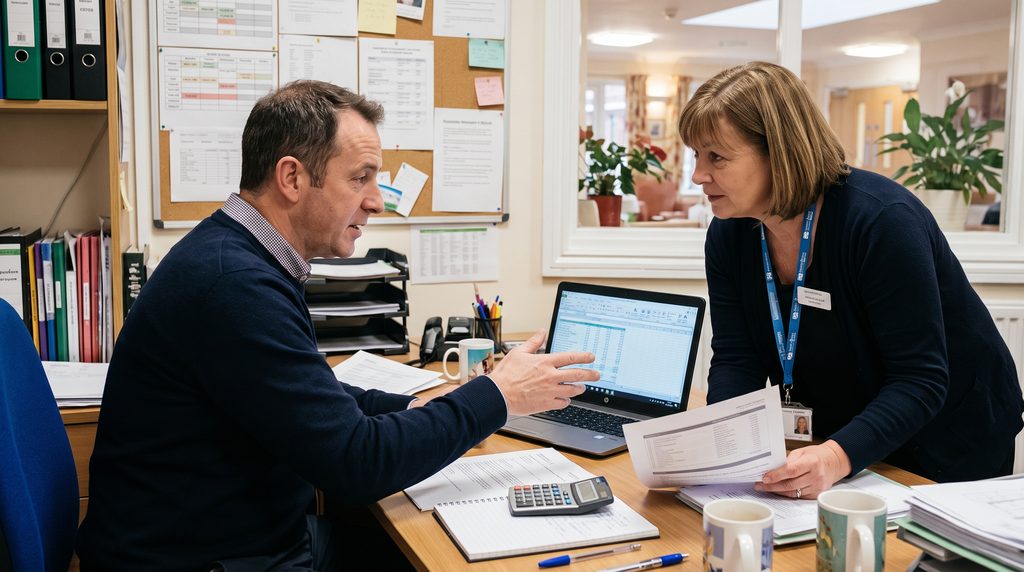
A Step-by-Step Workflow for Accounting for Care Homes
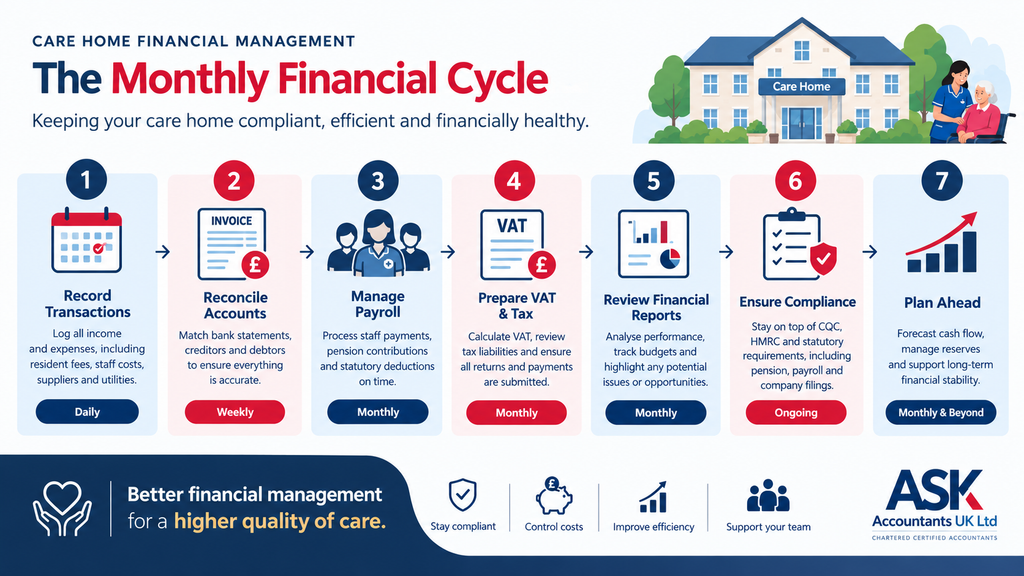
Creating a predictable routine is the secret to stress-free finances. Consequently, implement this practical workflow to keep your care home running smoothly.
- Daily Tasks: First, record all resident fee receipts and log petty cash expenses. Furthermore, ensure shift logs are updated accurately for the upcoming payroll run.
- Weekly Tasks: Next, reconcile your bank accounts using your cloud software. In addition, check your accounts receivable and chase any late local authority or private funding payments.
- Monthly Tasks: Subsequently, process your payroll, complete workplace pension submissions, and pay your PAYE/NI liabilities to HMRC. Moreover, review your monthly profit and loss statement to track your operating margins.
- Quarterly Tasks: If applicable, prepare and submit your VAT returns. Similarly, review your budget versus actual spending to ensure you remain financially viable for CQC standards.
- Annual Tasks: Finally, finalize your year-end accounts, calculate your Corporation Tax liability, and engage in proactive tax planning for the year ahead.
The Solution: Outsourcing for Peace of Mind
Ultimately, managing staff, residents, and the Care Quality Commission (CQC) leaves very little time for number crunching. Therefore, outsourcing accounting for care homes to a professional is a smart investment.
Furthermore, a specialized accountant can reduce administrative burden, help improve accuracy, and provide strategic insights that help your business grow. Consequently, when you hand over your financial management to experts, you reclaim your valuable time. You gain the confidence that your tax compliance is being handled correctly. In addition, professional oversight mitigates the risk of errors that could lead to costly HMRC tax investigations.
Moreover, by utilizing a dedicated bookkeeping service, you ensure that your records are always audit-ready and fully compliant with the latest digital reporting standards.
Partner with ASK Accountants UK Ltd
At ASK Accountants UK Ltd, we understand the immense pressure you face as a care provider. Indeed, we have 15 years of experience helping SMEs, startup founders, and property owners in Wimbledon and South-West London achieve financial clarity.
Furthermore, our team provides comprehensive support tailored to your sector. We handle everything from routine payroll management to advanced financial planning. We speak your language, avoid unnecessary jargon, and treat your business with the empathy and respect it deserves.
Are you ready to remove the stress of accounting for care homes? We are here to help you build a stronger, more resilient business.
Call our team today on 020 8543 1991, contact our Wimbledon office online, or visit us in person at 178 Merton High St.
Frequently Asked Questions
What expenses can a care home claim against tax?
Specifically, care homes can claim for a wide variety of wholly and exclusively business-related expenses. This includes staff wages, food for residents, medical supplies, utility bills, and insurance. Furthermore, Capital Allowances can often be claimed for specialist beds, hoists, and property improvements. Because these rules are highly nuanced, you should always consult an advisor to maximize your legitimate claims.
How does CQC registration affect my accounting requirements?
The CQC requires registered providers to demonstrate financial viability. Therefore, you must be able to prove you have the financial resources to provide safe and effective services. Consequently, maintaining accurate, up-to-date accounts and producing reliable cash flow forecasts are essential steps to satisfying these regulatory requirements.
Do I need specialized software for accounting for care homes?
While standard accounting software can work, utilizing robust cloud platforms like Xero or QuickBooks allows for better integration with specialized care management systems. Moreover, this digital approach ensures MTD compliance, simplifies complex payroll runs, and gives you real-time visibility into your financial health.