
If you run an e-commerce business, you already know that the digital marketplace never sleeps. Between managing inventory, fulfilling orders, dealing with customer returns, and optimizing your storefront, the sheer volume of daily tasks can feel completely overwhelming. It is easy to let your financial administration fall behind when you are focused on growth. However, proper accounting for online sellers is the absolute backbone of a sustainable and profitable e-commerce business.
Without a clear view of your numbers, you cannot truly know if your latest product launch was profitable or if platform fees are quietly eating away your margins. More importantly, poor record-keeping creates unnecessary stress when tax season arrives. We speak to startup founders and SME owners every day who feel lost in a sea of Stripe payouts, Shopify reports, and Amazon seller fees.
This guide will break down exactly what you need to know about e-commerce bookkeeping, HMRC rules for online sellers, and how to set up a workflow that actually makes sense for your business.

The Core HMRC Rules Every E-commerce Owner Must Know
When you sell goods online in the UK, HMRC expects you to keep accurate records of your income and expenses. Whether you operate as a sole trader or run a limited company, your legal obligations depend heavily on your business structure and your annual turnover.
If you are a sole trader, you must declare your e-commerce earnings through an annual Self Assessment tax return. You will need to pay Income Tax and National Insurance on your profits. If you have incorporated as a limited company, your business is a separate legal entity. You will need a accounting for Online Sellers to file annual accounts and a Company Tax Return, and your company will pay Corporation Tax on its profits.
Making Tax Digital (MTD) and VAT for Online Business
One of the biggest compliance shifts in recent years is the Making Tax Digital initiative. Most VAT-registered businesses must keep digital records and use MTD-compatible software to submit their VAT returns to HMRC.
Understanding when to register for VAT is crucial. If your taxable turnover exceeds the current VAT threshold in a rolling 12-month period, you must register for VAT services. You can also register voluntarily if it benefits your business model. Once registered, you must charge VAT on applicable sales and you can often reclaim VAT on business expenses. The rules surrounding international sales and digital services are highly complex. You should always seek specific advice if you are selling outside the UK to ensure you are meeting all cross-border tax obligations.
Understanding HMRC Deadlines and Penalties
Missing a tax deadline is a quick way to cause unnecessary financial strain on your business. HMRC has strict timelines for filing returns and paying what you owe. It is vital to understand how penalties work so you can avoid them entirely.
If you pay your tax late, HMRC applies late-payment interest that begins on day 1. If the debt remains unpaid, first penalties arise at day 15 and these increase at day 30. We always advise our clients to set aside a percentage of their weekly revenue specifically for tax liabilities. This simple habit mitigates the risk of cash flow panics when your tax bill is finally due.
Why Accounting for Online Sellers is Uniquely Complex
Traditional retail accounting is fairly straightforward. A customer walks into a shop, buys an item, and the money goes into the till. E-commerce bookkeeping is entirely different. When you sell a product on Shopify or Amazon, the money you eventually receive in your bank account is almost never the actual sales price.
The Problem with Platform Payouts
Payment gateways like Stripe, PayPal, or Amazon Seller Central deduct their merchant fees before transferring the remaining balance to your business bank account. If you only record the net deposit that hits your bank, your accounting will be fundamentally wrong.
You must record the gross sales figure as your income and record the platform deductions as business expenses. Failing to do this means you are underreporting your revenue. This can artificially keep you under the VAT threshold and lead to significant compliance issues down the line. Proper Shopify accounting requires you to split out these fees, refunds, and shipping costs accurately.
Managing Inventory Across Multiple Channels
If you sell on your own website, eBay, and Etsy simultaneously, tracking your stock becomes a massive challenge. When you purchase inventory, it sits on your balance sheet as an asset. It only becomes an expense (Cost of Goods Sold) when the item is actually sold to a customer. Accurate inventory accounting helps you understand your true profit margins and prevents you from paying tax on unsold stock holding up space in your warehouse.
Common Errors and Record-Keeping Risks
Running an online store requires you to wear many different hats. It is completely understandable that bookkeeping mistakes happen. However, certain habits can create massive headaches. Here are three common errors and record-keeping risks we see frequently in the e-commerce space.
1. Mixing Personal and Business Finances
This is the most common mistake made by new online sellers. Using your personal checking account to buy inventory or pay for Facebook ads creates a tangled mess. It makes it incredibly difficult to track your true business performance and adds hours of administrative burden when trying to separate personal coffees from business expenses. You should open a dedicated business bank account on day one.
2. Misunderstanding Business Expenses
Online sellers incur a wide variety of expenses from digital marketing costs to home office equipment. While many costs are allowable for tax purposes, the rules are highly nuanced. For example, if you claim a portion of your home utility bills or purchase a company vehicle, there are strict exceptions and partial recovery rules that apply. You cannot simply claim everything. Business entertainment is another area with very specific limitations. You should seek specific advice from an accountant to ensure you are claiming allowable expenses correctly without crossing the line.
3. Ignoring the Impact of Refunds and Chargebacks
In the world of online retail, customer returns are a fact of life. If you do not account for refunds correctly, you will end up paying tax on money you have already given back to the customer. Chargebacks also come with administrative fees from your payment processor. Your accounting system must capture these negative balances accurately to reflect your true net income.
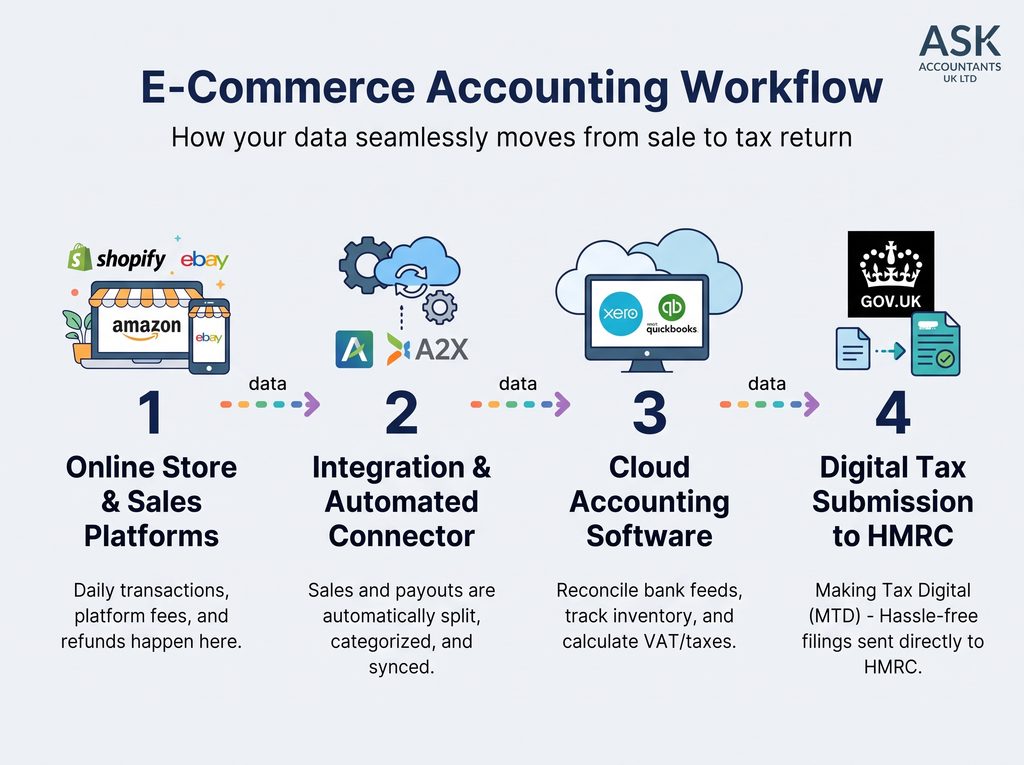
A Step-by-Step Workflow: Accounting for Online Sellers
Getting your finances in order does not have to be a nightmare. By setting up a robust digital workflow, you can automate much of the heavy lifting. Here is a practical checklist you can implement to streamline your Accounting for Online Sellers.
- Step 1: Separate Your Finances. Open a dedicated business bank account and secure a business credit card. Never use these for personal purchases.
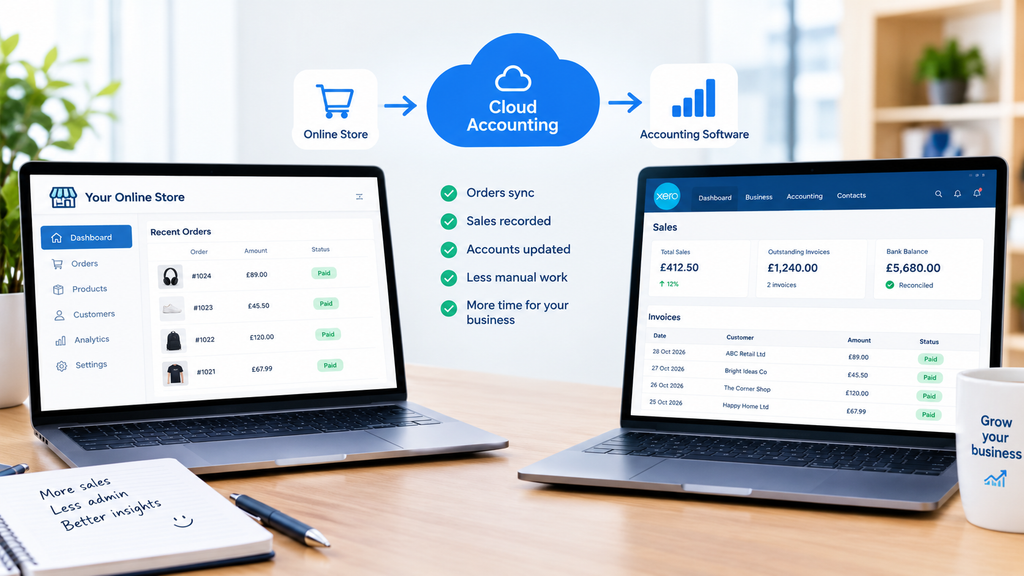
- Step 2: Adopt Cloud Accounting Software. You need a robust system to handle transaction volume. We highly recommend using platforms like Xero or QuickBooks. Exploring cloud accounting solutions allows for direct bank feeds and ensures you are fully MTD compliant.
- Step 3: Connect a Connector App. Do not manually enter sales data. Use integration tools like A2X or Dext Commerce. These apps pull your sales, fees, and tax data from Shopify or Amazon and push summarized, perfectly balanced journal entries into your accounting software.
- Step 4: Digitize Your Receipts. Stop keeping paper receipts in a shoebox. Use an app to snap photos of your supplier invoices and software subscriptions. This helps improve accuracy and ensures you never lose a deductible expense.
- Step 5: Reconcile Regularly. Set aside thirty minutes every single week to reconcile your bank feed. Match your software entries to your actual bank statements. Doing this weekly prevents a massive backlog at the end of the month.
- Step 6: Review Your Margins. Once a month, generate a Profit and Loss report. Look closely at your Cost of Goods Sold and your advertising spend. Ensure your pricing strategy is actually yielding a profit.
Why Outsourcing is a Smart Investment
As your online business grows, the sheer volume of financial data will eventually outpace your ability to manage it manually. Spending your weekends trying to reconcile Amazon merchant fees is not the best use of your time as a founder. Your time is much better spent sourcing new products, optimizing your ad campaigns, and building your brand.
Choosing to outsource your accounting and tax preparation to a professional can reduce administrative burden significantly. An experienced accountant will help you navigate complex VAT thresholds, manage cross-border tax liabilities, and ensure your payroll is handled correctly. Bringing in a professional also mitigates the risk of errors in your tax returns, giving you peace of mind that your business is compliant with current legislation. Check out our dedicated bookkeeping service page to see how we manage the daily financial heavy lifting for our clients.
Let ASK Accountants Support Your E-commerce Growth
Navigating the financial side of an online business requires specific expertise. General accounting principles are simply not enough when you are dealing with multiple payment gateways and international sales tax.
At ASK Accountants UK Ltd, we bring over 15 years of experience helping SMEs, startup founders, and landlords across Wimbledon and South-West London. We understand the unique pressures of the e-commerce landscape. Our team is passionate about providing clear, actionable financial guidance that helps you build a more profitable store. We do not just look at your past numbers. We help you plan for a more successful future.
If you are tired of stressing over your Shopify reports or worrying about HMRC deadlines, it is time to get expert help. You can reach out via our Contact Us page. Call our Wimbledon office today at 020 8543 1991 or visit us in person at 178 Merton High St to discuss how we can streamline your business finances.
Frequently Asked Questions
Do I need a separate bank account for my online business?
Yes. Even if you are a sole trader, having a dedicated business bank account is essential. It keeps your records clean, makes bookkeeping significantly easier, and ensures you do not miss allowable business expenses hidden among personal transactions.
When do I have to register for VAT as an online seller?
You must register for VAT if your total VAT taxable turnover for the last 12 months goes over the current threshold. You must also register if you expect your turnover to go over the threshold in the next 30 days alone. For the most current thresholds and rules, always refer to the official GOV.UK guidance on VAT registration.
How do I handle accounting for online sellers if I sell internationally?
Selling internationally adds a layer of complexity to your tax obligations. Depending on where your customers are located and the platform you use, you may need to register for local taxes or use specific schemes like the VAT One Stop Shop (OSS) in the EU. You should definitely consult a specialized accountant to navigate cross-border compliance safely.