
Running a non-profit organisation brings immense joy. However, administrative duties often cause severe stress. Founders and trustees shoulder a heavy financial burden. Therefore, you want to focus purely on your mission. You certainly do not want to spend weekends wrestling with spreadsheets. We understand this immense pressure perfectly. Financial reporting often feels like a frustrating distraction. This is exactly why mastering accounting for charities remains so crucial for your success. Solid financial management helps improve accuracy across your organisation. Furthermore, it mitigates the risk of costly errors. You must provide complete transparency to your generous donors. Consequently, this transparency builds absolute trust. Trust secures future funding reliably. As a result, you can direct your energy back to your core objectives.

Why Proper Charity Bookkeeping Matters
Traditional commercial businesses follow standard financial rules. Conversely, they focus entirely on profit margins. They chase commercial growth constantly. Charities operate under a completely different framework. Therefore, you must report your financial data differently. You must show the public exactly how you raise money. Furthermore, you must prove exactly how you spend every single pound. The public demands exceptionally high transparency. Regulators enforce strict compliance standards daily. Crucially, you simply cannot treat a charitable organisation like a standard limited company. You must adapt to these specific sector requirements. Consequently, specialized charity bookkeeping becomes essential. This process keeps your records pristine. Hence, you avoid unwanted regulatory scrutiny entirely.
The Core Rules of Accounting for charities
You must navigate unique rules to stay compliant. Consequently, you need a robust framework to succeed. Let us review the fundamental requirements together. These rules apply to thousands of organisations across the UK. Therefore, understanding them protects your trustees. It also protects your vital mission.
Achieving Strict SORP compliance
You will frequently hear about the Statement of Recommended Practice. Specifically, this framework dictates your annual reporting process. It tells you exactly how to prepare your accounts. SORP compliance ensures you present financial information fairly. Furthermore, it enforces consistency across the entire sector. You must provide a detailed Trustees’ Annual Report. This narrative document explains your charitable aims clearly. It also details your major achievements for the year. Following these guidelines meticulously helps improve accuracy. Moreover, proper compliance makes your annual independent examination much smoother. You reduce the administrative burden significantly. Thus, your team saves valuable time.
Mastering Complex Fund Accounting
You must understand fund accounting thoroughly. Traditional businesses throw all revenue into one central pot. Conversely, charities cannot do this legally. You must split your funds into distinct categories. Specifically, you have restricted funds and unrestricted funds. Donors give restricted funds for a highly specific purpose. For instance, they might fund a new community roof. You must spend that money only on that specific roof. Furthermore, you cannot use it to pay your office electricity bill. Unrestricted funds give your team more freedom. You can use them for general charitable objectives safely. Therefore, tracking these different pots requires excellent internal systems.
Maximising Your Gift Aid claims
You must manage your tax obligations very carefully. Indeed, Gift Aid claims provide a massive funding boost for your cause. This excellent scheme lets you claim back basic rate tax. Consequently, you increase the value of eligible donations by 25 percent. The donor pays nothing extra at all. However, you must maintain flawless records. You need a valid written declaration from every single taxpayer donor. Furthermore, you must keep a clear audit trail. Regulators will check these trails during routine inspections. Therefore, capturing this data digitally saves immense effort.
Understanding General Tax Rules and Penalties
Charities still face standard tax obligations constantly. Most VAT-registered entities must comply with Making Tax Digital rules. This includes the vast majority of VAT-registered non-profits. Therefore, you must keep digital financial records securely. You must submit your VAT returns using approved software. We strongly recommend exploring professional cloud accounting tools immediately. It makes daily compliance much easier for your busy team.
You must also understand strict HMRC penalties. You cannot afford to pay late fees. Specifically, late-payment interest begins on day 1. First penalties arise at day 15. Furthermore, penalties increase at day 30. Therefore, you must set up automated payment schedules. Do not waste valuable donor resources on avoidable fines. Protect your cash flow at all costs.
Common Errors in Accounting for charities
Even highly dedicated trustees make administrative mistakes occasionally. Complex regulations confuse many intelligent people daily. We see the exact same recurring issues constantly. You should understand these common errors and record-keeping risks. This vital knowledge helps you prevent them proactively. Protecting your organisation requires constant vigilance.
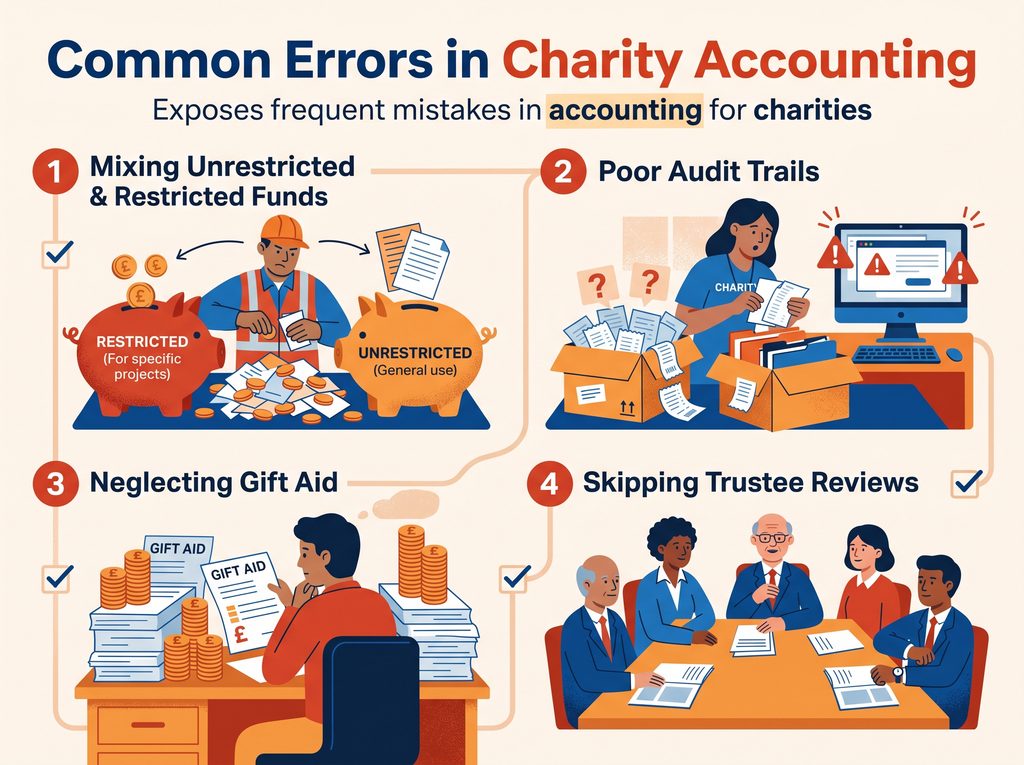
1. Mixing Restricted and Unrestricted Funds
Trustees frequently misclassify restricted funds by mistake. They mix them with general unrestricted funds in the bank. Spending restricted project money on general operational costs breaches trust law directly. Consequently, it violates strict sector rules. You need robust software to prevent this dangerous error. Therefore, your finance team must tag every single transaction correctly. This careful tagging prevents accidental fund misuse entirely.
2. Missing Out on Essential Revenue
Many small charities completely ignore their tax relief options. They miss out on thousands of pounds of free funding. For instance, their internal systems fail to capture basic donor details. Missing a simple written declaration means you lose that generous bonus. You must streamline this process to boost your income reliably. Hence, create a simple workflow to gather declarations at every event. You will see an immediate revenue increase.
3. Mishandling Complex Staff Expenses
You will often reimburse your volunteers or staff members. You must handle these expenses properly every single time. Crucially, rules around expenses like entertaining or vehicles are highly nuanced. There are notable exceptions. Therefore, readers should seek specific advice before processing complex claims. Poor payroll records cause major compliance problems. They can quickly trigger unwanted attention from regulators. As a result, robust expense tracking software remains absolutely essential.
Establishing Strong Internal Controls
Strong internal controls improve accounting for charities tremendously. You must protect the assets entrusted to your care. Consequently, you need formal written policies for all financial activities. These policies guide your staff and volunteers clearly. Furthermore, they protect your board of trustees from personal liability.
Protecting Cash Donations
Many non-profits still receive physical cash at fundraising events. First, you must secure this cash immediately. You should always have two unrelated people count the money together. Moreover, you must bank the cash on the very next working day. Do not leave loose cash in a desk drawer overnight. Therefore, strict cash handling procedures deter theft effectively.
Approving Vendor Payments
You must implement a dual approval system for all outgoing payments. One person should prepare the payment request carefully. Second, a completely different person must authorize the final bank transfer. This simple separation of duties prevents fraudulent activity. Thus, it keeps your charitable funds secure at all times.
A Step-by-Step Workflow for Accounting for charities
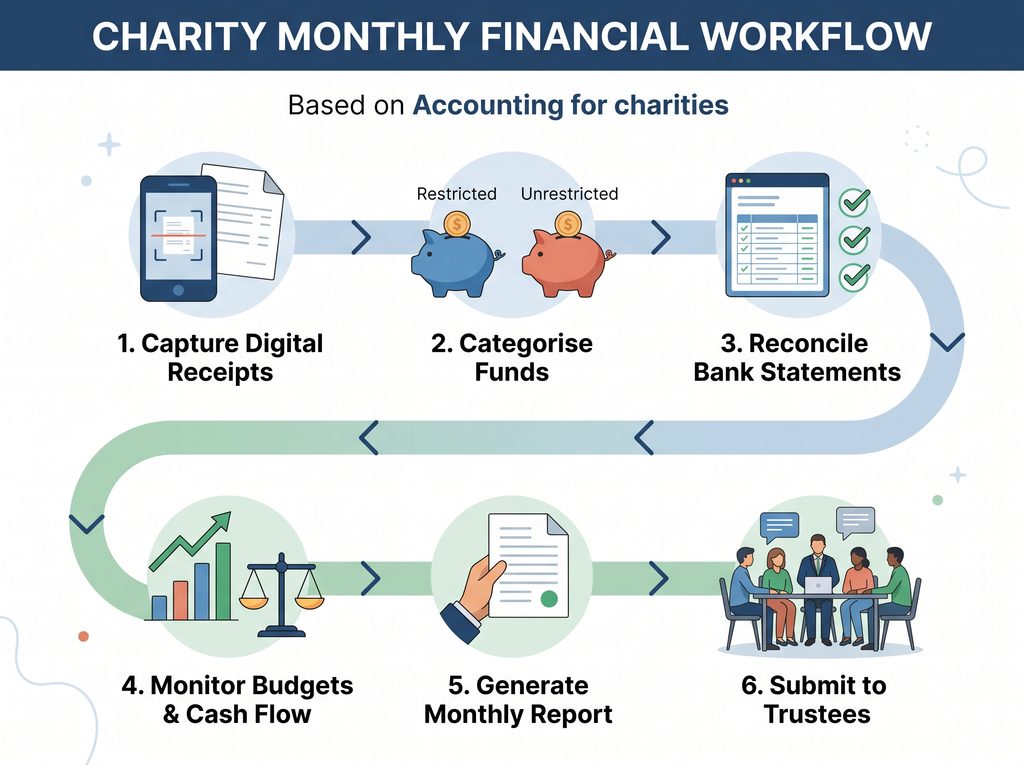
You need a highly structured monthly routine. Consistent financial habits build long-term stability. First, follow this simple workflow closely. It will reduce your administrative stress drastically. Consequently, you will regain control of your precious time.
- Step 1: Record Data Weekly. Do not let receipts pile up on your desk. First, enter every single transaction into your system immediately. Tag each transaction as restricted or unrestricted accurately.
- Step 2: Reconcile Banks Monthly. Match your bank statements with your software records every single month. This simple practice catches missing entries very quickly. Furthermore, it ensures your cash balances remain perfectly accurate.
- Step 3: Review Fund Balances. Generate regular reports focusing on your restricted funds. Give these clear reports to your project managers promptly. They must know exactly how much money remains available. Therefore, ensure no restricted fund falls into a negative balance.
- Step 4: Process Tax Claims. Do not wait until the financial year-end. Compile your relief claims every single month or quarter. Submit them to the government regularly. Thus, this maintains a steady cash flow for your charity.
- Step 5: Compare Your Budgets. Meet with your board of trustees regularly. Compare your actual spending directly against your forecast budget. Spot overspending early before it becomes a major crisis. Ensure your core projects retain enough funding always.
- Step 6: Check Official Guidance. Compliance rules change frequently in this sector. You must stay fully updated. Read the GOV.UK Charity Commission website regularly. Consequently, apply their latest best practices to your daily operations.
- Step 7: Automate Your Receipts. Use modern digital tools to automate your billing processes. Send digital receipts to your generous donors automatically. Hence, this saves your team hours of manual work every single week.
Why Outsourcing Accounting for charities is Smart
Founders often try to handle all finances alone initially. They want to save the charity money during the startup phase. However, outsourcing this critical task is usually a much smarter investment. The regulatory environment remains highly complex. Non-accountants struggle to navigate it safely. Therefore, you should focus your energy entirely on your mission. You should not spend hours doing tedious data entry.
Mastering accounting for charities takes considerable time. A professional accountant understands regulatory reporting deeply. They know all the crucial compliance steps intrinsically. Specifically, they set up highly efficient digital systems for you. They use robust platforms like Xero or QuickBooks flawlessly. These brilliant tools automate tedious manual tasks easily. Consequently, they save you endless frustration and worry.
Working with an expert helps improve accuracy across the board. Furthermore, they complete your statutory filings correctly the first time. They submit your annual returns well before the strict deadlines. Thus, finding a professional bookkeeping service provides massive peace of mind. You know a qualified expert handles your workload entirely. As a result, you can focus entirely on helping your community thrive.
How ASK Accountants UK Ltd Can Help You
Our dedicated team at ASK Accountants UK Ltd understands your daily struggles. We know you work incredibly hard for your vital cause. Moreover, we know the administrative burden drains your valuable energy. We bring over 15 years of solid experience to the table. We proudly help SMEs, startups, and non-profits across Wimbledon and South-West London. Therefore, we guide you through the complex UK finance world safely.
We specialize in comprehensive accounting for charities, we guide you calmly through every single compliance step. We offer top-tier tax compliance solutions tailored to your specific needs. Furthermore, we help you migrate seamlessly to modern cloud systems. Our friendly team is ready to support your unique goals.
Thus, remove the stress from your finances today. Call us directly on 020 8543 1991. You can also visit our welcoming office at 178 Merton High St. Alternatively, please visit our Contact Page to book a friendly consultation with our experts.
FAQ About Accounting for charities
Do all charities need a full statutory audit?
No, not all organisations require a full statutory audit. The requirement depends heavily on your gross annual income. Furthermore, it depends on your total asset value. Smaller charities often choose an independent examination instead. Consequently, this alternative process costs much less. It is far less rigorous than a full audit. You can find current financial thresholds on the official government website easily. We highly recommend seeking professional advice first. Therefore, we will determine your exact legal needs quickly.
Can I use standard software for a charity?
Yes, you can use standard platforms successfully. However, you must configure the software correctly from day one. You must set up proper fund tracking immediately. Specifically, you must separate restricted and unrestricted funds completely. The software must also meet digital tax requirements fully. This applies directly if your non-profit registers for VAT. Thus, proper setup mitigates the risk of reporting errors later. We assist with this technical setup constantly.
What are the strict filing deadlines for charities?
You face very strict reporting deadlines yearly. First, if you run a charitable company, you must file accounts with Companies House. You must do this within 9 months of your financial year-end. Second, you must file an annual return with the main regulator. You have 10 months from your year-end to do this successfully. Missing these deadlines causes severe operational problems. Consequently, it damages your public reputation instantly. Therefore, you must prepare early to maintain perfect compliance.