

Between long clinical shifts, patient care, and endless administrative tasks, mastering Accounting for medical professionals can quickly become overwhelming. Furthermore, whether you are a locum doctor, a private consultant, or a partner in a busy GP practice, your financial affairs are inherently complex. As a result, you are likely juggling NHS income, private patient fees, and intricate pension contributions.
Therefore, this guide is designed to clarify the fundamental principles of healthcare finance. We will explore essential HMRC rules, outline a practical workflow to manage your records, and highlight the common pitfalls that can complicate your tax returns. Ultimately, by understanding these core concepts, you can regain control of your time and your practice finances.

Why specialized Accounting for medical professionals matters
The financial landscape for healthcare workers is unique. For instance, a standard business owner typically deals with straightforward revenue streams. Conversely, medical practitioners often operate across multiple structures simultaneously. You might be employed by an NHS trust, work as a self-employed locum on your days off, and run a limited company for private consultations.
Consequently, this blend of employment statuses requires tailored tax advice for doctors. You need to correctly allocate income, track specialized expenses, and manage superannuation deductions without overlapping or underreporting. Moreover, generic accounting software templates rarely capture the nuances of clinical work. By treating your medical career as a specialized enterprise, you can better navigate tax compliance and prepare for long-term financial stability.
In addition, a specialized approach helps you track the precise performance of your private practice. Understanding exactly which services generate the most sustainable income allows you to make informed decisions about your career trajectory and working hours.
Core HMRC Rules and Deadlines
Every medical professional in the UK must adhere to strict HMRC reporting timelines. Specifically, for those earning non-PAYE income, the Self Assessment tax return is an annual requirement. The deadline for online submissions and paying the tax you owe is midnight on the 31st of January following the end of the tax year. Meanwhile, payments on account (advance payments towards your next tax bill) are due by the 31st of January and the 31st of July.
Furthermore, it is also crucial to understand the ongoing shift towards digital record-keeping. Under the Making Tax Digital (MTD) initiative, HMRC is changing how individuals and businesses report their income. Most VAT-registered businesses must follow MTD rules for their VAT returns, although there are limited exemptions for specific circumstances. Similarly, MTD for Income Tax Self Assessment (ITSA) will also be introduced in phases over the coming years. Therefore, preparing for this transition now by adopting cloud-based software will save you significant stress later.
For the most up-to-date guidance on Self Assessment deadlines and Making Tax Digital rollouts, you can always refer to the official resources provided on GOV.UK.
Understanding Accounting for medical professionals and NHS Pensions
One of the most complex areas of Accounting for medical professionals involves the NHS Pension Scheme. Specifically, your superannuation contributions are influenced by your pensionable pay, your tier rate, and any added years you may have purchased.
During the preparation of your tax return, accurately calculating your pension input amount is essential to check against your Annual Allowance. If you exceed this allowance without sufficient carry-forward relief, it can result in unexpected tax charges. Furthermore, the rules regarding the Annual Allowance taper (which reduces your allowance if your adjusted income exceeds a certain threshold) are particularly intricate for high-earning consultants and partners.
Consequently, navigating these pension rules requires meticulous attention to detail. Accurately recording your NHS pay and private earnings ensures your pension calculations are correct, which is a cornerstone of effective medical practice finances.
Common errors and record-keeping risks in Accounting for medical professionals
Even the most organized practitioners can make mistakes when balancing clinical duties with financial administration. Therefore, below are common errors and record-keeping risks to be mindful of.
1. Mixing Personal and Professional Finances
Using a single bank account for personal expenses, locum income, and private practice costs is a frequent misstep. As a result, this creates a tangled web of transactions that takes hours to unpick. Additionally, it increases the likelihood of missing allowable deductions or accidentally claiming personal items as business costs. Conversely, setting up a dedicated business bank account is a simple step that significantly helps improve accuracy.
2. Misunderstanding Allowable Expenses
It is easy to assume that any cost related to your working life is tax-deductible. However, the rules surrounding business expenses are strict. Claiming unallowable expenses is a common risk. For example, the rules around business entertainment or company vehicles are highly nuanced. Indeed, there are exceptions and partial recovery rules involved. Therefore, readers should always seek specific advice before claiming these types of expenses to ensure they remain compliant with HMRC guidelines.
3. Missing Payment Deadlines
Failing to pay your tax bill on time has immediate financial consequences. Specifically, it is vital to understand the precise timeline of HMRC penalties. Late-payment interest begins on day 1. Subsequently, first penalties arise at day 15 and increase at day 30. To prevent this, setting aside a percentage of your monthly income into a dedicated tax savings account can help you build the necessary reserves to meet your obligations on time.
Your Step-by-Step Financial Workflow
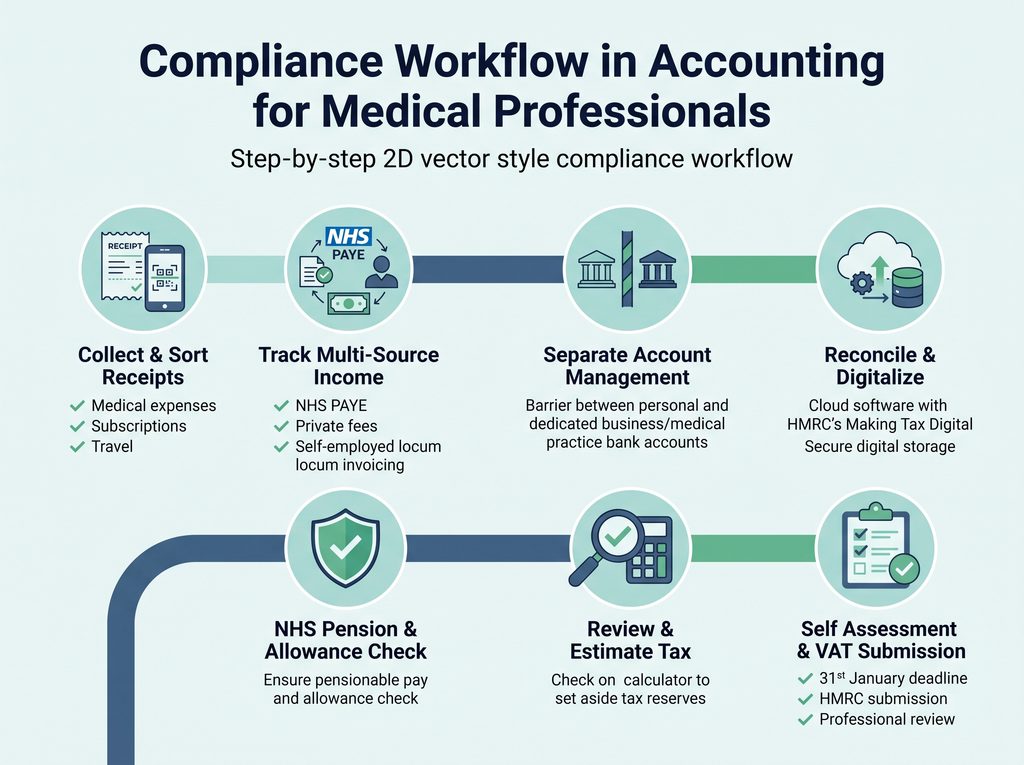
Implementing a structured routine can transform your financial administration from a dreaded annual chore into a manageable weekly task. Here, we provide a practical workflow to support your Accounting for medical professionals.
Weekly Tasks:
- First, log into your business bank account and review recent transactions.
- Next, scan and upload paper receipts using a digital app.
- Finally, categorize your expenses while the purchases are still fresh in your memory.
Monthly Tasks:
- To begin, reconcile your bank accounts to ensure all transactions are accounted for.
- Following that, send out invoices for any private consultations or locum shifts completed.
- Also, follow up on any unpaid invoices from clinics or private hospitals.
- Lastly, review your income against your estimated tax liabilities to ensure your savings are on track.
Quarterly Tasks:
- Primarily, review your financial reports (like a profit and loss statement) to understand your practice’s health.
- In addition, if you are VAT registered, prepare and submit your VAT return compliant with HMRC guidelines.
- Most importantly, discuss any significant changes in your working patterns with your financial advisor.
Ultimately, to streamline this workflow, we highly recommend utilizing robust cloud accounting platforms like Xero or QuickBooks. These tools allow you to automate data entry and keep your records secure.
Why Outsource Your Accounting for medical professionals?
As your medical career progresses, managing your own bookkeeping and tax submissions becomes increasingly inefficient. After all, your time is your most valuable asset. Consequently, spending your weekends categorizing receipts or researching tax legislation takes you away from your family and your patients.

Therefore, outsourcing this task to dedicated healthcare accountants UK is a strategic investment. Partnering with a professional can reduce administrative burden and free up your schedule. Furthermore, a qualified team understands the specific allowable expenses for your profession (such as GMC fees, BMA subscriptions, and medical indemnity insurance). In conclusion, professional support helps improve accuracy across your records and mitigates the risk of errors on your tax returns.
Partner with ASK Accountants UK Ltd for your Accounting for medical professionals
At ASK Accountants UK Ltd, we understand the pressures you face. Specifically, we bring 15 years of experience helping SME owners, startup founders, and medical practitioners navigate the complexities of UK tax legislation. As a result, our team is dedicated to providing clear, practical, and empathetic support to professionals across Wimbledon and South-West London.
Whether you need assistance with your annual Self Assessment, advice on structuring your private practice, or day-to-day transaction management, we are here to help. Additionally, you can learn more about how we support daily financial operations by exploring our Bookkeeping Service.
Ready to simplify your financial life? In that case, let us handle the numbers so you can focus on your patients. Call us today on 020 8543 1991 or visit our office at 178 Merton High St. Alternatively, you can also reach out through our Contact Page to schedule a confidential consultation.
Frequently Asked Questions about Accounting for medical professionals
Can I claim my GMC and BMA fees as tax deductions?
Yes. Generally, professional fees and subscriptions that are necessary for your work are allowable expenses. For instance, this includes your General Medical Council (GMC) registration, British Medical Association (BMA) membership, and essential medical indemnity insurance. However, you must ensure you only claim for the portions of these fees that relate directly to your professional duties.
How does locum work affect my tax return?
Handling locum GP tax returns requires careful tracking. Usually, locum income is treated as self-employed earnings. Therefore, you must declare this income on your Self Assessment tax return. Furthermore, you can deduct allowable business expenses incurred while performing your locum duties (such as travel to temporary workplaces and necessary medical equipment). Additionally, you must also calculate and pay your own National Insurance contributions on these earnings.
Do medical professionals need to charge VAT?
The rules regarding medical services and VAT depend heavily on the nature of the care provided. Typically, healthcare services performed by registered medical professionals aimed at protecting, maintaining, or restoring the health of a person are exempt from VAT. On the other hand, if you provide services that are not directly related to patient healthcare (such as writing medico-legal reports or certain cosmetic procedures), these may be subject to standard VAT rules. Consequently, always consult a professional regarding your specific services.